Quick wins for a faster PC:
Fix the driver behind crashes, sound loss and screen glitchesFind Drivers →Clear out junk files and repair common Windows errorsFree Scan →Scan for outdated or missing drivers - takes under a minuteDriver Scan →Satellite internet reception is affected by two different things: weather along the radio path can weaken the signal, while trees, buildings, roofs and other objects can block a terminal’s view of moving satellites. Moving or raising a terminal may help with a physical obstruction; it cannot prevent rain or snow from attenuating a signal. The right fix depends on which problem is causing the interruption.
Why satellite internet reception drops
A satellite connection depends on a radio link between the terminal at your home and satellites passing overhead. Those satellites move, so the terminal needs a usable view of the sky across the area its system uses—not merely a clear view in one direction at one moment. Anything that blocks part of that path can interrupt service as a satellite moves behind it.
As an Amazon Associate I earn from qualifying purchases.
Weather is a separate issue. Precipitation can weaken radio signals as they travel through it, and storms near a ground station can also affect service. A terminal mounted higher or moved away from a tree may have a clearer sky path, but it does not remove precipitation from the radio path.
For Starlink specifically, its Standard4 installation guide says that objects such as a tree branch, pole or roof obstructing the connection between the terminal and satellite will cause service interruptions. This is provider-specific guidance; service designs and recommendations can differ among satellite internet operators.
#1 Best Overall

- 【Compatible with Starlink Standard V3 / Gen3 / 4 / 4 X】Not compatible with Starlink Mini/Performance Gen 2/Performance Gen 3/Standard Actuated. Please verify your dish model before purchase.
- 【Aluminum Alloy Adapter Compatible with Starlink Standard 4 / 4 X / Gen3】 Unlike many plastic adapters, this aluminum alloy adapter offers greater durability, stronger support, and is less likely to crack or break over time.
- 【Adjustable Design】 For longer eaves, flip the pole for a better fit. The mount installs from either end, and the pole connected to the pipe adapter can rotate for angle adjustment. Tighten the screws to lock the position and optimize dish alignment.
- 【18-Inch Wall Mount for Starlink】 Works as a roof mount or pole mount. Includes two screw sets: expansion anchors for concrete/masonry and lag screws for wooden roofs.
- 【Accessories included】Aluminium Pipe Adapter x1,extension screws x6, self-tapping screw x4, short stainless steel screws x2, long stainless steel screws x1, support steel tubes x1, support base x1, wrench x1, drill bit x1, instruction manual x1
What weather can do to the signal
Rain, snow and hail
Starlink says significant weather can attenuate radio signals and that moderate to heavy rain, snow and hail can cause momentary dropouts. In plain terms, precipitation can reduce the strength of the signal reaching the terminal. Service normally returns as the weather passes, but there is no single outage duration or precipitation threshold that applies to every location, terminal, plan or storm.
Snow and ice can also affect the equipment physically if they build up on or around the terminal. That is different from attenuation in the radio path: precipitation can weaken a signal while falling, whereas accumulated snow, ice or debris may remain as an obstruction after the weather has eased. Check the terminal for buildup only when it is safe to do so, and follow the provider’s equipment guidance rather than climbing or reaching into a hazardous location.
Storms near ground stations
A satellite connection is not only a path between your home and a satellite. Starlink notes that storms near local ground stations can also affect service. This means a clear view from your property does not rule out a weather-related service effect elsewhere in the network path.
PC Slower Than It Used to Be?
A free scan shows the junk files, broken settings and background clutter dragging Windows down - then fixes them in one click.Free scan · Windows 10 & 11Outdated Drivers Are Slowing You Down
One free scan finds every outdated or missing driver and matches the right update for your exact hardware.Free scan · exact hardware matchRank #2

- [Easy Installation]- The mount includes all necessary installation components: a Starlink Gen 3、Gen 4 & 4X dish mount adapter, an angle-adjustable base, a 15.7" pivot pole, six screws and six anchors for base installation, six screws for the mount adapter, two screws for the pole and base, one lever, one wrench, and a comprehensive instruction manual, enabling immediate out-of-the-box installation
- [Robust Aluminum Alloy Adapter]- Features a durable, thickened aluminum alloy adapter, engineered for a secure connection to the Starlink V3 dish, ensuring optimal stability and signal integrity
- [Heavy-Duty Steel Pivot Pole]- Constructed with a resilient, 0.1-inch extra-thickened steel pipe, measuring 15.7 inches in length and 1.5 inches in diameter, the pivot pole provides exceptional strength and resistance to environmental factors, guaranteeing long-lasting durability and reliable performance, even in challenging weather conditions
- [Adjustable Base Mount]- An extra-thickened, heavy-duty adjustable base mount facilitates precise angle adjustments to optimize the Starlink V3 dish's alignment for superior signal reception
- [Seamless Compatibility]- Specifically designed for compatibility with the Starlink V3/V4 Standard Dish, ensuring a seamless and secure installation process
Clouds and outage expectations
The available Starlink guidance identifies significant weather and moderate to heavy precipitation as possible causes of momentary interruptions. It does not establish that ordinary clouds always block service, nor does it provide a universal household rain-fade figure or guaranteed recovery time. Avoid interpreting a cloudy sky alone as proof of the cause; compare interruptions with actual conditions and the provider app’s alerts.
The FCC’s 2024 satellite-system compatibility decision considered rain-attenuation assumptions as an engineering input, but declined to impose one set of assumptions and said it would evaluate their reliability and representativeness case by case. That regulatory analysis is not a consumer forecast or a prediction of how long a particular home will lose service.
How trees, buildings and other objects interrupt reception
The terminal needs a useful sky view
Branches, roofs, buildings, poles and similar objects can get between the terminal and a satellite. Since satellites move, a tree that does not seem to sit directly in front of the dish may still block part of the sky the system needs. The relevant area depends on the terminal’s hardware-specific field of view, so do not assume that a clear view toward one visible satellite means the installation spot is clear enough overall.
Rank #3

- TIP: Compatible with Starlink Standard 4/4X/Gen 3. This package does not include bricks. NOTE: If facing strong winds, additional BRICKS should be added for reinforcement (extra weight, load-bearing capacity) to prevent movement!!
- [Starlink Roof Mount]The package includes a Starlink pipe adapter, which has been rigorously tested, ensuring high precision and reliable compatibility. The starlink pivot mount helps achieve optimal positioning. The starlink ridge mount allows for better alignment of the satellite dish, ensuring a clearer line of sight to the satellites for improved performance and faster internet speeds.
- [Versatile Angle]This upgraded starlink mounting kit is equipped with a swivel mechanism and adjustable angle feature, enabling it to accommodate different roof slopes while providing stability, making it ideal for structures with sloped roofs.
- [Robust Metal Construction]Easy setup! No drilling is needed on the roof, ensuring the Starlink Gen 3 mount can be set up effortlessly without compromising the roof's integrity or leaving any unsightly marks. Plus, the Starlink roof ridge mount Gen 3 is reusable, making it easy to reposition your satellite dish when needed.
- [Keep Water from Pooling]This design allows water to drain away, no worry about any pooling. The Starlink Gen 3 roof mount is perfect for sloped roofs but works just as well on flat ones, making sure the antenna has a clear view. Overall, the Starlink pivot roof mount boosts both the performance and looks of your satellite setup!
Foliage and structures can change. New leaves, seasonal growth, branches, debris or snow buildup may worsen an installation that previously worked acceptably. If interruptions start after a seasonal change or a storm, consider whether the terminal’s view or surroundings have changed before assuming the service itself has failed.
Satellite switching helps, but does not erase obstructions
Starlink says its terminals can switch among visible satellites as links degrade and build an obstruction map while operating. That can make some interruptions less noticeable, but it is not a guarantee that the connection will remain uninterrupted behind trees or buildings. Starlink still advises users to seek a less obstructed location when obstruction alerts and interruptions persist.
How to identify the likely cause
Use timing and the provider’s own diagnostics to distinguish weather effects from a blocked sky path, equipment problems or a separate home-network issue. Work through these checks before buying a mount or making a permanent change.
Rank #4
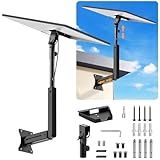
- ADJUSTABLE: Our starlink standard 4 mount features a retractable design with a support arm that telescopes up and down, back and forth, providing more versatility than a fixed length mount. Seamlessly compatible with your current Starlink Gen 3 mount, you'll enjoy an unobstructed view no matter where you place it
- HIGH QUALITY: Our Starlink Wall Mounts for Dishes is made of top-grade metal to ensure a long life and can withstand over 60 pounds of weight. And the starlink pole mount gen 3 comes with hidden cable holes to prevent damage to your cables, this thoughtful design not only enhances aesthetics but also protects the Starlink Gen 3 V4 from environmental wear and tear
- ANGLE ADJUSTMENT: Starlink 4x mount can be adjusted from 90-180° to ensure optimal reception of the signal. With its rustproof, windproof, and weatherproof properties, this starlink mount gen 3 ensures optimal performance in all conditions
- VERSATILITY: Our starlink v4 mount comes with two types of screws: expansion screws for concrete walls and lag screws for wood roofs. Suitable for a variety of walls such as wood, brick or concrete
- EASY INSTALLATION: This starlink wall mount standard 4 is simple to install. Simply drill the holes, secure the brackets, and plug directly into the Starlink Gen 3. This flexibility makes it an essential component for starlink mounts. The length of the mounting plate is 5.9 in/15cm, and the width is 5.11 in/13cm
- Check the provider app. Review outage and obstruction alerts. For Starlink, open the app and use “Check for Obstructions” at the intended terminal location. Follow the app’s current prompts if its labels or layout differ.
- Scan from the planned position and height. Hold the phone near the terminal’s intended height and perspective. Repeat the scan at candidate locations; a scan from inside the house or at ground level may not represent the view from a roof or pole installation.
- Compare interruption times with conditions. Note whether drops coincide with moderate or heavy rain, snow, hail, or high winds. If possible, check again after the conditions pass. Weather correlation is useful evidence, but it does not by itself exclude an obstruction or equipment issue.
- Inspect for physical changes when safe. Look for snow, ice, leaves, soil or other debris around the terminal, a dish that has shifted, and visible cable damage. Verify that cables are fully connected. Do not climb onto a roof or work around power lines to perform this check.
- Test a clearer location before committing. If the obstruction scan indicates a persistent issue, try a candidate spot with a better sky view before drilling, clamping or permanently routing cable. Recheck from the planned height and perspective.
- Choose a safe remedy. Relocate the terminal, clear an obstruction only when safe, or use a suitable compatible mount to raise it above the blockage. Get professional help for unsafe roof, pole or tree work.
Which fix matches the problem?
| Likely problem | Clues to check | What may help | What will not address it |
|---|---|---|---|
| Precipitation attenuating the radio path | Interruptions coincide with significant weather; the connection improves as conditions pass. | Wait for conditions to ease, then check service and equipment again. | Raising or relocating the terminal does not remove rain, snow or hail from the signal path. |
| Local sky obstruction | The app reports obstructions, or interruptions persist at a location with trees, rooflines or nearby structures in view. | Test a clearer location; relocate or safely raise the terminal if a suitable mount clears the measured obstruction. | Waiting for clear weather will not remove a permanent building or branch from the satellite path. |
| Snow, debris, a shifted terminal or a cable issue | Visible buildup or movement, a recent storm, cable damage, or an incomplete connection. | Inspect and reconnect equipment as appropriate, following provider guidance and safe access practices. | A new mounting height alone may not correct a loose cable or equipment problem. |
| Indoor Wi-Fi coverage | The satellite terminal appears online, but devices have trouble connecting in particular rooms. | Diagnose the home Wi-Fi network separately from the satellite link. | Changing the dish’s sky view addresses satellite reception, not necessarily wireless coverage inside the building. |
When moving or raising the terminal is worthwhile
Relocation or elevation is most useful when the obstruction scan and repeated interruptions point to a persistent object in the terminal’s sky view. Starlink describes roof, pole and wall mounting options and advises relocating or raising the unit above obstructions where practical. The intended result is a clearer view, not immunity to weather.
Compare candidate positions using the scan at the actual planned height and perspective. Also consider whether the mount is suitable for the specific terminal generation, whether the roof or other surface can safely support it, and whether the cable can be routed without damage or creating a hazard. A higher position is not automatically better if it leaves a remaining obstruction, creates an unsafe installation, or makes cable routing impractical.
Free tools Windows power users keep installed
One-click scans. No signup required.
Do not permanently drill or clamp a mount based only on a ground-level view. First test the proposed location as accurately as possible. If reaching the roof, pole, or a tree would be unsafe, use a qualified professional rather than attempting installation or clearing work yourself.
Best Value

- [📶Adjustable Tilt 160 Degree and Horizontally Rotatable 360 Degree for Better Signal]: The adjustable tilt, offering up to 160 degrees, allows precise alignment to maximize signal strength by fine-tuning the antenna's position relative to the satellite. Additionally, the mount rotates horizontally a full 360 degrees, enabling effortless direction adjustment for consistent connectivity in various environmental conditions. This dual-functionality not only enhances ease of installation but also ensures reliable, high-quality signal reception, making it an ideal choice for improving satellite communication efficiency and effectiveness across different applications and settings.
- [⛏️High-Quality Material Starlink Gen 3 Pipe Adapter Mount]: The starlink mounting kit is made of high-quality metal material, which not only possesses excellent strength and rigidity to withstand challenging environments but also has outstanding durability to maintain stability and reliability over time. The lightweight design makes the starlink Gen 3 roof mount easy to carry, while its premium appearance adds a sense of luxury and aesthetics, enhancing the user experience and product value.
- [🔩Easy Adjustment with Thumbscrews]:The thumbscrews, featuring an innovative design, allows for effortless adjustment of length to accommodate various installation needs. Typically comprised of a threaded portion and a handle, it enables quick adjustment of the threaded part's length by rotating the handle, thereby achieving precise control over the installation position. This design simplifies the installation process, eliminating the need for additional tools or complex steps. Users can easily adjust the bolt's length according to specific requirements, ensuring secure and reliable installation while saving time and effort.
- [🔧Easy to Install for Everyone]: The starlink Gen 3 mount includes all necessary hardware and detailed instructions, enabling users to effortlessly install this Starlink mount. From assembling the components to adjusting the positioning, each step is clear and understandable, requiring no specialized skills. This simplifies the installation process, allowing users to quickly and smoothly complete the setup and enjoy high-speed internet connectivity provided by the Starlink system.
- [💦Black Waterproof Spray Paint Starlink Gen 3 Mount]: The exterior is coated with waterproof spray paint, providing an additional protective layer to enhance durability and weather resistance, allowing it to be used in various harsh environments such as outdoor locations or damp conditions. This waterproof spray paint coating also effectively reduces water ingress, prolonging the lifespan of the starlink Gen 3 heavy duty pivot roof mount while enhancing its appearance.
Common troubleshooting mistakes
- Assuming every dropout has the same cause. Weather attenuation and a blocked satellite path require different responses; use alerts, timing and a scan to narrow down the issue.
- Treating satellite switching as a substitute for a clear view. Switching may reduce the effect of some obstructions, but persistent blockage can still interrupt service.
- Moving the terminal to solve a weather problem. A better mounting spot can clear a branch or roofline, but it cannot eliminate precipitation along the signal path or weather near a ground station.
- Trusting one scan from the wrong position. Assess candidate sites at the intended installation height and perspective, and account for changes such as seasonal foliage.
- Doing hazardous roof or tree work to save time. Starlink advises seeking professional assistance when clearing or installation is unsafe. A connectivity issue is not a reason to risk a fall or injury.
- Confusing satellite reception with home Wi-Fi. If the terminal is online but a device has trouble only in parts of the home, investigate the indoor wireless connection as a separate problem.
What to expect from troubleshooting
The most useful outcome is not necessarily a guaranteed explanation from a single check. A clear obstruction alert at the intended mounting position supports testing a different site; dropouts that track significant precipitation and ease afterward are consistent with weather effects. If neither pattern fits, the physical inspection and provider outage information can help identify whether the issue is a shifted terminal, buildup, cables, power or another service condition.
No general consumer statistic in the cited official material establishes how much reception loss or outage time a particular home should expect from a tree, building or storm. Treat performance as specific to the provider, hardware, site and conditions rather than applying an engineering assumption or another household’s experience as a guarantee.
Quick Recap
Product prices and availability are accurate as of the date/time indicated and are subject to change. Any price and availability information displayed on Amazon at the time of purchase will apply.




