Crashes, No Sound, or Screen Glitches?
Random freezes, missing sound and display glitches usually trace back to one bad driver. Find and replace yours safely.Free scan · under a minutePC Slower Than It Used to Be?
A free scan shows the junk files, broken settings and background clutter dragging Windows down - then fixes them in one click.Free scan · Windows 10 & 11Wavefront shaping is the broad practice of controlling light; adaptive optics is a correction-focused approach, while optical time reversal sends a measured field back through a medium to retrace its path. The terms describe related, sometimes overlapping ways to control light—not three mutually exclusive technologies.
What the three terms mean
Wavefront shaping: the umbrella term
Wavefront shaping means deliberately controlling an optical field’s spatial structure—and, in some methods, its temporal or spectral structure—to influence how light propagates or focuses. The goal might be to counter distortion, focus through scattering material, improve a detected signal, or use scattering constructively. A 2020 review of optical coherence tomography (OCT) discusses adaptive optics, time reversal and phase conjugation, iterative shaping, and transfer-matrix methods as distinct principles within the broader field of wavefront control (2020 OCT review).


As an Amazon Associate I earn from qualifying purchases.
Adaptive optics: estimate and compensate
Adaptive optics (AO) measures or estimates optical aberrations, then changes an optical element to compensate for them. A deformable mirror is one possible implementation: controlled changes to its surface add a correction to the wavefront. AO is used in fields including astronomy, microscopy, OCT, and ophthalmic imaging. In eye imaging, it can address aberrations introduced by the eye’s optical elements to improve images of retinal structures (review of adaptive optics in ophthalmology).
Do these 3 things before closing this tab:
1Scan for outdated or missing drivers - takes under a minute2Repair Windows errors before they cause bigger problems3Fix the driver behind crashes, sound loss and screen glitchesTime reversal and phase conjugation: send the field back
Optical time reversal starts with a field that has passed through a medium and been recorded. The field is then re-emitted in a time-reversed form, or a phase-conjugated counterpart is sent back through the medium. Under suitable conditions, this reverses propagation through the sample and can refocus light toward its original source. Optical phase conjugation is one way to implement this principle (2023 review of wavefront shaping in scattering media).
#1 Best Overall
How the approaches compare
| Question | Wavefront shaping | Adaptive optics | Time reversal or phase conjugation |
|---|---|---|---|
| What is it? | A broad family of methods for controlling an optical field. | A correction-oriented approach that compensates for estimated or measured aberration. | A reversal or refocusing approach based on a field that has propagated through a medium. |
| What information guides control? | It depends on the method: an aberration estimate, a feedback signal, or an input-output field mapping. | An estimate or measurement of aberration. | The field after propagation, including phase information in implementations that capture it. |
| How is control applied? | The input field is set or optimized to reach a target. | An optical correction is applied, often with a deformable mirror. | A time-reversed or phase-conjugated field is sent back through the medium. |
| Typical conceptual goal | Control propagation, focus light, or improve imaging in complex media. | Restore optical performance degraded by aberration. | Retrace propagation and refocus toward the original source. |
The boundaries depend on the literature and the implementation. For example, a wavefront-shaping optimizer might find a correction that is then applied with hardware resembling an adaptive-optics system. It is more accurate to distinguish the concepts by what information they use and how they apply control than to treat them as competing, non-overlapping technologies (2020 OCT review).
Why the distinction matters in scattering media
Scattering can limit penetration and resolution in biological tissue. Controlling the incident field may help manage scattered light for signal enhancement or imaging, but the appropriate method depends on what can be measured and how long the sample remains stable. The 2020 OCT review notes that scattering is deterministic on timescales over which a turbid medium can be considered static. That qualification matters: a correction or measured field relationship may cease to be useful if the medium changes before control is applied.
Reviews discuss OCT, focusing through scattering materials, and multimode-fiber endoscopy as application areas and active research directions. These reviews do not establish that any one approach is universally superior, or that all such applications are ready for routine clinical use (2020 OCT review; 2023 scattering-media review).
What determines which approach fits a system?
For a particular optical setup, the useful questions are practical rather than semantic:
Rank #3

- Exceptional Optical for Day & Night: Features a 300mm focal length, 70mm aperture and Fully Multi-Coated optical glass, maximizing light transmission for ultra-sharp images. Enjoy crisp daytime views of wildlife and mountains, or explore celestial wonders such as moon craters and lunar eclipses.
- 150X Magnification for Moon & Planet Viewing: Powerful 15x–150x magnification – Includes two telescope eyepieces (20mm for wide view & 6mm for detail) plus a 3X Barlow lens, allowing the refractor telescope to deliver 15X and 150X magnification. Perfect for observing Jupiter, Saturn’s rings, and bright stars in your backyard or campsite.
- Phone Adapter & Stable Tripod: Comes with a 5x24 finderscope to locate targets quickly, a sturdy telescope tripod, a universal phone adapter, and a wireless camera remote. Easily capture clear, stable photos and videos of the planets or scenery without shake to share with friends and family.
- Beginner-Friendly Telescope for Kids: Designed for kids, beginners, and adults with a quick setup (no tools required). Includes a star chart that helps users learn the night sky. Excellent hands-on tool to spark kids' interest in astronomy, foster practical skills, and create memorable family stargazing experiences.
- Astronomy Gift with Lifetime Maintenance: Packed in an attractive color gift box, this ultra-lightweight telescope is tailored for camping, road trips, and outdoor adventures away from city lights. Complete with all essential accessories and backed by our lifetime Maintenance for total peace of mind. This is the ideal gift for astronomy enthusiasts of adults and kids.
- What can be measured? A system may be able to estimate aberrations, collect a feedback signal, or map input-output behavior through the medium.
- How stable is the sample? A measured correction or field relationship is useful only while the medium remains sufficiently unchanged.
- How much of the field can be controlled? The number of optical modes under control affects what the system can shape.
- How quickly can measurement and control happen? Measurement speed matters when the sample or optical path changes.
- What is the objective? Correcting aberration, focusing through a scattering medium, and improving an image are related goals, but they are not identical.
- What are the wavelength and geometry? The optical setup constrains which measurements and control strategies are suitable.
Because performance depends on the sample and setup, a meaningful numerical comparison requires studies using specified methods and conditions. The cited reviews do not provide a single directly comparable benchmark across wavefront shaping, adaptive optics, and time reversal.
Quick Recap
Best Value
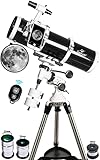
- Reflector Telescope with Superior Optics: This reflector telescope features a 5.1 inch aperture and all-glass optical components with high transmission coatings that allow for enhanced image brightness and clarity, suitable for observing the Moon, planets, brighter galaxies, nebulas, and star clusters
- Toothless Focusing Base for Easy Operation: The telescope's short 24 inch long optical tube design and fast f/5 focal ratio, along with its toothless focusing base, provide a user-friendly experience for beginners and advanced astronomers alike
- Complete Accessory Package: The included 3 eyepieces, a 3X Barlow lens, a finderscope, and an adjustable tripod make it easy to find and observe celestial objects from any viewing position
- Wireless Remote Control for Convenient Photography: There is no need to download app, the remote can be paired with your device via Bluetooth, compatible with iPhone or Android device. With the bluetooth camera remote, you can take pictures or videos and share them with your family and friends in real time
- Quality Construction and Support: This telescope comes with a 1-year warranty and lifetime maintenance. The manufacturer provides helpful customer support to ensure your satisfaction with any questions or concerns about the product or service
Product prices and availability are accurate as of the date/time indicated and are subject to change. Any price and availability information displayed on Amazon at the time of purchase will apply.




