What’s actually slowing this PC down?
Pick the symptom - the matching free tool is one click away.
Uranium compounds can behave magnetically in unusual ways because uranium’s 5f electrons sit between two familiar extremes: they can be partly localized around uranium atoms and partly spread through the material. Their behavior also depends on spin–orbit coupling and the surrounding atoms. The result is a wide range of magnetic responses—not one standard pattern that applies to every uranium compound.
Why do uranium’s 5f electrons make magnetism hard to predict?
In many materials, magnetism is explained with a fairly simple picture: electrons either stay close to individual atoms and form local magnetic moments, or they move through the solid and contribute to magnetism collectively. Uranium’s 5f electrons do not fit neatly into either category. Depending on the compound, they can show both localized-like and itinerant-like character.

That balance matters. More localized behavior can favor magnetic moments associated with uranium atoms; more itinerant behavior reflects electrons shared across the material. The uranium–uranium spacing and the chemical environment can shift the balance, influencing whether moments form and whether they align into long-range magnetic order.
As Alberto Martín-Martín put it in a 2000 doctoral thesis on uranium intermetallics, “the magnetic properties of 5f-based intermetallics cannot be explained by either of the limiting approaches.” The useful takeaway is not that uranium magnetism is inexplicable, but that a single localized-ion or itinerant-band model is often inadequate.
#1 Best Overall

- 48.27% Pure natural U with Calcium.
Why is a uranium magnetic moment more than a count of unpaired spins?
An electron has spin, but it also has orbital angular momentum: in effect, its motion around an atom contributes to magnetic behavior. In actinide systems, including uranium compounds, these contributions can oppose one another. The orbital contribution can be large enough to dominate the response, so a simple count of unpaired spins does not reliably describe the magnetic moment.
Spin–orbit coupling links an electron’s spin and orbital motion. In uranium compounds it is an important part of the magnetic picture, not a small correction that can be ignored. Because the spin and orbital parts are coupled, the magnetic response can depend strongly on the specific electronic states available in a compound.
Rank #2
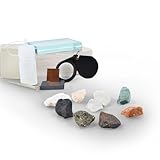
- COMPLETE MINERAL TESTING KIT || Includes essential tools and 9 raw mineral samples for testing hardness, streak color, magnetic properties, and effervescence. Perfect for hands-on geology demonstrations.
- 9 RAW MINERAL SPECIMENS || Includes Calcite, Quartz, Gypsum, Hematite, Magnetite, Microcline, Pyrite, Fluorite and Talc. Each sample is approximately 0.5 inches, making them ideal for testing and experimentation. Includes specimen key for identification.
- PORTABLE TESTING TOOLS || Comes with a reusable streak plate, glass plate, magnet, dropper bottle, nail, copper square, and retractable hand lens, all stored in a convenient reusable box. Ideal for field use.
- CLASSROOM AND FIELD USE || Great for teaching geology concepts in classrooms or conducting field tests. Engages students with hands-on activities to identify and classify minerals.
- LOCALLY PROCESSED MINERAL SAMPLES || Specimens are sourced globally and carefully cut and prepared in Victor, NY, ensuring high-quality samples that highlight defining features for study.
How do neighboring atoms change uranium’s magnetic response?
The local environment around uranium affects the electronic states that its 5f electrons occupy. In molecular compounds, the surrounding ligands create a local field that can split or shift those states. Together with spin–orbit coupling, these ligand-field effects make magnetic susceptibility—the change in magnetization in response to an applied field—more complicated to interpret than a basic spin-only model suggests.
The same broad principle applies in solids: chemical bonding and uranium–uranium spacing influence how localized or itinerant the 5f electrons are. A change in compound structure or composition can therefore alter the likelihood of moment formation and magnetic order. There is no universal uranium moment or magnetic response that can be inferred from the element alone.
Rank #3

- Natural U Dioxide, Uraninite, U ore Contains extremely high activity, ☢️ Radium!
What different magnetic behaviors occur in uranium intermetallics?
Uranium intermetallics do not share a single magnetic pattern. Some develop long-range magnetic order, while others remain paramagnetic, meaning they do not show a persistent, ordered magnetization in the absence of an applied field. Paramagnetic behavior does not necessarily mean a weak or simple response: some examples are strongly direction-dependent, and spin fluctuations are also observed in uranium intermetallics.
Magnetic order
When magnetic moments align in a regular pattern over long distances, a compound has long-range magnetic order. Whether that happens depends in part on the balance between the 5f electrons’ localized and itinerant character, as well as interactions among the atoms. Magnetic order is not inevitable just because a compound contains uranium.
Rank #4
Anisotropy
Magnetic anisotropy means that a material responds differently depending on the direction of the applied magnetic field. A paramagnetic uranium compound can still be highly anisotropic: “paramagnetic” describes the absence of long-range order, not an assurance that the response is the same in every direction.
Spin fluctuations
Spin fluctuations are changes in magnetic behavior over time rather than a fixed, static arrangement of moments. Their presence is another reason that a snapshot description—ordered or not ordered—may not capture the full behavior of a uranium intermetallic.
Windows Errors? Fix Them Before They Spread
Repair common Windows errors and clear accumulated junk for a smoother, more stable PC - no reinstall needed.Free scan · no reinstallOutdated Drivers Are Slowing You Down
One free scan finds every outdated or missing driver and matches the right update for your exact hardware.Free scan · exact hardware matchBest Value

- High Purity and Precision Engineering: Each 10mm cube is crafted with exceptional precision using cutting-edge technology.
- 8 Element Options Available – Choose individually from Fluorine (F), Indium (In), Samarium (Sm), Dysprosium (Dy), Holmium (Ho), Terbium (Tb), Erbium (Er), and Ytterbium (Yb). Each cube is high‑purity and precision‑cut.
- LASER ENGRAVING: Each cube is engraved with chemical symbols, name, atomic number, density, purity, atomic mass, melting point and electron layer structure, with crisp edges, flat cuts and minimum (+/-0.1) mm market tolerance.
- Safe Material: The metal cube are made of high-density elements, suitable for all ages, they are practical educational applications for different grades, and are also very suitable for element collection and display.
- Novel and unique gifts or teaching aids: This density cube set makes a fantastic gift for chemistry enthusiasts, teachers, and students alike. They can use it for collecting, as a desk ornament, a teaching tool, Christmas gifts, and so on. Let’s experience the real essence of chemical elements
Can uranium and another metal order magnetically together?
Yes. In some intermetallic compounds containing uranium and a 3d metal, both the uranium and the 3d-metal sublattices can order magnetically. A sublattice is one of the distinct groups of atoms in a crystal structure. This kind of compound has more than one magnetic contribution to consider: the behavior of uranium’s 5f electrons and the behavior of the 3d-metal atoms can both matter.
That does not mean every uranium–3d-metal compound has two ordered magnetic sublattices. It is a documented type of behavior in some compounds, not a rule for the whole family.
How should you compare the magnetism of two uranium compounds?
A useful comparison separates several questions rather than treating “magnetic” as a single property:
- 5f-electron character: Is the behavior more localized-like or more itinerant-like?
- Long-range order: Does the compound develop an ordered magnetic state, or is it paramagnetic?
- Direction dependence: Is its magnetic response anisotropic?
- Dynamics: Are spin fluctuations reported?
- Moment contributions: How do spin and orbital magnetism contribute relative to one another?
- Magnetic sublattices: If another magnetic element is present, does it order alongside uranium?
These questions describe distinct features, so one answer does not settle the others. For example, a compound can be paramagnetic yet anisotropic, and the absence of long-range order alone does not establish whether spin fluctuations are present. Numerical comparisons—such as transition temperatures or ordered moments—require compound-specific experimental results and their measurement conditions.
Recommended Free Tools
Why are uranium compounds specialist research materials?
Uranium compounds are not appropriate consumer samples. A 2024 review of actinide oxides identifies toxicity, radioactivity, and reactivity as constraints on research in this area. These materials belong in properly equipped specialist research settings, not in informal experiments or collections.
Quick Recap
Product prices and availability are accurate as of the date/time indicated and are subject to change. Any price and availability information displayed on Amazon at the time of purchase will apply.




