Free tools Windows power users keep installed
One-click scans. No signup required.
Update a Commander deck by testing a new card against a specific job and a specific cut—not by assuming the newest set is automatically stronger. First verify color identity, Commander legality and the current ban list; then compare the candidate with the card it would replace, check how the swap changes your deck’s play pattern and agreed power level, and make a small change you can observe over several games.
This process also handles the awkward cases: reprints, mixed products, set-specific legality, Game Changers and cards that are legal in a deck but restricted in another use.
As an Amazon Associate I earn from qualifying purchases.
How do I update my Commander deck for new Magic cards?
Use this sequence for every candidate:
- Define the need. Decide whether the deck needs ramp, card advantage, removal, protection, a payoff, a land or a theme card.
- Prove the card is legal. Check color identity, Commander rules, the current banned list and any release-note exception for that printing.
- Name the cut. Compare the new card with the card occupying the same role, not with an imaginary empty slot.
- Judge the fit. Look at mana value, commander synergy, reliability, flexibility, resilience and the way the swap changes speed and table interaction.
- Check the social contract. A legal card can still move a deck into a faster or more oppressive experience than your group expects.
- Change a few cards, then record games. Keep the swap only if it addresses the problem you identified.
A Commander deck contains 99 cards plus one commander, uses singleton construction except for basic lands, and requires every card to fit the commander’s color identity. The official Commander format page is the best starting point for rules and current bracket guidance.
Quick wins for a faster PC:
Scan for outdated or missing drivers - takes under a minuteDriver Scan →Repair Windows errors before they cause bigger problemsFix Now →Fix the driver behind crashes, sound loss and screen glitchesFind Drivers →Start by naming the job your deck needs
“Is this new card good?” is too broad a question. Ask what the deck is trying to do and which task is currently failing. A card that is excellent in a graveyard engine may be a poor draw in a creature-voltron list, even if both decks share a color.
#1 Best Overall
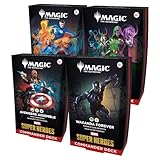
- GET ALL 4 MARVEL SUPER HEROES-THEMED COMMANDER DECKS—Avengers Assemble, Wakanda Forever, The Fantastic Four, and Doom Prevails
- ASSEMBLE EARTH’S MIGHTIEST HEROES & VILLAINS—The Marvel Universe has arrived in full force! Build your dream super teams of Heroes and Villains, then suit them up with iconic gear and unleash their earthshaking abilities
- 30 NEW COMMANDER CARDS—Each ready-to-play deck includes 30 Commander cards entirely new to Magic: The Gathering
- FOIL BORDERLESS COMMANDERS—Command your decks in style with Legendary Creature cards featuring Borderless art and a shiny Traditional Foil treatment. The Avengers Assemble, Wakanda Forever, and Doom Prevails decks each contain 1 foil Borderless card. The Fantastic Four deck contains 4 foil Borderless cards, 1 for each member of the team!
- EPIC MULTIPLAYER BATTLES—Magic’s most popular multiplayer play format, Commander is an action-packed, free-for-all battle full of strategic plays and social intrigue (best with 3–5 players)
Ramp and mana development
Identify whether you need an early accelerator, a land drop, fixing for several colors or a late-game mana sink. Compare the candidate’s mana value with the turns on which you want to cast it. A three-mana ramp spell may be preferable to a more powerful five-mana option if your commander and key plays compete at five.
Card advantage and selection
Separate cards that draw several cards immediately from cards that generate value over time, filter the top of the library or recur resources. Ask whether your deck can reliably meet the new card’s conditions. A conditional draw spell that is impressive only after your engine is active may not solve a problem that occurs before the engine starts.
Removal and protection
Write down the threats your table actually presents: creatures, artifacts, enchantments, graveyards, commanders or combo pieces. A flexible answer can be worth more than a narrower effect with a lower mana cost. Protection should be judged by the turns when you must keep the commander or a key permanent alive, not merely by its maximum upside.
What’s actually slowing this PC down?
Pick the symptom - the matching free tool is one click away.
Payoffs and theme cards
Payoffs are only upgrades when the deck supplies enough enablers. Count the relevant card types, triggers or permanents in the current list. A new payoff that asks for a high density of a theme can underperform if adding it forces out the enablers that make it work.
Lands and utility slots
A land is not automatically harmless because it occupies a land slot. Check whether it enters tapped, produces the colors you need on curve, carries a useful ability or creates a cost when you need untapped mana. Utility lands can improve late-game flexibility while quietly reducing early consistency if too many replace colored sources.
Is this new card legal in Commander?
Legality is a checklist, not a guess based on the product where you saw the card. Verify the actual card and printing before it enters the deck.
Check color identity, not only the casting cost
Color identity includes the mana symbols in a card’s casting cost and in its rules text. Hybrid, Phyrexian, activated and alternative-cost symbols can therefore matter even when the card’s front face appears colorless. A card must fit every color in the commander’s identity and cannot introduce a color outside it.
Confirm the 99-card singleton rules
Normal Commander construction is one copy of each card by name, apart from basic lands, in a 99-card deck plus one commander. A card that is legal in another format or in a different deck does not bypass Commander’s deck-building restrictions.
Check the live banned list
Use Wizards’ current Banned & Restricted list immediately before sleeving a card. The list can change independently of a set release. For example, Wizards’ February 9, 2026 announcement says Biorhythm was unbanned. It also says Lutri, the Spellchaser may be included in a deck or used as a commander while remaining banned as a companion; the live list currently describes Lutri as banned only as a companion. That distinction matters because a card’s legality can depend on how you use it.
Do not carry an old deck list forward on memory. Record the date you checked the list, especially when a group is preparing for an event or when a new announcement has just appeared.
Read release notes for new sets and unusual products
Set codes and product names do not always tell the whole story. Wizards’ Reality Fracture release notes, published September 18, 2026, state that cards with the FRA code are allowed in Commander. They also state that new FRC Commander cards are allowed in Commander, Legacy and Vintage, and that previously printed cards bearing an FRC set code are legal wherever a card of the same name is allowed. Those are printing-specific rules; do not generalize them to another set without reading that set’s notes.
Rank #2
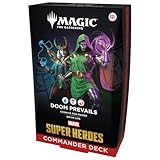
- PLAY THE VILLAIN—Bring the might of the Marvel Universe to the battlefield as you combat your friends with a deck featuring your favorite Marvel villains
- ALL SHALL KNOW DOOM—Harness the power of Doctor Doom and enact your master plan. The connive mechanic either strengthens your Villains or drains life from the whole table. Submit yourself to Doom!
- 30 NEW COMMANDER CARDS—Each ready-to-play deck includes 30 Commander cards entirely new to Magic: The Gathering
- FOIL BORDERLESS COMMANDER—Command your deck in style with 1 Legendary Creature card featuring Borderless art and a shiny Traditional Foil treatment
- EPIC MULTIPLAYER BATTLES—Magic’s most popular multiplayer play format, Commander is an action-packed, free-for-all battle full of strategic plays and social intrigue (best with 3–5 players)
Mixed products require the same care. The Mystery Booster Commander Edition release notes explain that reprints keep their prior legality, while 59 new cards plus one specified digital card are legal in Commander, Legacy and Vintage. The notes also provide separate exceptions for playtest cards and cards with acorn symbols. A card pulled from that product therefore needs to be identified by its card type and exception, not merely by the product name.
Keep a legality record for the deck
- Card name and exact printing or set code.
- Color identity, including symbols in rules text.
- Date and URL used for the legality check.
- Whether the card is in the 99, the command zone or a companion slot.
- Any product-specific exception listed in official release notes.
This small record prevents a legal deck from becoming accidentally illegal after a swap or a rules update.
What should I cut for this card?
Choose the replacement before deciding that the new card belongs. The strongest comparison is between two cards performing the same job in the same deck.
Find the closest current role
Sort the deck into functional groups rather than relying only on card type. A creature can be ramp, removal or a payoff; an instant can be protection or card selection. Mark the current card that most closely matches the candidate’s primary job. If no existing card has that job, identify the weakest slot in the category you would expand and explain why another category can afford to shrink.
Recommended Free Tools
Use a one-for-one first pass
A one-for-one swap makes the result easier to understand. If the new card is added without a cut, you may hide a curve problem, reduce the land count or dilute a theme. Broader rebuilds are reasonable when the commander or strategy has changed, but label that as a rebuild rather than an ordinary upgrade.
Compare the cards on the same axes
| Axis | Questions to ask | What a meaningful improvement looks like |
|---|---|---|
| Role | Do both cards solve the same problem? | The candidate addresses the deck’s stated need instead of adding unrelated power. |
| Mana value and curve | When can you cast each card, and what else competes for that mana? | The new card fits the turn and mana window where the deck is currently behind. |
| Commander synergy | Does the commander copy, recur, discount or trigger either card? | The candidate receives repeatable support that the outgoing card did not. |
| Reliability | How often can the deck meet the card’s conditions? | The effect works with the deck’s normal draws, not only an ideal board. |
| Flexibility | Can it serve more than one matchup or game stage? | The card remains useful when the primary line is disrupted. |
| Interaction and resilience | Can opponents answer it, and does it protect value from removal? | The swap improves your ability to act through common opposing interaction. |
| Play pattern | Does it speed up, slow down or centralize the deck? | The change produces the kind of games the pilot wants to play. |
| Power-level fit | Will the card alter the deck’s speed or consistency at your table? | The upgrade stays within the group’s agreed expectations. |
These axes are a practical evaluation framework, not a Wizards ranking system. A card does not need to win every category; it needs to improve the problem you named without creating a larger one elsewhere.
How do I know if a new card fits my commander?
Read the commander and the candidate as one system. A card’s text box is only part of its value when the commander changes how often it is drawn, cast or reused.
Check direct interactions
- Does the commander trigger when the candidate enters, attacks, dies, targets or casts a spell?
- Can the commander reduce the candidate’s cost or supply a missing color?
- Can the deck recur the card, copy it or use its card type repeatedly?
- Does the candidate protect the commander or compete with it for the same turn?
Write the interaction in one sentence. “This card draws when my commander attacks” is useful; “this card is powerful” is not a testable reason.
Measure support density
Count the cards that make the candidate good. If a payoff rewards sacrificing artifacts, count the sacrifice outlets and artifacts that can be supplied on the relevant turns. If a spell requires a creature in the graveyard, check how often the deck can place one there without spending an entire turn. The more conditional the card, the more explicitly you should verify its enablers.
Protect the commander’s turn
Many decks have a critical commander turn: casting the commander, equipping it, activating an ability or keeping mana open for protection. A new card that looks efficient but consumes that same mana may reduce the deck’s consistency. Compare not just total mana value but the opportunity cost of casting the card on the turn your commander matters most.
Watch for nonbo changes
A new card can be individually stronger while making the deck worse by displacing a card type, mana source or trigger the rest of the list needs. Check graveyard targets, creature counts, artifact counts, instant-and-sorcery totals, token producers and basic-land requirements after the swap.
Rank #3
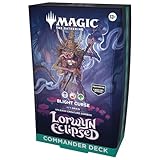
- RETURN TO THE LAND OF LIGHT AND SHADOW—Lorwyn returns, not as it once was, but a world split in two. Explore this dual-aspect plane filled with enchanting creatures and embrace the powers of order and chaos.
- READY-TO-PLAY COMMANDER DECK—Pick up and play Magic’s most popular multiplayer format
- CONTENTS—100-card Blight Curse deck with 12 new cards (including 2 foil Mythics), deck box, 10 double-sided token cards, strategy insert, reference card
How will the update change your table’s experience?
Commander legality does not settle whether a card is appropriate for your group. A highly efficient tutor, compact combo piece or free interaction can increase speed and consistency even when the rest of the deck remains unchanged.
The Tool Desk
Outbyte Driver Updater FREEScan for outdated or missing drivers - takes under a minuteDriver Scan →Outbyte PC Repair FREEClear out junk files and repair common Windows errorsFree Scan →Use brackets and Game Changers as context
The official Commander page describes brackets 1 and 2 as excluding Game Changers, bracket 3 as allowing up to three, and brackets 4 and 5 as allowing an unlimited number. Wizards labels the bracket system as beta, so check the live format page for updates. Treat those brackets as conversation aids rather than an automatic score for every card.
Describe the change in gameplay terms
Before playing, tell the group what changed: “This adds another two-mana piece of interaction,” “This commander now comes down a turn earlier,” or “This increases the number of repeatable tutors.” A concrete description lets opponents decide whether the deck still fits the planned pod better than a vague claim that the card is only a small upgrade.
Recognize power shifts beyond wins
Power can show up as earlier board development, fewer dead draws, more reliable access to a combo, or the ability to constrain opponents’ turns. If the new card changes one of those dimensions, discuss it even if the deck’s win condition is unchanged. The goal is a game experience everyone understood before shuffling.
Independent reader supportYour contribution helps us test, update, and keep practical guides available for everyone.A practical testing loop for each upgrade
Do not change ten cards at once if you want to know what helped. Use a short, repeatable log.
- Write the hypothesis. Example: “The deck misses its fourth land drop too often, so this two-mana ramp spell replaces a five-mana value creature.”
- Record the cut and the reason. Note the outgoing card’s role, mana value and weaknesses.
- Play normal games. Use the same commander and general power band. Do not claim a card is tested unless you have actually observed it in games.
- Mark each relevant draw. Record whether the candidate was cast, stranded, redundant, answered or responsible for a line the old card could not provide.
- Check costs as well as benefits. Note missed colors, awkward sequencing, lost synergy and turns where the card competed with the commander.
- Review after several games. Keep the card if it repeatedly addresses the hypothesis without violating the group’s expectations. Otherwise return it to the binder and test a different candidate.
A simple log can contain the date, pod power expectation, opening hand, turn cast, result of the effect and one sentence about the game’s turning point. This is not a statistical claim; it is a way to avoid making decisions from one memorable draw.
Choosing how to obtain the upgrade
Buy the specific single after choosing it
Once the comparison identifies a card, a single is the targeted acquisition path. It gives you the named card you selected instead of a random assortment. Availability, price and seller eligibility vary by region and date, so verify those details separately when you are ready to purchase.
Use a preconstructed deck for a broader rebuild
An official Commander preconstructed deck can make sense if you want a complete shell, a new commander or a large pool of coordinated cards. It is not a targeted substitute for a single-card upgrade: most of the list may not address the specific slot you identified.
Do not treat a booster as a guarantee
A random booster cannot promise the particular card your comparison selected. Opening packs can be enjoyable, but it is an unreliable way to solve a defined deck problem. Decide whether you are buying entertainment or acquiring a known upgrade, then choose the product accordingly.
Common update mistakes and how to fix them
“It is new, so it must be better”
Why it fails: New cards are designed for many strategies and may be less reliable in yours.
Fix: State the job, name the cut and identify the commander interaction before adding the card.
Rank #4

- FINAL FANTASY XIV-THEMED DECK—Battle your friends with FINAL FANTASY XIV’s iconic heroes, villains, and spells with the strategic gameplay of the Magic: The Gathering collectible card game
- ALWAYS SEEK OUT NEW KNOWLEDGE—Be a master caster and gain control with card advantage as you band together with Y’shtola, Night’s Blessed to aid Eorzea in its time of need
- 25 NEW CARDS plus ALL NEW ART—All 100 cards in this ready-to-play deck feature new FINAL FANTASY-themed art, including 25 Commander cards entirely new to Magic: The Gathering
- 2 FOIL LEGENDARY CARDS—Each deck includes 2 Legendary Creature cards with a shiny Traditional Foil treatment that can be played as your commander
- COLLECT SPECIAL ALT-BORDER CARDS—Each deck also comes with a 2-card Collector Booster Sample Pack containing 2 alternate-border cards of rarity Rare or higher
“The product says Commander, so every card is legal”
Why it fails: Reprints, new cards, playtest cards and acorn-symbol cards can receive different treatment.
Fix: Check the exact card and printing against the relevant release notes and the current banned list.
Do these 3 things before closing this tab:
1Fix the driver behind crashes, sound loss and screen glitches2Repair Windows errors before they cause bigger problems3Scan for outdated or missing drivers - takes under a minute“Colorless means it fits every commander”
Why it fails: A colorless frame can still contain colored mana symbols in its cost or rules text.
Fix: Evaluate the card’s complete color identity, not its frame color.
“I added it without deciding what leaves”
Why it fails: The deck can become overstuffed, lose a needed category or hide the actual trade-off.
Fix: Identify a real cut first; make a larger rebuild only when you can describe the strategic reason.
Windows Errors? Fix Them Before They Spread
Repair common Windows errors and clear accumulated junk for a smoother, more stable PC - no reinstall needed.Free scan · no reinstallCrashes, No Sound, or Screen Glitches?
Random freezes, missing sound and display glitches usually trace back to one bad driver. Find and replace yours safely.Free scan · under a minute“The strongest card is always the right card”
Why it fails: A card can raise speed or consistency beyond the pod’s agreed experience.
Fix: Explain the gameplay change to the table and use bracket/Game Changer guidance as a shared vocabulary.
“One great draw proves the upgrade”
Why it fails: Commander variance makes a single game a poor basis for a general conclusion.
Fix: Keep a small game log and judge whether the card repeatedly solved the stated problem.
Free tools Windows power users keep installed
One-click scans. No signup required.
Quick Recap
Final pre-sleeving checklist
- The card has a clearly stated job in this commander deck.
- The exact printing’s color identity fits the commander.
- The card is legal in Commander and is not prohibited for the way you intend to use it.
- You checked the current banned list and any applicable release notes.
- You identified the card leaving and documented the trade-off.
- The replacement fits the mana curve and does not remove a critical enabler or land source.
- You understand how the swap changes speed, consistency and interaction.
- The change matches the pod’s agreed bracket or power expectation.
- You selected a specific single if targeted acquisition is the goal, rather than relying on a random booster.
- You have a plan to observe the card in actual games before making further changes.
Product prices and availability are accurate as of the date/time indicated and are subject to change. Any price and availability information displayed on Amazon at the time of purchase will apply.




