Free tools Windows power users keep installed
One-click scans. No signup required.
When Ubuntu Desktop appears not to boot on a RISC-V system, first determine whether the board or virtual machine actually reached Linux. A blank monitor can mean an unsupported GPU, while a halt in firmware or an incorrect device tree can prevent the kernel from starting at all. Identify the exact board or QEMU configuration, Ubuntu release and image, firmware path, and available serial or SSH access before changing graphics packages.
Canonical describes current RISC-V Desktop images as experimental and unsupported. Image availability, graphics capability and boot requirements vary by board, so a procedure that works in QEMU or on one development board cannot be treated as a universal RISC-V fix.
As an Amazon Associate I earn from qualifying purchases.
Start by identifying the platform, image and failure boundary
Record the setup before replacing an image, changing firmware or editing kernel options. The phrase “Ubuntu RISC-V desktop won’t boot” does not identify a single failure: it could describe an unsupported headless image, a boot-media problem, a firmware handoff error, a kernel failure or a display session that never became visible.
What’s actually slowing this PC down?
Pick the symptom - the matching free tool is one click away.
Capture these details
- Hardware or emulator: board name, revision and RAM, or the QEMU version, machine type and emulated CPU profile.
- Ubuntu: release, architecture, image filename and whether it is a preinstalled server image, a live installer or a Desktop image.
- Image source: the exact entry in Canonical’s RISC-V image catalog or the board vendor’s documented image path.
- Boot media: SD card, eMMC, NVMe, USB or a virtual disk, including which device the firmware is configured to read.
- Firmware: U-Boot or EDK II, SBI implementation, firmware version and selected boot entry.
- Display hardware: monitor, cable and GPU model, if the platform has one.
- Access paths: the last serial-console line, whether keyboard LEDs react, and whether the machine answers on the network or accepts SSH.
Keep the last visible line exactly as displayed. “Stops at GRUB,” “prints a kernel panic,” “reaches a login prompt” and “boots but has no video” point to different layers and should not be collapsed into one graphics diagnosis.
#1 Best Overall

- Stable & Reliable CP2102 Chipset - Built with the trusted CP2102 chipset, ensuring stable data transmission and consistent performance. Supports 3.3V TTL logic level communication, making it suitable for most modern microcontroller systems.
- Extra Long 3ft/95cm Cable – More Flexible Than Standard Short Cables - Upgraded with a 3ft/95cm extended cable, providing greater flexibility than standard short cables. Perfect for hard-to-reach ports, complex setups and bench testing environments.
- Simplified 4-Wire Interface for Easy Wiring - Designed with a 4-pin configuration (TXD, RXD, VCC, GND), making connections faster, cleaner and less error-prone compared to traditional multi-pin modules.
- Plug and Play USB to TTL Adapter Cable - Easily connect TTL serial devices to your computer via USB without external power supply. Ideal for Arduino, ESP8266, ESP32, STM32 and other microcontroller platforms.
- Wide Compatibility for Development & Debugging - Provides stable 5V power output with 3.3V TTL signal level communication, ensuring reliable performance with Arduino, Raspberry Pi, ESP8266, ESP32 and other development boards.
Confirm that the image is intended for your board
Canonical’s RISC-V catalog is organized by board and image variant. The existence of a RISC-V Ubuntu download does not mean that a supported graphical image exists for every board. Several entries are server images, and some explicitly support headless operation only, without GPU or Wi-Fi support.
Physical-board checks
- Open the catalog entry for the exact board model and revision, not merely the RISC-V architecture.
- Check whether the download is a preinstalled server image, a live installer or a Desktop image.
- Read the entry’s limitations for GPU, Wi-Fi, PCIe and headless operation.
- Follow that board’s setup guide for boot media, firmware and console wiring.
- Use the release that the board documentation identifies as supported. Do not assume the newest release is the correct one.
If the only supported image is headless, a monitor remaining blank is expected behavior rather than evidence that Linux failed. Continue diagnosis through UART or SSH instead of installing a desktop driver intended for another board.
QEMU checks
QEMU has a separate, experimental desktop path. Verify the QEMU release, firmware and emulated CPU profile against the Ubuntu release before investigating GNOME. Canonical’s current documentation says Ubuntu releases from 25.10 onward require the rva23s64 CPU profile, available with QEMU 10.1 or later. The image catalog notes that hardware which is not RVA23-ready continues to be supported by Ubuntu 24.04.5 LTS. These are release and platform conditions, not optional performance tweaks.
Use serial or SSH to decide whether Linux booted
A RISC-V black screen is not a reliable boot-status indicator. On HiFive boards, Canonical strongly recommends connecting to the serial console for first boot because early messages appear there before the kernel initializes the GPU. On the VisionFive 2, the board guide documents a USB UART adapter connected to the GPIO UART. Pinout, voltage and serial settings are board-specific; do not copy a connector layout from another board.
What each access method proves
| Observation | What it establishes | Next focus |
|---|---|---|
| No serial output at all | Power, cabling, console settings, boot source or firmware may be wrong. | Check the board guide, UART connection, selected boot device and firmware. |
| Firmware or bootloader text, then silence | The failure is before or during kernel handoff. | Check UEFI/boot entry, GRUB, kernel, initrd and device tree. |
| Kernel messages or a login prompt over serial | Linux has started; the monitor may be the failing component. | Inspect userspace, display services and documented GPU limits. |
| SSH accepts a connection | The system reached networking and userspace far enough to run an SSH server. | Collect logs and identify why the graphical session is absent. |
| Serial and SSH both fail, but power remains on | The machine may be stuck in firmware, boot media or early kernel startup. | Return to boot-chain checks rather than changing desktop packages. |
Read-only checks after SSH or a text login
Run diagnostics without changing firmware or kernel parameters:
Rank #2

- Support 4 kinds of TTL levels:This is a versatile USB to TTL converter. It is powerful enough to handle almost all TTL level communications. It is compatible with 5V, 3.3V, 2.5V, 1.8V TTL levels.
- FTDI FT232RNL Chip:Built-in original FTDI FT232RNL Chip.Industrial grade, Compatible with Windows 7, 8, 10, 11, Linux, MacOS
- Protective case:Comes with a protective case, this transparent protective case can effectively prevent static interference from the hand and prevent accidental short circuit
- It provides access not only to UART TX,RX, RTS, CTS, VCC and GND pins,but also provides access to DSR,RI,DCD,DTR,RESET pins
- What You Get: SH-U09C5 USB to UART Adatper, 6PIN Cable
uname -a
cat /etc/os-release
ip addr
systemctl get-default
journalctl -b -p err
dmesg | tail -n 100
If installed, lspci can show whether a PCIe graphics device is enumerated. A missing command is not itself a graphics failure. Save the output with the board and image details so that a board-specific guide can be followed accurately.
Understand the RISC-V boot chain before changing anything
Canonical describes a typical Ubuntu RISC-V path as boot ROM, an SBI implementation such as OpenSBI, UEFI-enabled firmware such as U-Boot or EDK II, GRUB and Linux. The firmware selects an EFI entry; GRUB loads the kernel and configured initrd and device tree; the Linux EFI stub receives those components. A fault at any earlier stage prevents GNOME from being relevant.
Recommended Free Tools
When output stops before the kernel
- Confirm that the board is starting from the intended SD, eMMC, NVMe or USB device.
- Check that the selected firmware is the one required by the board guide and that its boot entry still points to the installed system.
- Verify that the image and firmware agree on UEFI support.
- Check that the kernel, initrd and board-matched device tree are being loaded together.
- If the problem began after a kernel or firmware update, compare the selected boot entry and device-tree model with the board documentation before blaming graphics.
Canonical explains that Ubuntu tries to use the device tree matching the board. Its boot-flow documentation also notes that flash-kernel uses the device-tree model property when arranging the tree for a kernel update. A wrong tree can therefore produce a failure that looks like a display problem because the system never reaches a usable userspace.
Separate physical-board troubleshooting from QEMU troubleshooting
| Environment | Check first | Diagnostic access | Graphics expectation |
|---|---|---|---|
| Physical RISC-V board | Board-specific image, boot source, firmware and documented limitations. | Board UART where documented; SSH when networking works. | Depends on the exact board. Some documented images are headless or have unsupported GPUs. |
| QEMU RISC-V | QEMU version, CPU ISA profile, EDK II firmware and image compatibility. | Serial monitor output plus emulator logs. | Experimental desktop image with an explicitly configured virtio GPU; regular GNOME can be extremely slow. |
Do not transfer a physical-board workaround to QEMU or vice versa. A real board’s PCIe and GPU limitations are hardware and firmware constraints; QEMU’s display is an emulated device that must be added to the virtual machine configuration.
Check graphics only after proving that Linux reached userspace
Once serial or SSH confirms a booted system, investigate the display path. First establish the board revision and the exact GPU capability documented for it. Then determine whether the image includes a graphical session and whether the display manager attempted to start.
Rank #3
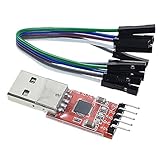
- Stable and reliable chipset CP2102
- Baud rates: 300 bps to 1.5 Mbps
- Connect MCU easily to your computer!
- Standard USB type A male and TTL 5pin connector. 5pins for 3.3V, RST, TXD, RXD, GND & 5V
- Supports Windows 98SE, 2000, XP, Vista, Window7, Mac OS 9, Mac OS X & Linux 2.40
VisionFive 2 limitations
Canonical’s VisionFive 2 guide states that the onboard GPU is unsupported. It also says incomplete PCIe support means an external GPU does not work on that board. Installing a generic desktop driver or purchasing a graphics card therefore cannot be treated as a fix for a blank screen on this platform. If serial or SSH works, the evidence points to the unsupported display path or platform limitation rather than a failed Ubuntu boot.
Quick wins for a faster PC:
Fix the driver behind crashes, sound loss and screen glitchesFind Drivers →Clear out junk files and repair common Windows errorsFree Scan →Scan for outdated or missing drivers - takes under a minuteDriver Scan →HiFive guidance in context
Canonical’s HiFive tutorial is useful for serial and GPU diagnostics, but it is legacy guidance and explicitly says the Ubuntu Desktop installation described there was not officially supported on riscv64. Use its console recommendation for the HiFive boards it covers; do not present it as a current, universal Desktop compatibility guarantee.
Userspace checks
From SSH or a text console, inspect the current boot’s errors with journalctl -b -p err, then look for display-manager or kernel graphics messages in the full journal. Check whether the system is configured for a graphical target with systemctl get-default. These commands identify symptoms; they do not make an unsupported GPU supported. Avoid installing packages until the board guide confirms that the hardware and image combination is meant to provide graphics.
Set up an experimental graphical desktop in QEMU
Canonical labels its RISC-V Desktop images “experimental” and “in no way supported.” Its documented QEMU example uses EDK II firmware, the rva23s64 CPU profile where required, a virtio-gpu-pci device, USB keyboard and mouse devices, an attached Ubuntu ISO and a serial monitor. The serial option is -serial mon:stdio; the example starts full-screen, and removing -full-screen shows the display in a window.
Validate the virtual hardware list
- Use the QEMU version required by the target release. For Ubuntu 25.10 and later, verify QEMU 10.1 or newer and the
rva23s64profile. - Boot with EDK II as documented rather than substituting an unrelated firmware image.
- Confirm that
virtio-gpu-pciis present. Without it, the guest has no configured virtual graphics adapter. - Include USB keyboard and mouse devices so the graphical installer or desktop can receive input.
- Keep
-serial mon:stdioenabled while diagnosing. It provides boot messages independently of the graphical window. - Remove
-full-screentemporarily if you need to see whether QEMU created a window but the monitor is displaying it elsewhere.
Canonical reports that regular GNOME Desktop can take more than 30 minutes to load under QEMU and suggests Xubuntu Minimal as more suitable for emulation. A long delay in GNOME is therefore not automatically a boot failure. Use serial output to decide whether the guest is progressing while the graphical session remains slow.
Rank #4

- Stable & Trusted CP2102 Chipset – Built with the reliable CP2102 chipset for stable data transmission and consistent performance in embedded and serial communication projects.
- Flexible Baud Rate Range – Supports a wide range of baud rates from 300 bps to 1.5 Mbps, meeting various data transmission needs for microcontrollers and development boards.
- Plug-and-Play USB Connectivity – Easily connects your TTL serial devices to a computer via USB. No external power supply needed. Ideal for Arduino, ESP8266, STM32, STC, and more.
- Standard Pin Configuration – Features USB Type-A male and TTL 5-pin female header (3.3V, RST, TXD, RXD, GND). Compatible with both 3.3V and 5V logic levels, ensuring broader hardware support.
- Broad OS Compatibility – Works with Windows 98SE/2000/XP/Vista/7/10/11, Mac OS 9/X, and Linux 2.4+, making it a versatile solution for developers and DIY electronics enthusiasts.
Work through a black-screen decision tree
The board is silent on serial
Stop changing desktop software. Recheck power, UART wiring, terminal baud and port, boot-media seating and the selected boot source. Use only the pinout and electrical requirements in the exact board guide. If the board guide documents a recovery or alternate firmware path, follow that procedure; do not flash firmware from a different board family.
Serial stops in firmware or GRUB
Compare the firmware type, EFI entry, kernel and initrd paths with the board’s documented boot flow. Confirm that the device tree corresponds to the board model. If the stop followed an update, select a known-good kernel entry if the firmware provides one and preserve the failing logs for diagnosis.
Kernel boots but the monitor is blank
Use SSH or a serial login to confirm userspace. Check whether the image is headless-only and whether the board guide marks its GPU unsupported. On VisionFive 2, the documented onboard and external-GPU limitations mean that a blank display is expected under the stated constraints.
QEMU boots but has no graphical window
Check the emulator log and serial monitor first. Verify EDK II, the release-appropriate CPU profile, virtio-gpu-pci, USB input devices and the display-window option. A missing virtual GPU device is a configuration problem; it is different from a slow GNOME session.
Do these 3 things before closing this tab:
1Fix the driver behind crashes, sound loss and screen glitches2Repair Windows errors before they cause bigger problems3Scan for outdated or missing drivers - takes under a minuteThe desktop eventually appears but is unusably slow
Allow for Canonical’s documented 30-plus-minute GNOME load time under QEMU, then consider Xubuntu Minimal for emulation testing. Do not use QEMU’s timing as evidence about the performance of a physical RISC-V board.
Best Value

- 6 ft USB to TTL serial adapter (with 4 pin 0.1” pitch female header socket) connects devices with 3.3 V logic level UART signals interface to a laptop via USB port
- A genuine PL2303TA chip module is housed in USB 2.0 type A male terminal for wider compatibility and supports reliable data transfer rates
- 6 feet USB to TTL serial cable 3V3 (4 way output flying leads ) provides access to UART (transmit) Tx, (receive) Rx, VCC (5V) and GND
- PL2303 Prolific chipset on the PCB board has configurable internal EEPROM and UART signals can be individually inverted by configuring the EEPROM
- 4 pin 3.3V USB to TTL converter cord Compatible with Windows 10, 8, 8.1, 7 (32, 64-bit), 2008/XP/Vista/CE; ideal USB 2.0 debug cord for Vendor ID re-write, router, GPS, set top box, transmitter, flash firmware on hard drive, etc.
What not to do
- Do not assume every RISC-V Ubuntu image contains a supported desktop.
- Do not infer a failed boot from a blank monitor before checking serial or SSH.
- Do not install a graphics driver selected for another board or architecture without a board-specific support statement.
- Do not buy an external GPU as a generic fix; VisionFive 2’s documented PCIe limitation prevents that approach.
- Do not copy UART pinouts, voltage levels or boot commands between boards.
- Do not change firmware, device-tree selection or kernel parameters blindly. Capture the failure stage first.
- Do not treat the HiFive legacy Desktop tutorial as proof of current official
riscv64Desktop support.
A concise evidence bundle for support
When asking a board maintainer or Ubuntu community for help, provide the board model and revision, Ubuntu release, image filename and source, boot medium, firmware and QEMU details if applicable, GPU information, serial settings, the final 30 to 50 serial lines, whether SSH works, and the outputs of uname -a, cat /etc/os-release, systemctl get-default and journalctl -b -p err. State whether the display is blank from power-on or becomes blank only after the kernel starts. This evidence lets others distinguish an unsupported graphics path from an early boot failure without asking you to repeat unrelated changes.
Frequently Asked Questions
Does a black screen mean Ubuntu failed to boot on RISC-V?
No. Serial output or a successful SSH connection can prove that Linux reached the kernel or userspace even when the display path is unavailable.
Can I use any Ubuntu RISC-V Desktop image on any board?
No. Canonical publishes board-specific images, and some entries are server or headless-only. Match the image, release and limitations to the exact board.
The Tool Desk
Outbyte Driver Updater FREEScan for outdated or missing drivers - takes under a minuteDriver Scan →Outbyte PC Repair FREERepair Windows errors before they cause bigger problemsFix Now →Why is QEMU GNOME taking more than 30 minutes?
Canonical documents regular GNOME Desktop as taking 30-plus minutes to load under QEMU and suggests Xubuntu Minimal as a more suitable emulation target.
What CPU profile is required for newer Ubuntu releases in QEMU?
Canonical’s current guide says Ubuntu 25.10 and later require the rva23s64 profile, available with QEMU 10.1 or later. Verify the release and emulator versions before changing the guest.
The Bottom Line
Diagnose in layers: identify the exact image and platform, use serial or SSH to establish the last successful boot stage, verify firmware and device-tree alignment, and only then investigate graphics. On RISC-V, board-specific support limits are often the explanation for a blank display, while QEMU requires its own experimental firmware, CPU and virtio-GPU configuration.
Quick Recap
Product prices and availability are accurate as of the date/time indicated and are subject to change. Any price and availability information displayed on Amazon at the time of purchase will apply.




