What’s actually slowing this PC down?
Pick the symptom - the matching free tool is one click away.
The fastest reliable way to identify a rock class is to combine texture and structure clues. Interlocking crystals or a glassy, vesicular texture point toward igneous rock; visible grains or fragments, bedding, or occasional fossils point toward sedimentary rock; aligned minerals, foliation, or compositional bands point toward metamorphic rock. Color alone is not dependable, and no single clue identifies every specimen. Use several observations, then add mineral identification and local geologic context when the sample is fine-grained, altered, or ambiguous.
The three rock classes at a glance
Rock classes describe how a rock formed, not merely what color it is. Igneous rocks solidify from molten material. Sedimentary rocks develop when particles accumulate and become cemented, or when dissolved substances or biological material precipitate and form rock. Metamorphic rocks begin as existing igneous, sedimentary, or metamorphic rocks that are substantially changed by heat, pressure, mineral-rich fluids, or a combination of those processes.
As an Amazon Associate I earn from qualifying purchases.
| Class | How it forms | Visible clues to check first | Important caution |
|---|---|---|---|
| Igneous | Molten rock cools and solidifies. | Interlocking crystals; coarse or fine grain size; glassy or vesicular texture; large crystals in a finer groundmass in porphyritic rocks. | Cooling rate controls much of the texture, but composition and mineral content also matter. |
| Sedimentary | Particles accumulate and lithify, or material forms by chemical precipitation or biological processes. | Visible grains or fragments; bedding or strata; occasional fossils. | Not all sedimentary rocks are made of loose-looking fragments. Beds can be tilted, and fossils may be absent or invisible. |
| Metamorphic | An older rock is altered by heat, pressure, fluids, or a combination. | Mineral alignment, foliation, sheets, stripes, light-and-dark bands, or a recrystallized texture. | Some metamorphic rocks are non-foliated, so a lack of stripes does not exclude this class. |
This comparison follows the classification approach used by the National Park Service overview of how rocks are classified (last updated February 12, 2024), together with its pages on igneous rocks and metamorphic rocks.
A practical, step-by-step identification method
Work from broad structure to finer details. The goal is a defensible first-pass classification, not a premature rock name.
#1 Best Overall

- Mineral and Rock Collection Box for Kids: Dive into geology with this rocks and minerals kit featuring 30 real specimens, perfect for young explorers eager to learn while building their very own collection through hands-on discovery and observation.
- Hands-On Geology Adventure: Spark a love for science with this rock and mineral kit, equipped with tools to test, classify, and identify samples, transforming learning into an engaging rock science kit experience for curious minds.
- Interactive Educational Experience: Discover geology using a rock identification kit and mineral identification kit with streak plate, hardness tools, and viewer, making it easy to compare specimens and understand their unique properties.
- Effortlessly Organized Collection: Use this mineral testing kit and rock and mineral identification kit to sort and store specimens in durable trays, keeping materials accessible while supporting structured learning and repeated exploration.
- Perfect for Young Geologists: Designed for ages 8–12, this mineral science kit for kids supports home and classroom learning, ideal for rock samples for science classroom activities and interactive group education environments.
- Inspect the whole surface. Use daylight or a bright lamp and rotate the specimen. Decide whether you see crystals, a fine uniform matrix, loose-looking grains, rock fragments, layers, or aligned minerals. Ignore color until after you have recorded texture.
- Search for particles and fragments. Rounded gravel-sized pieces suggest a conglomerate; sand-sized grains suggest sandstone; mud-sized material can form mudstone or shale. Distinct grains or pieces that look deposited rather than grown in place support a sedimentary interpretation.
- Check for bedding or strata. Repeated layers, bands that continue across the specimen, or planes along which the rock tends to split are strong sedimentary clues. Do not assume the layers must be horizontal: tectonic forces can tilt them after deposition.
- Look for fossils, but do not require them. Shell shapes, plant impressions, or other preserved remains support a sedimentary origin. Their absence proves nothing because fossils can be too small, destroyed, hidden on another face, or absent from the original material.
- Check whether minerals are aligned. Flat or elongated grains arranged into sheets, stripes, or light-and-dark bands indicate foliation and support a metamorphic interpretation. Alignment is a fabric produced during alteration, not ordinary sedimentary bedding.
- Examine crystals and the groundmass. Interlocking crystals with no deposited fragments suggest an igneous or metamorphic origin. In an igneous specimen, large crystals surrounded by much finer material indicate a porphyritic texture; a uniformly fine or glassy texture suggests rapid cooling.
- Test the non-foliated possibility. A crystalline rock without visible alignment could be igneous, but marble and quartzite show why crystallinity alone is insufficient: both are metamorphic and commonly non-foliated.
- Combine at least three observations. Record grain or crystal size, whether boundaries interlock, presence of fragments, layers, fossils, and mineral alignment. If those clues conflict, retain a broad class-level identification and consult mineral information or local geology rather than forcing a precise name.
The National Park Service teacher scheme organizes identification by texture, grain size, composition, and comments, illustrating why a cluster of attributes is more reliable than one visual feature. Its reference tables are available in the Rocky Mountain National Park geology teacher guide.
How igneous rocks reveal their cooling history
Formation and the basic texture
Igneous rock forms when molten rock cools enough to solidify. As crystals grow, their size and arrangement preserve information about the cooling environment. Slow cooling underground gives crystals more time to grow, commonly producing a coarse, visibly crystalline texture. Rapid cooling at or near the surface limits crystal growth and can produce very fine crystals or a glassy texture.
Look for boundaries that fit together like pieces of a three-dimensional mosaic. These interlocking crystals differ from sedimentary grains that were deposited as separate particles. A hand lens can make small crystals easier to see, but it is optional; the identification itself depends on the observations, not on owning a particular kit.
Fine-grained, glassy, and vesicular textures
A fine-grained sample may be igneous when individual crystals are too small to distinguish. A glassy appearance indicates cooling so quickly that crystals did not have time to develop visibly. Holes or rounded cavities, called a vesicular texture, are another volcanic clue because gas bubbles were trapped as the molten material solidified. These features should be weighed with the rest of the specimen: a fine surface can hide alteration or weathering, and a polished face may conceal the original texture.
Porphyritic texture
Some igneous rocks contain conspicuously larger crystals set in a much finer groundmass. This porphyritic pattern records a changing cooling history: crystals began growing before the remaining melt cooled more rapidly. The contrast between the large crystals and fine matrix is often easier to recognize than the identity of any individual mineral.
Why texture does not provide the entire name
The NPS igneous-rock guidance classifies igneous rocks using composition, mineral content, texture, and structure. Therefore, two specimens with similar grain size can still have different compositions and names. A visual field check can usually suggest the igneous class, but identifying the exact rock may require recognizing its minerals and understanding its geologic setting.
Rank #2

- PROFESSIONAL GEOLOGY TOOLS: Complete mineral identification kit includes streak plates, glass plate, dropper bottle, magnet, nail, and hand lens for comprehensive rock and mineral analysis.
- MOHS HARDNESS TEST KIT: Essential geology kit enables accurate hardness testing, streak color analysis, magnetic properties assessment, and effervescence testing for field identification.
- ROCKHOUNDING TOOLS: Professional-grade equipment perfect for rock hounding enthusiasts, geology students, and educators conducting mineral classification demonstrations.
- COMPLETE GEOLOGY KIT: 7 precision instruments support comprehensive rocks and minerals identification in classroom settings, field work, and educational demonstrations.
- ROCK HOUNDING EQUIPMENT FOR ADULTS: Durable lapidary supplies designed for serious collectors, geology professionals, and science educators requiring reliable testing tools.
How sedimentary rocks preserve deposition
Clastic rocks: particles that became rock
In clastic sedimentary rocks, fragments are transported, deposited, compacted, and cemented. The fragment size gives a useful first clue. Gravel-sized, often rounded pieces can form conglomerate. Sand-sized particles can form sandstone. Very fine mud can form mudstone or shale. On a broken surface, the individual grains may stand out as differently colored or differently sized pieces rather than interlocking crystals.
Free tools Windows power users keep installed
One-click scans. No signup required.
The USGS explanation of rocks and layers uses these particle-based examples to show how sediment becomes rock. A weathered exterior can obscure the grains, so compare a fresh break with the outside surface when it is safe and permitted to do so.
Bedding and strata
Bedding is one of the most recognizable sedimentary features. Repeated layers can differ in color, grain size, or resistance to weathering. A single hand specimen may show only a small section of a bed, while an outcrop can reveal many stacked beds. Layers are not guaranteed to be horizontal today. As the USGS Find-A-Feature resource explains, tectonic forces can tilt sedimentary layers after they formed. Judge whether planes are depositional layers or a later fracture fabric before using orientation as evidence.
Chemical and biological sedimentary rocks
Sedimentary formation is broader than the accumulation of visible debris. Dissolved material can precipitate from water and form a chemical sedimentary rock. Biological material can accumulate or precipitate and later become rock. Such specimens may lack obvious separate grains, so the absence of a clastic texture does not automatically make a rock igneous or metamorphic.
Fossils: useful when present, inconclusive when absent
Fossils are especially valuable because they preserve organisms or traces in the sediment that buried them. Look for repeated shell outlines, plant fragments, or patterned impressions on a fresh surface. However, many sedimentary rocks contain no visible fossils, and metamorphism or weathering can destroy them. Treat a fossil as strong supporting evidence for sedimentary origin, never as a required feature.
Recommended Free Tools
How metamorphic rocks record pressure and heat
Alteration of an older rock
Metamorphic rocks start as pre-existing rocks. Heat, pressure, mineral-rich fluids, or a combination can change their minerals and texture without the rock simply becoming a new sediment deposit. The starting material may have been igneous, sedimentary, or metamorphic, which is why metamorphic specimens can resemble either of the other classes.
Rank #3

- YOUR FIRST ROCK COLLECTION KIT: A one-of-a-kind 54 PCS geology set featuring 9 polished gemstones, 45 raw crystals, rocks, and minerals sourced globally. Each gem stone is distinct and handpicked, 1-1.5 inches (approx. 2.5cm) in size, ensuring no two pieces are alike—an excellent starter set for rock collectors, geoscience learners, or anyone looking to kickstart a mineral rock collection.
- FUN & EDUCATIONAL ROCK GAME CARDS: Includes 54 vividly illustrated cards that function as both a rock identification kit and game cards for family time or classroom activities. This unique feature combines fun with learning, making it a perfect STEM gift idea for geological discovery.
- PROFESSIONAL MINERAL DISPLAY CASE: The organized compartment storage box with a transparent lid ensures easy sorting and showcases rocks and gemstone rocks for tumbling. A beginner-friendly, easy-to-use rock study kit, ideal for educational presentations, outdoor adventures, or creating classroom exhibits.
- COMPREHENSIVE GEOLOGY EDUCATION GUIDE: The colorful reference book breaks down each geology sample's origins, hardness, and global mining locations. This rock science kit is ideal for beginners and aligns with earth science curriculum standards while sparking curiosity through engaging visuals and detailed explanations.
- PREMIUM ROCKS & MINERALS GIFT COLLECTION: Whether you’re starting a new hobby or fueling a passion for STEM learning, this rock collection box is perfect for special occasions like birthdays and holidays. PIBEX delivers high-quality science toys designed to inspire exploration. Unsatisfied? Let us know, and we'll make it right.
Foliation and mineral alignment
Pressure can rotate or grow flat and elongated minerals so they become aligned. The National Park Service states: “Foliation forms when pressure squeezes the flat or elongate minerals within a rock so they become aligned.” This alignment can produce a platy split, silky sheets, stripes, or alternating light-and-dark bands. Look across several faces: a foliation plane may be obvious on one surface and subtle on another. The NPS metamorphic-rock page describes this relationship between metamorphic processes and foliation.
Recognizing a progression of foliated textures
Slate, phyllite, schist, and gneiss provide a useful visual sequence in the NPS teacher identification scheme. Slate tends to show very fine planar cleavage; phyllite has a more visible sheen; schist commonly displays larger platy minerals; gneiss is recognized by pronounced compositional banding. You do not need to assign one of these names to make a class-level identification. The key observation is increasing visibility of aligned minerals or bands.
Non-foliated metamorphic rocks
Not every metamorphic rock develops stripes or sheets. Marble and quartzite are important counterexamples. Recrystallization can produce a mosaic of interlocking crystals without a preferred alignment. If a specimen is crystalline but lacks foliation, compare it with igneous possibilities and ask whether the texture looks recrystallized rather than freshly solidified. Mineral composition and local context may be necessary to decide.
The Tool Desk
Outbyte Driver Updater FREEFix the driver behind crashes, sound loss and screen glitchesFind Drivers →Outbyte PC Repair FREEClear out junk files and repair common Windows errorsFree Scan →Separating the look-alikes
| What you see | Most useful interpretation | What to check next |
|---|---|---|
| Large, interlocking crystals with no layers | Igneous is plausible. | Check whether the crystals are uniformly coarse, whether a fine groundmass surrounds larger crystals, and whether any foliation is present. |
| Very fine or glassy material | Rapidly cooled igneous rock is possible. | Look for bubbles, tiny crystals, or deposited grains; fine grain size alone is not conclusive. |
| Rounded or angular pieces set in a matrix | Clastic sedimentary rock is likely. | Look for bedding and determine whether the pieces are grains or interlocking crystals. |
| Distinct repeated layers | Sedimentary origin is favored. | Check whether the layers are tilted, whether grain size changes between beds, and whether the planes could instead be metamorphic foliation. |
| Sheets, stripes, or light-and-dark bands made by aligned minerals | Foliated metamorphic rock is likely. | Inspect for recrystallized grains and distinguish alignment from depositional bedding. |
| Crystalline but unlayered and unfoliated | Could be igneous or non-foliated metamorphic. | Consider marble or quartzite, cooling textures, mineral composition, and geologic context. |
| Fossil or biological impression | Sedimentary origin is strongly supported. | Confirm that the feature is a fossil or trace rather than a mineral pattern or weathering mark. |
The table is a decision aid, not a substitute for mineral identification. A metamorphic rock can inherit a sedimentary-looking composition, and an altered igneous rock can lose the texture that originally revealed its cooling history.
Independent reader supportYour contribution helps us test, update, and keep practical guides available for everyone.Common mistakes that lead to wrong identifications
Using color as the deciding test
Light, dark, red, green, or speckled colors occur in more than one class. Mineral content, weathering, staining, and lighting can all change appearance. Record color as a descriptive detail only after checking texture and structure.
Assuming every layer is sedimentary
Depositional beds are common in sedimentary rocks, but metamorphic rocks can develop stripes and sheets through mineral alignment. Compare the material inside the bands. Separate grains and repeated beds suggest deposition; crystals aligned through the rock suggest foliation.
Rank #4
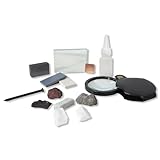
- Complete Mineral Testing Kit: Includes 13 essential tools like a dropper bottle, streak plate, glass plate, nail, copper sheet, retractable hand lens, magnet, and mineral samples (talc, coal, magnetic iron ore, gypsum, hematite, calcite) for hands-on geology experiments.
- Test Hardness & Streak Colors: Use talc, gypsum, and calcite with the glass streak plate to perform Mohs hardness tests. Scratch coal and hematite on the streak plate to reveal distinct
- Magnet & Effervescence Tests: Detect magnetic properties with the included magnet and magnetic iron ore. Conduct acid reaction tests using the dropper bottle and calcite (add vinegar or diluted hydrochloric acid* for fizzy results).
- Portable & Detailed Analysis: Retractable hand lens allows for close-up mineral inspections, while the foldable design and durable materials make this kit ideal for fieldwork, classrooms, or home labs.
- Perfect for Learning: Designed for students, teachers, and rock hounds! Includes rocks, tools, and step-by-step guidance to explore geology principles like luster, cleavage, and mineral reactions.
Assuming a non-layered crystal rock must be igneous
Marble and quartzite show that metamorphic rocks can be crystalline and non-foliated. Recrystallized grains, mineral composition, and the surrounding geology may be needed to separate them from an igneous specimen.
Do these 3 things before closing this tab:
1Repair Windows errors before they cause bigger problems2Fix the driver behind crashes, sound loss and screen glitches3Clear out junk files and repair common Windows errorsRejecting sedimentary rock because no fossil is visible
Fossils are occasional clues, not a required ingredient. Many sedimentary rocks formed without organisms, and fossils can be too small, weathered away, or hidden on another face.
Calling every fine-grained rock volcanic
Rapid cooling can make an igneous rock fine-grained or glassy, but fine material can also be sedimentary mud or a metamorphic rock whose crystals are below the unaided eye’s resolution. Search for fragments, bedding, alignment, and any glassy or vesicular texture before deciding.
Worked observations from familiar examples
A gravel-rich specimen
Suppose a sample contains many rounded, gravel-sized pieces held in a finer matrix. The pieces are visibly separate and do not fit together as a single crystal mosaic. That combination supports conglomerate, a clastic sedimentary rock. If the specimen also shows repeated beds, the sedimentary interpretation becomes stronger.
A sandy or muddy specimen
A surface made of sand-sized grains suggests sandstone; a very fine, fissile or massive mud-rich sample may be mudstone or shale. Check more than the weathered exterior, because a coating can hide the grains. Lack of fossils does not change the particle-based evidence.
Quick wins for a faster PC:
Clear out junk files and repair common Windows errorsFree Scan →Scan for outdated or missing drivers - takes under a minuteDriver Scan →Repair Windows errors before they cause bigger problemsFix Now →A banded specimen
If light and dark minerals form continuous bands and the grains appear aligned, the rock is likely foliated metamorphic material, with gneiss-like banding as one possible example in the NPS teaching scheme. If the bands are instead discrete deposited layers containing separate grains, sedimentary bedding is more likely.
Best Value

- Explore the wonders of the natural world and unlock the mysteries of common minerals with the Toysmith Mineral Science
- Encourage youthful curiosity in geology with this hands-on natural science activity
- Identify 15 different mineral specimens using a magnifying glass and detailed identification guide
- The kit includes 15 mineral specimens, a magnifying viewer and an identification guide
- Recommended for ages 8 and up
A crystalline white or pale specimen without stripes
A uniform crystalline sample without foliation could be igneous, but marble or quartzite are metamorphic alternatives. Examine whether the texture looks like crystals that grew during recrystallization and use mineral composition or local geology when a visual answer remains uncertain.
When a hand lens, guide, or local geology helps
You can make a useful first classification with unaided observation. A hand lens is an optional aid for separating tiny crystals from fine sediment and for seeing whether grains interlock. A labeled rock-and-mineral identification kit can support classroom or home comparison, but no kit is required and no kit guarantees a correct identification.
Use a field guide or museum resource when you need a rock name beyond the three broad classes. Match the specimen to its collection location if known: the rocks exposed nearby, the orientation of layers, and the regional geologic history can resolve cases that appearance alone cannot. Keep the location, observed texture, grain size, and any uncertainty with your notes rather than treating a color match as proof.
How confident should your answer be?
Report a class-level result with the evidence that led to it. For example: “Likely sedimentary because it contains rounded fragments and two visible beds,” or “Likely foliated metamorphic because platy minerals form continuous alignment.” Use “uncertain between igneous and non-foliated metamorphic” when the sample is simply crystalline and unlayered. Fine-grained, weathered, polished, or altered specimens may require mineral identification, a fresh surface, laboratory work, or expert geologic context for a confident name.
The most dependable habit is to let formation-related texture lead the identification: interlocking or volcanic textures for igneous rocks, deposited particles and bedding for sedimentary rocks, and mineral alignment or recrystallization for metamorphic rocks. Treat each clue as part of a combined case rather than a yes-or-no test.
Quick Recap
Product prices and availability are accurate as of the date/time indicated and are subject to change. Any price and availability information displayed on Amazon at the time of purchase will apply.




