You can configure Amazon Bedrock as the model provider for Codex in the ChatGPT desktop app—but this does not route ordinary ChatGPT conversations through Bedrock. The setup is a local Codex configuration: AWS handles inference, credentials, regional access, quotas, and billing. A ChatGPT subscription or OpenAI API key does not authenticate it.
What this setup does—and does not do
OpenAI documents Bedrock support for Codex, available in the ChatGPT desktop app, Codex CLI, and VS Code extension. It does not document a setting that connects the regular ChatGPT Chat or Work experiences to Bedrock. OpenAI says, “The OpenAI-hosted Responses API is not in the request path” when Codex is configured this way (OpenAI: Use Codex with Amazon Bedrock).
As an Amazon Associate I earn from qualifying purchases.
Bedrock’s OpenAI-compatible APIs do not make its behavior identical to OpenAI-hosted Codex. Codex uses its own provider configuration and supported model list; do not try to configure ordinary ChatGPT by pasting a Bedrock base URL into it.
Quick wins for a faster PC:
Clear out junk files and repair common Windows errorsFree Scan →Fix the driver behind crashes, sound loss and screen glitchesFind Drivers →Check prerequisites first
- Client version: OpenAI’s configuration guide specifies Codex CLI 0.128.0 or later, and desktop app or VS Code extension version 26.429.30905 or later. Check the current guide because minimum versions can change (Configure Codex with Amazon Bedrock).
- AWS access: You need an AWS account with access to a supported OpenAI model in Bedrock, in a Region where that model is available.
- Authentication: Choose either a Bedrock API key or credentials resolved through the AWS SDK credential chain.
- Provider mode: This configuration is for Codex using Bedrock credentials—not Codex signed in with ChatGPT or authenticated with an OpenAI API key.
Choose a supported model and AWS Region
OpenAI’s guide lists these Bedrock model IDs: openai.gpt-5.6-sol, openai.gpt-5.6-terra, openai.gpt-5.6-luna, openai.gpt-5.5, and openai.gpt-5.4. The guide recommends openai.gpt-5.6-sol as the default. These IDs and their availability may change; confirm that your AWS account can access the exact model in your chosen Region.
#1 Best Overall

- 【Crystal Clear Audio Quality】Our Omnidirectional pattern condenser microphone accurately captures your voice, making it perfect for dictation, online classrooms, and more.
- 【Active Noise-Cancelling】Come in CMTECK CCS2.0 SMART CHIP with Omnidirectional Polar Pattern, which can effectively block the background noise. The pop filter prevents plosives from overloading the microphone, ensuring only your voice is heard.7
- 【Convenient Mute Button with LED Indicator】You can quickly mute/un-mute the microphone with the Mute Button and the built-in LED light lets you know the working status(Greenlight: Connected; Red light: Mute mode).
- 【Easy to use】 No drivers needed, just plug and record without external power supply, directly connect the microphone to a USB compatible device, well compatible with Windows(7, 8 and 10), Mac OS and PS4 (NOT compatible with Raspberry Pi/Linux/Android)
- 【Mini size with Adjustable Gooseneck】Adopted flexible and adjustable gooseneck metal pipe, easily adjust position 360 degrees to suit user comfort. The compact and stable base maximizes your desktop space.
The example below uses us-west-2. It is not a required Region: replace it with a Region where the model is available to your account.
Configure Codex in config.toml
- Open
~/.codex/config.toml. Create the file if it does not exist. - Add the provider configuration, replacing the example model or Region if needed:
model = "openai.gpt-5.6-sol" model_provider = "amazon-bedrock" [model_providers.amazon-bedrock.aws] region = "us-west-2" wire_api = "responses" # Optional when using AWS SDK authentication: # profile = "codex-bedrock" - Save the file. The
profileline is optional and only applies when using AWS SDK authentication;codex-bedrockis an example profile name.
The required provider setting is amazon-bedrock, the documented wire API is responses, and the Region must match your AWS access and model availability.
Rank #2
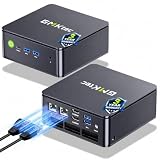
- MINI PC COMPUTER OFFICE BUSINESS PERSONAL - GMKtec Nucbox G11 PLUS Series is equipped with the Ryzen 5 3500U, a 64-bit quad-core mid-range performance x86 mobile microprocessor. This processor is based on AMD's Zen+ microarchitecture and is fabricated on a 12 nm process. The 3500U operates at a base frequency of 2.1 GHz with a TDP of 15 W and a Boost frequency of 3.7 GHz. This APU supports up to 32 GB of dual-channel DDR4-2400 memory and incorporates Radeon Vega 8 Graphics operating at up to 1.2 GHz. 20% Multi-core Performance increase over previous Ryzen 3 models such as 4300U. 35% performance increase over the Intel N-series N95/N97/N150.
- AMD RADEON GRAPHICS 1.2GHz - this powerful mini computer with 480% Faster Integrated Graphics: The built-in AMD Radeon Graphics GPU delivers a staggering 480% higher 3DMark Time Spy performance than the Intel N150's UHD graphics. Powered by dedicated shader cores clocked at 1.2GHz, it dramatically outperforms the N150 for intensive visual tasks and surpasses the 4300U's iGPU by 21% in raw computational throughput. With support for triple independent 4K displays, H.265/HEVC encoding, and modern APIs like DirectX 12 and Vulkan, this GPU turns the R2514 into a true multimedia powerhouse for professional edge computing, industrial HMI, or high-end digital signage station.
- DUAL CHANNEL 16GB RAM MEMORY - The R2514 platform supports dual-channel DDR4 memory (2×8GB; Total 16GB), effectively doubling the data pathway between RAM and the processor compared to a single 16GB stick used in N150 or 4300U systems. With dual-channel, the GPU experiences zero memory bottlenecks, resulting in significantly higher frame rates (up to 30% improvement in gaming scenarios), smoother 4K video playback, and faster application responsiveness—especially in professional workloads like CAD viewing, real-time data visualization, and multitasking across multiple displays.
- DUAL NIC 2.5GBE ETHERNET - The G11 mini PC with dual 2.5GbE ports, you can transform it into a high-speed, all-in-one networking hub. This setup enables it to function as a professional-grade firewall and router (using software like pfSense/OPNsense) for unbeatable network security and ad-blocking, a blazing-fast Network Attached Storage (NAS) server, and a compact server for a home lab running virtual machines and containers (with Proxmox). It can also be used to create a dedicated, isolated network for IoT devices and security cameras or as a compact VPN server for secure remote access.
- UNLEASH RAW PERFORMANCE MODE 35W - Dominate demanding tasks with the AMD Ryzen Embedded R2514 processor. When switched to Performance Mode in the BIOS (press "Esc" key repeatedly during boot, save then exit), this mini PC delivers superior multi-core processing power, significantly outperforming Intel N-series chips in CPU-intensive applications, multitasking, and creative workloads.
Set up one authentication method
Option 1: Bedrock API key
Set AWS_BEARER_TOKEN_BEDROCK to your Bedrock API key in the environment Codex can read. For this authentication path, the Region is required in the Codex configuration.
AWS_BEARER_TOKEN_BEDROCK=<your-bedrock-api-key>Do not substitute OPENAI_API_KEY; it does not authenticate the Bedrock provider.
Rank #3

- 【AMD Ryzen 5 7640HS for AI Productivity】Trycoo Mini PC features the AMD Ryzen 5 7640HS with Zen 4 architecture, 6 cores, 12 threads, up to 5.0GHz, and Radeon 760M graphics. Designed for multitasking, 4K streaming, photo editing, video editing, office work, studying, and AI-assisted tasks with ChatGPT, Gemini, or Claude—including writing, coding assistance, prompt testing, and cloud-based workflows.
- 【Dedicated to Gaming and Content Creation】 Trycoo Gaming Mini PC features an AMD Radeon 760M integrated graphics card with up to 12 compute units and a clock speed of up to 2600MHz, delivering smooth and responsive visuals for gaming and content creation. Adjustable via BIOS, it supports up to 4GB of dedicated video memory, optimizing performance for specific tasks—whether gaming, video editing, or 3D design.
- 【16GB DDR5 RAM & 512GB PCIe SSD】 Equipped with 16GB DDR5 5600MHz dual-channel memory (16GB×1), expandable up to 64GB. Built-in 512GB PCIe 3.0 M.2 2280 NVMe SSD, featuring dual M.2 slots (PCIe 4.0 ×4 and PCIe 3.0 ×4) for expandable high-speed storage up to 8TB. Effortlessly handles large files, games, and creative projects with fast boot times and rapid loading speeds.
- 【Seamless 4K Quad-Screen Display】The small PC supports HDMI 2.0 (up to 4K 60Hz), Type-C (USB4.0), USB3.2 Type-C (supports DP1.2 output), and DP 1.4 (up to 4K 60Hz). Whether you need cross-screen multitasking, connecting a docking station, or enjoying UHD media content, all connections are seamlessly achieved without compromising performance.
- 【Professional Dual Ethernet Ports and Wireless Connectivity】Equipped with a high-speed 2.5 Gigabit Ethernet port for NAS/file transfers (up to 2.5Gbps) and a standard Gigabit port for stable network connections. Combined with WiFi 6 and Bluetooth 5.2 technology, it delivers flexible, stable, and low-latency connectivity for gaming, streaming, and home office use.
Option 2: AWS SDK credential chain
Instead of a Bedrock API key, Codex can use the AWS SDK credential chain. It can resolve standard AWS credentials, AWS SSO, or a named profile. If you use a named profile, set its name in the optional profile field in config.toml. Make sure that identity has permission to invoke the selected Bedrock model.
Make credentials available to the desktop app
A desktop app may not inherit environment variables set only in a shell. If Codex cannot see the variables it needs, put them in ~/.codex/.env; for example, the bearer token and AWS_REGION when required for your setup. Keep credentials private and do not share the file.
Rank #4
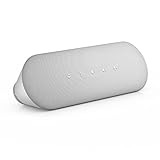
- ELEGANT AESTHETIC: With a compact style and finish, this desk micro soundbar sits easily on a monitor base, or beside a laptop or desktop.Waterproof : No
- LED LIGHTS: MS-Teams app status, call / hang-up, volume up, volume down, and mic mute / unmute are all clearly indicated by LED indicators
- FULL DUPLEX AUDIO: With AI noise cancellation, numerous people can speak at the same time, while still being heard clearly in a business conference
- ENHANCED CONNECTIVITY: With an intuitive set up process, connect the speakerphone to monitors, laptops, or desktops through the USB-A or USB-C port
- MS TEAMS BUTTON: Provides quick access to meetings and notifications -- the perfect multimedia speaker for business conferences and a home office
Restart Codex and verify the configuration
- After editing
config.tomlor.env, restart the desktop app or VS Code extension. - Start a new Codex session.
- If using the CLI, run
/statusto check the active configuration. OpenAI’s guide does not specify an equivalent desktop status command.
Troubleshoot connection and access errors
- Codex does not recognize the provider or model: Confirm the client meets the documented minimum version, that
model_provideris exactlyamazon-bedrock, and that the model ID is spelled exactly as listed in the current guide. - Model access or invocation fails: Check that the model is available to your AWS account in the configured Region, and that the selected identity has permission to invoke it.
- Authentication fails: For API-key authentication, verify that
AWS_BEARER_TOKEN_BEDROCKis valid and visible to the app. For SDK authentication, check the active credentials, SSO session, and profile selection. - Shell works but the desktop app does not: Check whether the desktop process can read the necessary environment variables; add them to
~/.codex/.envif appropriate, then restart the app. - Changes seem to have no effect: Restart the app or extension after editing either local file, then open a new session.
AWS controls Bedrock credentials, model access, quotas, billing, regional availability, and service-side errors. OpenAI support covers Codex client setup and local behavior.
Know which features differ from hosted Codex
With Bedrock configured, AWS processes inference requests rather than OpenAI’s hosted Responses API. OpenAI’s Bedrock overview lists these features as unavailable in this configuration: image generation, voice transcription for input, the cloud plugin store, cloud configuration and policies, and Codex cloud agents, including review, security, and web agents (OpenAI: Use Codex with Amazon Bedrock). Feature availability can also depend on the model, Region, API surface, account setup, and AWS service status.
Bedrock endpoints are not interchangeable
Amazon Bedrock offers different endpoint APIs and capability mixes. AWS recommends the bedrock-runtime endpoint for most new applications and documents support for OpenAI-compatible Responses and Chat Completions APIs; it also describes bedrock-mantle with a different set of capabilities. Model API support varies by endpoint. AWS’s general endpoint guidance does not replace Codex’s specific provider configuration or guarantee identical behavior to OpenAI’s API Platform (AWS: Endpoints supported by Amazon Bedrock; AWS: API compatibility).
Quick Recap
Product prices and availability are accurate as of the date/time indicated and are subject to change. Any price and availability information displayed on Amazon at the time of purchase will apply.




