You can power an ESP32 from a LiPo battery only through a power path designed for the exact board: use a board with documented battery support, or convert the cell’s changing voltage to the board’s specified input. A regulator does not charge or protect a battery, and an ordinary development board may not include either function.
Start with the exact ESP32 board and revision
ESP32 chips do not define a universal battery connector or charging circuit. Those features depend on the development board’s power circuitry. Before connecting a cell, check the board’s guide and schematic for its permitted power input, charging capability, battery protection, and behavior when USB is also connected.
As an Amazon Associate I earn from qualifying purchases.
- If the board documents a battery input and charging path, follow its battery connection and operating instructions.
- If it does not, do not connect a LiPo to a convenient-looking pin. Use a suitable power-management path designed for the board instead.
- If you cannot establish the board’s allowed inputs from its documentation, treat battery compatibility as unconfirmed.
Powering the ESP32-DevKitC V4
Espressif lists three power options for the ESP32-DevKitC V4: Micro USB, 5V/GND, or 3V3/GND. Its guide says to use only one option at a time and warns that combining them can damage the board or supply. See the ESP32-DevKitC V4 guide for the board’s power instructions.
That list does not identify a LiPo connector or authorize wiring a cell directly to 5V or 3V3. A cell’s nominal voltage is not enough to establish compatibility. Verify the exact board revision and schematic, and do not run USB alongside another supply unless the board documentation explicitly permits that arrangement.
#1 Best Overall

- Charging Method: The recommended charging current is 0.6A, the maximum does not exceed 1.5A. The discharge current is recommended 0.6A, and the maximum does not exceed 1.5A
- Overcharge Protection: When charging the battery, when the voltage reaches the highest battery voltage (4.2V), the protection board will automatically power off and shut down, indicating that it will not continue to charge when fully charged, forms overcharge protection
- Over-discharge Protection: When the battery is about to run out and the voltage is as low as 3.0V, the protection board will also be turned off and can no longer be discharged, forming an over-discharge protection effect
- Short Circuit Protection: When an accidental short circuit occurs, the protection board will automatically shut down within a few milliseconds and will not be powered on again. Note that the cell is short-circuited (not through the protection board). The protection board will also fail due to continuous high current, or the components are heated and damaged
- Widely Application: With JST 1.25 plug, these lithium polymer batteries can be used for development board whose plug is SH1.25-2, such as ESP32 LoRa V3, ESP32 LoRa V4, Wireless Tracker, Mesh Node T114, Mesh Node T096 and electronic devices
Choose a safe power path for a custom build
A one-cell LiPo’s voltage changes as it discharges, while the ESP32 circuit needs a suitable, stable supply. For a custom circuit, select a regulator or power-management module whose input range covers the cell’s operating voltage and whose output matches the board or circuit’s specified supply.
Espressif’s ESP32 schematic checklist recommends 3.3 V for a single supply, with output current no less than 500 mA. Treat that as a design recommendation, not proof that every board and peripheral combination needs exactly that amount: size the supply for the actual board, radio activity, and attached loads. Check the regulator’s transient behavior and current capability as well as its headline rating.
Rank #2

- Battery Specifications:Dimensions: 36*10*65mm/ 1.42*0.39*2.56inch;Battery Weight(Single): 49g; Capacity: 3000mAh; Plug: JST1.25; Discharge Rate: 1C. Make Sure Device Polarity Matches with Battery Pack Connector Before Purchase.1.Battery Size; 2.Connector Model;3.Connector Size; 4.Connector Polarity - THIS IS NOT UNIVERSAL!!! (It will cause a shortage if the polarity of the battery connector does not match your device.)
- Reliable Performance: Our 3.7 volt rechargeable lithium polymer battery provides reliable performance with long life. It is no fire, no explosion or no leakage after vibration and collision.Each lipo battery comes equipped with a built-in protection board that prevents overcharging, over-discharging, overcurrent, overheating, and short circuits. Enjoy peace of mind while using our lithium polymer battery, knowing that it is designed with advanced safety features.
- Application:Our batteries are perfect for ESP3 projects or a small Internet of Things (IoT) project. Also suitable for battery replacement of DIY 3.7V electronic products, mobile energy storage, power supply, LED light, wireless Bluetooth game headset, Bluetooth speaker, outdoor video and audio electronic scale, GPS Watch recorder, USB Fan tester, dash cam controller, gaming controller, electric toy car, mouse and keyboard, Wi-Fi smart home system, digital camera, e-book, and so on.
- Storage & Usage:When storing lithium polymer batteries for a long time, please keep the battery in a state of 40%-60%. We recommend to charge the battery every 3 months receipt of the battery and maintain the voltage 3.7-4.0V. Store battery in cool and dry place.
- Easy Installation with Micro JST1.25 Connector: The 3000mAh lithium polymer battery feature a Micro JST1.25 connector and a wire of about 70mm, making installation simple and convenient. Upgrade your devices effortlessly with our user-friendly design, ensuring a secure connection for maximum performance.(NOTE!!! The maximum operating current of this battery is only about 1.5A, Can Not be used for unmanned vehicles, model aircraft or other products that require high current)
When comparing a 3.3 V regulator module or LiPo-to-3.3 V power module, verify its input-voltage range, output voltage and current, wiring requirements, and compatibility with the board’s existing regulator and power path. The module must supply power appropriately; it does not, by itself, charge the cell.
What’s actually slowing this PC down?
Pick the symptom - the matching free tool is one click away.
Charging and battery protection are separate requirements
Use a charger and any required protection circuitry specified for the exact cell. Charge voltage, charge current, cutoff behavior, and protection requirements depend on the cell and charging hardware; there is no universal setting established here for an unspecified LiPo. Follow the cell manufacturer’s documentation and the charger’s instructions rather than inferring a safe charging circuit from the battery’s nominal voltage.
Rank #3

- Battery Specifications:Dimensions: 36*10*65mm/ 1.42*0.39*2.56inch;Battery Weight(Single): 49g; Capacity: 3000mAh; Plug: JST1.25; Discharge Rate: 1C. Make Sure Device Polarity Matches with Battery Pack Connector Before Purchase.1.Battery Size; 2.Connector Model;3.Connector Size; 4.Connector Polarity - THIS IS NOT UNIVERSAL!!! (It will cause a shortage if the polarity of the battery connector does not match your device.)
- Reliable Performance: Our 3.7 volt rechargeable lithium polymer battery provides reliable performance with long life. It is no fire, no explosion or no leakage after vibration and collision.Each lipo battery comes equipped with a built-in protection board that prevents overcharging, over-discharging, overcurrent, overheating, and short circuits. Enjoy peace of mind while using our lithium polymer battery, knowing that it is designed with advanced safety features.
- Application:Our batteries are perfect for ESP32 projects or a small Internet of Things (IoT) project. Also suitable for battery replacement of DIY 3.7V electronic products, mobile energy storage, power supply, LED light, wireless Bluetooth game headset, Bluetooth speaker, outdoor video and audio electronic scale, GPS Watch recorder, USB Fan tester, dash cam controller, gaming controller, electric toy car, mouse and keyboard, Wi-Fi smart home system, digital camera, e-book, and so on.
- Storage & Usage:When storing lithium polymer batteries for a long time, please keep the battery in a state of 40%-60%. We recommend to charge the battery every 3 months receipt of the battery and maintain the voltage 3.7-4.0V. Store battery in cool and dry place. Please contact us if you have any questions or concerns with the product via Amazon message. Storage & Usage:When storing lithium polymer batteries for a long time, please keep the battery in a state of 40%-60%. We recommend to charge the battery every 3 months receipt of the battery and maintain the voltage 3.7-4.0V. Store battery in cool and dry place.
- Easy Installation with Micro JST1.25 Connector: The 3000mAh lithium polymer battery feature a Micro JST1.25 connector and a wire of about 70mm, making installation simple and convenient. Upgrade your devices effortlessly with our user-friendly design, ensuring a secure connection for maximum performance.(NOTE!!! The maximum operating current of this battery is only about 1.5A, Can Not be used for unmanned vehicles, model aircraft or other products that require high current)
Also decide whether the device must operate while charging. That requires a documented power-path arrangement that handles USB input, battery charging, and the system load together. Do not assume a generic charger board or an ESP32 development board supports this behavior; confirm it in the relevant documentation.
Battery-capable Espressif boards illustrate why schematics matter
Espressif’s ESP32-S2-HMI-DevKit-1 guide describes an uncontrolled 3.3 V domain supplied by 5 V from USB when USB is connected, or by 3.6–4.2 V from the lithium battery when USB is disconnected. It also documents a separate 5 V domain.
Rank #4
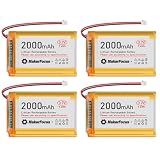
- Safety and Reliability: Our product utilizes a cutting-edge, A-grade lithium battery system. Compared to others, it offers superior capacity and density, along with more stable discharge performance and an extended lifespan. Additionally, it meets the stringent UN 38.3 safety standards, ensuring both safety and reliability
- Protection Mechanisms: When the charging voltage reaches the highest battery voltage (4.2V), the protection board will automatically power off, it will not continue to charge; when the voltage drops below 3.0V, the protection board will also turned off to prevent deep discharge of the battery. Overcharge and overdischarge can lead to the loss of cell performance and battery function
- Prohibit Reverse Charging: Connect the positive and negative poles of the battery correctly and strictly prohibit reverse charging. If the positive and negative terminals of the battery are reversed, the battery cell cannot be charged. At the same time, reverse charging will reduce the charging and discharging performance and safety of the battery cell, and may cause heating and leakage
- Storage: When not in use for a long time, please keep the battery voltage between 3.7V-3.9V and the storage temperature must be within the range of -20°C~45°C. The capacity for a long time storage shall be 40%~80%. We recommend charging the battery every 3 months after receiving it and storing it in a cool and dry place
- Widely Application: With JST 1.25 plug, these 2000mAh LiPo battery can be used for ESP32 development board whose plug is SH1.25-2, Mesh Node T114 and other low-power IoT/DIY electronics requiring compact power solutions
The ESP32-S3-USB-OTG guide describes a 3.7–4.2 V single-cell battery and a boost circuit for 5 V functions. These are specific board designs, not instructions to apply those voltages to a different ESP32 board.
Do these 3 things before closing this tab:
1Scan for outdated or missing drivers - takes under a minute2Clear out junk files and repair common Windows errors3Fix the driver behind crashes, sound loss and screen glitchesPower-entry details for custom hardware
For a custom PCB, Espressif’s schematic checklist suggests an ESD protection diode and at least a 10 μF capacitor at the main power entrance, where the external supply enters the PCB. This is a power-entry design recommendation, not a substitute for a suitable regulator, charger, or battery-protection circuit.
Quick Recap
Best Value

- Battery Specifications:Dimensions: 25*10*42mm/ 0.98*0.39*1.65inch;Battery Weight(Single): 19g; Capacity: 1100mAh; Plug: JST1.25; Discharge Rate: 1C. Make Sure Device Polarity Matches with Battery Pack Connector Before Purchase.1.Battery Size; 2.Connector Model;3.Connector Size; 4.Connector Polarity - THIS IS NOT UNIVERSAL!!! (It will cause a shortage if the polarity of the battery connector does not match your device.)
- Reliable Performance: Our 3.7 volt rechargeable lithium polymer battery provides reliable performance with long life. It is no fire, no explosion or no leakage after vibration and collision.Each lipo battery comes equipped with a built-in protection board that prevents overcharging, over-discharging, overcurrent, overheating, and short circuits. Enjoy peace of mind while using our lithium polymer battery, knowing that it is designed with advanced safety features.
- Application:Our batteries are perfect for ESP3 projects or a small Internet of Things (IoT) project. Also suitable for battery replacement of DIY 3.7V electronic products, mobile energy storage, power supply, LED light, wireless Bluetooth game headset, Bluetooth speaker, outdoor video and audio electronic scale, GPS Watch recorder, USB Fan tester, dash cam controller, gaming controller, electric toy car, mouse and keyboard, Wi-Fi smart home system, digital camera, e-book, and so on.
- Storage & Usage:When storing lithium polymer batteries for a long time, please keep the battery in a state of 40%-60%. We recommend to charge the battery every 3 months receipt of the battery and maintain the voltage 3.7-4.0V. Store battery in cool and dry place.
- Easy Installation with Micro PH2.0 Connector: The 1000mAh lithium polymer battery feature a Micro PH2.0 connector and a wire of about 70mm, making installation simple and convenient. Upgrade your devices effortlessly with our user-friendly design, ensuring a secure connection for maximum performance.(NOTE!!! The maximum operating current of this battery is only about 1.5A, Can Not be used for unmanned vehicles, model aircraft or other products that require high current)
Pre-power checklist
- Identify the exact board model and revision, then confirm its permitted supply input in the official guide or schematic.
- Confirm whether battery charging and protection are built in, and whether the board supports operating while charging.
- Choose a regulator or power-management path that matches the cell’s input range and the board’s required supply voltage and current.
- Check USB and battery power-path behavior; keep incompatible supply inputs separate.
- Use cell-specific charge limits and protection requirements from the cell and charger documentation.
Product prices and availability are accurate as of the date/time indicated and are subject to change. Any price and availability information displayed on Amazon at the time of purchase will apply.




