The Tool Desk
Outbyte Driver Updater FREEScan for outdated or missing drivers - takes under a minuteDriver Scan →Outbyte PC Repair FREERepair Windows errors before they cause bigger problemsFix Now →The sound solution to nanoparticle handling problems is to assess the specific material and task, then prevent release at the source. Keep free-particle material contained; use an appropriate enclosure or local exhaust for work that could disperse it; and plan cleanup, hygiene, and task-specific personal protective equipment (PPE). There is no single control or respirator that fits every nanomaterial or process.
Why “nanoparticle” is not enough to choose a control
Nanomaterials differ in physical and chemical properties that can affect their hazards. OSHA says the potential health effects of engineered nanomaterials are not yet fully understood, and that toxicity depends on material-specific properties. Its nanotechnology health-effects page recommends consulting trusted, current sources as knowledge develops: OSHA: Nanotechnology — Health Effects.
As an Amazon Associate I earn from qualifying purchases.
NIOSH defines engineered nanomaterials on its publication page as materials with at least one primary dimension less than 100 nanometers. That definition is useful for identifying scope, but size alone does not determine how a material behaves or what controls a task needs: NIOSH: Current Strategies for Engineering Controls in Nanomaterial Production and Downstream Handling Processes.
What’s actually slowing this PC down?
Pick the symptom - the matching free tool is one click away.
Consider, where relevant, particle size and distribution, agglomeration, shape, crystal structure, surface area and chemistry, surface charge, and porosity. Then connect those properties to the actual work: the material form, amount, process, duration, frequency, and plausible exposure routes.
#1 Best Overall

- Our Premium Respirator Kit offers unparalleled protection for your face and eyes in a wide range of hazardous environments. This complete suit includes a half face shield, safety glasses, and an ample supply of replaceable filters, making it the ideal choice for professionals and DIY enthusiasts alike.
- The half face shield and safety glasses provide a secure barrier against harmful substances, including gases, paints, fumes, and more.
- Superior Filtration: Equipped with a dual filtration system, the respirator effectively blocks 97% of airborne particles.
- Versatility: Ideal for a variety of applications, including gas, painting, machine polishing, organic vapors, staining, car spraying, sanding, cutting, and general DIY work.
- Complete Kit: Includes one half face shield, one safety glasses, ten cotton filters, two filter cartridges, and two filter covers for comprehensive protection.
Map where exposure could occur
Trace the material through receiving, storage, transfer, weighing, mixing, processing, equipment cleaning, waste handling, and spill response. Look for steps that can release dust, droplets, or other airborne material, as well as opportunities for contaminated surfaces or hands to spread it. OSHA’s worker guidance recommends identifying tasks, physical state, routes, sampling methods, exposure amount and duration, and whether additional controls are needed: OSHA: Working Safely with Nanomaterials.
Identify whether the material is a powder or dust, spray, droplets, slurry, suspension, or solution. Consider inhalation, skin contact, ingestion, and relevant eye or mucous-membrane contact. Dry material that readily disperses deserves particular care because inhalation is a concern; material embedded in a solid matrix or suspended in liquid presents different exposure considerations. Different forms do not mean no risk: assess the specific operation and whether it can create airborne material or contaminate surfaces.
Rank #2
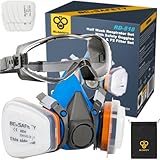
- Dual Protection for Vapor, Dust & Eye Safety : BEESAFETY RD-518 respirator mask kit combines a half face respirator with safety goggles, designed to help reduce exposure to organic vapors, paint fumes and airborne particles such as dust and sanding debris. Provides both respiratory and eye protection, making it ideal for painting, sanding, resin work and construction environments
- Reusable System with Replaceable Filters : Includes 2 A1 organic vapor filter cartridges and 8 P2 replacement filters, allowing continued use as a reusable respirator mask. Replace filters when breathing becomes difficult or when odors are detected. Designed for environments where both dust particles and organic vapors may be present
- A1 Vapor & P2 Particle Filtration System : Equipped with A1 organic vapor filters to help reduce exposure to paint fumes, solvent vapors and VOC gases, and P2 filters to help capture at least 95% of airborne particles such as dust, wood particles and fine debris. Suitable as a paint respirator mask, sanding respirator and respirator for resin and chemical fumes
- Integrated Goggles for Full Work Protection : Includes protective safety goggles designed to shield eyes from dust, splashes and particles during work. The respirator and goggles combination offers a practical solution for environments where both respiratory and eye protection are needed, such as spray painting, grinding, woodworking and cleaning tasks
- Comfortable & Secure Fit for Long Use : The half face respirator design provides improved airflow and reduced breathing resistance, while adjustable head straps help ensure a stable and comfortable fit. Lightweight construction and soft sealing materials make it suitable for extended use in workshops, construction sites and DIY projects
Review existing controls under normal work and foreseeable disturbances, such as transfer, equipment opening, or cleanup. Use appropriate exposure assessment and sampling methods where needed; do not assume that a control is effective simply because it is installed.
Recommended Free Tools
Choose controls by how they interrupt exposure
| Control | How it helps | Best fit and limits |
|---|---|---|
| Closed containers and process enclosure | Prevents or limits material dispersal before it reaches the work area. | Use sealed containers where possible and enclosed processes for free-particle handling or tasks that can generate nanoparticles. OSHA recommends avoiding open-air handling of free-particle nanomaterials and using an enclosure at negative pressure relative to the workers’ breathing zone for work that could generate engineered nanoparticles. [c001] |
| Ventilated enclosure | Contains and captures material near the task. | OSHA identifies glove boxes, laboratory hoods, and process chambers fitted with HEPA filters as possible engineering controls. The choice depends on the operation and facility; a hood is not automatically suitable for every task. [c004] |
| Local exhaust ventilation | Captures material at the point of release before it spreads. | Consider when full enclosure is impracticable. The exhaust must be designed and positioned to capture the release effectively. [c004] |
| Hygiene and planned cleanup | Reduces secondary spread from surfaces, equipment, and contaminated work practices. | Use defined housekeeping, spill-response, and decontamination procedures alongside source controls. Avoid dry sweeping and compressed air for contaminated dust; OSHA describes wet wiping or HEPA-filtered vacuuming instead. [c004] |
| PPE, including respirators when required | Provides supplementary protection against residual exposure. | Select PPE through a hazard evaluation. Respirators do not replace enclosure or effective local exhaust, and respirator selection and use must follow the exposure assessment and applicable respiratory-protection requirements. [c004] |
OSHA’s recommendations for laboratory work include avoiding open-air handling of free-particle nanomaterials, using tightly sealed containers where possible, and performing work that could generate engineered nanoparticles in an enclosure operating at negative pressure relative to the workers’ breathing zone. These are control principles to apply to the task and facility, not a substitute for assessing whether a specific setup is suitable.
Rank #3

- MAXIMUM PROTECTION & COMFORT - Advanced industrial-grade mask designed to offer maximum breathability and protection.
- COMPLETE COVERAGE - Protects the user from gasses, vapors, solids, and liquid particulates, making it ideal for a wide range of industrial and hazardous applications.
- UNIVERSAL COMPATIBILITY - Compatible with any 40mm NATO standard filter for interchangeability, making it easy to find replacement filters.
- CLEAR VISION - Panoramic Class 1 (EN 166) visor with scratch-resistant finish offers a wide and clear field of view.
- PERFECT FIT - Highly adaptable design that contours to fit various face shapes comfortably, featuring a 5-point adjustable head harness for maximum breathability and comfort.
NIOSH’s laboratory guidance is intended to be used alongside established laboratory practices and the laboratory chemical hygiene plan: NIOSH: General Safe Practices for Working with Engineered Nanomaterials in Research Laboratories. OSHA’s laboratory chemical-hygiene recommendations are available in its appendix: OSHA: Non-Mandatory Recommendations for Chemical Hygiene in Laboratories.
Plan housekeeping, spills, and PPE before work begins
- Set hygiene and decontamination practices: Define how workers will prevent transfer from the work area, equipment, and clothing, and how surfaces will be cleaned.
- Choose a cleanup method for the material and form: For contaminated dust, OSHA describes wet wiping or HEPA-filtered vacuuming rather than dry sweeping or compressed air. Establish a spill procedure and suitable waste handling before an incident.
- Evaluate residual exposure: Select gloves, eye protection, protective clothing, and respiratory protection as appropriate to the hazard evaluation and task. Do not treat a particulate-filter class as a complete respirator recommendation.
- Check the control in operation: Confirm that containment or capture is appropriate for the task, and reassess if the material, process, amount, or work conditions change.
OSHA lists N100, R100, and P100 as NIOSH particulate filter classes. A P100 filter may be relevant as part of an appropriately selected respirator, but the filter class alone does not establish respirator suitability, fit, or required use. Those decisions depend on the exposure assessment and respiratory-protection requirements.
Rank #4

- REUSABLE RESPIRATOR MASK WITH FILTERS: A half face respirator built for repeat use, not a throwaway paper mask. Pop in a fresh filter, rinse the silicone face piece, and it is ready for tomorrow. Ships with 10 replacement filters so one purchase covers months of projects.
- PAINT RESPIRATOR FOR SPRAY AND BRUSH WORK: Built for spray painting, airbrushing, staining, and finishing. The soft silicone seal sits snug against your face so paint mist and aerosol particles stay out of your nose and mouth while you work.
- DUST MASK FOR WOODWORKING AND SANDING: Sawdust, drywall dust, insulation, concrete grinding, and shop cleanup. The filter traps airborne dust and particles so you can finish the job without breathing in a lungful of debris.
- CLEAR SAFETY GLASSES INCLUDED: Most masks leave your eyes exposed. This set includes reusable clear safety goggles sized to sit with the mask, so overspray and flying particles stay off your eyes. One bundle instead of two separate purchases.
- ONE MASK FOR EVERY MESSY JOB: Resin and epoxy pouring, soldering, garden and pesticide spraying, welding prep, and cleaning with strong smelling products. Adjustable headband and lightweight silicone keep it comfortable. One size fits most adults.
Use exposure limits narrowly, not as a universal “nano” threshold
OSHA’s April 2013 worker fact sheet reports NIOSH Recommended Exposure Limits of 1.0 microgram per cubic meter as an 8-hour time-weighted average for respirable carbon nanotubes and carbon nanofibers, and 0.3 milligrams per cubic meter for nanoscale titanium dioxide compared with 2.4 milligrams per cubic meter for fine-sized titanium dioxide. These figures apply to the named materials and distinctions; they are not a universal exposure limit for nanoparticles. Consult the current guidance and applicable requirements for the material and jurisdiction.
PC Slower Than It Used to Be?
A free scan shows the junk files, broken settings and background clutter dragging Windows down - then fixes them in one click.Free scan · Windows 10 & 11Crashes, No Sound, or Screen Glitches?
Random freezes, missing sound and display glitches usually trace back to one bad driver. Find and replace yours safely.Free scan · under a minuteApply the guidance to your jurisdiction and facility
The cited OSHA and NIOSH material is U.S.-focused, and much of the guidance dates from 2012–2013. It should not be mistaken for a newly issued standard or a universal requirement. Requirements elsewhere may differ, and the appropriate controls depend on the material, task, quantity, facility, and applicable jurisdiction. Use current trusted guidance, the facility’s chemical hygiene plan, and qualified occupational-safety expertise when evaluating a specific operation.
Quick Recap
Best Value

- CE CERTIFIED COMPLETE RESPIRATOR KIT : The BREATHOO AirGuard half face respirator mask and anti-fog safety goggles are CE certified and designed for reliable performance. This complete kit includes a respirator mask, safety goggles, 2 filter boxes, 10 filter cotton pads, and filter covers, providing everything needed in one convenient package.
- DUAL FILTER SYSTEM : Designed with a dual filter structure to support comfortable airflow during extended use. The reusable design allows filter components to be replaced when needed, helping maintain performance while reducing waste. COMFORTABLE &
- ADJUSTABLE FIT : Features adjustable head straps and a lightweight design for a secure fit on different face shapes. The soft sealing surface and balanced construction help improve comfort during longer work sessions.
- ANTI-FOG SAFETY GOGGLES INCLUDED : Comes with protective safety goggles designed to provide clear visibility while helping shield the eyes from flying particles, debris, and dust. The anti-fog design helps maintain visibility while working.
- IDEAL FOR WORKSHOP & DIY PROJECTS : Suitable for woodworking, sanding, spray painting, grinding, renovation, construction, maintenance work, and general DIY projects. Designed for hobbyists, home users, and workshop environments.
Product prices and availability are accurate as of the date/time indicated and are subject to change. Any price and availability information displayed on Amazon at the time of purchase will apply.




