Compare screenshot APIs with matched page states, controlled capture settings, and separate browser/platform baselines. Score capture success, completeness, geometry and format, visual differences, and repeatability as distinct results; a single pixel-difference score cannot tell you whether a mismatch is a rendering defect or a failed capture.
What a fair comparison can—and cannot—establish
A reproducible test can show how services behave for your pages, browsers, and chosen settings. It cannot establish a universal best API from one sample page or a pixel score alone. The reviewed documentation explains comparison mechanics and service categories, but does not provide a controlled cross-provider benchmark.


As an Amazon Associate I earn from qualifying purchases.
Browser screenshots vary with the operating system, browser version, settings, hardware, power state, and headless mode. Playwright advises: “For consistent screenshots, run tests in the same environment where the baseline screenshots were generated.” Its visual-comparison guidance also keeps browser and platform identity in snapshot names because rendering, fonts, and other details can differ. Playwright: Visual comparisons
Quick wins for a faster PC:
Repair Windows errors before they cause bigger problemsFix Now →Fix the driver behind crashes, sound loss and screen glitchesFind Drivers →Clear out junk files and repair common Windows errorsFree Scan →There is no suitable named statistic for comparative screenshot API output quality in the reviewed material. Do not treat a vendor feature list or category guide as independent evidence that a provider renders more accurately.
#1 Best Overall
Build a test matrix that reflects your workload
Choose pages and states that represent what you actually capture, rather than relying on a single static landing page. Include the cases that matter to your product:
- Typography and font loading.
- Images and other important assets.
- Responsive layouts at relevant viewport or device settings.
- Dynamic content and a defined application state.
- Long pages, if full-page capture is part of the workload.
List each browser, operating system, viewport, and device setting explicitly. Keep browser/platform combinations distinct when comparing outputs to references; a baseline from one environment is not automatically an appropriate reference for another.
Match capture conditions and define readiness
For every service, request the same URL and page data or state. Where the API allows it, match viewport size, device scale factor, locale, time zone, capture extent, and output format. Use equivalent readiness rules: wait for the same meaningful selector or application state, then ensure fonts and important assets have loaded.
Rank #2
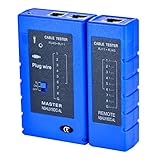
- 100% new network tester, with LED lights and micro-power supply interface.
- Keep your network running smoothly by testing your cables to uncover problematic shorts, open wires, crossing pairs and other wiring mishaps.
- Use for testing your homemade Ethernet patch cables to make sure they are in working order prior to connecting to your devices.Tests RJ45 cables, RJ11 telephone cables and network cables.
- Easy to read LED display indicates problems.Hand-held for portability.
- Requires one 9-volt battery (not included).Battery is advised to change if any weak light appears.Or through the micro-port power work.
Capture APIs can offer different controls, including format, clipping, full-page or element screenshots, and returning image bytes for downstream processing. Playwright documents full-page and element capture as well as returning screenshot bytes. Playwright: Screenshots
Do not silently treat unlike setups as equivalent. If one service cannot match a setting or wait condition, record the limitation and interpret the result accordingly. Wait strategies are one of the operational differences discussed in the vendor-authored RenderScreenshot comparison guide (February 10, 2026); its service descriptions are not a measured quality benchmark.
Stabilize captures and preserve the evidence
- Control volatile content. Disable or neutralize animation and hide or stabilize content that changes between runs when it is not part of the test. Keep such changes documented so they do not conceal a genuine defect.
- Repeat each capture. Run the same request multiple times to reveal nondeterminism, such as late assets or variable page state.
- Retain original files. Keep the raw images rather than only a diff or report, so unexpected results can be inspected later.
- Record the run. Save the service and request configuration, timestamp, browser and platform identity where available, dimensions, format, and any errors or timeouts.
Playwright’s screenshot assertion waits for two consecutive screenshots to match before comparing them and provides controls for disabling animations and setting comparison thresholds. These mechanisms help stabilize a test; they do not prove that two different services used identical capture conditions. Playwright: PageAssertions
Rank #3
Measure five dimensions separately
Capture success
Record whether the requested page and state loaded and whether the service returned an image rather than an error or timeout. Treat a failed load as a capture failure, not as a low-fidelity rendering.
What’s actually slowing this PC down?
Pick the symptom - the matching free tool is one click away.
Completeness
Check whether expected regions are present. Note clipping, missing assets, and unexpected blank areas. For full-page captures, confirm that the output covers the intended page extent; for element captures, verify that the target region is the one requested.
Geometry and format
Compare the returned pixel dimensions, viewport behavior, full-page extent, and file format against the request. A visually plausible image can still be wrong if it is cropped, sized incorrectly, or returned in an unexpected format.
Visual differences
Compare matched captures with one another, or compare each capture to a reference made in the same browser/platform environment. State the diff method and any pixel threshold, and include visual examples. A pixel difference proves that pixels changed; by itself, it does not prove a reader-visible defect. Inspect differences in context.
Repeatability
Compare repeated captures under the same settings. Report whether the output remains stable, and keep instability distinct from systematic browser-specific rendering differences.
Keep image quality separate from operational fit
Evaluate output quality and service fit on separate axes. Self-hosted browser automation, hosted browser infrastructure, and dedicated screenshot APIs involve different trade-offs; category descriptions do not show which produces better images.
Best Value
| Approach | Operational trade-off described in the vendor guide | What it does not establish |
|---|---|---|
| Self-hosted Puppeteer or Playwright | More control, with browser infrastructure to manage. | That self-hosting produces more accurate output than a service. |
| Hosted browser infrastructure | Less infrastructure work while retaining capture logic. | That hosted browsers match a particular local baseline without testing. |
| Dedicated screenshot API | Simplifies capture through HTTP calls. | That a provider renders better than another API. |
The service descriptions above are from a vendor-authored guide, not an independent benchmark. For operational fit, separately record browser coverage and control, readiness options, deployment and maintenance work, concurrency or batch needs, and downstream image delivery requirements. The guide discusses setup complexity, wait strategies, batch processing, caching, device emulation, and SDK availability as service differentiators; verify current provider claims directly.
Independent reader supportYour contribution helps us test, update, and keep practical guides available for everyone.Or skip the browser setup
For an API-based capture option, ScreenshotNeo takes a URL in one GET request and returns an image or PDF. Its available format, capture, and wait controls can be reviewed in the ScreenshotNeo API documentation. This is a service option, not evidence that its output is more accurate than another provider’s.
curl -G "https://api.screenshotneo.com/v1/shot" -d access_key=YOUR_API_KEY --data-urlencode url=https://stripe.com -o shot.webpCookie banners, popups, and chat widgets are removed before capture; bot checks, blank pages, and failed loads are not billed. An MCP server lets AI agents take screenshots. The free plan includes 1,000 screenshots a month with no card; paid plans start at $5 for 3,000. ScreenshotNeo is worth considering when you want those cleanup and billing behaviors without running browser infrastructure. Sign up for 1,000 free screenshots a month, with no card.
The Tool Desk
Outbyte PC Repair FREERepair Windows errors before they cause bigger problemsFix Now →Outbyte Driver Updater FREEScan for outdated or missing drivers - takes under a minuteDriver Scan →Troubleshoot misleading comparison results
- Large differences across every service: Check whether page content or state changed, whether the capture ran before fonts or assets were ready, and whether the environment differs from the baseline.
- Differences limited to one browser or platform: Compare against a baseline for that browser/platform rather than assuming the service failed. Rendering and fonts can vary across configurations.
- Blank or incomplete output: Determine whether the page state loaded and whether the capture extent or target element was correct. Record load failures separately from image comparisons.
- Unstable diffs across repeats: Inspect animations and other volatile page content, then apply consistent stabilization and readiness rules before measuring differences.
- Unexpected dimensions or format: Check the requested viewport, clipping or full-page setting, element target, and output-format configuration against the returned file.
- One API cannot match a setting: Document that difference and avoid presenting the run as a strictly matched comparison.
A reproducible report template
For each result, publish enough detail for another developer to repeat it: page and state, service and relevant request settings, browser/platform identity, viewport and device scale factor, locale and time zone, readiness rule, capture extent and format, timestamp, repeated-run count, dimensions, error or timeout details, diff method and threshold, and visual examples. Report the five quality dimensions separately, then summarize operational fit in its own section.
Frequently Asked Questions
Does a lower pixel-diff score mean an API is better?
No. It indicates fewer changed pixels under the chosen comparison method, not necessarily a more useful or correct capture. Inspect the differing regions and verify page state and completeness.
Should I compare screenshots from different browsers to the same baseline?
Generally, keep baselines specific to browser and platform. Rendering and fonts can differ between configurations, so label the environment with each reference.
Quick Recap
Product prices and availability are accurate as of the date/time indicated and are subject to change. Any price and availability information displayed on Amazon at the time of purchase will apply.
Do these 3 things before closing this tab:
1Fix the driver behind crashes, sound loss and screen glitches2Clear out junk files and repair common Windows errors3Scan for outdated or missing drivers - takes under a minute



