Do these 3 things before closing this tab:
1Clear out junk files and repair common Windows errors2Scan for outdated or missing drivers - takes under a minute3Repair Windows errors before they cause bigger problemsTo assess whether a local grid can serve a data center, compare the facility’s expected peak demand in megawatts (MW) with a capacity assessment for the utility and grid infrastructure that would supply it. Compare annual energy use in megawatt-hours (MWh) or terawatt-hours (TWh) separately: energy measures electricity used over time, while MW measures power at a moment or peak interval. A national electricity-use share cannot establish whether a particular site can be connected.
Start with the location and the grid connection
Identify the data center’s point of interconnection and the infrastructure behind it: the serving utility, relevant distribution feeder or substation, transmission provider or planning area, and regional grid operator where applicable. Distribution and transmission constraints are different, and power available elsewhere is not necessarily deliverable to the site.
As an Amazon Associate I earn from qualifying purchases.
This local detail matters even when regional or national supply appears ample. The International Energy Agency (IEA) says local impacts can be more pronounced than global totals suggest and identifies siting where grid capacity is available as one way to mitigate them. IEA, Energy and AI — Executive summary (2025).
The Tool Desk
Outbyte Driver Updater FREEScan for outdated or missing drivers - takes under a minuteDriver Scan →Outbyte PC Repair FREEClear out junk files and repair common Windows errorsFree Scan →Choose the right demand figure
For a capacity comparison, use the data center’s requested or expected maximum coincident demand at the point of interconnection, expressed in MW. “Coincident” means the facility’s demand during the relevant system peak, rather than its separate maximum at some other time. Record the forecast year and whether the figure includes cooling and other facility loads.
#1 Best Overall

- Bulk Purchasing for IT Departments: Multi-pack quantities designed for enterprise procurement, data centers, and system integrators. Reduce per-unit costs while maintaining standardized power cabling across workstations, server racks, and office deployments. Simplifies purchase orders and reduces vendor management overhead.
- Heavy-Duty Universal Compatibility: Features IEC 60320 C13 female to NEMA 5-15P plug connection with durable 18AWG wire construction. Compatible with desktops, monitors, printers, scanners, servers, projectors, powered speakers, HDTVs, and enterprise hardware. Reduces downtime with one standard cable across multiple devices.
- UL Listed for Professional Environments: Engineered to meet commercial safety standards with UL approval, 10A/300V rating, and grounded 3-prong design. Withstands continuous use in mission-critical environments including offices, data centers, schools, and government facilities. Built for long-lasting performance in demanding applications.
- Versatile Replacement & Expansion Solution: Perfect for replacing worn cables or extending reach in server rooms, office workstations, and classroom technology setups. Flexible yet durable build makes it easy to manage in tight spaces such as racks and office setups while maintaining reliable power delivery.
- Enterprise Procurement Ready: Available in standardized multi-pack bulk quantities ideal for schools, businesses, and government offices standardizing power cables across devices. Compatible with enterprise asset management systems and meets typical procurement specifications for professional power cabling solutions.
Label the project’s status as well as its size: proposed, requested, approved, under construction, energized, or forecast. These are not interchangeable measures of existing load. Forecasts depend on which planned facilities proceed and when. FERC notes that project size and timing matter to planning, and that regional forecasts may use coincident or non-coincident peak conventions; check which convention the local assessment uses. FERC, 2025 State of the Markets (published 2026).
Compare like with like
- Power versus energy: Compare peak demand in MW with a relevant grid power or capacity assessment. Annual consumption in MWh or TWh describes energy over a period and does not answer whether the grid can supply a peak load.
- Same boundary and time horizon: Match the demand estimate and grid assessment to the same site, grid layer, forecast year, and peak definition.
- Deliverable capacity, not just a nameplate total: Installed or stated capacity does not by itself show what can be delivered at the site under network and reliability conditions.
- Keep project status visible: Do not add proposed or requested load to energized demand without identifying it as forecast or pipeline demand.
A simple ratio of facility peak demand to a clearly defined local capacity figure can help convey scale, but it is only a screen. It does not show that service is available or prove that the network can meet reliability requirements. That conclusion requires a utility impact assessment or interconnection study.
Rank #2

- COMPLETE 2-PIECE POWER SUPPLY KIT - Includes 1x 14V 4A 56W power adapter and 1x AC wall power cord. No extra power cable required. Ready to connect and use with supported 14V Samsung display models.
- BUILT FOR SAFE DAILY USE - Over-voltage, over-current, overheating, and short-circuit protection for stable 14V output.
- COMPATIBLE SAMSUNG 14V MONITORS - Models: C24F390, C27F390, C27F396, C27R500, C32F391, S24F350, S27F350, S27D390, S27D590, U28E590D and more.
- CHECK CONNECTOR SIZE - Round barrel plug: 6.5mm outer x 4.4mm inner. NOT for 5.5x2.5mm, USB-C, or 19V monitors.
- WHAT IS IN THE BOX: 1x 14V 4A (56W) AC Adapter + 1x AC Power Cord. NOT for 12V, 19V, 24V, or USB-C monitors.
What national statistics can—and cannot—tell you
National and global figures help explain why data center demand is receiving attention, but they are context rather than local capacity measures.
What’s actually slowing this PC down?
Pick the symptom - the matching free tool is one click away.
| Measure | Reported figure | What it means for a local comparison |
|---|---|---|
| United States annual electricity use | DOE’s December 20, 2024 summary of the Lawrence Berkeley National Laboratory report says data centers used 176 TWh in 2023, or 4.4% of total U.S. electricity. The report estimated 325–580 TWh by 2028, about 6.7%–12% of U.S. electricity. | National annual energy use and estimates; not the available MW at a particular site. DOE (December 20, 2024). |
| U.S. in-service data center capacity | FERC staff reported more than 50 GW in service at the end of 2025. Average facility size for sites entering service rose from 25 MW in 2020 to almost 80 MW in 2025. | National capacity and facility-scale context; neither figure is the capacity available on a local feeder or transmission path. FERC, 2025 State of the Markets (published 2026). |
| Global annual electricity use | The IEA estimated data centers consumed 415 TWh, around 1.5% of world electricity, in 2024. Its base case projects around 945 TWh in 2030. | Global observation and scenario projection; neither determines local interconnection feasibility. IEA (2025). |
Account for onsite supply and flexibility carefully
Onsite generation, batteries, or flexible operations can change how much power a facility draws from the grid and when it draws it. Do not simply subtract their nameplate capacity from the data center’s peak demand. Document each resource’s location, expected contribution, availability during the relevant peak, and whether it is firm or conditional. An interconnection or planning assessment should make clear how these resources are treated.
Rank #3

- Managed DC PDU: Input Voltage of 10 - 60 VDC; Total Capacity of 80 A divided into 8 outputs of 10 A each; Includes individual fuses for protection on each output. Applications CriticalPower Loads; TelecommunicationNetworks; DataCenters; RenewableEnergy Systems; Alarm Systems. Remote management and monitoring play a crucial role in these products. The models include a secure and user-friendly interface through a web browser, providing remote power monitoring, displaying information on voltage, current, and power for each output, alarms, and control of operations through an Ethernet connection, along with SNMP support for integration into your network management system.
What to request before judging whether the grid can handle a project
A defensible local answer requires location-specific information; national reports do not establish a capacity result for an unnamed site. Ask the utility or grid operator for the relevant interconnection study, distribution planning information, transmission planning assessment, or other local capacity analysis. For a useful comparison, assemble:
- The site’s point of interconnection and serving utility.
- Requested or forecast peak demand in MW, its status, forecast year, and peak convention.
- Confirmation of which facility loads are included, including cooling.
- The local assessment’s capacity measure, scope, time horizon, and reliability assumptions.
- Identified network upgrades and their timing, if any.
- Documented onsite supply, storage, and operational flexibility, including whether each is firm or conditional.
When comparing multiple facilities or grid areas, keep the geographic boundary and forecast year constant. Compare point-of-interconnection demand, project status and in-service date, coincident peak contribution, load coverage, local study findings, required upgrades, and documented flexibility. The IEA says around 20% of planned data center projects could be at risk of delays if grid risks are not addressed; it also reports that new transmission lines can take four to eight years to build in advanced economies. These are conditional, broad findings—not a schedule prediction for any individual project. IEA (2025).
Quick Recap
Best Value
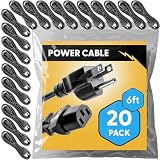
- Bulk Purchasing for IT Departments: Multi-pack quantities designed for enterprise procurement, data centers, and system integrators. Reduce per-unit costs while maintaining standardized power cabling across workstations, server racks, and office deployments. Simplifies purchase orders and reduces vendor management overhead.
- Heavy-Duty Universal Compatibility: Features IEC 60320 C13 female to NEMA 5-15P plug connection with durable 18AWG wire construction. Compatible with desktops, monitors, printers, scanners, servers, projectors, powered speakers, HDTVs, and enterprise hardware. Reduces downtime with one standard cable across multiple devices.
- UL Approved for Professional Environments: Engineered to meet commercial safety standards with UL approval, 10A/300V rating, and grounded 3-prong design. Withstands continuous use in mission-critical environments including offices, data centers, schools, and government facilities. Built for long-lasting performance in demanding applications.
- Versatile Replacement & Expansion Solution: Perfect for replacing worn cables or extending reach in server rooms, office workstations, and classroom technology setups. Flexible yet durable build makes it easy to manage in tight spaces such as racks and office setups while maintaining reliable power delivery.
- Enterprise Procurement Ready: Available in standardized multi-pack bulk quantities ideal for schools, businesses, and government offices standardizing power cables across devices. Compatible with enterprise asset management systems and meets typical procurement specifications for professional power cabling solutions.
Rank #4

- 3 AC Power + CAT6 + USB (data) + VGA + HDMI
- Desk Hole: 3.5" (9 cm)
- Extends Above Desk: 11" | Retracts Under Bezel: 14"
- Bezel Size W x H: 4"W x 3"H
- 6FT Power Cord | 5FT Data Cables
Product prices and availability are accurate as of the date/time indicated and are subject to change. Any price and availability information displayed on Amazon at the time of purchase will apply.
Quick wins for a faster PC:
Scan for outdated or missing drivers - takes under a minuteDriver Scan →Clear out junk files and repair common Windows errorsFree Scan →



