What’s actually slowing this PC down?
Pick the symptom - the matching free tool is one click away.
Collect customer feedback at the moments that matter, combine what people say with what they do, and turn recurring themes into owned work. A useful process does not end when a survey closes: it ends when the team makes a decision, tells customers what happened, and checks whether the change helped.
Build a feedback process around a decision
Before choosing a survey, interview, or monitoring tool, define the decision the feedback should inform and what outcome would count as improvement. For example, a team might want to understand why shoppers abandon checkout or choose which recurring product issue to address first. That purpose determines whom to ask, when to ask, and what evidence to collect.
As an Amazon Associate I earn from qualifying purchases.
- Name the decision. State what the team could change, such as a checkout step, support workflow, or product feature.
- Choose an outcome. Identify an observable result to monitor after a change, such as task ease, fewer repeat complaints, or a change in a relevant satisfaction measure.
- Choose the evidence. Use structured questions to compare responses across customers and open-ended input or behavioral signals to understand context.
- Set an owner and response route. Decide who will handle an individual customer issue and who will evaluate recurring themes.
- Close the loop. Tell customers what changed or why a request cannot be addressed, then check the outcome against the objective.
Salesforce describes a customer feedback loop as “the ongoing cycle of collecting customer input, acting on it, and telling customers what changed as a result.” The essential point is operational: an unanswered comment without an owner or decision has not completed the loop. Salesforce’s 2026 customer feedback guide and its customer feedback management guide describe collection, action, and follow-up as connected work.
Outdated Drivers Are Slowing You Down
One free scan finds every outdated or missing driver and matches the right update for your exact hardware.Free scan · exact hardware matchPC Slower Than It Used to Be?
A free scan shows the junk files, broken settings and background clutter dragging Windows down - then fixes them in one click.Free scan · Windows 10 & 11Choose collection methods that fit the question
No single channel captures the whole experience. Surveys and interviews solicit answers; reviews, social posts, and support conversations reveal feedback customers share in their own settings; behavioral evidence can indicate friction even when nobody reports it directly. Keep the source and customer context attached so unlike evidence is not treated as interchangeable.
#1 Best Overall

- IMPROVE CUSTOMER SATISFACTION - Filling out a comment card will reinforce positive feelings in guests, while also helping them feel heard if they have any concerns or suggestions. Plus, you’ll be able to correspond and keep in touch with customers directly, building brand loyalty and customer retention!
- REFLECT YOUR QUALITY - Customers will love that you went the extra mile to request their feedback! Reflect your care with these sturdy, stylish cards. Professional yet friendly, the streamlined format makes the cards easy and quick to fill out.
- PREMIUM CARDSTOCK - Made with thick 4x6” card stock, each card is easy to write on with any kind of pen. They make a much better impression than cheap looking flimsy paper forms!
- BULK VALUE PACK - Our bulk comment box forms are an easy, fun way to engage with customers. Whether you run a vacation rental, restaurant, B&B or other service based business, it's those little touches that really make a lasting positive impression!
- GET USEFUL FEEDBACK - You may be surprised at how helpful and encouraging the comments are! Guests may have some great ideas for how to make your business even more successful. Be sure to save those glowing comments to read anytime you feel down and need a little encouragement!
| Method | Best use | What it reveals | Trade-off |
|---|---|---|---|
| Surveys | Measuring a defined pattern across a larger group | Comparable ratings and answers, with optional explanations | Structured results are easier to compare, but a score alone rarely explains the cause. |
| Interviews | Understanding needs, motivation, context, and unexpected use cases | Detailed accounts and follow-up answers | They require time to conduct and interpret; obtain permission before recording or transcribing. |
| Focus groups | Exploring reactions and points of agreement or disagreement | Participants’ responses to an idea and to one another | Facilitation matters because one participant may dominate. |
| Feedback forms | Capturing input at a relevant point in a journey | Experience-specific comments tied to a particular task or moment | Ask only for information the team plans to use and set expectations for a response. |
| Reviews, social posts, and support conversations | Finding unsolicited concerns, praise, and recurring issues | Feedback customers share in public or while seeking help | These sources reflect different contexts and may not represent all customers. |
| Behavioral signals | Checking how customers use or move through an experience | Signals such as repeat purchases, product use, or cart abandonment | Behavior can reveal friction, but does not by itself establish why it occurred. |
Surveys: measure a focused question
Keep surveys concise and tied to the decision. Closed questions help quantify a pattern; an open follow-up lets customers explain a rating when the reason matters. Net Promoter Score (NPS), for example, asks how likely a customer is to recommend a company or product on a 0–10 scale. Treat the score as a signal, not a diagnosis, and pair it with an explanation or other evidence.
Interviews and focus groups: learn the context
Use interviews when the team needs to understand what a customer was trying to do, what shaped a choice, or what happened before a problem. Ask a consistent set of core questions, then probe useful answers. Focus groups can surface contrasting reactions, but a facilitator should make room for quieter participants as well as managing dominant voices.
Shopify’s 2026 Voice of the Customer guide reports that Abbie Griffin and John Hauser found 20 to 30 interviews could identify at least 90% of customer needs within a relatively similar customer segment. That is a scoped finding, not a guaranteed sample size for every audience or study; the guide also reports that the researchers recommended having several team members review transcripts.
Forms, reviews, and behavior: meet customers where evidence appears
Place a feedback form near the experience it concerns, and tell customers when to expect a response. Review product and public reviews, social posts, support tickets, chats, calls, and email for repeated themes. A shopper who abandons a cart or a customer who repeats a purchase can offer useful behavioral context, but those actions do not explain themselves; compare them with comments and customer conversations.
Rank #2

- 1.Our suggestion card is made of thick cardboard, with a smooth surface, making it easy for most types of pens to write.
- 2. Each suggested card has a size of 4 x 6 inches, providing enough space to write down your thoughts and suggestions. A set of 100 sheets, this rich quantity will meet your needs for collecting opinions and comments.
- 3. Each card contains question prompts such as "describe your idea", "what are the benefits of your idea", and "other comments and suggestions". These sections will guide respondents in providing comprehensive feedback.
- 4. These customer suggestion cards are perfect for building networks in workplaces, offices, churches, guests, suppliers, communities, restaurants, salons, and schools to submit useful ideas, comments, and suggestions.
- 5. Comment cards are a simple and fun way to interact with customers.
Ask questions that produce usable answers
Neutral, specific questions reduce the risk of steering customers toward an answer. Keep each question relevant to the decision, and test the wording with a small group before sending it broadly.
- Ask about a concrete event: “What problem were you trying to solve?”
- Explore a point of friction: “What, if anything, nearly stopped you from buying?”
- Measure a task: “How easy was it to complete your task?”
- Invite prioritization: “What is the most important change we could make?”
- Ask for improvement without implying a preferred response. Shopify quotes Heaven Mayhem founder Pia Mance saying, “I always ask, ‘What can I do better?’ rather than ‘What did you think?’”
For interviews and groups, get permission before recording or transcribing. For review incentives, Shopify notes that US FTC rules prohibit fake reviews and incentives conditioned on positive or negative opinions; consult applicable current rules and the relevant geography before putting an incentive program in place. Shopify’s guide discusses question design, research methods, and these review considerations.
Turn collected feedback into decisions and action
Preserve source and customer context
Bring enough input together to see themes across channels and teams, but retain where each item came from and the customer or journey context. A survey rating, support conversation, public review, and usage signal are different kinds of evidence. Combining them without preserving their differences can make a theme harder to interpret.
Tag themes and look for patterns
Tag feedback by theme, customer group, and journey stage. Count recurring issues and compare patterns across groups; use comments to understand why something happened and quantitative measures to understand how often it appears. Automated summaries can help with large volumes, but a person should review labels and context before decisions rely on them.
Rank #3
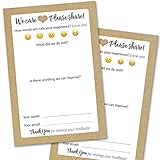
- IMPROVE CUSTOMER SATISFACTION - Filling out a comment card will reinforce positive feelings in guests, while also helping them feel heard if they have any concerns or suggestions. Plus, you’ll be able to correspond and keep in touch with customers directly, building brand loyalty and customer retention!
- REFLECT YOUR QUALITY - Customers will love that you went the extra mile to request their feedback! Reflect your care with these sturdy, stylish cards. Professional yet friendly, the streamlined format makes the cards easy and quick to fill out.
- PREMIUM CARDSTOCK - Made with thick 4x6” card stock, each card is easy to write on with any kind of pen. They make a much better impression than cheap looking flimsy paper forms!
- BULK VALUE PACK - Our bulk comment box forms are an easy, fun way to engage with customers. Whether you run a vacation rental, restaurant, B&B or other service based business, it's those little touches that really make a lasting positive impression!
- GET USEFUL FEEDBACK - You may be surprised at how helpful and encouraging the comments are! Guests may have some great ideas for how to make your business even more successful. Be sure to save those glowing comments to read anytime you feel down and need a little encouragement!
Prioritize against the objective
Use the decision defined at the start to evaluate evidence. Recurrence, customer impact, and whether the team can address a root cause can inform priority. A single strongly worded comment may merit a thoughtful personal response, but it does not by itself establish that a broad product change is the right priority. The available guidance does not establish a universal prioritization formula.
Assign ownership and close both loops
Route an individual problem to someone who can resolve it, and route repeated themes to the team that can address their cause. Track whether individual cases were resolved. Then tell customers what changed or explain why a request cannot be met; monitor the result against the chosen objective and revisit the feedback program over time. Sogolytics’ customer feedback management guide describes routing issues to responsible people and tracking resolution.
Choose measures that explain different parts of the experience
| Measure | What it asks or captures | How to use it |
|---|---|---|
| NPS | Likelihood to recommend, typically asked on a 0–10 scale | Use the rating as an indicator and examine explanations; Salesforce describes calculating it by subtracting detractors from promoters. |
| CSAT | Satisfaction with a specific product, purchase, or interaction | Keep the measured experience clear so responses relate to the same event or item. |
| CES | Perceived ease or difficulty of completing an action | Use it to assess a particular task, then investigate what made it easy or difficult. |
Track selected measures consistently over time and assess the result of changes as well as the quality of the feedback being collected. A rating by itself does not identify the fix. Salesforce’s customer feedback guide and Shopify’s Voice of the Customer guide cover these measures and the importance of interpreting them with context.
Recommended Free Tools
Select tools to support the workflow, not replace it
A small business can begin with one collection tool and a spreadsheet for theme tags, then add specialized software as feedback volume and routing needs grow. Shopify names Shopify Forms, SurveyMonkey, Shopify Inbox, Zendesk, Brandwatch, Loom, and Rev as examples spanning forms, surveys, chat and support, social monitoring, and transcription. These are examples of tools for different tasks, not a comparative ranking or evidence that one platform suits every team.
Rank #4
- Suggestion Cards: Each suggested card has a size of 4 x 6 inches, providing enough space to write down your thoughts and suggestions. A set of 50 sheets
- Improve Customer Satisfaction and Get Useful: Guests may have some good ideas and can connect directly with customers. Proactive customer service can enhance positive feelings and allow you to handle any complaints offline, making your small business more successful
- High Quality: Our suggestion card is made of thick cardboard, with a smooth surface, making it easy for most types of pens to write
- Wide Application: These customer suggestion cards are perfect for building networks in workplaces, offices, churches, guests, suppliers, communities, restaurants, salons, and schools to submit useful ideas, comments, and suggestions
- Quality Assurance:we firmly believe that you will love them that if you have any question,Please feel free to contact us and your satisfaction is always our top priority
When comparing software, consider the channels it covers, its analysis and reporting, how it routes and tracks follow-up, how it fits existing customer records, the volume it can support, and the staff capacity needed to run it. Confirm current features, pricing, privacy terms, geography, and availability with the vendor; those details vary and are not established here. Salesforce also describes feedback management in its CRM, while Sogolytics discusses issue routing and resolution tracking. No single platform is established as universally best.
Independent reader supportYour contribution helps us test, update, and keep practical guides available for everyone.How to choose a practical starting point
- If the decision is about prevalence: use a concise survey with comparable questions, then add an open explanation where useful.
- If the decision is about why customers struggle or choose differently: interview customers and review relevant support conversations.
- If reactions to one another matter: use a facilitated focus group and guard against one voice dominating.
- If the experience is tied to a particular step: place a short form there and specify when the customer can expect a reply.
- If customers already share feedback elsewhere: review ratings, social posts, support channels, and behavioral signals alongside solicited responses.
- If volume is modest: start with a simple collection tool and a spreadsheet that records theme, source, journey point, owner, status, and follow-up.
- If work is falling between teams: prioritize routing and resolution tracking so individual cases and systemic themes each have a responsible owner.
These choices depend on the decision, audience, volume, budget, and team capacity. The sources do not establish a universally best channel, sample size, metric, or software platform, nor do they establish that collecting feedback alone causes higher retention or revenue.
Frequently Asked Questions
What is the difference between collecting customer feedback and managing it?
Collection gathers input. Management also organizes it, assigns responsibility, makes and tracks decisions, resolves individual issues, and tells customers what happened.
The Tool Desk
Outbyte PC Repair FREEClear out junk files and repair common Windows errorsFree Scan →Outbyte Driver Updater FREEFix the driver behind crashes, sound loss and screen glitchesFind Drivers →Should I use surveys or interviews?
Use surveys to compare structured answers across more customers. Use interviews to explore needs, motivation, and context in depth. Many teams combine them because they answer different questions.
Best Value

- Abundant quantity and reliable material: you will get 400 sheets of blank suggested cards, divided into 16 small books, 25 pieces each book, abundant quantity to meet your needs, so you will not miss important suggestions, which are made of quality paper, smooth for you to write
- Clear Printed Contents: the paper comment card is printed with phrases [ What's your idea] , [ How will your idea help] , [ Additional comments] , clear and neat, helping the advisor clarify his thoughts and write down his advice in an organized way, which makes it easier for the recipient to accept the ideas of others
- Wide uses: these office complaint cards can help your guests, suppliers, employees and customers better explain their ideas in easy-to-understand sections, which is a nice tool to improve communication efficiency and effectiveness, and improve work progress
- Thoughtful design: the upper end of the small notebook is sealed with glue, so these suggestion box cards are not easy to be scattered, and they can be easily removed when using them, convenient and tidy
- Proper size: each refill suggestion box card measures 3.5 x 6.7 inch/ 8.89 x 17.02 cm, enough spaces for you to write down what your ideas and advantages without harangue, fitting for most suggestion boxes
Is NPS enough to explain customer satisfaction?
No. NPS records likelihood to recommend on a 0–10 scale, but a score alone does not explain its cause. Ask for an explanation and consider other customer and behavioral evidence.
How should a small business get started?
Choose one decision, collect feedback at a relevant point, and use a simple spreadsheet to record themes, context, an owner, and status. Add specialized software when volume or routing needs exceed what the team can manage simply.
What should I do when a customer requests something the business cannot provide?
Respond to the customer and explain why the request cannot be met. Record the request with its theme and context so the team can consider it alongside recurring feedback and its stated priorities.
Quick Recap
Product prices and availability are accurate as of the date/time indicated and are subject to change. Any price and availability information displayed on Amazon at the time of purchase will apply.




