Choose a dice-building roguelite by asking what you want to build and how much control you want over each roll. Circadian Dice focuses on shaping die faces, Astrea: Six-Sided Oracles combines pool-building with face editing, and Dicey Dungeons asks you to fit rolled dice to character-specific equipment. Their challenges and replay hooks differ, but the available descriptions do not establish a reliable head-to-head difficulty or replayability ranking.
What does “building” mean in a dice roguelite?
“Dice-building roguelite” is a useful umbrella, not a strict genre label. The key distinction is what your choices change from run to run: the faces on your dice, the dice in your pool, or the actions and equipment that make use of a roll.
As an Amazon Associate I earn from qualifying purchases.
| Game | What you build or change | What a turn asks of you |
|---|---|---|
| Circadian Dice | Upgrade and shape six-sided dice; its publisher describes building dice rather than a deck. | Use dice and resources strategically, turning faces into effects such as weapons, wealth generators, or stat boosts. |
| Astrea: Six-Sided Oracles | Build a dice pool and edit die faces to add actions. | Choose dice with different risk profiles and use Purification and Corruption effects against enemies and yourself. |
| Dicey Dungeons | Develop a character’s equipment and class-specific abilities rather than primarily reshaping dice. | Assign rolled dice to equipment and balance planned actions against the uncertainty of the roll. |
Choose Circadian Dice if you want to engineer die faces
Shuffle Up Games describes Circadian Dice as a single-player, deck-building-inspired game in which you build up dice. Its central appeal is deliberate probability manipulation: upgrades let you shape faces for different functions, while a semi-random upgrade system creates new combo possibilities. This suits players who enjoy making a die itself into a tool or engine, not just choosing how to spend a roll.
Quick wins for a faster PC:
Clear out junk files and repair common Windows errorsFree Scan →Scan for outdated or missing drivers - takes under a minuteDriver Scan →The Steam description lists 10 heroes, 60 relics, 110+ abilities, 66 enemies, 27 bosses, and 13 hand-crafted scenarios. These are publisher-listed content counts from the July 11, 2022 listing, not independent measures of variety. Runs are described as lasting 10–30 minutes. Scenario options include Normal and Hard, and upgrades and unlocks persist across scenarios. The listing also names a campaign and an endless randomized scenario as end-game modes.
#1 Best Overall

- Strategic Dice Game with Depth Plan your moves carefully as you roll, set aside, and reroll dice to achieve the best possible results.
- Exciting Competitive Gameplay Compete with 2–4 players across three rounds to earn Influence cards and claim victory as the new ruler.
- Easy to Learn, Hard to Master Simple rules make it accessible for beginners, while layered strategies keep experienced players engaged.
- Dynamic Scoring System Multiply dice values with crown icons to maximize your score and outplay your opponents.
- Replayable with Unique Rounds Each round introduces different card combinations and evolving strategies for high replay value.
Choose Astrea if you want to build a pool and manage opposing effects
Astrea is the closest of these three to a dice-deck-builder: you construct a pool, choose between safe, balanced, and risky dice, and edit faces to add actions. Its defining system is Purification versus Corruption. Purification can damage enemies or heal you; Corruption can hurt you or heal enemies. Taking Corruption can also activate skills on a dynamic health bar, so risk is not simply a penalty—it can be part of how a build works.
The developers and publisher list six Oracles with distinct dice sets, abilities, and play styles, and describe the game as containing over 350 dice. The Steam page lists 80 achievements. These storefront figures indicate available content, but do not by themselves prove how long the game stays fresh or how much replay value an individual player will find.
Rank #2

- Award-Winning : American Tabletop Casual Games Winner.
- Dice Rolling, Cube Racing : Players take on the role of participants in the annual Cube Cup, a race of strategy and luck to determine the Cubitos Champion.
- Great for Casual Gamers : Competitive play perfect for 2-4 players, ages 10 and up!
- From Designer John D Clair : Acclaimed designer of Dead Reckoning, Mystic Vale & Ready Set Bet.
- Endless Replayability : Use a different combination of Ability Cards each game, so no two games will ever be the same!
Choose Dicey Dungeons if you want class abilities to shape the puzzle
In Dicey Dungeons, the roll is assigned to equipment, and your character changes the rules around that process. Terry Cavanagh’s Steam description names six classes: Warrior, Thief, Robot, Jester, Inventor, and Witch. For example, the Thief steals random enemy equipment, the Robot plays a push-your-luck blackjack game to gain dice, and the Inventor destroys equipment after fights to make gadgets. If you want each run’s problem-solving to depend strongly on a character’s abilities, this is the clearest fit.
The game combines planned strategy with roll uncertainty and uses procedurally generated playthroughs. Its Steam listing also describes Reunion as free DLC with six new episodes. That is a concrete extra set of scenarios, rather than evidence for a particular number of replay hours.
Rank #3

- The game designed by Adam Kwapiński, the designer of Nemesis, Lords of Hellas, Dark Ages.
- City building game in a unique theme.
- Number of players: 2+
- Package Weight: 4.0 pounds
How much control over luck do you want?
Think about whether you enjoy turning randomness into a construction puzzle or prefer to react to what a roll gives you. Circadian Dice explicitly foregrounds probability manipulation and face-shaping. Astrea gives you ways to edit faces and select among risk levels, while its Corruption system can make taking a harmful effect strategically useful. Dicey Dungeons frames the tension as balancing a planned strategy against the unknown of the roll, with class mechanics adding different ways to use dice.
- For the most explicit die-face engineering: start with Circadian Dice.
- For pool-building, face edits, and risk choices tied to a health system: consider Astrea.
- For adapting equipment and tactics to rolls and class rules: consider Dicey Dungeons.
These are differences in emphasis, not a measured control score. A game can offer tools to shape chance and still ask you to manage uncertainty; whether that feels satisfying depends on how much unpredictability you want to keep in the run.
Rank #4

- FUNNY FAMILY GAMES-In fact, happiness is so simple.through Nicecho shut the box,makes you addicted and gives your brain a good tease, leaving you hooked for hours, and offering you a perfect way to beat boredom. simple rules of the game, enjoy the thrilling moments of the game.
- PREMIUM QUALITY DESIGN-Shut the box made of solid pinewood. The design of felt surface reduces noise when the board game is going on. Durable, scratch-resistant and environmentally friendly.Four different colors of acrylic silk-screen technology dice to ensure long-term use.
- LEARNING AND SOCIAL TOOLS-It is not only a math game, to promote children's learning ability of math addition, subtraction, multiplication and division,but aslo a kind of social entertainment, which can develop a sense of rules and exercise their thinking ability, logic ability and reaction ability in an interesting way.
- PORTABLE AND PRACTICAL-The size of shut the box is 8.74*8.74*1.1inch. Because of its light weight, it can be easily carried into any outdoor activity. Perfect for home, classroom, parties, picnics, birthday, and bars. Make your own rules and enjoy the game whenever and wherever you are.
- INTIMATE SERVICE-Shut The Box is a great game for families and friends of all ages. If for any reason you're not 100% SATISFIED, please let us know and our customer service team will help you RETURN OR REFUND.
How should you compare difficulty?
The available indicators are not a standardized comparison. Circadian Dice offers Normal and Hard scenario modes. Astrea has a “Difficult” tag on its Steam page and includes high-risk dice, but that tag is a storefront label, not a calibrated rating. Dicey Dungeons emphasizes six asymmetrical classes and luck without a comparable global difficulty scale in its listing.
Instead of trying to identify the objectively hardest game, consider what kind of challenge you prefer: selecting a mode, managing a system where risk can also be useful, or adapting to different class rules and rolls. The cited game descriptions do not provide comparative win rates, completion times, or a controlled difficulty test.
Best Value
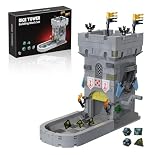
- 【Product Design】:Castle Inspired Design Designed with detailed railings and a gate to resemble a medieval tower adding a fantasy touch to your tabletop setup.
- 【Desktop Layout】:This dice tower, inspired by medieval watchtowers, complements any tabletop game setting.
- 【Compatibility】Compact and practical, it can be easily placed on any desktop, making it an ideal choice for role-playing games or board games enthusiasts.
- 【Package contains】: 7 pcs Dice + 382 parts + paper instruction manual
- 【Gift】:This dice tower building block set is a perfect gift for board game enthusiasts.
What gives each game reasons to replay?
| Game | Listed replay hooks | What the listing does not establish |
|---|---|---|
| Circadian Dice | 10 heroes, 13 hand-crafted scenarios, Normal and Hard modes, persistent upgrades and unlocks, a campaign, and an endless randomized scenario. | How many hours most players will spend or whether it offers more replay value than the other games. |
| Dicey Dungeons | Six distinct classes, procedurally generated playthroughs, and the free Reunion DLC with six episodes. | A comparable total run count or average playtime. |
| Astrea | Six distinct Oracles, a dice pool with face editing, and 80 Steam achievements. | How much replay value the achievement count represents or how it compares in playtime. |
Use these features to match replay structure to your taste. Hand-crafted scenarios and persistent unlocks offer a different kind of variation from procedural runs, character-specific rules, or switching Oracles and adjusting a pool. The listed counts are developer or storefront facts, not an independent measure of depth.
A practical way to make your choice
- Decide what you want to customize. Pick face engineering for Circadian Dice, pool and face construction for Astrea, or equipment and class-driven tactics for Dicey Dungeons.
- Choose your preferred relationship with chance. Look for explicit probability manipulation, selectable risk and potentially useful Corruption, or the push-and-pull between planning and rolls.
- Match the challenge format to your preference. Consider selectable Normal and Hard scenarios, risk embedded in the game system, or class asymmetry—without treating any as a universal difficulty ranking.
- Pick the replay structure that appeals to you. Compare scenarios and persistent unlocks, procedural play and extra episodes, or distinct Oracles and dice-pool experimentation.
All three are digital games. The cited listings do not establish that physical dice, a controller, or another accessory is needed to play.
Quick Recap
Product prices and availability are accurate as of the date/time indicated and are subject to change. Any price and availability information displayed on Amazon at the time of purchase will apply.
Do these 3 things before closing this tab:
1Fix the driver behind crashes, sound loss and screen glitches2Repair Windows errors before they cause bigger problems3Scan for outdated or missing drivers - takes under a minute



