The Tool Desk
Outbyte PC Repair FREERepair Windows errors before they cause bigger problemsFix Now →Outbyte Driver Updater FREEFix the driver behind crashes, sound loss and screen glitchesFind Drivers →Calibrate the camera against a flat chessboard target with a known pattern and square spacing: capture multiple sharp views from varied positions, detect and refine the target corners, estimate the camera matrix and lens-distortion coefficients, then validate and save those parameters. This corrects camera geometry; it does not identify chess pieces. Reliable recognition also needs board alignment and a separate classifier for the contents of each square.
What camera calibration does—and what it does not do
A calibrated camera model describes how the lens and camera project points in the scene onto image pixels. Its camera matrix includes focal lengths and the optical center; distortion coefficients describe lens effects such as visible bending near image edges. Applying those parameters can make later geometric processing more dependable.
As an Amazon Associate I earn from qualifying purchases.
Calibration is not board detection or piece recognition. A chess application still needs to locate the board, rectify its perspective so the squares are aligned, divide it into squares, and determine whether each square is empty or contains a particular piece. A chessboard calibration target is used to estimate camera geometry, not to teach the system the appearance of chess pieces.
Do these 3 things before closing this tab:
1Clear out junk files and repair common Windows errors2Fix the driver behind crashes, sound loss and screen glitches3Repair Windows errors before they cause bigger problemsChoose and measure the chessboard target
Count internal corners, not squares
For a chessboard pattern, the detector’s dimensions refer to the number of internal corner intersections, not the number of black or white squares. OpenCV’s calibration-pattern guidance makes this distinction explicit in its calibration pattern tutorial. Check the actual printed target and enter its internal-corner width and height in the same order expected by your code.
#1 Best Overall

- Optical calibrator for film, lens, slide, projector etc.
- Calibration board
- Chess board pattern calibrater
- 12×9 small blocks(6mm square) on 100*100 mm PET base
- Focus distortion calibration
Measure the physical spacing accurately
Measure the distance between adjacent corners—the physical square spacing—and use that value consistently when constructing the target’s object-point coordinates. These coordinates describe known points on the flat target; their depth coordinate can be zero. A printable pattern is convenient, but a print that has been scaled inaccurately or distorted during printing can weaken the physical accuracy of the estimated parameters. OpenCV’s camera-calibration tutorial relies on correctly specified target points, while its pattern guidance emphasizes precise grid dimensions.
Plan for orientation ambiguity
A regular chessboard is symmetric, so a detector may find the pattern without determining which end is which. OpenCV warns that a pattern with an even number of corners in one direction can have a 180-degree pose ambiguity; a square N×N corner pattern can have a 90-degree ambiguity. If resolving orientation matters to your application, choose a non-square pattern and avoid those stated ambiguous configurations.
Rank #2

- Debugging of DVR system for 360 degree closed aerial panoramic view.
- Fabrics Car Camera Correction Calibration Cloth for 360 Degree.
- Surround Bird View Panoramic DVR System Debugging.
- Wire. Size: 4.4X1.2M (2 large); 1.6 * 1.2M (2 small ).
- Correct parking position.
Capture a useful set of calibration images
Take images of the same target at different positions and orientations within the camera’s intended working area. Include views that vary the target’s tilt and location in the image, while keeping the corners visible and sharp. Repeating essentially the same pose provides less information about the camera’s geometry than showing the target across varied parts of the frame.
Outdated Drivers Are Slowing You Down
One free scan finds every outdated or missing driver and matches the right update for your exact hardware.Free scan · exact hardware matchWindows Errors? Fix Them Before They Spread
Repair common Windows errors and clear accumulated junk for a smoother, more stable PC - no reinstall needed.Free scan · no reinstallOpenCV says two snapshots are sufficient in theory, but its practical recommendation is at least 10 good snapshots in different positions because real images contain noise. That is a practical recommendation, not a universal minimum or guarantee of accuracy. The OpenCV calibration tutorial does not establish a universal image count for every camera and setup.
Rank #3

- Lens test target on aluminum board with glass base, no shining under light
- 9 rows 12 columns checkerboard pattern, totally 50 mm long (1.97 inches), totally 50 mm wide (1.97 inches), small black square is 3 mm long
- High precession ( 3 um )
- Clear pattern, diffuse reflection, no specular reflection
- Aluminum alloy, good thermal stability
- Keep the complete corner pattern visible in accepted views.
- Use images where corners are in focus and not motion-blurred.
- Vary the board’s location and orientation rather than capturing near-identical views.
- Use the same camera and lens setup for calibration and later recognition; changing the setup can make saved parameters unsuitable.
Detect corners, estimate parameters, and save the result
- Find the pattern: run a chessboard-pattern detector on each calibration image using the measured internal-corner dimensions. Reject images where detection fails or the points are visibly unreliable.
- Refine detected corners: refine the image coordinates to subpixel accuracy before calibration. OpenCV describes corner detection and refinement in its pattern tutorial and calibration tutorial.
- Build corresponding object points: pair each detected 2D image point with the corresponding known point on the planar target, using the measured spacing and zero depth for the flat board.
- Estimate camera parameters: use the corresponding image and object points to estimate the camera matrix and distortion coefficients.
- Save the successful calibration: store those values with enough information to identify the camera and target setup, so the same parameters can be reused with that setup rather than recalculated for every frame.
- Undistort when useful: apply the saved parameters to correct lens distortion where it matters to the image geometry. OpenCV notes that undistortion maps can be calculated once and reused, which is useful when processing a stream from a fixed setup.
Validate calibration before relying on recognition
Check both the numerical reprojection error and the corrected images. Reprojection error measures how closely projected target points match the observed image points. OpenCV calls average reprojection error a good estimate of parameter precision and says it should be close to zero in its calibration documentation. The documentation does not prescribe a universal pass/fail threshold, so do not treat one number as proof that a calibration will work for every camera or recognition task.
- Overlay detected and projected target points on calibration images and look for systematic offsets.
- Inspect representative images from the intended setup before and after undistortion, especially near image edges where lens bending may be visible.
- Test with the target at the positions and orientations the camera will encounter in use, not only in the center of the frame.
- If the fit looks poor, check corner-count order, square spacing, detection quality, target flatness, and whether the images contain enough pose variation.
When a chessboard pattern is not the right target
A regular chessboard remains a straightforward choice when all its corners are visible and its symmetry does not interfere with the task. OpenCV documents alternatives for situations where those conditions are inconvenient:
Rank #4

- Maximum accuracy of 0.1 micrometers
- The thinnest line could be 0.2 micrometers
- Diffuse surface, no specular reflection
- Clear pattern, sharp pattern edge
- 12*9 pattern, other pattern customizable
| Pattern | Useful when | Practical consideration |
|---|---|---|
| Chessboard | You can detect the full internal-corner grid and measure its spacing. | Symmetry can leave pose orientation ambiguous; OpenCV provides a printable 9×6 internal-corner A4 pattern in its pattern tutorial. |
| ChArUco | You need labeled corners or may have partial board occlusion. | It combines a chessboard with ArUco markers; the detector must know the marker set and order. OpenCV documents rotation invariance and use with a partially occluded board in its pattern tutorial. |
| Circle grid | Circle centers suit the detector or target you can produce. | OpenCV says its detector returns subpixel circle centers without additional refinement. Symmetric grids can retain a 180-degree ambiguity in the stated even-size case; see the pattern tutorial. |
Calibration does not guarantee a piece-recognition score
Published recognition results depend on a particular method and evaluation setup. A 2017 chessboard-and-piece-recognition paper reported 99.57 ± 0.0147% lattice-point detector accuracy, 95% board-positioning accuracy, and almost 95% piece-recognition accuracy for its proposed method and experiments; those figures are not predicted outcomes for another camera or model. A 2025 CVChess preprint describes a smartphone pipeline and a dataset of 10,800 annotated smartphone images, but its retrieved abstract does not report a recognition-accuracy figure. Neither result makes calibration alone a measure of piece-recognition performance.
Quick Recap
Best Value
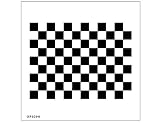
- Optical calibrator for film, lens, slide, projector etc.
- 12×9 small blocks(15mm square) on 200*200 mm PET base
- Chess board pattern calibrater
- Alignment card
- Lens calibrator
Product prices and availability are accurate as of the date/time indicated and are subject to change. Any price and availability information displayed on Amazon at the time of purchase will apply.




