There is no proven universal way to make a one-row keyboard faster than a conventional layout. “One-row keyboard” can describe two very different systems: a physical keyboard with every letter on one line, or a virtual eye-typing interface that shows one row at a time. The strongest available speed data concerns the second system, and it was slower than a full three-row QWERTY interface in a small experiment.
You can still run a careful adaptation trial. First identify your input method, establish a baseline, then change one variable at a time while recording speed and errors. Treat any improvement as personal evidence, not a guarantee that the layout is faster for other users.
As an Amazon Associate I earn from qualifying purchases.
Identify which “one-row keyboard” you have
Advice for a physical keyboard does not automatically apply to a gaze-controlled screen keyboard. Before changing a layout, classify the device and the way characters are selected.
Physical single-row letter layout
An orthographic one-row keyboard (ORK) puts all letter keys on one horizontal line. The 2021 paper One Row Keyboard: The Concept of Designing a Common Layout for Physical and Virtual Keyboards describes ORK use with all fingers except the thumbs or with the thumbs alone. It presents a layout concept and methods for assigning characters; it does not demonstrate that a particular arrangement increases everyday touch-typing speed.
#1 Best Overall

- Improved Typing Posture: Type more naturally with a curved, split keyframe and reduce muscle strain on your wrists and forearms thanks to the sloping keyboard design
- Pillowed Wrist Rest: Curved wrist rest with memory foam layer offers typing comfort with 54 per cent more wrist support; 25 per cent less wrist bending compared to standard keyboard without palm rest
- Perfect Stroke Keys: Scooped keys match the shape of your fingertips so you can type with confidence on a wireless keyboard crafted for comfort, precision and fluidity
- Adjustable Palm Lift: Whether seated or standing, keep your wrists in total comfort and a natural typing posture with ergonomically-designed tilt legs of 0, -4 and -7 degrees
- Ergonomist Approved: The ERGO K860 wireless ergonomic keyboard is certified by United States Ergonomics to improve posture and lower muscle strain
Virtual keyboard that reveals one row at a time
Some on-screen systems display or scroll through rows while a user types with eye gaze. Only one row may be visible at a time, but the interface, selection method and scrolling behavior determine performance. Results from this setup should not be treated as measurements of a physical keyboard.
Reduced-key or chording system
A small set of keys can also represent letters through combinations, prediction or approximate matching. That is a different input model again: the user must learn codes or resolve ambiguous entries. A patent describing QWERTY-to-reduced-key mapping is a description of an invention, not proof of current availability or independently validated typing outcomes.
What the measured evidence actually shows
The clearest numerical comparison comes from a 2009 experiment by Oleg Špakov and Päivi Majaranta. Eight expert participants used a gaze-based, scrollable on-screen keyboard under one-row, two-row and three-row conditions. The three-row QWERTY condition served as the comparison point.
| Condition | Reported result | What it means |
|---|---|---|
| Three-row QWERTY | Reference condition | Full three-row display in the experiment |
| Two-row scrollable keyboard | Typing speed was 25.3% lower than the three-row condition | Applies to the study’s gaze-input setup, not physical keyboards |
| One-row scrollable keyboard | Typing speed was 51.4% lower than the three-row condition | A study-specific result from eight experts using eye typing |
| Unoptimized one-row arrangement | 7.26 words per minute | Measured in that experiment’s gaze-based setup |
| Optimized one-row arrangement | 8.86 words per minute | Improved over the unoptimized arrangement in the same setup |
The optimized arrangement reduced scrolling compared with the unoptimized one, but the participants initially found the unfamiliar arrangement harder to use. The result supports a narrower conclusion: character placement and transition patterns matter in a scrollable eye-typing interface. It does not show that a physical one-row keyboard, a different user, or a different software implementation will produce the same speed.
A 2024 mechanical-keyboard paper refers to ORK as a proposed single-line layout and discusses Keydrop, a dynamic virtual keyboard studied for speed and error reduction. That context does not establish that either is a currently available product or that either has been validated for your physical keyboard.
Why a one-row layout can lose speed
Extra movement or scrolling
When the desired character is not visible, a gaze interface may require scrolling or another selection action before typing can continue. Frequent transitions add time even when the user knows the layout.
Rank #2
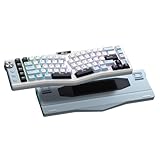
- Ergonomic Alice Layout — This 72 keys Alice keyboard features a split, angled design that promotes a natural typing posture to reduce wrist and forearm strain, minimizing fatigue during extended use. Compact 68% layout saves desktop space while keeping functional arrow keys. Seamlessly blending ergonomic wellness with high-performance typing.
- Seamless Tri-Mode Connectivity — Easily switch between 2.4GHz wireless, BT 5.0, and USB-C wired connections using the toggle switch. The RK A72 supports multi-device connectivity and features 15 dazzling RGB backlit modes for vibrant effects.
- Gasket Structure & 5-Layer Dampening — Enjoy a soft, cushioned typing feel with the RK A72's gasket-mounted design that reduces vibrations. Combined with five internal dampening layers—including dual sound-absorbing foam, IXPE switch pad, silicone dampener, and PET film — it effectively minimizes hollow sounds and cavity noise for a satisfying acoustic experience. Paired with durable, oil-resistant Cherry-profile PBT keycaps for lasting texture and comfort.
- Macro Keys & Easy Media Control — Boost productivity with five customizable M1-M5 macro keys, ideal for shortcuts or complex commands. The convenient volume knob and media keys provide instant access to audio adjustments, ensuring seamless control without interrupting your workflow.
- Touchable Nameplate & Online Driver Support — The touch-sensitive nameplate unlocks instant access to RK's web-based driver— no software installation needed. Assign touch actions to launch websites, trigger macros, or execute commands, while using the intuitive online platform to effortlessly remap keys, configure macros, and personalize RGB lighting directly through your browser, compatible with both Windows and macOS.
Letter-transition patterns
Character placement changes how often the interface must move between regions. An arrangement that places commonly followed letters near one another can reduce transitions in a scrollable system. This is why the 2009 optimized condition outperformed its unoptimized one-row condition.
Quick wins for a faster PC:
Clear out junk files and repair common Windows errorsFree Scan →Scan for outdated or missing drivers - takes under a minuteDriver Scan →Repair Windows errors before they cause bigger problemsFix Now →Familiarity and relearning
QWERTY knowledge is a substantial advantage for people who already type with it. A new arrangement can be logically designed yet initially slower because the user must recall unfamiliar positions. Early sessions therefore measure learning as much as the layout itself.
Disambiguation burden
Reduced-key systems may require a prediction choice or a correction after an approximate entry. Those decisions are not present in ordinary one-key-per-letter typing, so speed and error rate must be measured together.
A cautious adaptation trial for a physical one-row keyboard
No source-backed training regimen establishes a reliable speed gain for physical ORKs. The following is a controlled personal experiment, not a validated method. Its purpose is to reveal whether a proposed arrangement works for you under repeatable conditions.
1. Define the exact hardware and hand technique
- Record whether the keyboard is used with all fingers except thumbs or with thumbs alone.
- Write down the number of physical letter keys, any non-letter keys needed for spaces or punctuation, and whether keys can be remapped.
- Keep the same keyboard position, chair, lighting and input device for every trial.
2. Establish a baseline before changing anything
Choose a short set of passages that contains common words, less familiar words, punctuation and repeated letter pairs. Type the same passages with your current arrangement. Record elapsed time, completed words, uncorrected errors and corrected errors. Repeat enough times to see whether results are stable rather than relying on one unusually fast attempt.
Do these 3 things before closing this tab:
1Repair Windows errors before they cause bigger problems2Fix the driver behind crashes, sound loss and screen glitches3Clear out junk files and repair common Windows errors3. Change one layout variable
If the keys are programmable, create one proposed letter order at a time. Do not simultaneously change key size, software, text, hand posture and practice schedule. If the keyboard is not programmable, document the physical order you are testing so a later comparison remains identifiable.
Rank #3

- PREMIUM CHERRY RED SWITCHES - Experience silky smooth keypresses ideal for performance with our quiet tactile Cherry Red mechanical switches rated for 50 million keystrokes providing unmatched durability and reliability
- VERSATILE CONNECTIVITY OPTIONS - Connect via 2.4GHz wireless USB Bluetooth or wired connection with seamless switching between devices powered by a long-lasting 4000mAh battery for extended use without frequent recharging
- ERGONOMIC DESIGN WITH RGB ILLUMINATION - Ergonomically shaped keyboard with adjustable RGB backlighting perfect for low-light environments with customizable brightness levels and lighting effects
- MULTI OS COMPATIBILITY AND VIA SUPPORT - Easily switch (Fn+M) between Windows Mac layouts , plus fully programmable functionality through open source VIA software allowing complete customization of layouts shortcuts and backlight effects
- HOT SWAPPABLE KEYS WITH GASKET STRUCTURE - Personalize your keyboard with hot swappable keycaps and switches using the included puller tool while the unique gasket structure reduces noise and improves typing feel with dedicated CoPilot AI hotkey for instant access to AI assistance
There is no evidence here for a universally best letter sequence. A sensible hypothesis is to place letters that occur frequently together closer together, but that is a design assumption to test, not a proven prescription. Avoid presenting an invented order as an established standard.
4. Use matched test sessions
- Use the same passages in the same order for the baseline and the new arrangement.
- Allow a short familiarization period, then record timed attempts separately from untimed practice.
- Keep the timing method and definition of an error unchanged.
- Record words per minute and errors for every attempt, not only your best score.
- Repeat the comparison on another day to check whether an apparent gain survives fatigue and normal variation.
5. Decide with a speed-and-accuracy rule
Do not accept a layout merely because its fastest run is quicker. Prefer the arrangement that gives a repeatable result with an acceptable error rate for the work you actually do. If speed rises while corrections or uncorrected mistakes rise sharply, the apparent gain may not be useful.
Adapting a one-row gaze or virtual keyboard
For a scrollable eye-typing interface, the adaptation target is different: reduce the number of row changes and make the selection path predictable.
Confirm the interface’s operating model
- Determine whether gaze selects a key directly, dwells on it, or uses a separate confirmation action.
- Check whether the row scrolls automatically, by gaze gesture, or with another control.
- Note how spaces, backspace and punctuation are reached; these controls can dominate real text-entry time.
Test the supplied arrangement before redesigning it
Learn the existing order long enough to separate unfamiliarity from a genuine layout problem. Measure the same passages and error categories used in your baseline. If the interface offers more than one arrangement, compare them without changing dwell time or calibration between runs.
Optimize transitions, then retest
The 2009 study indicates that an arrangement reducing scrolling can improve one-row performance relative to an unoptimized arrangement. Apply that idea only as a hypothesis: identify the transitions that force the most row changes, make one documented adjustment if the software permits it, and repeat the matched test. A layout that reduces scrolling but increases selection mistakes may be a poor trade.
Independent reader supportYour contribution helps us test, update, and keep practical guides available for everyone.How to compare options without mixing unlike evidence
| Question | Physical ORK | Scrollable virtual or gaze keyboard |
|---|---|---|
| What moves? | Hands or thumbs move across one physical line | Rows, gaze focus or selection state may move on screen |
| Main learning issue | Remembering unfamiliar key positions | Remembering positions plus the interface’s scrolling and selection rules |
| Likely speed constraint | Reach distance, hand coordination and recall | Scrolling, dwell/confirmation time and visual transitions |
| Useful measurements | Words per minute, corrected and uncorrected errors | Words per minute, row changes, selection errors and corrections |
| Evidence available here | Layout proposal, not a validated speed result | One small 2009 experiment with eight expert participants |
Do not compare a physical typing score directly with the 7.26 or 8.86 words-per-minute gaze results. They come from different input methods, hardware, interfaces and participants.
Rank #4

- Full-Size Ergonomic Design: Say goodbye to discomfort with the RAGNOK RK104 Ergonomic Keyboard. Unlike standard keyboards, our full-size layout features a curved, split-keyframe design that reduces muscle strain on your wrists and forearms while promoting proper posture. The unique wave design keys are crafted to fit your fingertips perfectly, making typing effortless and natural.Media control knob adds extra convenience.
- Ergonomic Palm Rest: Our ergonomic keyboard with leather wrist rest and foldable stand provides 54% more support, allowing your hands to remain at the same level as the cordless keyboardto reduce wrist fatigue, ensuring comfortable typing for hours. Great for work and gaming.
- Premium Red Linear Switches: Hot-swap compatible with 3-pin low-profile switches, but not with 5-pin high-profile switches. They deliver silky-smooth keypresses, ideal for performance, featuring quiet tactile red linear switches rated for 50 million keystrokes for unmatched durability and reliability.
- Adjustable Backlighting: The ergonomic wireless keyboard comes with 9 switchable backlights colors, 19 Dynamic Lighting Effect and 6 brightness levels to provide you with a different visual typing atmosphere. Using FN + TAB, FN + 丨 to suit your environment or mood, enhancing both the functionality and aesthetic of your keyboard.
- Rechargeable and Long Lasting: The ergo keyboard is powered by a 5000mAh rechargeable battery for long-lasting use, with a Type-C fast-charging cable included. Focus on your tasks without worrying about frequent charging.
Troubleshooting an adaptation that feels slower
You are slower only during the first sessions
That pattern is consistent with relearning. Continue recording results rather than judging the layout by a single session. If performance does not stabilize or errors remain unacceptable, the arrangement is not meeting your practical goal.
The Tool Desk
Outbyte Driver Updater FREEFix the driver behind crashes, sound loss and screen glitchesFind Drivers →Outbyte PC Repair FREEClear out junk files and repair common Windows errorsFree Scan →Speed improves but mistakes increase
Separate corrected from uncorrected errors. For text that will be published or sent without extensive review, an error-heavy speed gain is usually not an improvement. Test with realistic passages and keep the error threshold explicit.
Gaze input requires constant row changes
Count row changes in a timed passage. If the software supports character reassignment, test one transition-focused change at a time. If it does not, a different row count or interface may be more consequential than memorizing the existing order.
You cannot remap the physical keys
Do not assume replacement keycaps or a generic typing tutor will solve the specific problem. Without evidence that an accessory supports your exact one-row arrangement, document the current order and evaluate it with the baseline method instead.
The proposed layout works for short tests but not real work
Include the punctuation, capitalization, symbols and word lengths found in your normal tasks. A layout can perform well on simple lowercase passages while becoming inefficient when it requires frequent mode changes.
Crashes, No Sound, or Screen Glitches?
Random freezes, missing sound and display glitches usually trace back to one bad driver. Find and replace yours safely.Free scan · under a minuteWindows Errors? Fix Them Before They Spread
Repair common Windows errors and clear accumulated junk for a smoother, more stable PC - no reinstall needed.Free scan · no reinstallWhen a one-row design may still be the right choice
Speed is not the only design objective. A single line may fit a constrained enclosure, simplify a specialized physical design, or suit a user who prefers thumb-only operation. Those benefits should be evaluated separately from the claim that it is faster. If accessibility, reach distance or device size is the primary requirement, record those outcomes alongside typing speed and errors.
Quick Recap
A practical decision checklist
- Identify the system: physical single-row, gaze-based virtual row, or reduced-key/chording input.
- Set the goal: higher speed, fewer errors, smaller hardware, reduced reach or another measurable outcome.
- Measure a baseline: same text, timing method and error definitions.
- Change one variable: layout order, row arrangement or selection setting, but not everything at once.
- Repeat the test: include another day and realistic punctuation and corrections.
- Keep the result local: your score demonstrates what worked for you under those conditions, not a universal advantage.
Product prices and availability are accurate as of the date/time indicated and are subject to change. Any price and availability information displayed on Amazon at the time of purchase will apply.




