“Ultimate force measurement” can mean two different things here: how much tension a nanotube withstands before breaking, or how weak a force a nanotube-based sensor can detect. Experiments report both remarkable tensile strengths and highly sensitive force sensing, but the figures measure different properties and cannot be compared directly.
What does “ultimate force measurement” mean?
For a material, ultimate tensile strength is the stress it withstands under tension before failure, reported here in gigapascals (GPa). For a sensor, force sensitivity describes how small a force it can detect, often normalized by measurement bandwidth and reported in units such as zN Hz−1/2. A higher tensile-strength number does not mean a sensor is more sensitive.
As an Amazon Associate I earn from qualifying purchases.
How strong are individual carbon nanotubes?
Structure-defined nanotubes measured in 2019
A 2019 Nature Communications study reported direct ultimate tensile-strength measurements on 16 structure-defined individual single-walled carbon nanotubes. Their measured strengths ranged from 25 to 66 GPa and varied with tube structure. Within that measured set, small-diameter tubes close to armchair structure had the highest strengths. The result is specific to those 16 measured tubes, not a universal value for every carbon nanotube. Nature Communications (2019)
Do these 3 things before closing this tab:
1Scan for outdated or missing drivers - takes under a minute2Repair Windows errors before they cause bigger problems3Fix the driver behind crashes, sound loss and screen glitchesDefect-free and defect-containing tubes measured in 2010
A separate 2010 Advanced Materials study reported approximately 100 GPa for individual single-walled nanotubes with no visible defects, a value the authors described as approaching the theoretical limit for defect-free tubes. For tubes with spatially separated, stepwise pentagon–heptagon defects, it reported 40–70 GPa. The study tested individual tubes using a high-resolution transmission electron microscope equipped with a conducting atomic-force-microscope unit, and related strength to visible structure and defects. These results come from a different study and sample set than the 2019 measurements; the values should not be merged into a single range or treated as directly interchangeable. Advanced Materials (2010)
#1 Best Overall

- 4 MEASUREMENT UNITS - The portable digital force gauge can switch between 4 units of N / Lb / kg / Oz ; Max. load value: 500N/50kg/110Lb/1800Oz ; Load value: 0.1N/ 0.01kg/ 0.01lb/1Oz ; Accuracy: ±1% ; Power: 2pcs AAA battery
- 3 MEASUREMENT MODES - This pull gauge can switch three measurement modes (Real-time / PEAK / First-PEAK). In "PEAK" mode, it can hold the maximum force applied shown on the screen.
- AUTO POWER OFF - The push pull scale can set the automatic shutdown time and automatically shut down without operation for a long time to achieve the effect of power saving. The auto shutdown time can be set within 0-15 minutes, and the default time is 10 minutes.
- MIN FORCE SHIELDING - The dynamometer can be set to shield the display of data below 0.5% of the full scale. This function can be cancelled, and the instrument defaults to enable the minimum force shielding function.
- APPLICATION - The handheld force gauge is widely applied in pull push load testing, insertion force or destructive experiment and industry like electric, hardware, automobile parts, lighter and ignition system, light industry, mechanical, textile...
Can a carbon nanotube measure force?
Yes. Researchers have used nanotubes as resonators and as elements in more complex sensor arrangements. These experiments address sensing performance, not how much tensile stress the nanotube material can withstand.
Nanotube resonator sensitivity
A 2013 Nature Nanotechnology study reported force sensitivity of 12 zN Hz−1/2 at 1.2 K using a carbon-nanotube resonator. The team detected low-amplitude vibrations through cross-correlated electrical-noise measurements with parametric downconversion, then calibrated sensitivity by applying a known capacitive force. The reported sensitivity belongs to that resonator and cryogenic operating condition; it is not a room-temperature or general-purpose sensor specification. Nature Nanotechnology (2013)
Rank #2

- [Range]0.1N-500N;0.01 KG-50KG;0.1LB-110LB;1OZ-1800OZ
- [4 uints]N(Newton),Kg (Kilogram) , Lb (Pound) and Oz(Ounce)four units for selection and conversion.
- [Setting gravity acceleration]Setting function of gravity acceleration--User can input at your option the accurate valuc of gravity acceleration at the using place so as to make the testing and unit conversion be more accurate.
- [Buzzer alarm]Upper and lower limits can be set for statistic analysis. The buzzer will alarm if exceeding the limits.
- [Minimum force value shielding] the data within the set minimum range can be shielded.
Single-molecule force sensing
A 2018 Nano Letters study paired a suspended carbon-nanotube transistor with dual-trap optical tweezers to measure interactions between individual molecules near equilibrium, at sub-piconewton resolution. It reported an equilibrium force of 1.2 ± 0.5 pN, which the authors said was likely related to binding between the nanotube and a single DNA base. That value is a measured interaction in this particular sensor arrangement, not the resonator’s force-sensitivity figure. Nano Letters (2018)
What’s actually slowing this PC down?
Pick the symptom - the matching free tool is one click away.
Why the reported numbers cannot be ranked together
| Study and measurement | Reported result | What it describes |
|---|---|---|
| 2019, 16 structure-defined individual single-walled nanotubes | 25–66 GPa | Ultimate tensile strength; the measured values depended on structure. |
| 2010, individual tubes without visible defects | Approximately 100 GPa | Ultimate tensile strength in that study’s defect-free specimens. |
| 2010, tubes with stepwise pentagon–heptagon defects | 40–70 GPa | Ultimate tensile strength in that study’s specified defect-containing specimens. |
| 2013, nanotube resonator at 1.2 K | 12 zN Hz−1/2 | Force sensitivity under cryogenic operating conditions. |
| 2018, transistor and dual-trap optical-tweezer sensor | 1.2 ± 0.5 pN | Measured equilibrium force in a single-molecule interaction experiment. |
Strength is stress at failure; sensor sensitivity is a device-level measure of force detection, while the 2018 result is an equilibrium force measured in a specific molecular experiment. Differences in specimen structure, sensor architecture, operating conditions, calibration and measured quantity prevent a meaningful one-number ranking across these studies.
Rank #3

- 🖥️ GOYOJO’s Trigger Pull Gauge With Display: Designed with a triple-sized screen for unmatched clarity, the GOYOJO force gauge delivers bold, easy-to-read measurements in Newton (N), kilogram (kg), and pound (lb) units—perfect for demanding industrial environments.
- 🔄 Innovative Rotatable Display by GOYOJO: The 180-degree rotatable screen offers maximum flexibility for professionals working in tight spaces, complex setups, or multi-directional testing applications.
- 🎛️ Enhanced Keys for Effortless Precision: GOYOJO’s optimized key design requires minimal pressing force and delivers superior tactile feedback, ensuring smooth operation during high-frequency industrial testing.
- ⚖️ Accurate and Reliable Performance: With a measurement range of 0-500N and ±0.5% precision, the GOYOJO force gauge excels in applications such as push-pull testing, tensile strength evaluations, and material durability assessments.
- 🔁 Tailored for Specialized Testing Needs: Featuring an L-shaped screw rod, GOYOJO makes trigger pull force and other precision force measurements easy and reliable, ensuring consistent results for professional applications.
Other ways researchers characterize nanotubes
Not every experiment uses a nanotube as the force sensor itself. One method measures force–distance behavior with a metal-coated tipless AFM cantilever while monitoring electrical current, to derive mechanical and electrical properties of vertically aligned nanotubes. Another uses an individual-nanotube micro-cantilever force sensor calibrated inside a scanning electron microscope. These are specialized laboratory approaches rather than consumer measurement products. Sensors and Actuators A: Physical Nano Letters
Quick Recap
Best Value

- Data Output Capabilities: This digital force gauge offers convenient USB data output and includes free software for comprehensive data analysis and logging. Each package comes with a TypeC→USB cable, enabling seamless data transfer and management. 【Note】 The data output cable is also the charging cable.
- Certified Accuracy and Large Display: Each USB Digital Force Gauge ships with a certificate of calibration and a user manual for accurate and reliable measurements. The large 3.9'' LCD backlit screen ensures clear readability, while the high-quality ABS plastic housing guarantees durability and toughness.
- Versatile Test Parts and Accessories: The force gauge includes multiple test parts – four pressure test parts, one tension test part, and one extension shaft – to cater to a wide range of experimental requirements. The portable design and included carrying case make it easy to store and transport the gauge and its accessories.
- Intuitive Main Features: Our device boasts three measurement modes – Real-Time, Peak, and First Peak Value – with free switching to cater to your specific needs. The long-press function on the U button allows for screen value flipping, adapting to various measurement scenarios. Additionally, the Upper and Lower Limits (HL & LL) warning feature helps detect qualified products, enhancing your quality control processes.
- Versatile Applications: Ideal for a multitude of industries, this handheld dynamometer excels in pull and push load testing, insertion force or destructive testing, and is widely used in electrical, hardware, automotive parts, lighters and ignition systems, light industrial, mechanical, textile, and other sectors. Its versatility and precision make it an indispensable tool for various testing needs.
Rank #4
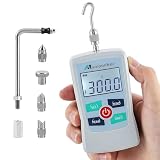
- 4 MEASUREMENT UNITS - The portable digital force gauge can switch between 4 units of N / Lb / kg / Oz ; Max. load value: 300N/30kg/65Lb/1100Oz ; Load value: 0.1N/ 0.01kg/ 0.01lb/1Oz ; Accuracy: ±1% ; Power: 2pcs AAA battery
- 3 MEASUREMENT MODES - This pull gauge can switch three measurement modes (Real-time / PEAK / First-PEAK). In "PEAK" mode, it can hold the maximum force applied shown on the screen.
- AUTO POWER OFF - The push pull scale can set the automatic shutdown time and automatically shut down without operation for a long time to achieve the effect of power saving. The auto shutdown time can be set within 0-15 minutes, and the default time is 10 minutes.
- MIN FORCE SHIELDING - The dynamometer can be set to shield the display of data below 0.5% of the full scale. This function can be cancelled, and the instrument defaults to enable the minimum force shielding function.
- APPLICATION - The handheld force gauge is widely applied in pull push load testing, insertion force or destructive experiment and industry like electric, hardware, automobile parts, lighter and ignition system, light industry, mechanical, textile...
Product prices and availability are accurate as of the date/time indicated and are subject to change. Any price and availability information displayed on Amazon at the time of purchase will apply.




