Do these 3 things before closing this tab:
1Clear out junk files and repair common Windows errors2Scan for outdated or missing drivers - takes under a minute3Repair Windows errors before they cause bigger problemsRobotic organic synthesis can make experiments easier to repeat by turning a procedure into explicit, executable steps, automating measured operations, and tying results to analytical checks. It does not guarantee reproducibility: evidence so far concerns defined reactions and workflows, and results still depend on chemistry, reagents, equipment, handling, and measurement.
Why does reproducibility benefit from robotic synthesis?
Many organic synthesis procedures require a chemist to interpret written instructions and carry out a sequence of operations. If details are incompletely documented or interpreted differently, repeating the experiment becomes harder. As Sebastian Steiner and colleagues put it in the abstract of their 2019 Science paper, “The synthesis of complex organic compounds is largely a manual process that is often incompletely documented.” (PubMed)
As an Amazon Associate I earn from qualifying purchases.
A robot can make execution more consistent by expressing those operations in a defined procedure: what to dispense, in what order, and what other actions to perform. The procedure can then be stored, inspected, revised, and run again. This makes the execution record more explicit than a written protocol alone, but a precisely repeated procedure can still produce variable results if its chemistry, materials, setup, or measurements vary.
How does a robotic procedure work?
Translate instructions into executable operations
In a modular robotic system reported by Steiner and colleagues, reported methods were converted into discrete operations controlled through a chemical programming language. The platform synthesized diphenhydramine hydrochloride, rufinamide, and sildenafil without human intervention; the authors reported yields and purities comparable to or better than manual synthesis. These results demonstrate the approach on those compounds, not on organic synthesis as a whole. (PubMed)
#1 Best Overall

- Lab Glassware and Labware: there are 5 measuring cups, 4 glass stirring rods, 4 graduated cylinders, 3 glass droppers and 4 lab beakers, a total of 20 pieces of laboratory glassware; This is a complete range of products to meet your laboratory science needs and uses
- Multiple Sizes to Meet Your Various Needs: measuring cups: 50ml, 100ml, 250ml, 500ml, 1000ml, glass stirring rods: 7.87 inches/ 20 cm, graduated cylinders: 100ml, 50ml, 25ml, 10ml, glass droppers: 90mm, 120mm, 200mm, lab beakers: 50ml, 100ml, 150ml, 200ml; Different sizes are suitable for various experiments
- Durable and Reliable Material: the science beakers, lab droppers, lab stirring rods and lab cylinders are made of quality borosilicate glass materials, which are thick and stable, acid and alkali resistant, available for long term use
- Easy to Use: the glass graduated cylinder and other science lab glassware are designed with clear scales for easy to read, and the measuring cups and graduated cylinders have tapered gates for easy to pour liquid
- Wide Range of Applications: these beakers and graduated cylinders are practical gifts for experimenters and science , very suitable for projects, laboratories, science researches and so on
Make the protocol inspectable and repeatable
When operations are represented as code, a lab can preserve the procedure itself rather than relying only on prose or memory. Explicit steps make it easier to identify what changed between runs. If a protocol is revised, keeping track of its version helps distinguish results produced by different instructions. These benefits depend on documenting relevant parameters and on the robot being configured to carry out the operations the protocol describes.
Separate execution consistency from chemical success
Automation can standardize dispensing and other supported operations. It cannot by itself ensure that a reaction will work with a different substrate, reagent batch, vessel, or instrument setup. Reproducibility claims are therefore strongest when they specify the reaction scope, the equipment and protocol used, how many repeats were performed, and how products were measured.
Rank #2

- High-Performance Materials: Crafted to withstand high temperatures, our distillation apparatus maintains structural integrity without deforming or breaking, ensuring long-term durability and reliability in demanding applications.
- Exceptional Corrosion Resistance: Designed to resist chemical degradation, this set is ideal for common laboratory distillation processes and chemical education experiments.
- Superior Thermal Stability: With a low coefficient of thermal expansion, our apparatus can handle sudden temperature changes without sustaining damage, making it perfectly suited for complex distillation processes.
- Crystal Clear Transparency: The high clarity of our distillation apparatus allows for easy monitoring of contents and processes, facilitating precise control over your distillation operations.
- Optimal Safety Features: Equipped with excellent electrical insulation properties, our 12-piece set enhances safety during use, preventing electrical conduction and protecting users from potential hazards.
Can the same protocol run on different lab robots?
Cross-platform transfer has been demonstrated for selected protocols. A 2024 Nature Synthesis study introduced χDL protocols for several reaction types across four hardware systems in two laboratories. Three case studies covered seven reaction steps and three final compounds, with validation across two international laboratories and three independent robots. This is evidence of portability within those tested workflows, not proof that any protocol will run unchanged on any lab robot. (Nature Synthesis)
Recommended Free Tools
In practice, portability depends on whether the protocol’s operations can be mapped to the destination system and whether its hardware and workflow support them. A transferable description helps make that mapping explicit; labs still need to validate execution on their own setup.
Rank #3
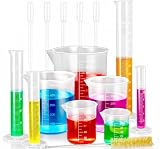
- Durable Plastic Construction: Made from eco-friendly food-grade plastic for durability and non-toxicity.
- Multiple Sizes: Includes 4 plastic cylinder sizes (10-1000ml) and 5 plastic beaker sizes (50-1000ml) for versatile use.
- Clear Scale Lines: Standard metric scale lines on cylinders and beakers for accurate measurement.
- Flexible Pipettes: 5 included 3ml pipettes allow for precise transfer of small amounts of liquid.
- Hexagonal Base: Hexagonal base design provides stable placement and reduces measurement error.
How repeatable were the tested reactions?
A 2023 Synbot study repeated three aromatic coupling reactions 12 times each and reported measurements for both dispensing and reaction outcomes. The figures below describe those tested reactions and setup; they are not universal performance guarantees. (PMC)
| Measure | Reported result | Scope |
|---|---|---|
| Repeat count | 12 repeats | Each of three aromatic coupling reactions |
| Dispensing mean absolute error | ≤ 0.73 mg | Synbot study, 2023 |
| Dispensing coefficient of variation | ≤ 2.55% | Synbot study, 2023 |
| Conversion-yield coefficient of variation | < 5% during monitoring; < 2.5% in the converged latter reaction period | Synbot study, 2023 |
Dispensing precision and reaction repeatability are related but distinct. A robot may dispense consistently while the measured reaction outcome varies; tracking both helps show where variability occurs.
Rank #4

- Satisfy Your Large Needs: our plastic cylinder set leaves no stone unturned when it comes to meeting your laboratory needs; The comprehensive package contains 6 test tubes with 1 rack, 3 differently sized graduated cylinders, 2 plastic beakers, 3 plastic handle beakers, 10 3ml droppers pipettes and 3 erlenmeyer flasks, you can also share them with your classmates and friends
- Various Sizes to Choose: the package includes 3 sizes of graduated cylinders, 10ml, 25ml and 50ml, 3 sizes of plastic beakers with handles, 250ml, 500ml and 1000ml, 2 beakers without handles, 50ml and100ml, 3 conical flasks, 50ml, 100ml, 500ml and 10 3ml pipettes, 6 plastic test tubes with lid, 1 test tube rack, the lab equipment set is transparent and sufficient in quantity to meet your needs
- Sturdy for Long Time Use: the plastic beaker set is crafted with sturdy plastic material that ensures long lasting use, even under heavy daily use; This plastic beaker set lowers the risks of any injuries that might occur from broken glass, providing peace of mind in the lab
- Clear Scale: the beaker set and the dropper have scale, clear markings on the sides, which are clear and easy to read, making the measuring and storage more convenient and accurate
- Versatile to Use: the measuring cylinder set adopts a hexagonal base design, which provides stability and reduces errors when measuring; The beaker measuring cylinder is suitable for experiments because it can be reused and is resistant to most acids, alkalis, and solvents; The plastic dropper has a dial and scale on the outside, which is convenient to use
Why do analytical measurements matter?
Repeating a sequence of robotic actions is not enough to establish that the chemistry reproduced. The product and reaction outcome also need to be measured. In a 2024 mobile-robot laboratory study, a Chemspeed ISynth synthesis platform was coupled with UPLC-MS and benchtop NMR. The workflow used these orthogonal analytical methods to select screening hits and automatically check their reproducibility. (Nature)
Free tools Windows power users keep installed
One-click scans. No signup required.
Using complementary measurements can make an automated workflow more informative than one that records only whether a reaction was attempted. Analytical results can guide which experiments advance and whether a result withstands a reproducibility check. The cited study shows this approach in its designed workflow; it does not establish that a particular combination of instruments is required for every synthesis lab.
Best Value
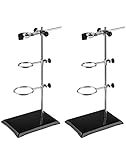
- STABLE BASE DESIGN: Thick cast iron platform keeps the stand balanced and secure during lab use.
- ADJUSTABLE CLAMPS: Includes two ring sizes (2"/2.8") and a burette clamp for different flask or beaker diameters.
- RECOMMENDED LOAD: Supports laboratory containers up to 500 mL or 1 kg for safe everyday experiments.
- EASY ASSEMBLY: Rod connects firmly to the base with a locking screw and is ready to use in minutes.
- PACKAGE CONTENT: 2 sets with base, rod, ring clamps and burette clamp – ideal for teaching or small research setup.
What do autonomous chemistry robots decide?
Automation and autonomy are not the same as open-ended chemical judgment. In the mobile-robot study, domain experts selected reactions and building blocks before experiments. The platform automated execution, measurement-informed decisions, and follow-up within that designed problem space; it did not select arbitrary organic chemistry targets. (Nature)
Another scale figure needs similar care: a 2022 portable-platform paper reported 24,936 base steps over 329 hours of platform runtime across a broader demonstration that included five small organic molecules, four oligopeptides, and four oligonucleotides. Those totals cover multiple kinds of synthesis and should not be treated as an organic-synthesis-only throughput measure. (Nature Chemistry)
What should a lab check before relying on automation?
- Reaction scope: Confirm that the reactions and operations in question are represented by the validation, rather than assuming results extend to different chemistry.
- Protocol detail: Record the executable steps and relevant parameters, and keep versions distinguishable when procedures change.
- Hardware fit: Check that the destination robot supports the required operations and validate any transferred protocol on that equipment.
- Repeat count and variability: Look for the number of repeats and reported variation in both operations, such as dispensing, and reaction outcomes.
- Analytical confirmation: Use appropriate measurements to establish what the reaction produced and whether repeated runs agree.
- Decision boundaries: Identify which choices were made by chemists and which the automated system made from measurements.
Robotic organic synthesis makes reproducibility simpler by making execution more explicit, repeatable, and measurable. The evidence supports that benefit for particular reactions and platforms; confidence beyond those cases requires validation on the chemistry and equipment a lab intends to use.
The Tool Desk
Outbyte PC Repair FREERepair Windows errors before they cause bigger problemsFix Now →Outbyte Driver Updater FREEScan for outdated or missing drivers - takes under a minuteDriver Scan →Quick Recap
Product prices and availability are accurate as of the date/time indicated and are subject to change. Any price and availability information displayed on Amazon at the time of purchase will apply.




