Do these 3 things before closing this tab:
1Fix the driver behind crashes, sound loss and screen glitches2Clear out junk files and repair common Windows errors3Scan for outdated or missing drivers - takes under a minuteQuantum calculations can help refine a crystal structure by improving the model of electron density used to interpret diffraction data, or by supplying chemical-energy restraints for a selected part of a larger structure. These are different approaches, not one universal algorithm—and neither replaces experimental evidence or careful validation.
What quantum calculations add to crystal-structure refinement
In ordinary crystallographic refinement, a structural model is adjusted to better fit measured diffraction data. Quantum-crystallographic methods bring a quantum-mechanical description of the electrons into that process. This matters because electrons are not distributed as isolated, perfectly spherical atoms: chemical bonds and the surrounding environment make the electron density aspherical.
As an Amazon Associate I earn from qualifying purchases.
One way to use that information is to calculate atomic scattering factors from quantum-mechanical charge densities, improving the model used to interpret diffraction intensities. Another is to calculate energies and apply them as restraints to a selected region while refining the overall structure against experimental data. The approaches share a quantum-mechanical foundation, but they use it differently. The IUCr’s overview of current developments describes quantum crystallography as a family of methods rather than a single refinement procedure: Current developments and trends in quantum crystallography.
What’s actually slowing this PC down?
Pick the symptom - the matching free tool is one click away.
Three approaches that should not be conflated
| Approach | Typical target | What the quantum calculation contributes | How it is used |
|---|---|---|---|
| Periodic multipole refinement | Small-molecule crystals | Multipole parameters derived from periodic solid-state calculations and theoretical diffraction data | Improves the electron-density and scattering model used in iterative least-squares refinement |
| Hirshfeld atom refinement (HAR) | Small-molecule structures | A quantum-mechanical description of atomic scattering factors; the cited periodic-method paper compares its results with gas-phase HAR | Uses the calculated scattering description when refining against diffraction data |
| Biomolecular quantum refinement | A selected region of a larger biomolecular structure, such as an unusual ligand or metal site | Quantum-mechanical energetic information for the chosen region | Combines the calculated information with crystallographic data and the surrounding structural model |
The methods differ in their physical model, the region treated quantum mechanically, and how the calculation enters refinement. In particular, periodic multipole refinement is not another name for HAR or for biomolecular quantum refinement. The broader distinctions are discussed in the IUCr review of quantum-crystallography developments and the review of combining crystallography with quantum mechanics.
#1 Best Overall

- SCIENTIFIC EDUCATIONAL TOOL: Ideal for teachers and students, this plastic molecular crystal structure model kit aids in understanding complex scientific concepts related to crystal structures.
- sturdy PLASTIC MATERIAL: Made from high-quality plastic, the atoms and in this model are built to last, ensuring long-term use in educational settings.
- EASY ASSEMBLY & DISASSEMBLY: The model kit is designed for easy assembly and disassembly, making it convenient for repeated use in classrooms and demonstrations.
- ENHANCED LEARNING EXPERIENCE: By visualizing molecular structures, students can develop a stronger understanding of chemistry and physics concepts, leading to improved academic performance.
- COMPLETE PACKAGE: Includes a variety of molecular structures such as Carbon C60, , and Graphite, along with and a storage box for organized storage.
How periodic multipole refinement works for small-molecule crystals
In a periodic calculation, the model includes the repeating crystal environment rather than treating the molecule as an isolated gas-phase species. Patzer and Lehmann describe a workflow in which the crystal structure and calculation settings are used to run periodic solid-state calculations, derive theoretical multipole parameters, and then carry those parameters into iterative least-squares refinement.
The ReCrystal workflow
- Start with a crystallographic model. ReCrystal takes a CIF file and calculation settings as input.
- Calculate the periodic electronic structure. The reported workflow uses CRYSTAL17 with periodic boundary conditions to represent the crystal.
- Derive multipole parameters. The calculation supplies parameters for a more detailed electron-density model, rather than relying on a database of multipole parameters.
- Refine against diffraction data. The theoretical parameters are used in iterative least-squares refinement, so the model is still assessed against experimental observations.
Patzer and Lehmann describe an advantage of their approach this way: “multipole parameters can be obtained from high-resolution calculated diffraction data, no database is required, and errors due to the model and errors resulting from the experiment are clearly separated.” That is the authors’ characterization of their method, not a claim that all sources of error disappear. Read their 2025 IUCrJ paper on solid-state calculations for iterative refinement for the implementation and its test cases.
Rank #2
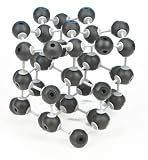
- DIAMOND STRUCTURE MODEL || Build an accurate 3D representation of a diamond crystal lattice using interconnecting atoms and bonds.
- 39 ATOMS & 60 CONNECTORS || Includes black atoms and medium connectors to assemble the tetrahedral arrangement of carbon atoms.
- HANDS-ON LEARNING || Helps visualize molecular geometry, bonding, and crystal structures in chemistry and material science studies.
- DURABLE & REUSABLE COMPONENTS || Sturdy plastic materials ensure long-term use in classrooms, labs, and demonstrations.
- GREAT FOR STEM EDUCATION || Ideal for students, educators, and researchers to explore the fundamental structure of diamond.
What the reported test cases establish
The authors demonstrated the method with D/L-serine and xylitol crystals, including weak hydrogen-bonding motifs. For xylitol, they compared reported hydrogen positions with neutron-diffraction results and reported an improvement over gas-phase HAR for those positions. This is evidence from those test cases—not a general guarantee that periodic multipole refinement will outperform HAR for every compound, dataset, or refinement choice.
The paper also emphasizes that high-resolution diffraction data remain important for accurate single-crystal structures. The calculation adds a richer chemical model; it cannot recover experimental information that the data do not contain. The authors present ReCrystal as a tool for testing the approach and do not claim the program is error-free.
Rank #3

- Visualize Molecular: The molecular model kit simplifies complex chemistry concepts into tangible 3D structures improve learning efficiency, suitable for students from Grade 7 to Graduate level.
- 444 Pcs Complete Set: The atom model kit includes with 136 atoms,158 bonds, and 150 fullerene model parts, explore most the molecules structures from simple compounds to complex polymers.
- Effortless Assembly: Embedded component design ensures easy to construct Ball-and-stick and Space-filling models that maximizes focus on exploration without complex assembly.
- Durable & Portable: Built to last, the chemistry set is crafted from high-quality materials. Plus, its portable Snap-Lock design allows you to take your experiments learning anywhere, between the home, classroom and lab.
- Essential Study Tool: Whether you're studying organic chemistry, biochemistry, or molecular biology, molecule building kit is an perfect learning tool for you deeper comprehension of molecular science.
How quantum refinement is used for biomolecules
Biomolecular structures often rely on empirical geometric restraints. Such restraints are comparatively well established for common amino acids and nucleic acids, but may be less dependable for unusual ligands, reaction substrates, cofactors, or metal sites. Quantum refinement addresses that problem by applying calculations to a focused region while retaining the crystallographic data and the surrounding structural model.
The 2024 QRef implementation connects Phenix and ORCA for this type of refinement. Its paper reports applications to X-ray and neutron structures and to a cryo-EM structure. The quantum calculation supplies energetic information for the selected region; it does not replace the experimental observations or automatically decide which chemical interpretation is correct. The implementation and reported applications are described in Quantum refinement in real and reciprocal space using the Phenix and ORCA software.
Rank #4

- Made of durable and colorful plastic
- Molecular geometry and bond angles can be visibly seen in the structure, making it great for studying
- Excellent molecular model kit for students studying chemistry in middle school or university
- A visual representation of molecular structures of common compounds and substances
- These unique molecular structures are excellent for visual display
Questions it can help investigate
When the experimental data support more than one plausible chemical model, a quantum-refined model can help compare alternatives involving local geometry, protonation, tautomeric state, or metal oxidation state. These are evidence-guided interpretations: the answer depends on the quality of the data, the chosen structural model, the region included in the calculation, and how calculated restraints are weighted against the experimental target. A quantum calculation does not resolve ambiguity independently of those choices.
Recommended Free Tools
What the 2025 protocol means for accessibility
A 2025 protocol paper asks whether quantum crystallography is “now mature enough and easy enough to use to extend and ultimately supersede standard X-ray crystal structure determination routines?” The question captures the field’s practical ambition, but a protocol and its demonstrations do not establish that one method should replace routine refinement in every case. They show that a workflow can be made more accessible and testable; researchers still need to choose a method suited to the crystal and validate the resulting model. See A quantum crystallographic protocol for general use.
Best Value

- [COLOR CODED ATOMS] Universal color coding helps students recognize roles quickly and build crystal structure with clearer visual contrast during chemistry and biology lessons.
- [CLASSROOM TEACHING KIT] Designed as an educational tool for classroom demonstration and hands on learning this set supports crystal structure teaching in high school chemistry biology and chemical physics.
- [MULTIPLE STRUCTURE ] Students can assemble C60 fullerene style arrangements and layered graphite structures making abstract lattice concepts easier to observe discuss and remember.
- [DURABLE PLASTIC PARTS] Plastic atoms and connectors fit tightly for stable assembly while remaining removable with tools helping teachers and students rebuild repeatedly during practice sessions.
- [COMPLETE SET WITH BOX] Includes 60 Carbon C60 30 parts 39 Graphite 95 short connectors 90 medium long connectors 14 long connectors and 1 storage box for organized school use.
What to check before trusting a quantum-refined model
- Match the method to the structure. A periodic solid-state multipole workflow for a small-molecule crystal and a local-region biomolecular calculation address different modeling problems.
- Check whether the calculation is periodic or local. A crystal-environment calculation and a calculation on an isolated molecule or selected biomolecular region do not make the same environmental assumptions.
- Keep the experimental fit in view. Refinement should still be judged against the relevant experimental observations. For biomolecular quantum refinement, the balance between the experimental target and restraints is a consequential choice.
- Inspect chemical plausibility as well as crystallographic fit. QRef discusses considering crystallographic fit measures alongside quantum-mechanical measures such as strain energy. Neither class of measure should be treated as a substitute for the other.
- Read software versions as publication-specific. ReCrystal’s reported workflow uses CRYSTAL17; the QRef paper reports tested software versions at publication. Those details describe the papers’ implementations, not a guarantee about current software support or compatibility.
- Retain ordinary structural judgment. Quantum refinement improves or constrains a model; it does not make model selection, data-quality assessment, or validation unnecessary.
Does quantum refinement replace standard structure determination?
No. These methods refine structural models using experimental observations together with calculated electron density or chemical energies. They can add useful chemical detail, especially where conventional models are limited, but they do not make diffraction or cryo-EM measurements unnecessary, nor do they eliminate uncertainty in the structural interpretation. The appropriate method depends on whether the task is to improve a small-molecule scattering model or to refine a chemically difficult region in a larger biomolecule.
Quick Recap
Product prices and availability are accurate as of the date/time indicated and are subject to change. Any price and availability information displayed on Amazon at the time of purchase will apply.




