With two 24 TB drives, a mirrored two-bay NAS gives you roughly 24 TB of pool capacity—about 21.8 TiB—before system partitions and filesystem overhead. RAID 0 or JBOD can expose capacity closer to the full 48 TB (about 43.7 TiB), but neither layout provides drive-failure redundancy. The exact space available for files depends on the NAS model, storage layout and filesystem.
What does “48 TB” mean in a two-bay NAS?
Assuming the advertised figure is the sum of two equal 24 TB drives, 48 TB describes the raw, decimal capacity printed on the drive labels. It does not mean that a protected two-drive NAS will have 48 TB available for files. The storage layout determines how much of that raw capacity becomes pool capacity, and the NAS uses some space for its own system partitions and filesystem metadata.
As an Amazon Associate I earn from qualifying purchases.
There are three quantities worth keeping separate:
- Raw capacity: the sum of drive-label capacities. Two 24 TB drives total 48 TB decimal.
- Pool capacity: the capacity exposed by the chosen arrangement, before all system and filesystem reservations are accounted for.
- File space: the space the NAS reports as available for shared folders and other data after its reservations and volume setup.
When someone asks how much usable storage a NAS has, they often mean either pool capacity or file space. For a two-drive mirror, the practical estimate starts at one drive’s capacity, not both; the final file-space figure will be lower.
How much capacity does each layout provide?
The table assumes two equal 24 TB drives and shows approximate pool capacity before system partitions and filesystem metadata. The capacity figures follow the documented behavior of the layouts; exact reported file space depends on the NAS and its configuration.
#1 Best Overall
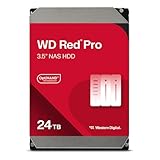
- Available in capacities ranging from 2TB to 26TB
- For RAID-optimized NAS systems with unlimited # of bays
- Rated for 550TB/year workloads and up to 2.5M hours MTBF
- Designed for Continuous Operation
| Layout | Approximate pool capacity | Approximate binary equivalent | Drive-failure protection |
|---|---|---|---|
| RAID 1 or two-drive SHR-1 | 24 TB decimal | 21.8 TiB | Mirroring preserves a copy if one drive fails while the other remains operational. |
| RAID 0 | 48 TB decimal | 43.7 TiB | No redundancy; failure of one member drive loses the pool’s data. |
| JBOD | 48 TB decimal | 43.7 TiB | No redundancy. |
RAID 1 or two-drive SHR-1: about half the raw capacity
A mirror writes the same data to both drives. Because each drive holds a copy, the pair’s capacity is limited by the smaller member: with two 24 TB drives, that is about 24 TB decimal before overhead, or roughly 21.8 TiB. Synology describes RAID 1 as providing data protection as long as one drive is operating normally. Its two-drive SHR-1 arrangement is the mirrored-capacity case in this comparison.
This is generally the relevant estimate if you mean a protected two-bay setup. The trade is straightforward: the second drive holds a duplicate rather than extending the amount of data you can store. If the drives are unequal in capacity, the smaller drive sets the mirror’s usable capacity; the calculations here assume equal-size drives.
RAID 0: nearly all raw capacity, without redundancy
RAID 0 combines capacity across both drives, so the two 24 TB drives yield approximately 48 TB decimal before overhead. That is about 43.7 TiB. The layout does not keep a second copy for protection: Synology’s documentation says a single member-drive failure loses the pool’s data. The extra capacity therefore comes with a materially different failure risk from mirroring.
Quick wins for a faster PC:
Clear out junk files and repair common Windows errorsFree Scan →Fix the driver behind crashes, sound loss and screen glitchesFind Drivers →Repair Windows errors before they cause bigger problemsFix Now →JBOD: combined capacity, without redundancy
JBOD can also expose capacity close to the combined 48 TB decimal, or 43.7 TiB, before overhead. It does not provide redundancy, according to Synology’s description. Do not treat its larger capacity figure as equivalent to a protected mirror: a capacity total says how much the arrangement can expose, not whether it can withstand a drive failure.
How to compare the trade-off
For this two-drive configuration, the central choice is not simply “more or less usable space.” Compare the pool capacity with what happens if a drive fails. RAID 1 and two-drive SHR-1 reserve the equivalent of one drive’s capacity for the second copy, leaving about 24 TB decimal before overhead. RAID 0 and JBOD may expose close to twice that pool capacity, but the cited Synology descriptions do not promise redundancy for either layout. That makes a 48 TB RAID 0 or JBOD pool a different risk choice, not a higher-capacity version of a mirror with the same protection.
If preserving a second copy on the NAS matters more than maximizing the pool, the mirror’s roughly 24 TB starting point is the relevant number. If the priority is exposing more of the installed capacity, the RAID 0 and JBOD estimates are closer to 48 TB, but those layouts do not protect against a member-drive failure. Neither capacity figure tells you how much storage is left after the NAS reserves system and filesystem space.
Why a NAS may show 21.8 or 43.7 “TB”
Drive makers use decimal units: 1 TB is 1,000,000,000,000 bytes. Binary units use a different divisor: 1 TiB is 1,099,511,627,776 bytes. As a result, 24,000,000,000,000 bytes works out to about 21.83 TiB, while 48,000,000,000,000 bytes is about 43.66 TiB.
The Tool Desk
Outbyte PC Repair FREERepair Windows errors before they cause bigger problemsFix Now →Outbyte Driver Updater FREEScan for outdated or missing drivers - takes under a minuteDriver Scan →Rank #2

- Store vast amounts of data with a class-leading 24TB capacity, perfect for hyperscale environments, data centers, and big data applications.
- 7200 RPM, SATA 6Gb/s interface, and large 512MB cache, delivering fast, predictable performance for demanding server workloads.
- Designed for 24/7 operation with a high 2.5 million hours MTBF (Mean Time Between Failures) rating, ensuring enterprise-class durability and data dependability.
- Conventional Magnetic Recording (CMR): Employs proven CMR technology for consistent and reliable performance across various workloads.
- Engineered for massive scale-out (MSO), high-density data centers, and cloud storage applications.
The conversion is simply the byte total divided by the number of bytes in a TiB. In this example, first multiply the drive-label total in TB by 1,000,000,000,000 to get bytes, then divide by 1,099,511,627,776. That gives a useful way to compare a manufacturer’s decimal drive label with a NAS interface that reports binary-sized units. It is still an approximate pool comparison, not a promise of final file space, because it does not subtract the device’s system or filesystem reservations.
A NAS interface may label a binary-sized figure “TB” even though the number is effectively in TiB. That can make an expected 24 TB mirror look closer to 21.8 and a 48 TB combined pool look closer to 43.7. The difference is a unit conversion, not by itself evidence that a drive or pool is missing capacity.
Synology says its calculator uses binary storage calculations. Its example reports 1.8 TB available from two 2 TB drives; that example illustrates the calculator’s unit convention, not a measured result for a pair of 24 TB drives. The 24 TB and 48 TB equivalents above are arithmetic conversions from the advertised byte capacities.
Why the file-space figure is lower than pool capacity
Pool capacity is not the same as space available for files. A NAS sets aside space for system partitions and, when creating a volume, filesystem metadata. Synology’s calculator specifically notes both reservations and says actual available capacity will be lower than its estimate.
PC Slower Than It Used to Be?
A free scan shows the junk files, broken settings and background clutter dragging Windows down - then fixes them in one click.Free scan · Windows 10 & 11Crashes, No Sound, or Screen Glitches?
Random freezes, missing sound and display glitches usually trace back to one bad driver. Find and replace yours safely.Free scan · under a minuteFor its calculator, Synology lists metadata reservations of 4% for Btrfs volumes and 2% for ext4 volumes. These are Synology-specific calculator notes, not universal rates for every NAS manufacturer or filesystem. They also do not capture every possible difference between models or configurations, so they should not be used as a precise net-capacity calculation for an unnamed NAS.
Those percentages are one part of the estimate, not a simple guarantee that you can subtract exactly 4% or 2% from the mirror’s 24 TB figure and get the final file-space total. The system partitions also take space, and Synology notes that its calculator’s actual available capacity can be lower than the estimate. For another brand, a different model, or a different filesystem setup, use that manufacturer’s own capacity information rather than applying these percentages by default.
In practical terms, start with the layout estimate—about 24 TB decimal for a mirror, or about 48 TB decimal for RAID 0 or JBOD—then expect the NAS’s reported file space to be lower. The amount below that estimate depends on the device and volume. Without the NAS model, filesystem and configured pool, there is no defensible exact final number.
Rank #3

- 26TB ultra-high capacity for large-scale storage
- 7,200 RPM for sustained enterprise workloads
- SATA 6Gb/s interface for wide system compatibility
- Enterprise-class reliability for continuous operation
- High workload rating for data-intensive applications
How to estimate the capacity for your setup
- Confirm the drive-label total. Check whether “48 TB” means two 24 TB drives or some other combination. The estimates here assume two equal drives, each rated at 24 TB.
- Identify the intended storage layout. For a two-drive mirror, use roughly one drive’s capacity: 24 TB decimal, or 21.8 TiB. For RAID 0 or JBOD, use roughly the combined drive capacity: 48 TB decimal, or 43.7 TiB, while recognizing the lack of redundancy.
- Check the NAS model’s drive and volume limits. Confirm that the model supports 24 TB drives and the intended volume size. Consult the manufacturer’s compatibility information and model specifications before buying or configuring drives; compatibility and limits vary by model.
- Use the manufacturer’s calculator for a closer estimate. Select the exact NAS model, drives, layout and filesystem where the calculator offers those choices. Treat its result as an estimate, because system space and filesystem metadata reduce the final available space.
- Compare the estimate with the configured volume. Once the pool and volume are created, use the NAS interface’s capacity report to see the system’s actual available-space figure. If it is below the pool estimate, first distinguish decimal TB from binary TiB and account for system and filesystem reservations.
Do the compatibility check before purchasing rather than assuming that a two-bay chassis accepts any drive capacity. The relevant confirmation is specific to the NAS model: verify both support for 24 TB drives and the intended volume size in its specifications or compatibility information. The source calculator accepts HDD inputs through 24 TB, but that does not establish support for every 24 TB drive on every NAS. Do not infer compatibility for an unnamed model from the capacity arithmetic alone.
What’s actually slowing this PC down?
Pick the symptom - the matching free tool is one click away.
For a realistic budget, consider the stages separately: the advertised raw total, the layout’s pool capacity, and the space reported after the volume is created. This lets you identify whether the difference is primarily the mirror’s duplicate copy, the decimal-to-binary display, or the device’s system and metadata reservations. A manufacturer calculator can refine the estimate for a named model, but the actual configured volume is the relevant figure when you want to know what space the device reports for files.
What mirroring protects—and what it does not
A mirror is useful because either drive contains a copy of the data. If one drive stops operating, the other can keep the mirrored data available while the failed drive is replaced and the mirror is rebuilt, subject to the NAS and its condition. This protection is why the mirror exposes only about one drive’s worth of capacity.
Mirroring is not an independent backup. Both copies belong to the same storage system, so a mirror does not provide a separate recovery copy if data is deleted, damaged or otherwise lost in a way that affects both copies. If the data matters, keep a separate backup in another location or on a separate system; RAID layout and backup solve different problems.
Independent reader supportYour contribution helps us test, update, and keep practical guides available for everyone.Common capacity questions and troubleshooting
My two-drive mirror shows about 21.8 instead of 24. Is that normal?
It can be. A displayed binary-sized value near 21.8 corresponds to 24 TB decimal before NAS overhead. The reported file-space figure can be lower still because the NAS reserves system space and filesystem metadata. Check the units and whether you are looking at pool capacity, volume capacity or free space before diagnosing a discrepancy.
Why doesn’t the NAS show all 48 TB in a mirror?
Because a mirror stores the same data on both drives. Its capacity is approximately the size of one member, not the sum. RAID 0 and JBOD can expose capacity closer to the combined total, but they do not provide redundancy.
Can I rely on the exact Synology overhead percentages on another NAS?
No. The 4% Btrfs and 2% ext4 metadata figures are stated in Synology’s calculator notes. The amount reserved on another vendor’s device—or under a different model, filesystem or configuration—is not established by those figures. Use the calculator or capacity information for the NAS you plan to configure.
Rank #4

- (1) 1GB = 1 billion bytes and 1TB = 1 trillion bytes. Actual user capacity may be less depending on operating environment.
- For RAID-optimized NAS systems with unlimited number of bays
- Rated for 550TB/yr workload rate(2) | (2) Annualized Workload Rate = TB transferred x (8760 / recorded power-on hours). The maximum rated workload is specified for operating at typical temperature of 40C. Workload Rate will vary depending on your hardware and software components and configurations.
- Designed to handle the demands of high-intensity 24x7 multi-user NAS environments
- Western Digital partners with a wide range of NAS system vendors for extensive testing to ensure compatibility with most NAS enclosures
What if my NAS reports less space than the estimate?
Check, in order, whether the interface is showing decimal TB or binary TiB; whether the configured pool is a mirror rather than a capacity-combining layout; whether system partitions and metadata have been deducted; and whether the NAS model supports the drive capacity and volume size. If those checks do not explain the difference, compare the pool and volume details against the manufacturer’s documentation for that exact model.
Frequently Asked Questions
How much space is left after RAID on two 24 TB drives?
In RAID 1 or a two-drive SHR-1 mirror, expect roughly 24 TB decimal of pool capacity, or about 21.8 TiB, before system partitions and filesystem metadata. The final file-space figure is lower and depends on the NAS model and volume.
Do these 3 things before closing this tab:
1Clear out junk files and repair common Windows errors2Fix the driver behind crashes, sound loss and screen glitches3Repair Windows errors before they cause bigger problemsDoes a 48 TB two-bay NAS give you 48 TB of usable storage?
Not if it is configured as a mirror. A mirror keeps a copy on each drive, so its pool capacity is about one drive’s size. RAID 0 or JBOD can expose capacity closer to the combined 48 TB, but neither provides drive-failure redundancy in Synology’s descriptions.
Why does my NAS show about 21.8 TB instead of 24 TB?
24 TB decimal is about 21.83 TiB. Some interfaces label binary-sized figures as “TB,” and system partitions or filesystem metadata reduce the reported file space further.
Are Synology’s 4% Btrfs and 2% ext4 reservations universal?
No. Those are Synology calculator notes and should not be generalized to other manufacturers, models or filesystems. Check the documentation or calculator for your NAS.
The Bottom Line
For two 24 TB drives, a mirror provides about 24 TB decimal of pool capacity—roughly 21.8 TiB—before NAS system and filesystem overhead. RAID 0 or JBOD can expose close to 48 TB decimal, or 43.7 TiB, but neither provides drive-failure redundancy. Check the NAS model’s drive compatibility and volume limits, and use its calculator or capacity report for the closest estimate of file space.
Quick Recap
Product prices and availability are accurate as of the date/time indicated and are subject to change. Any price and availability information displayed on Amazon at the time of purchase will apply.




