The familiar FM output-SNR equation is useful only while the received carrier-to-noise ratio (CNR) stays above the demodulator’s threshold region. Below it, noise can drive the received phasor near the origin, making phase estimates jump; a discriminator turns those jumps into large output spikes. Because a higher deviation ratio also requires more bandwidth, it may push a design outside the operating conditions assumed by the high-CNR equation.
What the FM threshold effect means
In the high-CNR region, an FM discriminator can deliver the expected noise improvement as deviation ratio rises. That approximation fails as input CNR falls into the threshold region, where demodulated noise increases abruptly and may produce conspicuous spikes. Simon Haykin and Michael Moher describe the mechanism in Principles of Communications, sixth edition, section 7.4: “Since angle modulation is a nonlinear process, demodulation of an angle-modulated signal exhibits a threshold effect.”
As an Amazon Associate I earn from qualifying purchases.
Think of the received signal as a carrier phasor plus a noise phasor. When noise is small relative to the carrier, the resultant phasor stays near the carrier and its phase changes gradually. When noise becomes comparable to the carrier, the resultant can pass close to or circle around the origin. Near the origin, a small change in noise can cause a large change in resultant phase. A discriminator responds to the time derivative of phase, so rapid phase excursions appear as large output spikes.
Recommended Free Tools
How to apply a threshold check
There is no single exact threshold CNR that applies to every receiver and performance criterion. The All About Circuits examples by Dr. Steve Arar report a CNR convention of 20 in their account of Haykin and 10 in their account of Proakis, and use CNR = 10 (10 dB) for the calculations. Treat that value as the article’s chosen design convention, not a universal boundary.
#1 Best Overall

- 【HIGH PERFORMANCE SIGNAL GENERATOR】:The TSG-17 RF signal generator offers a wide frequency range from 100kHz to 150MHz, with six distinct frequency bands for precise signal output. Its low phase noise ensures excellent signal purity, making it ideal for radio frequency testing tools and precision applications.
- 【VERSATILE MODULATION OPTIONS】:Equipped with AM and FM modulation, the TSG-17 provides flexibility to meet diverse testing needs. Whether for general signal generation or specific radio frequency signal testing, it supports a wide range of applications, from standard RF testing to more complex signal analyses.
- 【DURABLE AND STABLE DESIGN】:Crafted from high-quality metal and finished with a plastic spraying process, this signal generator is designed for durability. It remains stable even in demanding environments, making it perfect for long-term use in laboratories, repair shops, or production lines.
- 【EASY OPERATION AND INTUITIVE CONTROL】:The TSG-17 signal generator features a user-friendly front panel with clear, labeled controls. With its intuitive knob and buttons, it allows for quick and precise parameter adjustments, ensuring you can operate the device efficiently without confusion.
- 【COMPACT AND PORTABLE】:With a convenient top handle and non-slip mats, the TSG-17 is both portable and stable, ensuring ease of transport and secure placement during use. It’s a perfect choice for professionals who need reliable low-frequency signal generators in a compact form.
Using that convention, the input CNR is approximated as Ac2/(2BTN0) ≥ 10, where Ac is carrier amplitude, BT is estimated FM transmission bandwidth, and N0 is the one-sided noise power spectral density. Carson’s rule estimates bandwidth as BT = 2(D + 1)W, where D is deviation ratio and W is message bandwidth. The corresponding baseband SNR is γ = Ac2/(2N0W), so combining the expressions gives:
γ ≥ 20(D + 1)
This is a design approximation tied to the selected CNR convention and Carson bandwidth estimate. Carson’s rule is a practical bandwidth measure, not a hard spectral cutoff: angle-modulated signals are strictly infinite in bandwidth, as Haykin and Moher note.
Keep the noise-density convention consistent
The equations above use one-sided N0. If a problem gives a two-sided density N0/2, convert it before substituting: for the stated example, N0/2 = 10−8 W/Hz means N0 = 2 × 10⁻⁸ W/Hz. Mixing the one-sided and two-sided forms changes the computed SNR and power.
Rank #2

- High Precision & Dual Channels:35MHz frequency output, 125MSa/s sampling rate, 14-bit resolution for precise and stable signal generation. Supports dual-channel output with up to 8K arbitrary waveform length.
- Multiple Standard & Arbitrary Waveforms:Includes 5 standard waveforms (Sine, Square, Pulse, Ramp, Noise) and 150 built-in arbitrary waveforms, making it ideal for lab testing, research, and education.
- Clear 3.6" LCD Display & User-Friendly Design:The TFT color screen displays real-time waveform status and menu settings. With shortcut keys and an ultra-thin design, it’s easy to operate and highly portable.
- Advanced Modulation & Sweep Functions:Supports AM, FM, PM, FSK modulation, sweep mode, burst function, and 16 non-volatile digital waveform storage for advanced testing applications.
- PC Control & Versatile Applications:Supports remote control via USB, making it perfect for electronics engineers, research labs, educational training, and industrial testing. Compact and lightweight for easy transport.
Example 1: minimum power without a channel-bandwidth limit
Consider the All About Circuits example with W = 10 kHz, normalized message power 0.5, two-sided noise density N0/2 = 10−8 W/Hz, and target output SNR of 40 dB, or 104. Its high-CNR output-SNR expression is SNRout = 3D2γ multiplied by normalized message power Pm/[max(|m(t)|)]2.
If threshold is ignored initially, solving for the target gives D = 15, γ ≈ 29.6 and carrier power Ac2/2 = 5.92 mW. But at D = 15, the chosen threshold rule requires γ ≥ 20(15 + 1) = 320. Since 29.6 is far below 320, that candidate uses the high-CNR formula outside its assumed region and is not valid.
Solving at the adopted threshold boundary instead gives D = 6.6, γmin = 20(6.6 + 1) = 152, and carrier power Ac2/2 = 30.4 mW. This is an illustrative minimum under the example’s simplified model and CNR = 10 convention; an actual design generally needs operating margin and receiver-specific analysis.
Rank #3

- 【Upgraded Signal Stability】Seesii Dual-channel DDS arbitrary waveform generator adopts large-scale FPGA integrated circuit and high-speed MCU microprocessor. The internal circuit adopts an active crystal oscillator as a benchmark. So the signal stability is greatly strengthened
- 【Storage And Custom】 You can store 99 groups of instrument state parameters set by the user, which can be called up to Reproduce. The frequency output of a Sine wave can be up to 15MHz. 200MSa/s sampling rate. It has 60 positions for saving user-defined waveforms. In addition, it has a very good software package that allows you to create your waves and frequency combinations. After you save them, you can disconnect the unit from the computer and use them for any applications you wish
- 【High Precise】 Using Dual-channel DDS signal and TTL electric level output to generate a precise, stable, low distortion output signal. Includes Sine wave, Square wave, Triangle wave, Sawtooth wave, Pulse wave, white noise, user-defined waveform, etc. Each channel can be independently set the parameters. The duty cycle of each channel can be adjusted separately. Precision can be 0.1%
- 【Frequency Meter】With linear sweep(Max. up to 999.9s) and logarithmic frequency sweep functions.Has a frequency measurement, period measurement, positive and negative pulse width measurement, and counting function. The settings allow you to enter up to 20volts
- 【Lightweight Compact and Portable】With an intuitive control panel, you can easy to control. This Signal Generator is the ideal instrument for electronic engineering, laboratories, production lines, teaching, and scientific research. This is an important tool for both experts and newcomers
Example 2: a 100 kHz channel limit
Now impose a 100 kHz channel bandwidth in the same example, keeping the message, noise, and 40 dB output-SNR target unchanged. Carson’s rule gives 100 kHz = 2(D + 1)(10 kHz), so D = 4. The output-SNR calculation then gives γ ≈ 416.6 and carrier power 83.3 mW.
Do these 3 things before closing this tab:
1Repair Windows errors before they cause bigger problems2Fix the driver behind crashes, sound loss and screen glitches3Clear out junk files and repair common Windows errors| Design case | Deviation ratio D | Calculated carrier power | Interpretation |
|---|---|---|---|
| No channel limit; operated at the selected threshold boundary | 6.6 | 30.4 mW | Illustrative minimum under CNR = 10 convention |
| 100 kHz Carson bandwidth limit | 4 | 83.3 mW | Lower deviation ratio provides less noise improvement for the same output-SNR target |
The bandwidth cap forces a smaller deviation ratio, sacrificing FM noise improvement and raising the calculated carrier-power requirement for the same target. A larger D is not automatically a better usable choice: its bandwidth cost and the threshold condition both matter.
Independent reader supportYour contribution helps us test, update, and keep practical guides available for everyone.Example 3: minimum signal level for a test generator
The source article also estimates a minimum FM test-generator level using matched available-noise-power reasoning. It assumes 300 Ω source and receiver input resistances, a 290 K source noise temperature, a 250 K receiver noise temperature, 200 kHz FM bandwidth, and CNR = 10. Adding the source and receiver equivalent temperatures gives the noise-power basis for the calculation.
Rank #4
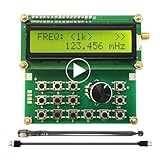
- Wide Frequency Range: 35Mhz-4400Mhz, making it suitable for a variety of applications.
- Dual Modes: Single Frequency and Sweep mode, provide greater flexibility.
- Wave From: Sine Wave, it is Not strictly Wave with some noise wave. Power: about 1mw.
- Power off memory: When the power is off, the parameters will be saved and will continue to work at the previous frequency after being powered on again.
- Convenient Power Supply: Powered by a mobile charger or Power bank or usb connecting to a computer.
With those assumptions, available noise power is kTB = 1.49 × 10⁻¹⁵ W. Applying the chosen CNR of 10 gives a minimum signal power of 1.49 × 10⁻¹⁴ W, or −108.3 dBm, and a carrier amplitude of approximately 3 μV into 300 Ω. These figures depend on the assumed temperatures, matched available-power model, bandwidth, and threshold convention; they are not a general receiver sensitivity specification.
How receiver design can extend the threshold region
Receiver techniques can reduce the likelihood that noise drives the discriminator into threshold behavior, but they do not make the conventional high-CNR equation valid below threshold. The All About Circuits article identifies FM feedback and phase-locked-loop demodulators as threshold-extension approaches. A Government of Canada technical report describes predetection filtering: restricting bandwidth before the discriminator reduces the noise reaching it and can lower the C/N at which threshold occurs. An earlier technical reference is J. Duncan’s 1964 NASA report, “FM demodulator threshold reduction final report”.
Compare receiver options using the required output SNR and input-CNR margin, the deviation ratio allowed by the bandwidth estimate, the resulting carrier power, and the demodulator structure. Threshold extension is a receiver-design choice, not a reason to rank deviation ratio by itself.
Quick Recap
Product prices and availability are accurate as of the date/time indicated and are subject to change. Any price and availability information displayed on Amazon at the time of purchase will apply.




