PC Slower Than It Used to Be?
A free scan shows the junk files, broken settings and background clutter dragging Windows down - then fixes them in one click.Free scan · Windows 10 & 11Outdated Drivers Are Slowing You Down
One free scan finds every outdated or missing driver and matches the right update for your exact hardware.Free scan · exact hardware matchChoosing the right battery fuse starts with understanding the battery system, the connected loads, and the fault current the fuse may need to stop. A fuse is not chosen only by matching the normal operating current; it must also have the correct voltage rating, interrupt capacity, physical style, and placement to protect wiring and equipment during a short circuit.
Automotive, marine, RV, solar, and backup power systems can all use different fuse types and sizing practices because their voltages, cable lengths, surge loads, and environmental conditions vary. A properly selected fuse allows normal current and temporary startup surges to pass, but opens safely before cables overheat or a battery fault becomes dangerous.
As an Amazon Associate I earn from qualifying purchases.
Understand What a Battery Fuse Does
A battery fuse is a sacrificial safety device installed in series with a battery cable. Under normal operation, current flows through it to the connected load or distribution panel. If current rises beyond the fuse’s designed limit, the metal element inside the fuse melts and opens the circuit. That interruption helps stop an overloaded wire, failed inverter, shorted charger, damaged alternator lead, or pinched cable from turning into a fire.
Quick wins for a faster PC:
Fix the driver behind crashes, sound loss and screen glitchesFind Drivers →Repair Windows errors before they cause bigger problemsFix Now →Scan for outdated or missing drivers - takes under a minuteDriver Scan →The fuse is primarily there to protect the wiring and the battery system, not the appliance itself. A refrigerator, winch, inverter, bilge pump, solar charge controller, or backup power load may have its own internal protection, but the battery cable feeding it can still be exposed to very high current. Lead-acid, AGM, lithium, and other battery banks can deliver hundreds or thousands of amps into a short circuit. Without a properly selected fuse, the cable insulation can overheat quickly, especially in automotive, marine, RV, solar, and standby power installations where cables often pass through metal compartments or tight spaces.
#1 Best Overall

- Multi Model Adaptation: Designed specifically fit for Nissan models, it is compatible with Altima 2013-2018, compatible with Maxima 2016-2019, compatible with Murano 2015-2019, and compatible with Pathfinder 2013-2019 to ensure perfect installation and optimal performance
- Rated Current Protection: Our fuse melting module has rated current values of 250Amp, 100Amp, 80Amp, 100Amp, 80Amp, 100Amp, etc. The automatic melting mechanism effectively prevents damage to automotive electronic equipment due to excessive current
- Strong Reliability: High quality car fuse protection blocks provide stable and reliable current protection, ensuring that your vehicle systems and equipment can operate normally in any situation, bringing you a reassuring driving experience
- Fast Response: This positive battery fuse connector terminal can fuse quickly in the case of abnormal current, effectively preventing damage that may be caused by overload or short circuit
- Easy to Install: Plug and play, can be installed directly without complex tools and steps. Timely replace damaged and malfunctioning fuse and fuse boxes to avoid circuit failures causing damage to electrical components and even causing accidents such as fires
A fuse should be sized so it can carry the expected operating current without nuisance blowing, while still opening before the cable or equipment is exposed to unsafe current. This is fuse selection depends on both the load and the conductor. For example, a 2,000-watt inverter on a 12-volt battery bank can draw well over 160 amps at full load before efficiency losses and surge current are considered. The fuse must be large enough for that real current, but not so large that it exceeds the safe ampacity of the cable feeding the inverter.
What a battery fuse protects against
- Short circuits: A positive cable touching a chassis, engine block, battery box, or negative conductor can create an extremely high-current fault.
- Overloads: Loads that draw more current than expected can overheat cables and terminals over time.
- Equipment failures: Failed inverters, chargers, DC-DC converters, pumps, or controllers can pull abnormal current from the battery.
- Installation damage: Vibration, abrasion, loose lugs, corrosion, and crushed insulation are common in vehicles, boats, and off-grid systems.
Different applications place different demands on the fuse. Automotive starter and accessory circuits must handle vibration and high surge loads. Marine systems need corrosion-resistant hardware and ignition-protected components where fuel vapors may be present. RV and van electrical systems often combine inverters, converters, solar chargers, and alternator charging, so mulle fused branches may be required. Solar and backup battery systems may need fuses rated for higher DC voltages and high available fault current, especially with large lithium battery banks.
A good way to think about the battery fuse is as the first line of defense for every positive cable leaving the battery. If that cable is connected directly to the battery positive terminal, it should generally have overcurrent protection as close to the battery as practical. Once you understand that the fuse is protecting the cable path from the battery to the load, the rest of the selection process becomes more straightforward: choose a fuse type that fits the environment, a current rating that matches the load and wire size, a voltage rating that matches the battery bank, and an interrupt rating high enough for the battery’s short-circuit capability.
What’s actually slowing this PC down?
Pick the symptom - the matching free tool is one click away.
Calculate the Correct Fuse Amperage
The correct battery fuse amperage is based on the current the circuit is expected to carry, not simply the largest fuse that fits the holder. A battery fuse should be large enough to handle normal operating current without nuisance blowing, but small enough to open before the cable, connector, switch, or device overheats during a fault. In practice, this means sizing the fuse to protect the wire first, while also checking that the connected load can operate normally.
Start by identifying the maximum continuous current of the load. For a DC appliance, inverter, charger, trolling motor, winch, solar charge controller, or backup power device, use the manufacturer’s rated current when available. If the device is rated in watts instead of amps, estimate current with the formula amps = watts ÷ volts. For example, a 1,200-watt inverter on a 12-volt battery bank can draw about 100 amps at full load before efficiency losses. Since inverters are not 100% efficient, a more realistic current may be 110 to 120 amps.
After calculating the expected current, add a safety margin for continuous loads. A common method is to size the fuse at about 125% of the continuous current, then choose the next standard fuse size that does not exceed the safe ampacity of the cable. For example, if a marine pump circuit draws 18 amps continuously, 18 × 1.25 = 22.5 amps, so a 25-amp fuse may be appropriate if the wire is rated for at least 25 amps in that installation. For short-duration loads such as winches, starters, and some motor loads, the fuse must also tolerate brief inrush or surge current without opening unnecessarily.
Practical fuse sizing steps
- Find the maximum load current: Use the equipment label, manual, or watts-to-amps calculation.
- Account for continuous operation: Multiply continuous current by 1.25 where applicable.
- Check the wire ampacity: The fuse rating must not be higher than the current the cable can safely carry.
- Consider surge current: Motors, compressors, and inverters may need a fuse type that handles short peaks.
- Select a standard fuse size: Choose the nearest suitable fuse rating that protects the wire and supports the load.
For automotive, marine, RV, solar, and battery backup systems, cable length and installation conditions matter. A wire in a hot engine bay, a bundled RV cable run, or a marine compartment may carry less current safely than the same gauge wire in open air. Long cable runs may also require larger wire to reduce voltage drop, but increasing wire size does not mean the fuse should automatically be oversized. The fuse should still match the protected circuit and the smallest current-rated component in that path.
Recommended Free Tools
Common examples show how this works. A 40-amp DC-DC charger may use a 50-amp or 60-amp fuse depending on the manufacturer’s instructions and cable size. A 30-amp solar charge controller generally should not be protected by a 100-amp fuse just because the battery bank is large. A 2,000-watt inverter on a 12-volt system may draw over 180 amps under heavy load, so it usually needs large cable and a high-current fuse selected from the inverter manual. When manufacturer fuse recommendations are provided, follow them unless the cable ampacity requires an even smaller fuse.
Rank #2

- Easy Identification: Made of a high quality zinc alloy, with a transparent cover and color coded
- 14 Most Common Fuses: Standard and Mini. (5A/ 7.5A/ 10A/ 15A/ 20A/ 25A/ 30A)
- Wide Applications: Fits most vehicles like car, truck, marine, SUV, travel trailer and other vehicles
- Note: Please use the right amp fuse to protect the vehicle and electronic equipment from short-circuit/overload
- ll Sizes You Need: The package contains 140pcs fuse and 2pcs fuse puller - 70pcs standard fuse and 70pcs mini fuse. (10pcs of each AMP)
Match the Fuse Voltage Rating to Your Battery System
After choosing an amperage rating, check the fuse voltage rating against the battery bank it will protect. A fuse must be rated for at least the maximum voltage it may need to interrupt, not just the nominal battery label. A 12 V automotive battery can sit around 12.6 to 12.8 V at rest and may see about 14.4 V while charging. A 24 V, 36 V, or 48 V battery bank also rises above its nominal value during charging, equalization, or solar controller operation. Select a fuse with a voltage rating equal to or higher than the highest system voltage, including charging voltage.
The voltage rating matters because opening a DC circuit is harder than opening an AC circuit. In AC systems, the current naturally crosses zero many times per second, which helps extinguish an arc. In DC battery systems, current keeps flowing in one direction, so a fuse that is underrated for voltage may blow but fail to stop the arc safely. This can leave a sustained arc inside the holder, damage nearby wiring, melt insulation, or start a fire. A fuse marked 32 V DC may be suitable for many 12 V and 24 V automotive circuits, but it is not suitable for a 48 V lithium battery bank that may charge above 56 V.
Use the highest possible system voltage
Do not size fuse voltage from the appliance voltage alone. Size it from the battery source and charger behavior. For example, a 48 V nominal LiFePO4 bank is commonly charged to about 56 to 58 V, while some lead-acid systems may be equalized at higher voltages than their normal absorption setting. Solar arrays, inverter chargers, DC-DC chargers, alternators, and shore-power chargers can all raise the voltage the fuse must interrupt during a fault.
| Battery system | Typical charging range | Common minimum fuse voltage choice |
|---|---|---|
| 12 V automotive, marine, or RV | 13.8-14.8 V DC | 32 V DC or higher |
| 24 V truck, marine, or RV | 27.6-29.6 V DC | 32 V DC minimum, often 58 V DC or higher |
| 36 V battery system | 41-45 V DC depending on chemistry | 58 V DC or higher |
| 48 V solar, inverter, or backup bank | 54-58.4 V DC for many systems | 58 V DC minimum; 80 V, 125 V, or higher where specified |
| High-voltage battery or PV-linked equipment | Varies widely | Use the equipment manual and listed DC fuse rating |
Check the marking on the fuse, not just the package
Read the actual fuse body and datasheet for a DC voltage rating. Some fuses have different AC and DC ratings, and an AC-only rating is not acceptable for a battery circuit unless the manufacturer explicitly lists a DC rating for that use. This is especially relevant when replacing industrial cartridge fuses, ANL fuses, Class T fuses, MIDI/AMI fuses, MEGA fuses, or photovoltaic fuses. A fuse may be physically similar to another style but have a lower voltage rating or be intended only for a specific holder.
For automotive 12 V accessory circuits, blade fuses and 32 V DC-rated fuse blocks are common. For marine and RV house batteries, verify the rating when the system is 24 V or 48 V, because many low-cost fuse holders are intended for 12 V and 24 V service only. For solar and backup power systems, inverter manufacturers often specify a fuse class and voltage rating because lithium battery banks can deliver very high fault current at elevated DC voltage. Matching that rating is part of the protection design, not an optional upgrade.
A safe selection rule is simple: the fuse voltage rating must be equal to or greater than the maximum battery and charging voltage. A higher voltage rating does not force more current through the circuit; it only means the fuse is built to open safely at that voltage. Never replace a 58 V, 80 V, 125 V, or 160 V DC fuse with a lower-voltage part just because the amperage is the same.
Choose the Right Fuse Type for the Application
After you know the current and voltage requirements, choose a fuse style that fits the battery system, wiring, environment, and fault energy. Battery fuses are not interchangeable just because the amp number looks right. A 150 A blade-style fuse, a 150 A ANL fuse, and a 150 A Class T fuse can behave very differently during a short circuit. The right choice depends on how much current the battery can deliver, how fast the circuit must open, how the fuse will be mounted, and whether the installation is in a vehicle, boat, RV, solar bank, or backup power cabinet.
For automotive and light-duty 12 V circuits, blade fuses, MIDI fuses, and MEGA fuses are common. Standard blade fuses are best for smaller branch circuits such as lights, radios, pumps, relays, and accessories. MIDI and MEGA fuses are better suited for higher-current feeds such as auxiliary fuse panels, DC-DC chargers, winches, and amplifier power cables. In engine compartments or off-road vehicles, use sealed fuse holders and hardware that can tolerate vibration, heat, dirt, and moisture.
Rank #3

- Protect your system: using as circuit breaker and battery Disconnect, allows to charge or maintain the battery without having to disconnect all the wires; Protect excessive current between battery or electrical from damage
- Solid breaker: new design with waterproof resistant housing and solid build; Fuse breaker Holders have Pass professional electrical performance test and aging test, the switch button is on/off smoothly, reliable quality
- Manual reset: Unique on/ off reset push button, mounted on panel or firewall, can used as a kill switch; No need to buy more replacing fuses
- Application: used in auxiliary and accessory circuits for fit to Boat Marine RV Yacht Battery Trailer Bus Truck ATV Winches applications; Also used in battery charges and DC sound amplifier system
- Use the waterproof cover to better prevent rust from metal parts. Max current 60A; Voltage DC 24V
Marine and RV battery systems often use ANL, MRBF, MEGA, or Class T fuses. ANL fuses are widely used for inverters, windlasses, bow thrusters, and large DC distribution feeds, but the holder must be protected from corrosion and water spray. MRBF terminal fuses mount directly on or near the battery terminal, which makes them useful when space is tight and the cable needs protection immediately after the battery. For large inverter banks, lithium batteries, and high-capacity AGM banks, Class T fuses are often preferred because they are fast acting and have high interrupt ratings when paired with the correct holder.
Solar and backup power systems need particular care because the battery bank and inverter can produce very high fault currents. For small DC loads, a properly rated DC breaker or fuse may be suitable. For inverter battery cables, use fuses specifically rated for DC battery protection, such as Class T, ANL, or NH-style fuses where appropriate. In lithium systems, follow the battery manufacturer’s fuse recommendation closely; many lithium iron phosphate batteries can deliver extremely high short-circuit current before the battery management system reacts.
Common fuse types and typical uses
| Fuse type | Typical application | Best suited for |
|---|---|---|
| Blade fuse | Vehicle accessory circuits | Low-current branch loads |
| MIDI fuse | Auxiliary panels, chargers, medium DC feeds | Compact automotive and RV wiring |
| MEGA fuse | High-current automotive and RV circuits | Alternator feeds, amplifiers, DC-DC chargers |
| ANL fuse | Marine, RV, and inverter circuits | Large DC cables with moderate to high current |
| MRBF fuse | Battery terminal protection | Short battery cable protection in tight spaces |
| Class T fuse | Large inverter and lithium battery banks | High fault-current battery systems |
Select the fuse holder as carefully as the fuse itself. The holder must match the fuse series, voltage rating, current rating, cable size, and environment. Loose studs, undersized terminals, exposed metal, or mismatched holders can create heat even when the fuse rating is correct. Use proper crimped lugs, clean contact surfaces, insulating covers, and strain relief so the connection stays tight under vibration and thermal cycling. For marine installations, choose ignition-protected components where required and use tinned cable and corrosion-resistant hardware.
A practical way to narrow the choice is to start with the equipment manual. Inverter, charger, battery, and motor manufacturers often specify a fuse type as well as an amperage. If the manual calls for a Class T fuse, do not substitute an ANL fuse simply because it is cheaper or easier to find. If no fuse type is specified, choose one that is DC rated, has enough interrupt capacity for the battery bank, fits the cable and holder correctly, and is proven for the application’s temperature, vibration, and moisture conditions.
Check Interrupt Rating and Short-Circuit Protection
The fuse amp rating tells you when the fuse should open during an overload, but the interrupt rating tells you whether it can safely stop the worst possible short circuit. This value is often listed as AIC, AIR, breaking capacity, or interrupting capacity. It is the maximum fault current the fuse can interrupt without exploding, arcing across its terminals, or continuing to conduct. In battery systems, this matters because even a low-voltage battery bank can deliver extremely high current into a dead short.
To choose correctly, compare the fuse interrupt rating with the maximum short-circuit current available from the battery bank. A small automotive starting battery may deliver several hundred to more than 1,000 amps into a short. Large AGM, lithium, marine, RV, solar storage, and backup power banks can deliver several thousand amps or more, especially when batteries are paralleled. The fuse interrupt rating must be higher than the available fault current at the fuse location. If the battery manufacturer publishes a short-circuit current rating, use it. If not, use the fuse and battery manufacturer’s guidance, or choose a fuse class commonly rated for high battery fault currents.
Common interrupt-rating considerations
- Automotive systems: Main battery and alternator fuses should be rated to interrupt the current available from the starting battery. ANL, MIDI, MEGA, and Class T fuses are common, but their interrupt ratings vary by brand and voltage.
- Marine and RV systems: House battery banks often use multiple batteries in parallel, increasing available short-circuit current. Do not assume an automotive blade fuse is suitable for the main battery feed.
- Solar battery systems: Inverter cables require fuses with high interrupt ratings because lithium and large lead-acid banks can feed a severe fault. Class T fuses are frequently used for high-current inverter circuits.
- Backup power systems: UPS and off-grid banks may have high-energy battery strings. The fuse must match both the DC voltage and the fault current capability of the full bank.
Short-circuit protection also depends on how fast the fuse clears a fault. Some fuses are designed for time delay so they can tolerate motor starts, inverter surges, or compressor inrush without nuisance blowing. Others open very quickly to protect sensitive wiring and electronics. For a battery main fuse, the goal is to protect the cable from overheating and to clear a bolted short before insulation melts or a fire starts. The fuse’s time-current curve should coordinate with the wire size, cable insulation temperature rating, and the expected surge current of the load.
A practical sizing check is to confirm three things together: the fuse’s continuous amp rating is appropriate for the circuit, its DC voltage rating meets or exceeds the battery bank voltage, and its interrupt rating exceeds the maximum battery fault current. For example, a 200 amp fuse on a 12 volt inverter circuit is not automatically safe just because the inverter normally draws less than 200 amps. If that fuse has a low DC interrupt rating and the battery bank can deliver 5,000 amps into a short, it may fail dangerously during the exact event it is meant to control.
Rank #4
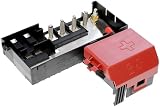
- Direct replacement - this battery fuse is designed to match the function of the original fuse in specified applications
- Ideal solution - this fuse is a reliable replacement for an original fuse that is missing or has failed
- Durable construction - made of quality materials to provide years of reliable service
- Quality assured - backed by a team of product engineers based in the United States
- Ensure fit - Input your vehicle into the garage tool and check Confirmed Fit bar at the top of the page. If there is an “i” in a blue circle, additional verification is needed. Please hover over the "i" to verify fitment notes match your vehicle
Common mistakes include using AC-rated fuses in DC battery circuits, choosing a fuse only by amperage, assuming all ANL or MEGA fuses have the same breaking capacity, and installing a high-amp fuse in a holder that has a lower voltage or interrupt rating. The fuse holder, studs, busbars, and enclosure should be rated for the same environment and current level. In high-energy systems, especially lithium battery banks feeding large inverters, select fuse hardware as a matched system rather than mixing parts by appearance or terminal size.
Independent reader supportYour contribution helps us test, update, and keep practical guides available for everyone.Place the Fuse in the Right Location
A battery fuse should be installed as close to the battery’s positive terminal as practical, because its main job is to protect the cable leaving the battery. If that cable rubs through on a chassis edge, battery box, engine bracket, or metal cabinet, the fuse must open before the wire overheats. In automotive, marine, RV, solar, and backup power systems, the unfused section between the battery terminal and the fuse should be kept extremely short and physically protected.
For many low-voltage DC systems, a common target is to place the main fuse within about 7 inches of the battery terminal when possible. Some marine and RV standards allow longer distances if the conductor is enclosed in conduit, loom, or a protected raceway, but the principle stays the same: minimize exposed, unfused cable. The fuse should come before long cable runs, distribution blocks, inverters, charge controllers, DC panels, and other loads.
Do these 3 things before closing this tab:
1Repair Windows errors before they cause bigger problems2Fix the driver behind crashes, sound loss and screen glitches3Clear out junk files and repair common Windows errorsTypical Fuse Placement by System
- Automotive: Install the main fuse or fusible link close to the battery positive post before the cable runs to amplifiers, auxiliary fuse panels, winches, or aftermarket accessories.
- Marine: Place the fuse near the battery bank, then route protected conductors to battery switches, bus bars, bilge circuits, and DC distribution panels. Use ignition-protected components where gasoline vapors may be present.
- RV and van systems: Fuse the positive lead from the house battery before it reaches the inverter, DC fuse block, solar charge controller connection, or DC-DC charger wiring.
- Solar battery banks: Fuse each battery string or battery positive lead before it connects to a common bus bar, especially in parallel battery banks where one battery can feed a fault in another cable.
- Backup power and UPS-style battery banks: Install battery-rated fuses close to the battery rack or cabinet output before cables run to the inverter/charger or DC disconnect.
Battery switches and disconnects do not replace proper fuse placement. A disconnect can isolate the system during service, but it may not open automatically during a short circuit. In many layouts, the safest order is battery positive terminal, short protected cable, main fuse, then disconnect switch, bus bar, or distribution equipment. If the disconnect must be closer to the battery for operational reasons, the cable between the battery and switch still needs short-circuit protection unless it is specifically designed and routed as a protected unfused conductor.
Parallel battery banks need extra attention. If mulle batteries feed a shared bus, each battery positive lead should usually have its own fuse near that battery. This prevents the remaining batteries from dumping current into a shorted battery cable. In larger lithium systems, follow the battery manufacturer’s requirements for class-T, ANL, MRBF, or other specified fuses, and coordinate fuse placement with the battery management system, contactor, and main disconnect.
Placement Details That Matter
- Protect the unfused lead: Use abrasion-resistant loom, grommets, cable glands, or conduit where the cable passes through metal or near sharp edges.
- Keep fuse holders accessible: Mount the fuse where it can be inspected and replaced without dismantling the battery compartment, but not where tools can easily short across terminals.
- Avoid heat and moisture: Keep fuses away from exhaust parts, engine heat, standing water, battery acid spray, and areas with poor ventilation.
- Use proper enclosures: In marine, outdoor solar, and exposed RV compartments, use sealed or corrosion-resistant fuse holders rated for the environment.
- Label the circuit: Mark the fuse size, circuit served, and battery bank voltage so future maintenance does not result in an oversized replacement.
Do not place the only fuse at the far end of the cable near the load. A fuse next to an inverter, amplifier, or DC panel may protect that device, but it leaves the long battery cable unprotected. For high-current equipment, it is common to have both a main battery fuse near the battery and additional branch fuses near distribution points. This layered approach protects the source cable, the branch wiring, and the connected equipment without relying on a single fuse to handle every possible fault.
Avoid Common Battery Fuse Sizing Mistakes
Many battery fuse problems come from treating the fuse as a general-purpose part instead of a coordinated safety device. The fuse must protect the cable, survive normal operating current, open safely during a fault, and match the battery voltage and chemistry. A fuse that is “close enough” may work during light use but fail when an inverter starts, a winch stalls, a charger peaks, or a battery bank delivers thousands of amps into a short circuit.
The Tool Desk
Outbyte PC Repair FREEClear out junk files and repair common Windows errorsFree Scan →Outbyte Driver Updater FREEFix the driver behind crashes, sound loss and screen glitchesFind Drivers →A common mistake is sizing the fuse only to the load and ignoring the wire ampacity. For example, if an inverter can draw 180 amps but the installed cable is only safe for 150 amps in that routing and temperature, installing a 200 amp fuse leaves the cable underprotected. The correct fix is either to increase the cable size and terminals or reduce the fuse rating to protect the existing wiring. The fuse rating should be high enough for expected continuous current and short surges, but never higher than the safe current capacity of the smallest conductor or device in that branch.
Best Value

- Direct replacement - this battery fuse is designed to match the function of the original fuse in specified applications
- Ideal solution - this fuse is a reliable replacement for an original fuse that is missing or has failed
- Durable construction - made of quality materials to provide years of reliable service
- Quality assured - backed by a team of product engineers based in the United States
- Ensure fit - to make sure this part fits your exact vehicle, input your make, model and trim level into the garage tool
- Using an oversized fuse: This may prevent nuisance blowing, but it can allow cables, lugs, switches, and bus bars to overheat before the fuse opens.
- Using an undersized fuse: This can cause repeated nuisance trips during motor starting, inverter surge loads, compressor startup, or battery charger inrush.
- Ignoring voltage rating: A 32 V automotive fuse should not be used on a 48 V solar battery bank or higher-voltage DC backup system unless its DC voltage rating clearly covers the system.
- Overlooking interrupt capacity: Lithium batteries and large AGM banks can deliver very high fault current. The fuse must have an ampere interrupting capacity suitable for the battery bank, not just the load current.
- Installing the fuse too far from the battery: Unprotected positive cable between the battery and fuse can still short to chassis, engine parts, frames, or metal enclosures.
Another frequent error is failing to account for continuous-load derating. In many DC systems, loads expected to run for long periods are sized so the fuse is not operated at its absolute limit. As a practical approach, calculate the maximum continuous current, mully by about 125%, then compare that value with the cable ampacity and the equipment manufacturer’s fuse recommendation. For a 60 amp continuous DC load, this often points toward a 75 or 80 amp fuse, provided the cable and terminals are rated accordingly. For an inverter, use the manufacturer’s specified fuse size whenever available, because surge behavior and internal protection vary widely.
Application details also matter. In automotive systems, blade fuses and MIDI or MEGA fuses are common, but high-output alternators, winches, and auxiliary battery circuits may need heavier-duty fusing. In marine and RV systems, corrosion-resistant fuse holders, ignition protection where required, and secure strain relief are just as as amperage. In solar and backup power systems, check whether the fuse is rated for DC, whether it can clear faults from lithium batteries, and whether each parallel battery string needs its own protection. Reusing an old fuse holder, mixing fuse brands with incompatible holders, or stacking extra wires on a battery post can create heat and resistance even when the fuse size looks correct on paper.
Good fuse selection ends with a physical inspection. Confirm that the fuse holder matches the fuse type, all terminals are crimped with the proper tool, fasteners are torqued to specification, and no cable can rub against sharp metal. After the system has run under a heavy load, check for warm holders, discolored insulation, soft plastic, or voltage drop across the fuse connection. These signs usually point to poor contact, undersized hardware, or the wrong fuse style, and they should be corrected before relying on the battery system in daily service.
Frequently Asked Questions
Should my battery fuse match the battery size or the device load?
The fuse should be sized to protect the wire first, while still allowing the connected load to operate normally. Start with the expected maximum current of the inverter, charger, motor, or DC panel, then confirm the cable can safely carry more than the fuse rating. Do not choose a larger fuse just because the battery has a high amp-hour rating or high cranking capability.
How close should the fuse be to the battery?
Install the fuse as close to the battery positive terminal as practical, often within 7 inches in many automotive and marine guidelines. The goal is to protect the entire length of positive cable from a short to chassis, hull, or another conductor. If the cable leaves the battery compartment before being fused, that unfused section remains a serious fire risk.
Can I use an automotive blade fuse for a solar, RV, or lithium battery system?
Only if the fuse is rated for the system voltage, current, and available short-circuit current. Small automotive blade fuses may work for low-current 12V branch circuits, but they are usually not appropriate for large inverters, lithium batteries, or higher-voltage solar battery banks. For high-current battery circuits, ANL, MIDI/AMI, Class T, MEGA, or properly rated DC breakers are more common choices.
What happens if I install a fuse with too high of an amp rating?
A fuse that is too large may not blow before the wire overheats during an overload or short circuit. This can melt insulation, damage equipment, or start a fire, especially in boats, RVs, and battery banks with long cable runs. If a fuse keeps blowing, find the overload, short, or undersized cable problem instead of simply increasing the fuse size.
Free tools Windows power users keep installed
One-click scans. No signup required.
Do battery fuses need a DC voltage rating and interrupt rating?
Yes, the fuse must be rated for the battery system’s DC voltage and have an interrupt rating high enough for the maximum fault current the battery can deliver. DC arcs are harder to extinguish than AC arcs, so using an underrated fuse can let the fuse fail dangerously instead of clearing the fault. This is especially critical with lithium batteries, large lead-acid banks, inverters, and backup power systems.
Bottom Line
Choosing the right battery fuse comes down to matching the fuse to the system’s voltage, expected current, wire size, battery chemistry, and available fault current. Size it to protect the cable first, choose the correct fuse style and interrupt rating, and place it as close to the battery positive terminal as practical.
Before installing or upgrading a fuse, verify the load current, surge current, cable ampacity, voltage rating, and environment, especially in automotive, marine, RV, solar, and backup power systems. When in doubt, use manufacturer recommendations or consult a qualified electrician, because the right fuse is a small part that prevents very large problems.
Quick Recap
Product prices and availability are accurate as of the date/time indicated and are subject to change. Any price and availability information displayed on Amazon at the time of purchase will apply.




