Recommended Free Tools
Data centers add large, concentrated electricity loads, but the effect on a particular power grid depends on where facilities connect, when they begin operating, how much power they draw at peak, and whether grid upgrades are ready. National forecasts show rapid growth; local utility and transmission studies determine where that growth becomes a constraint—and who may pay to address it.
How do data centers affect the local power grid?
A data center is a large electricity customer concentrated at one or a small number of grid connection points. When a facility connects, the serving utility must assess whether the local network can deliver its demand reliably. Depending on the site and the wider system, that can mean work on distribution equipment, a substation, transmission lines, generation resources, or several of these at once. The Federal Energy Regulatory Commission (FERC) says facilities of this scale might need new generation or transmission infrastructure to interconnect reliably (FERC, 2025 State of the Markets, published March 2026).


As an Amazon Associate I earn from qualifying purchases.
The impact is not captured by annual electricity use alone. Energy is the amount consumed over time, usually reported in terawatt-hours (TWh); capacity or peak demand describes the power needed at a particular time, often in gigawatts (GW) or megawatts (MW). A high annual total does not by itself reveal the local peak, the timing of that peak, or what equipment needs to be upgraded. Converting between annual energy and peak capacity requires assumptions about how demand varies over time.
Quick wins for a faster PC:
Clear out junk files and repair common Windows errorsFree Scan →Fix the driver behind crashes, sound loss and screen glitchesFind Drivers →Repair Windows errors before they cause bigger problemsFix Now →Why one large connection can matter locally
National demand can be spread across a broad system, but a new facility draws power through specific network connections. If projects cluster in one utility territory or near the same constrained equipment, the local planning challenge can be more acute than a national share suggests. A national forecast therefore cannot establish whether a particular town, substation, or utility has enough capacity.
How much electricity will data centers use?
Forecasts point upward, but their numbers refer to different geographies, years, and measures. They are scenarios, not a single guaranteed outcome.
| Geography and source | Projection | How to read it |
|---|---|---|
| United States — Lawrence Berkeley National Laboratory (LBNL), 2025 update | Data centers could account for 11.8% of total U.S. electricity consumption in 2030; scenario range: 9.5%–15.3%. | Share of U.S. electricity consumption, not a peak-capacity figure. See LBNL’s Data Centers page. |
| Global — International Energy Agency (IEA), 2026 outlook | 485 TWh in 2025, rising to 950 TWh in 2030—around 3% of global electricity demand in 2030. | Global annual electricity consumption estimate; not a forecast for any one country or local grid. See the IEA’s 2026 executive summary. |
| United States — U.S. Department of Energy (DOE), July 2026 draft | Its compilation of projections implies as much as over 400 TWh of additional data center load by 2030. | The document is a draft for consultation and public comment. It also cites a separate FERC capacity-growth range of 13–55 GW by 2030; that GW range is not interchangeable with TWh. See the DOE draft transmission study. |
LBNL’s 2024 U.S. report estimated historical use back to 2014 and developed scenarios through 2028 using computing-equipment shipments and infrastructure such as cooling. Its 2024 range of 6.7%–12.0% by 2028 should not be compared as though it were the same forecast as the 2025 update’s 2030 range: the horizon and scenario sets differ. The 2024 LBNL report explains its approach.
Forecasts also depend on whether proposed projects are built, when they enter service, how much computing equipment they install, and how efficiently they operate and cool it. The IEA’s 2026 outlook says bottlenecks make more aggressive near-term outcomes less likely, while longer-term upside remains possible. Those uncertainties are a reason to plan against scenarios rather than treat announced projects as certain demand.
What’s actually slowing this PC down?
Pick the symptom - the matching free tool is one click away.
Where are grid impacts most concentrated?
The DOE’s July 2026 draft identifies Virginia and Texas as states with among the greatest estimated current data center electricity demand and some of the largest projected increases through 2030. Arizona and Oregon are also among the states it identifies for significant expected growth. These are comparative findings summarized in a draft study, not a complete measured state ranking or a guarantee about any individual utility territory.
At the local level, the relevant questions are which utility serves a proposed site, which transmission and distribution facilities supply it, what other loads are expected nearby, and whether those facilities have room at the hours the data center needs power. Two projects with similar annual energy use may pose different grid challenges if they connect in different places or have different peak-demand patterns.
Why do utilities and grid planners use scenarios?
Projects can be announced or apply for service well before they become operating loads. Planners need to estimate both whether a proposed facility will enter service and when. FERC staff’s analysis of Yes Energy data found that the average size of data centers entering service in its dataset rose from 25 MW in 2020 to almost 80 MW in 2025. Those are dataset averages, not a standard size for every facility.
Rank #3

- Powerful Output: 4400 peak watts and 3400 running watts, 2*120V AC ports, 1* 30A RV port, 1*12V DC port, 14 hours runtime at 25% load
- Gas Powered: 2 gallon fuel tank capital
- Features: Inverter technolog, ECO mode, EPA compliment, RV ready, overload protection, low oil shutdown, cold start technology
- Portable Generator: Weight 56lbs, lightweight and easy to move
- Note: All Oxseryn generators are functionally tested in the factory, so there may be a slight smell of gas when you receive it
For its 2024 report, LBNL varied assumptions about equipment shipments, operational practices, and cooling energy. The IEA discusses equipment and chip bottlenecks, project pipelines, and uncertainty; DOE’s draft compiles projections that use different measures. Taken together, these differences make a single deterministic forecast a poor basis for deciding what to build. Forecasts are more useful when they test how plans change with project timing, realized demand, efficiency, and operational flexibility.
What can supply the added electricity?
More demand does not automatically mean one particular power source will serve it. In the IEA’s 2025 global outlook, renewables meet nearly half of the projected growth in data center electricity demand through 2030, while natural gas and coal together provide over 40%. The mix varies by region; this global scenario does not identify the resource that will serve a specific local project. See the IEA’s Energy and AI: Energy supply for AI.
Some U.S. developers have pursued onsite natural-gas generation in response to slow grid connections, according to the IEA’s 2026 update. Onsite generation does not automatically remove grid constraints: most data centers still prefer grid connections. Storage and flexible operations may also help the system when incentives and operating arrangements support them (IEA, 2026 executive summary).
Rank #4

- 5000 Peak Watts and 3900 Rated Watts at Less Than 3% THD – Telescoping Handle – Gas or Propane Powered – Remote Start With Included Key Fob, Electric and Recoil Start
- Features a 5–20R 120V Duplex Household Outlet, an RV-Ready TT-30R 30 Amp Outlet and Two USB Outlets – Great Choice for Travel Trailers or Home Use – Strong Enough to Run All Your Essentials
- Led Data Center: Rotating Digital Display Shows Fuel Level, Power Output, Remaining Run Time, Voltage Output, and Lifetime Hours
- Extremely Quiet, Extremely Fuel Efficient: as Low as 52 dBA Noise Output and Up to 18 Hour Run Time on a 3.4 Gallon Gas Tank – Features “Economy Mode” for Maximum Fuel Efficiency
- All Westinghouse Portable Generators are Functionally Tested in the Factory and May Contain Minimum Residual Oil and/or Fuel Odor; EPA Compliant; Backed By 3-Year Limited Service, Labor, and Parts Coverage and Nationwide Customer Service Network
Flexibility can help, but it is not automatic
Shifting some electricity use to different hours could reduce coincident peaks or the cost of serving demand at particular times. Its usefulness depends on the facility, grid conditions, contracts, and operating requirements. Not every data center can shift the same share of its load, and flexibility should not be assumed without a specific operating arrangement.
Independent reader supportYour contribution helps us test, update, and keep practical guides available for everyone.Will data centers increase my electricity bill?
Not necessarily by a predictable amount. The effect on other customers depends on the utility’s tariff and cost-allocation rules, what upgrades are needed, who pays for dedicated facilities and shared network work, and whether expected projects actually arrive. The sources cited here do not establish a single household-bill effect or a rule that applies across jurisdictions.
State utility commissions and regulators consider large-load tariffs and policy options, among other issues. To assess a specific proposal, check the applicable utility tariff, commission orders, and utility filings. Those documents determine how costs for dedicated connections, shared upgrades, and any assets left underused are allocated under local rules. NARUC’s July 2025 large-load literature review covers tariffs and policy alongside forecasting, reliability, interconnection, flexibility, and other planning themes.
Best Value
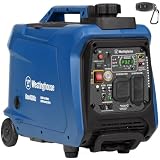
- 4000 Peak Watts and 3300 Rated Watts at Less Than 3% THD; Telescoping Handle; Gas Powered; Remote Start With Included Key Fob, Electric and Recoil Start
- Features a 5–20R 120V Duplex Household Outlet, an RV-Ready TT-30R 30 Amp Outlet and Two USB Outlets – Great Choice for Travel Trailers or Home Use with Automatic Low Oil and Carbon Monoxide (CO) Shutdown – Strong Enough to Run All Your Essentials
- Led Data Center: Rotating Digital Display Shows Fuel Level, Power Output, Remaining Run Time, Voltage Output, and Lifetime Hours
- Extremely Quiet, Extremely Fuel Efficient: as Low as 52 dBA Noise Output and Up to 7 Hour Run Time on a 1.69 Gallon Gas Tank – Features “Economy Mode” for Maximum Fuel Efficiency
- All Westinghouse Portable Generators are Functionally Tested in the Factory and May Contain Minimum Residual Oil and/or Fuel Odor; EPA Compliant; Backed By 3-Year Limited Service, Labor, and Parts Coverage and Nationwide Customer Service Network
How can readers evaluate a local grid proposal?
When a utility, regulator, or local government discusses a proposed data center or grid expansion, look for evidence on these points:
- Timing and certainty: Is the facility proposed, under construction, or committed to a service date? What is the basis for assuming it will operate?
- Location and network: Which utility territory and transmission connections are involved? Are substation or local distribution upgrades also required?
- Demand profile: Does the filing report annual energy and peak demand separately? Does it explain load factor, ramps, or hours of highest demand?
- Supply plan: Is the project relying on grid purchases, new generation, renewable procurement, co-location, storage, or onsite generation? A contract for energy does not by itself establish that power can be delivered at the needed place and time.
- Cost allocation: Who pays for dedicated facilities, shared upgrades, and assets that could be left unused if a project is delayed or canceled?
- Reliability and local effects: Does the analysis address resource adequacy, resilience, emissions, land and water use, and other local impacts?
- Flexibility: Are any promises to shift or limit demand backed by enforceable operating terms and incentives?
NARUC’s review organizes many of these issues into eleven themes, including load forecasting, resource adequacy, large-load interconnection, demand flexibility, generation, co-location, infrastructure, tariffs, policy, planning tools, and design and operations.
Quick Recap
Product prices and availability are accurate as of the date/time indicated and are subject to change. Any price and availability information displayed on Amazon at the time of purchase will apply.




