Researchers at Nanjing Tech University demonstrated a continuous way to make magnetic, polymer-coated nano-stirrer bars: electrospin iron oxide-containing fibres, collect them in water, then use ultrasound to break them into short bars. In a laboratory proof of concept, the bars mixed a reaction while gold nanowires grown on their surfaces helped catalyse it. The 2020 study describes a research method, not commercially validated microfluidic equipment.
How the nano-stirrer bars are made
Qiaozhen Ji, Ting Hu, Qiuxian Chen, Wenwen Xin, Xueyang Liu and Hongyu Chen reported the method in Chemical Communications in 2020. The Royal Society of Chemistry describes it as a scalable, continuous preparation route, combining electrospinning with ultrasonic breaking rather than relying on the batch assembly approach discussed as prior work.

As an Amazon Associate I earn from qualifying purchases.
- Electrospin the material: The process forms magnetic Fe3O4 nanofibres coated in a polymer. In the demonstrated version, the shell is low-porosity polyacrylonitrile (PAN).
- Collect the fibres in water: The electrospun fibres are collected in a water bath.
- Break the fibres into bars: Ultrasound divides the fibres into shorter nano-stirrer bars.
The paper says an external magnet is not required during synthesis. That refers only to making the bars; it does not mean they can be actuated in use without a magnetic field. Chemistry World describes them as magnetically field-driven. The researchers described the PAN shell as durable in acidic and basic conditions, but the accessible accounts give no quantitative durability measure or operating lifetime.
How they mix and what the proof of concept showed
Once made, the magnetic bars can be driven by an applied magnetic field to stir small volumes. This offers a way to induce mixing without relying solely on channels or other external influences. The motivation is practical: mixing becomes difficult when the amount of solution is very small, and inserting a bar that can be activated externally may help. This is a proposed advantage, not a quantified comparison with other mixing methods.
#1 Best Overall
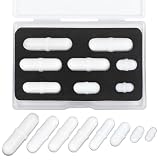
- Versatile Magnetic Stir Bar Set: This 8-piece PTFE Magnetic Stir Bar set includes 8 different sizes, providing perfect options for various laboratory applications
- Good Quality Material: Polyethylene tetrafluoroethylene (PTFE) magnetic stir bars are made by sealing permanent magnets in PTFE material can withstand high temperatures
- Perfect for Laboratory and DIY Use: Ideal for laboratory applications such as chemistry labs, general training, science lab, also a good choice for the home diy handmade project
- How to Select: Select the stir bar based on the volume; For volumes up to 1000 mL, a 15 mm stir bar is sufficient. For volumes up to 3000 mL, a 30 mm stir bar should be used; Note: Stir bars are suitable for use with liquids of low viscosity. If used with thick, oil-like liquids, the stirring efficiency may be affected
- Ideal for Flat Bottom Container: This cylindrical with shaft ring shape stir bar set is suitable for use in flat-bottom containers
The study also demonstrated a second function. The researchers grew gold nanowires on the bars’ surfaces, then used the nanowire-bearing bars in a 4-nitrophenol reduction while stirring. This shows a laboratory example of combining mixing with a catalytic surface. It does not establish broad chemical compatibility, industrial deployment, or performance across other reactions.
What the study establishes—and what it does not
| Question | What the reported work supports |
|---|---|
| Can the preparation be continuous? | The authors report a continuous electrospinning and ultrasonic-breaking route. |
| What are the bars made from? | Magnetic Fe3O4 fibres with a polymer coating; PAN was the demonstrated shell. |
| Can they mix and catalyse? | A proof of concept combined magnetic stirring with surface-grown gold nanowires in a 4-nitrophenol reduction. |
| Is there a measured mixing-rate or throughput advantage? | No comparable numerical benchmark is provided in the cited accounts. |
| Are they commercially available or validated for particular microfluidic platforms? | The cited accounts do not establish retail availability or platform compatibility. |
The word “scalable” appears in the paper’s title, and a corresponding author told Chemistry World that the method’s biggest advantage is “the large scale.” Neither source excerpt supplies a numerical production rate, yield, or head-to-head performance test. The work therefore supports the researchers’ continuous-production approach and a specific proof of concept, not a claim that it outperforms established equipment or is ready for routine commercial use.
Rank #2
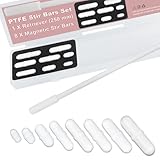
- Versatile Magnetic Stir Bar Set: This 8-piece PTFE Magnetic Stir Bar set includes 8 different sizes and recycling rod for stir bar retrieval, providing perfect options for various laboratory applications
- Good Quality Material: Polyethylene tetrafluoroethylene (PTFE) magnetic stir bars are made by sealing permanent magnets in PTFE material can withstand high temperatures
- Perfect for Laboratory and DIY Use: Ideal for laboratory applications such as chemistry labs, general training, science lab, also a good choice for the home diy handmade project
- How to Select: Select the stir bar based on the volume; For volumes up to 1000 mL, a 15 mm stir bar is sufficient. For volumes up to 3000 mL, a 30 mm stir bar should be used; Note: Stir bars are suitable for use with liquids of low viscosity. If used with thick, oil-like liquids, the stirring efficiency may be affected
- Ideal for Flat Bottom Container: This cylindrical with shaft ring shape stir bar set is suitable for use in flat-bottom containers
Where this approach may fit
For researchers considering microscale mixing options, the useful questions are how mixing is actuated, how the method integrates with a small system, whether movement might disturb tiny droplets, and whether a catalytic function is useful alongside stirring. The paper raises these considerations but does not provide a head-to-head trial or validated integration results for specific devices.
Free tools Windows power users keep installed
One-click scans. No signup required.
The bars are magnetically actuated, so a laboratory magnetic stirrer is a related equipment category, not a confirmed compatible product. The sources identify no retail make or model and do not verify compatibility with any particular stirrer, electrospinning system, ultrasonic processor, or microfluidic platform.
Rank #3
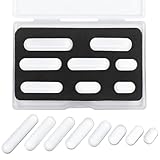
- Versatile Magnetic Stir Bar Set: This 8-piece PTFE Magnetic Stir Bar set includes 7 different sizes, providing perfect options for various laboratory applications
- Good Quality Material: Polyethylene tetrafluoroethylene (PTFE) magnetic stir bars are made by sealing permanent magnets in PTFE material can withstand high temperatures
- Perfect for Laboratory and DIY Use: Ideal for laboratory applications such as chemistry labs, general training, science lab, also a good choice for the home diy handmade project
- How to Select: Select the stir bar based on the volume; For volumes up to 1000 mL, a 15 mm stir bar is sufficient. For volumes up to 3000 mL, a 30 mm stir bar should be used; Note: Stir bars are suitable for use with liquids of low viscosity. If used with thick, oil-like liquids, the stirring efficiency may be affected
- Ideal for Various Container Types: This cylindrical shape stir bar set is ideal for use in flat-bottom, cylindrical beakers
Publication details
The Royal Society of Chemistry lists the article as “Scalable and continuous preparation of nano-stirbars by electrospinning,” first published on 31 August 2020 in Chemical Communications, volume 56, pages 11767–11770, DOI 10.1039/D0CC04408C. Read the paper at the Royal Society of Chemistry. Chemistry World’s accessible account, by Ella Wren and published 14 September 2020, includes comments from co-author Xueyang Liu and Argonne National Laboratory scientist Elena Shevchenko: Read the Chemistry World report.
Quick Recap
Best Value

- 🧲 Comprehensive 8-Piece Stir Bar Set Includes A9×25mm, B9×30mm, C8×35mm, G8×20mm high-temp glass stir bar (350°C), H12×26mm, gear-type 7×40mm, cross 10×40mm, 180mm PTFE magnetic stir bar retriever
- 🧪 High Compatibility with Lab & DIY Uses Perfect for use with magnetic stirrers, hot plates, beakers, stir plates, and mycology supplies. Compatible with most laboratory magnetic stirrer mixers, including multi-position stirrers.
- 🔥 Heat-Resistant Glass Stir Bar Included The G8×20mm magnetic glass stir bar withstands up to 350°C, ideal for high-temperature chemical reactions or cooking tasks requiring consistent stirring.
- 💡 PTFE Coated for Chemical Resistance All stir bars and rods (except glass) are coated with inert PTFE, ensuring corrosion resistance, low friction, and long service life for magnetic agitation.
- 📦 Secure Storage Case for Organization All 9 magnetic stir bars and the stirring rod come in a labeled foam-insert plastic case for easy access, storage, and protection of your lab tools.
Product prices and availability are accurate as of the date/time indicated and are subject to change. Any price and availability information displayed on Amazon at the time of purchase will apply.




