Recommended Free Tools
AI is changing warfare less as a single “robot weapon” than as a layer across intelligence, planning, logistics, cyber operations, information work, decision support and uncrewed systems. Some applications recommend actions to people; autonomous functions can select or act from sensor inputs within defined limits. The central question is whether people retain meaningful authority to understand, authorize, restrict, stop and review the use of force.
Current policy documents and international debate describe major potential benefits and serious risks, but they do not provide a complete, independently verified record of AI-caused battlefield outcomes. What can be assessed now is how systems are designed, governed and supervised—and whether those arrangements are adequate for civilian protection and lawful military operations.

As an Amazon Associate I earn from qualifying purchases.
Military AI is broader than autonomous weapons
“Military AI” covers software and machines that perform tasks associated with perception, prediction, classification, optimization or decision-making. The United Nations Office for Disarmament Affairs (UNODA) describes uses that include weapon systems, decision-support tools and other military tasks. The U.S. Department of Defense (DoD) groups applications across operational planning, logistics, intelligence, information operations, cyber activities, decision support, and uncrewed or autonomous systems.
That distinction matters. An algorithm that helps analysts sort satellite imagery may be AI-enabled without being able to use force. A planning model may rank supply routes while leaving every decision to a commander. Conversely, an autonomous function can be embedded in a larger system that also has non-autonomous components. Treating all military AI as an autonomous weapon obscures where risks actually arise.
| Application area | What AI may do | Does it select or apply force? |
|---|---|---|
| Intelligence and reconnaissance | Classify images, detect patterns, fuse sensor feeds and flag possible objects or activities. | Not necessarily; outputs may be recommendations for human analysts. |
| Decision support | Compare courses of action, estimate logistics demand, identify anomalies or prioritize information. | Usually no direct authority to use force, though recommendations can influence decisions. |
| Operational planning and logistics | Optimize routes, schedules, maintenance and resource allocation under changing conditions. | No, unless connected to a system with separate authorities to act. |
| Cyber and information operations | Detect threats, automate defensive responses, generate or target information and manage network activity. | Potentially disruptive, but effects and authorities depend on the specific system and mission. |
| Uncrewed and autonomous systems | Navigate, track, classify, select or engage objects, or perform other tasks with varying degrees of human involvement. | Some systems can select or act against targets; others only assist an operator. |
AI can therefore alter military operations even when no machine is authorized to fire. Faster analysis, persistent sensing and automated coordination may compress the time available for human judgment. That can improve responsiveness, but it can also make errors propagate faster and make it harder for operators to understand why a recommendation appeared.
What “autonomous” means in a military system
Autonomy describes a function, not a product label or a claim that a machine is completely independent. In the relevant policy and humanitarian discussions, an autonomous function can select or act based on sensor inputs after activation, rather than requiring a person to approve every individual movement or engagement.
Automation, autonomy and remote operation
- Automation: A system follows a rule or performs a repetitive task, such as maintaining a course, without making a broad judgment about a changing situation.
- Remote operation: A human directly controls the system from another location. The platform may be uncrewed but not autonomous.
- Autonomous function: After activation, software interprets inputs and selects actions within its programmed or learned parameters. The operator may set the mission, constraints or conditions rather than directing each action.
These categories can overlap. A platform might navigate autonomously, require human authorization to select a target, and then automate a narrowly defined defensive response. The meaningful issue is which decisions are delegated, for how long, in what environment, against what target types and with what ability to intervene.
How human oversight is designed
“Human in the loop” and “human on the loop” are not sufficient descriptions of control. A person may technically be present yet lack the information, time, authority or reliable communications needed to make a meaningful decision. The practical test is what the human can know, decide, stop and review.
An ICRC–SIPRI framework makes oversight concrete through three control families: weapon parameters, environmental constraints and human supervision. These controls can be combined rather than treated as competing labels.
1. Weapon and target parameters
Designers and commanders can restrict what the system is allowed to detect, classify or engage. Limits may specify target categories, prohibited objects, geographic boundaries, munition effects, confidence thresholds or circumstances in which an engagement is permitted. Narrower parameters reduce the range of situations in which an unexpected classification can lead to force.
2. Environmental constraints
A system may be authorized only in a defined area, time window, weather condition, communications state or level of battlefield complexity. A capability that performs predictably in an open, sparsely populated area may be unsuitable in a crowded urban environment with civilians, damaged infrastructure and rapidly changing signals.
Free tools Windows power users keep installed
One-click scans. No signup required.
Rank #2
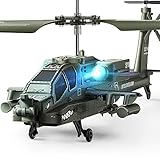
- Authentic Fighter Design: Inspired by real military helicopters, this RC combat chopper features intricate detailing and high-quality craftsmanship—perfect for kids and adults who appreciate military nostalgia. It’s powered by dual hollow cup motors for strong propulsion and responsive maneuvering
- Beginner-Friendly Flight: Worried about complicated controls? Don’t be. This helicopter features one-touch takeoff and landing, allowing new pilots to get airborne effortlessly. Once in the air, it hovers steadily at about 5 feet, making it perfect for indoor or backyard flying. Great for kids 8+ and adults who are new to RC flying
- Dual Protection System: Your investment is protected. If the blades get stuck or blocked during flight, the built-in motor cut-off kicks in to prevent damage. When the battery runs low, the helicopter’s lights flash as a visual reminder to land. A worry-free experience for both kids and parents
- Multiplayer Ready: Fly solo or battle in the air! The 2.4GHz anti-jamming remote offers up to 80 feet (25 meters) of responsive range and allows multiple helicopters to fly simultaneously without interference. Ideal for weekend family competitions, birthday parties, or after-school fun with friends
- Educational Toy: In addition to being used as a toy, our rc army helicopter can also be used as an ornament to decorate your desktop. More importantly, playing together helps spark curiosity about military aircraft and encourages quality parent-child bonding
3. Human supervision
Supervision includes who authorizes activation, how frequently operators receive information, whether they can modify or abort an action, and how quickly a stop command can take effect. It also includes staffing, training, communications resilience and procedures for reviewing logs after an event.
The comparison axes below help evaluate two systems or governance approaches. They are practical questions drawn from ICRC and DoD material, not a universal scoring standard.
| Control question | What to examine |
|---|---|
| Target type and selection | Are targets objects, people, vehicles or emissions? Can the system select among them, and are prohibited categories encoded? |
| Operating environment | Where may it operate, and how are civilians, allies, neutral objects, weather and degraded sensors handled? |
| Activation duration and scope | How long does autonomy run, over what area, and can the mission expand without a new authorization? |
| Timing and authority of supervision | Who approves activation, who can change parameters, and how much time is available to intervene? |
| Predictability and explainability | Can operators anticipate behavior across realistic conditions and understand why a classification or action occurred? |
| Testing and demonstrated performance | Has the system been tested against realistic variation, edge cases, electronic interference and failures—not only ideal demonstrations? |
| Auditability and training | Are decisions and sensor data logged, and are users trained to detect automation bias and misuse? |
| Disengagement and deactivation | Can the system be safely stopped or recalled when behavior is unintended, communications fail or circumstances change? |
What U.S. policy requires
The U.S. Department of Defense announced an update to Directive 3000.09 on January 25, 2023. The directive says autonomous and semi-autonomous weapon systems should allow commanders and operators to exercise appropriate levels of human judgment over the use of force. It also calls for compliance with applicable law and rules of engagement, appropriate care in system development and use, and performance demonstrated under realistic conditions.
The stated purpose includes minimizing the probability and consequences of failures that could produce unintended engagements. DoD guidance on responsible military AI also emphasizes governance, bias mitigation, auditability, user training to reduce automation bias, rigorous testing and safeguards against unintended behavior.
This is U.S. policy, not a global rule. It does not by itself establish how every country defines autonomy or human control, nor does a policy statement prove that a particular deployed system has performed safely in combat. Evaluating a system still requires information about its mission, authorization chain, testing, operating limits and incident-review process.
Humanitarian and legal concerns
The International Committee of the Red Cross (ICRC) identifies several connected risks. Autonomous systems may make it harder to comply with international humanitarian law when sensors misclassify people or objects, when context changes faster than operators can respond, or when the system’s behavior is difficult to predict. The ICRC also points to civilian-protection risks, ethical concerns about replacing human life-and-death decisions with machine processes, and the possibility that rapid or opaque actions could contribute to escalation.
The ICRC recommends prohibiting autonomous weapon systems that are unpredictable and systems designed to apply force against people. Those are ICRC recommendations, not statements that a universal prohibition has already been adopted.
Rank #3

- 【2K Ultra HD Camera】Loiley drone features a high-quality 2K HD camera with a 90° remote adjustable angle, allowing you to capture breathtaking photos and ultra-clear videos from the sky. Whether it's a scenic landscape or a special family moment, this drone helps you preserve every beautiful memory with precision. Simply connect your smartphone to the drone’s camera to enjoy a real-time panoramic view, and easily share your adventures directly to social media with just a tap
- 【User-friendly & Optical Flow Positioning】 The Loiley drone operation is magically simple—press the one-touch start/land button to begin flying. With headless mode and gravity sensing, you only need to tilt the controller up, down, left, or right to make the drone fly forward, backward, or sideways. The upgraded optical flow positioning ensures more stable and controllable flight, allowing you to focus on photography. Altitude Hold helps you capture high-quality photos and videos effortlessly
- 【Take it with you】 Loiley drone with camera is your ultimate travel partner! It is small and lightweight, and the size is only 5 x 3 x 2 inches when folded, which can be easily put into a pocket or backpack. Weight under 250g to save you from FAA registration. Whether you're going on an outdoor adventure or exploring new places, you can easily take this mini drone with you and capture amazing aerial shots wherever you go
- 【Safe and Long Battery Life】With two rechargeable drone batteries, this drone extends the flight time to approximately 26 minutes, providing a worry-free flying experience. The batteries are easy to charge and replace, with built-in overvoltage protection. The remote controller emits a low battery warning, ensuring beginners never lose their RC drone
- 【Professional After-Sales Support】A mini drone with a camera makes for a cool and creative gift. Along with that, the package includes a portable bag for outdoor travel. The drone comes with propeller guards, spare fan blades, and remote control batteries, ensuring safety and reliability. Additionally, 24-hour technical support, quality warranty, and Accessories Supply services are provided for customer satisfaction
Legal review is not limited to asking whether software is accurate. Authorities must consider distinction, proportionality, precautions, command responsibility and the foreseeable consequences of deploying a capability in a particular context. A high average classification rate cannot by itself answer those questions, especially when a rare error could kill civilians.
Cyber, reliability and accountability risks
Cyber interference and data manipulation
Autonomous or highly automated systems depend on sensors, software, communications and data. Jamming, spoofing, malicious inputs or compromised updates can alter what a system perceives or how it behaves. A submission recorded in a United Nations member-state process attributes concerns about cyber interference to the United Kingdom. That submission is a national position, not a settled empirical finding about every autonomous system.
Automation bias and excessive reliance
Operators may accept machine recommendations too readily, particularly under stress or when a system appears more precise than it is. DoD’s responsible-AI approach therefore treats user training, auditability and clear authorities as technical and organizational safeguards, not optional extras.
Unpredictability and failure in unfamiliar conditions
Testing in realistic conditions matters because sensor quality, weather, adversarial deception, civilian presence and communications loss can differ sharply from laboratory trials. A system that behaves acceptably in one environment may not generalize to another. Safe design requires defined operating boundaries and a way to disengage when assumptions no longer hold.
Accountability after an incident
Delegating a task to software does not erase responsibility. Institutions need records showing who authorized activation, which parameters were set, what the system sensed, what warnings appeared, what interventions were attempted and how the event was reviewed. Without such records, investigations and legal accountability become harder.
Do these 3 things before closing this tab:
1Repair Windows errors before they cause bigger problems2Scan for outdated or missing drivers - takes under a minute3Clear out junk files and repair common Windows errorsEscalation and strategic effects
AI can compress decision timelines, increase the volume of activity and make it harder for an opponent to distinguish an accident from a deliberate act. Automated cyber responses or rapid targeting recommendations could therefore create pressure to act before information is verified. The ICRC identifies escalation as a concern, while UNODA warns that military AI applications can exacerbate existing risks and create unintended consequences.
These concerns do not establish a universal causal rule that AI always escalates conflict. Outcomes depend on doctrine, communications, political decisions, system design and the behavior of other parties. They do show why speed and efficiency should not be treated as unqualified benefits.
Rank #4

- [Realistic LM19-D Chinook Helicopter Design] Look this advanced outlooking 1:100 sacle LM19-A Amy helicopter with rotating blades and authentic military green color scheme,sleek and compact design, a great RC helicopter with camera for kids and adults to experience the thrill of FPV flight and aerial adventures. Moreover, The RC drone helicopter display stand is tailored to fit the bottom structure of the helicopter for desktop display or placed in a showcase for collection, it's a great Amy Plane model who are passionated on.
- [720P HD Camera, 2.4GHz FPV Drone] Equipped with 720P WIFI Camera, allows you to capture high-quality video and aerial photos from the sky. FPV Real-Time transmission, transmits live images and videos to your mobile device which you can enjoy real-time images through App for beautiful scenery.2.4GHZ Remote Controller, suitable for both kids and adults, has better signal transmission capability and is less prone to interference, making the flight easier to control.
- [Altitude Hold Function] Equipped with advanced air pressure technology, the helicopter with remote control is automatically locked at a certain height when the throttle lever is released. Equipped with an imported gyroscope ,it makes the military helicopter move more flexibly and stable.
- [One Key Take-Off/Landing] By simply pressing a button , the remote helicopter easily takes off and maintains stable flight. This feature is ideal for beginners and experienced pilots alike, enabling faster skill mastery and ensuring safe operations.
- [Dual Batteries, Longer Flight, More Portable] The rc amy helicopter with camera boasts a flight time of 10 minutes, 2 Pieces 800mAh modular batteries support up to 20 minutes flight which permits our player to have more enjoyable moments. The modular batteries make it easy to replace and safer when charging.
International debate and the 2026 proposal
The UN Secretary-General’s 2024 report, A/79/88, compiles submissions from states, international and regional organizations, the ICRC, civil society, scientific communities and industry. It is a snapshot of positions and debate; it does not mean all participants agree.
In a message to informal consultations in May 2025, Secretary-General António Guterres said: “First — human control over the use of force is essential. We cannot delegate life-or-death decisions to machines.” He advocated a legally binding instrument by 2026. That was a call for negotiation and a proposed deadline, not evidence that a treaty had been concluded.
The Tool Desk
Outbyte Driver Updater FREEFix the driver behind crashes, sound loss and screen glitchesFind Drivers →Outbyte PC Repair FREEClear out junk files and repair common Windows errorsFree Scan →Any future international instrument would have to resolve difficult questions: which systems are covered, how unpredictability is assessed, what “meaningful” control requires, how compliance is verified, and how rules apply to defensive functions, cyber operations and systems that can be repurposed.
What the forecasts do—and do not—show
A 2024 futures analysis sponsored by the U.S. Department of Defense Technology Warfare Group estimated an 86–99% probability that technically advanced countries would develop functional human-out-of-the-loop lethal autonomous weapons by 2030, and estimated that such systems would be fielded by 2035.
Those figures are forecasts from that report. They are not observed deployment rates, official consensus estimates or proof that the systems will be developed or fielded. Forecasts are useful for stress-testing policy, but they should not be presented as battlefield statistics.
Uncrewed systems and what is publicly known
In December 2024, DoD announced that the Secretary of Defense had signed a classified strategy for countering unmanned systems and described those systems as an urgent and enduring threat. Because the strategy is classified, the public announcement supports the characterization of urgency but not claims about its detailed provisions, capabilities or operational results.
Outdated Drivers Are Slowing You Down
One free scan finds every outdated or missing driver and matches the right update for your exact hardware.Free scan · exact hardware matchWindows Errors? Fix Them Before They Spread
Repair common Windows errors and clear accumulated junk for a smoother, more stable PC - no reinstall needed.Free scan · no reinstallMore broadly, publicly available policy material does not provide a comprehensive, independently verified inventory of deployed military AI systems or a measured statistic for AI-caused civilian casualties, battlefield effectiveness or specific AI-made targeting decisions. Claims should therefore identify the system, mission, date, operator and evidence rather than generalize from policy documents or forecasts.
A practical checklist for judging whether humans remain in control
- Define the delegated function. Identify exactly what the software can perceive, recommend, select or execute.
- Set mission and target limits. Record permitted target types, locations, effects, duration and prohibited circumstances.
- Match autonomy to the environment. Reassess authorization for urban areas, civilian concentration, degraded sensors, contested communications and changing weather.
- Specify human authority. Name who activates the system, who can change parameters, who can stop it and what time is available for intervention.
- Test realistic failure modes. Include spoofing, jamming, data drift, ambiguous objects, communications loss and unexpected civilian presence.
- Train against automation bias. Operators should understand uncertainty, warnings, known failure modes and when to reject a recommendation.
- Preserve an audit trail. Log authorizations, inputs, outputs, interventions and system state for later review.
- Plan for safe disengagement. Ensure recall, shutdown or mission termination works when behavior is unintended or circumstances change.
- Review and update. Revalidate the system after software, hardware, data, mission or environment changes.
Bottom line
AI is already reshaping military decision-making and support functions, while autonomous features can delegate increasingly complex sensing and action. Human control is not guaranteed by a label; it depends on concrete limits, context, supervision, testing, accountability and the ability to stop unintended behavior. Current sources support serious concern about civilian protection, law, ethics, reliability, cyber interference and escalation, but they do not justify invented battlefield casualty figures or claims that a universal treaty or consensus already exists.
Quick Recap
Product prices and availability are accurate as of the date/time indicated and are subject to change. Any price and availability information displayed on Amazon at the time of purchase will apply.




