For the strongest official brightness and built-in audio claims, the 2025 Hisense U8 is the more premium choice; for a value- and gaming-focused option, the U7 is the better fit. But “U7 vs. U8” is not a clean same-year comparison: Hisense’s current U.S. U7 lineup is from 2026, while the detailed U8 specifications here are from 2025. Check the full model suffix, screen size, platform, and current price before choosing. Hisense’s specifications are manufacturer claims, not independent comparative test results.
What is the difference between the Hisense U7 and U8?
The U7 and U8 are Mini-LED televisions in Hisense’s ULED lineup, but the series number alone does not tell you which television is newer or which exact features you will get. The current U.S. lineup announcement covered here is the 2026 U7. The detailed U8 information is for the 2025 U8. Treat this as a comparison across model years, not a controlled head-to-head between televisions released together.
As an Amazon Associate I earn from qualifying purchases.
In Hisense’s 2025 specifications, the U8 has the higher stated peak-brightness ceiling—up to 5,000 nits—and a more powerful listed sound system: 82W, 4.1.2-channel. The 2025 U7 is described with a detailed set of gaming features, including VRR, ALLM, Dolby Vision Gaming, and FreeSync Premium Pro. For 2026, Hisense confirms a native 165Hz refresh rate for the U7, but its launch announcement does not restate that full 2025 gaming feature list. Check the specifications for the exact 2026 model you are considering.
There is no universal winner established by these announcements. They do not provide independent brightness or gaming measurements, a size-by-size price comparison, or a current U8 transaction price. A sensible choice depends on your priorities and the exact models’ live prices and specifications.
#1 Best Overall

- MINILED PRO WITH UP TO 5000 NITS PEAK BRIGHTNESS AND UP TO 5600 LOCAL DIMMING ZONES: See the realism of every shadow cast by the players and the ball. When your TV is backlit by thousands of tiny LEDs, your viewing experience gets even more precise. Think of the LEDs like thousands of pinpoints of light illuminating your screen. And Full Array Local Dimming creates deeper shadows and brighter highlights, while virtually eliminating halos
- HI-VIEW AI ENGINE PRO: Enjoy the game from home, but feel like you’re there. Powered by the Hisense proprietary chipset, Hi-View AI Engine Pro automatically optimizes the picture and sound based on the content you are watching. This intelligent feature detects, analyzes and adjusts the details, depth and appearance of everything you watch or play, making every visual even more realistic
- NATIVE 165HZ PANEL WITH GAME BOOSTER 288: Turbo power your gaming! The Native 165Hz Panel has a Variable Refresh Rate of 48Hz to 165Hz, almost as fast as your reaction time. AMD FreeSync Premium Pro, Auto Low Latency Mode and Low Latency MEMC eliminate screen tearing and controller lag. And with our new Game Bar you can control multiple game settings right from your TV remote and on-screen display
- ENHANCED GAME BAR: Enjoy your gaming dashboard and manage performance in real time. Seamlessly adjust settings and monitor gameplay data as you play. Lead the moment. Play to win
- ANTI-REFLECTION PRO: Keep your eye on the ball all day and all night long. Anti-Reflection Pro incorporates a special coating into the liquid crystal layer of the screen to minimize glare and reflections, so you can see the picture in all of its vibrancy and detail without any interference
U7 vs. U8 specifications at a glance
The table separates generations so that a 2025 feature is not mistaken for a confirmed feature of a 2026 television. Figures below come from Hisense’s U.S. lineup announcements; check a size-specific product specification sheet before applying a figure to a particular retail SKU.
| Feature | 2026 U7 | 2025 U7 | 2025 U8 |
|---|---|---|---|
| Lineup context | Current U7 lineup covered in Hisense’s March 9, 2026 announcement | Previous-generation U7 described in Hisense’s March 28, 2025 announcement | U8 described in Hisense’s March 28, 2025 announcement |
| Display and dimming | MiniLED with full-array local dimming | MiniLED Pro | MiniLED; expanded local dimming zones |
| Peak brightness | No comparable peak-brightness figure stated in the cited announcement | No comparable peak-brightness figure stated in the cited announcement | Up to 5,000 nits, a manufacturer claim; the announcement does not state a test window, size, or independent test method alongside the figure |
| Native refresh rate | 165Hz | 165Hz | 165Hz |
| Gaming features stated in the announcement | 165Hz native refresh is stated; verify other features on the exact 2026 model sheet | Game Mode Ultra, Game Booster 288Hz, VRR, ALLM, Dolby Vision Gaming, and FreeSync Premium Pro | MEMC is listed; the announcement does not provide the same detailed gaming feature list as for the 2025 U7 |
| Built-in audio | 50W, 2.1.2-channel; Dolby Atmos and DTS Virtual:X | 60W, 2.1.2-channel; Dolby Atmos | 82W, 4.1.2-channel; Dolby Atmos |
| Other stated features | Hi-View AI Engine Pro | AGLR antiglare low-reflection panel | Hi-View AI Engine Pro, Quantum Dot, Dolby Vision, Dolby Vision IQ, HDR10+, IMAX Enhanced, and Wi-Fi 6E |
| Smart TV platform | U7SG is Google TV; U7SF is Fire TV. Model, size, and platform vary by retailer. | Not stated in the cited 2025 announcement | Not stated in the cited 2025 announcement |
| Price information | Starting MSRP of $1,299 announced in March 2026; this is a launch MSRP, not a verified current selling price | Not stated in the cited announcement | Not stated in the cited announcement |
Sources: Hisense USA’s March 9, 2026 ULED MiniLED announcement and March 28, 2025 ULED announcement.
How the different model years change the comparison
Why “U7 vs. U8” is not enough to identify the TVs
A U7 from one year is not necessarily interchangeable with a U7 from another. Hisense’s 2026 announcement focuses on U6 and U7, while the detailed U8 specifications in the comparison are for 2025. As a result, you should not assume the 2025 U8 is newer than the 2026 U7 because “8” is a higher series number, or assume every 2025 U7 feature carried over to 2026.
Recommended Free Tools
When comparing listings, record the model year and complete suffix alongside the size. For the 2026 U7, Hisense identifies U7SG as the Google TV variant and U7SF as the Fire TV variant. The company says model, screen size, and platform vary by retailer, so a broad series name may conceal a meaningful configuration difference.
What the announcements can—and cannot—settle
Manufacturer announcements are useful for identifying announced features, lineup positioning, and launch pricing. They are not independent tests. The 2025 U8’s “up to 5,000 nits” figure is not accompanied by a test window, a screen size, or an independent measurement method in the announcement. It therefore should be read as Hisense’s stated peak-brightness claim, not as a promise that every size reaches that figure in ordinary viewing.
Likewise, a missing number is not evidence that one TV performs worse. Hisense’s cited 2026 U7 announcement describes MiniLED and full-array local dimming but does not give a comparable peak-brightness figure. The available announcements do not establish which model produces higher measured brightness in a matched test, controls blooming better, has wider off-angle viewing, or has lower input lag.
Picture quality: when the U8’s brightness claim matters
Hisense gives the 2025 U8 a stated peak brightness of up to 5,000 nits and says it has expanded local dimming zones. It also lists Quantum Dot and HDR formats including Dolby Vision, Dolby Vision IQ, HDR10+, and IMAX Enhanced. These are useful features to note if you want a TV whose official specification emphasizes bright HDR highlights and a broad set of named picture formats.
Free tools Windows power users keep installed
One-click scans. No signup required.
The figure is a ceiling claimed by the manufacturer, not a direct measure of how bright every scene will look. Because the announcement does not specify the conditions behind the number, it cannot by itself tell you how the TV behaves in a particular room, at a particular screen size, or with a particular HDR scene. Nor does the announcement establish a measured picture-quality advantage over the 2026 U7.
Rank #2

- MINILED PRO WITH UP TO 5000 NITS PEAK BRIGHTNESS AND UP TO 5600 LOCAL DIMMING ZONES: See the realism of every shadow cast by the players and the ball. When your TV is backlit by thousands of tiny LEDs, your viewing experience gets even more precise. Think of the LEDs like thousands of pinpoints of light illuminating your screen. And Full Array Local Dimming creates deeper shadows and brighter highlights, while virtually eliminating halos
- HI-VIEW AI ENGINE PRO: Enjoy the game from home, but feel like you’re there. Powered by the Hisense proprietary chipset, Hi-View AI Engine Pro automatically optimizes the picture and sound based on the content you are watching. This intelligent feature detects, analyzes and adjusts the details, depth and appearance of everything you watch or play, making every visual even more realistic
- NATIVE 165HZ PANEL WITH GAME BOOSTER 288: Turbo power your gaming! The Native 165Hz Panel has a Variable Refresh Rate of 48Hz to 165Hz, almost as fast as your reaction time. AMD FreeSync Premium Pro, Auto Low Latency Mode and Low Latency MEMC eliminate screen tearing and controller lag. And with our new Game Bar you can control multiple game settings right from your TV remote and on-screen display
- ENHANCED GAME BAR: Enjoy your gaming dashboard and manage performance in real time. Seamlessly adjust settings and monitor gameplay data as you play. Lead the moment. Play to win
- ANTI-REFLECTION PRO: Keep your eye on the ball all day and all night long. Anti-Reflection Pro incorporates a special coating into the liquid crystal layer of the screen to minimize glare and reflections, so you can see the picture in all of its vibrancy and detail without any interference
For the 2026 U7, Hisense specifies MiniLED with full-array local dimming and the Hi-View AI Engine Pro, but does not state a peak-brightness number in the cited announcement. That leaves an important gap for shoppers who want to compare brightness using like-for-like specifications: the two announcements do not provide matching figures. Do not convert the U8’s published claim and the U7’s absent figure into a measured comparison.
What to verify for your room and viewing habits
- Check the exact size-specific specification sheet rather than assuming every size in a series has identical hardware or performance.
- If HDR brightness is a deciding factor, look for comparable measurements for the exact sizes you are considering. The launch announcements alone do not supply that comparison.
- Confirm which HDR formats appear on the exact listing. The 2025 U8 announcement names its formats; those claims should not automatically be applied to another model year or suffix.
- Do not treat the number of local-dimming zones, real-world blooming, or off-angle performance as settled by the cited announcements; those comparative results are not provided there.
Gaming: the U7’s clearest strength, with a generation caveat
The 2025 U7 has the more explicit gaming feature list in Hisense’s 2025 announcement. It specifies a native 165Hz refresh rate and names 165Hz Game Mode Ultra, Game Booster 288Hz, VRR, ALLM, Dolby Vision Gaming, and FreeSync Premium Pro. It also lists an AGLR antiglare low-reflection panel. These are the announced features that support the U7’s gaming-focused positioning for that generation.
For the 2026 U7, Hisense confirms a native 165Hz refresh rate. Its March 2026 announcement does not repeat the rest of the 2025 U7 list, so do not assume that the current U7 has every one of those features without checking its exact specification sheet. In particular, verify VRR, ALLM, gaming HDR support, and any advertised refresh-rate modes for the specific U7SG or U7SF and screen size you plan to buy.
The 2025 U8 is also listed with a native 165Hz refresh rate and MEMC, but the announcement does not give it the same detailed list of gaming features it gives the 2025 U7. That is a difference in what the source specifies, not proof that the U8 lacks features that are not mentioned. The announcements also do not provide independent input-lag or motion measurements, so they cannot establish which television feels more responsive in play.
Gaming checklist before checkout
- Match the model year and full suffix on the TV listing to the specification sheet.
- Confirm the refresh-rate specification and the exact gaming features you need; a 165Hz native refresh claim alone does not confirm every gaming feature.
- If you are relying on a particular gaming format or variable-refresh feature, look for it by name on the exact model’s listing or manufacturer specification.
- Do not read “Game Booster 288Hz” as an independent measurement of native panel refresh. Hisense lists it separately from the U7’s 165Hz native refresh rate.
Built-in sound: the 2025 U8 has the strongest stated system
Hisense lists the 2025 U8 with an 82W, 4.1.2-channel Dolby Atmos sound system. For comparison, the 2025 U7 is listed at 60W and 2.1.2 channels, while the 2026 U7 is listed at 50W and 2.1.2 channels with Dolby Atmos and DTS Virtual:X. Among these announced specifications, the 2025 U8 has the highest stated power and the most channels.
Those figures describe the listed built-in systems; they are not independent sound-quality tests. They do not establish how loud or clear a television sounds in a particular room, nor do they substitute for listening to the exact model. The power ratings are also drawn from different model years, and size-specific sheets should be checked before treating them as universal across a series.
If built-in audio is important because you do not plan to add separate speakers, the U8’s official specification is a meaningful reason to consider it. If you already use external audio, the listed TV speaker system may carry less weight in your decision; prioritize the features you will actually use and verify the ports and connections on the exact product listing.
Smart TV platform: choose the exact 2026 U7 variant
The 2026 U7 comes in two identified platform variants: U7SG with Google TV and U7SF with Fire TV. Hisense says the model, screen size, and platform can vary by retailer. This makes the suffix more than a minor detail: it identifies which of the two announced smart TV platforms is attached to that 2026 U7 configuration.
Rank #3
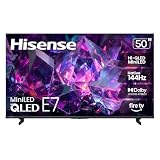
- HI-QLED MINILED: Mini-LED backlighting uses thousands of precise light zones to enhance contrast across the screen, revealing deeper shadows, brighter highlights, and more visible detail. Whether watching movies at night or sports during the day, the picture stays clear and impactful
- NATIVE 144HZ GAME MODE: High refresh performance keeps fast movement fluid and sharp, reducing blur during gameplay and live sports. The quick response helps you stay in control during competitive gaming while making rapid camera shots in shows and movies easier to follow
- DOLBY VISION & DOLBY ATMOS: Experience cinematic HDR with vivid brightness and deeper contrast through Dolby Vision, paired with immersive, room-filling sound from Dolby Atmos—so every scene feels bigger, clearer, and more lifelike from your couch
- AI PICTURE: Advanced AI processing analyzes content scene by scene and automatically optimizes brightness, contrast, and color for a clearer, more natural image. Whether you’re streaming shows, watching sports, or gaming, the picture adjusts in real time to look its best without manual settings
- AI SMOOTH MOTION WITH MEMC: Motion enhancement technology reduces blur and sharpens fast-moving scenes, keeping action crisp and easy to follow. From live sports to action movies and gaming, fast transitions stay smooth and comfortable to watch
The cited 2025 ULED announcement does not state the smart TV platform for the 2025 U7 or U8. Do not infer the platform of a 2025 set from the 2026 U7 announcement. For any U8 or older U7 listing, confirm the operating system on the precise retailer page or model specification rather than relying on the series name.
Before buying, decide which platform you want and verify that the listing’s full suffix matches it. Also confirm the size and retailer configuration: a retailer’s headline may emphasize “U7” while the suffix and platform are elsewhere in the product details.
Price and value: compare current listings, not a launch MSRP
Hisense announced a $1,299 starting MSRP for the 2026 U7 on March 9, 2026, and named Best Buy, Amazon, Walmart, and select retailers. This is a launch MSRP, not a verified current selling price. The cited announcement does not give a size-by-size price table, and it does not establish a current U8 price.
The Tool Desk
Outbyte PC Repair FREERepair Windows errors before they cause bigger problemsFix Now →Outbyte Driver Updater FREEScan for outdated or missing drivers - takes under a minuteDriver Scan →To judge value, compare the same screen size and a clearly identified model year and suffix. Comparing a discounted older U8 with a newer U7, or comparing different screen sizes, can make a simple “U7 costs less” conclusion misleading. No universal price premium for the U8 is established by the available announcements, so there is no supported dollar threshold at which the U8 becomes a better buy.
A practical way to compare two live listings
- Write down the full model identifiers. Include the year, series, suffix, and screen size for each candidate. For a 2026 U7, distinguish U7SG from U7SF.
- Compare like with like. Use the same screen size where possible, then compare the actual current checkout prices rather than a launch MSRP or an old advertised price.
- Check the feature that matters most to you. For the U8, that may be its published brightness ceiling or 2025 audio specification. For a U7, it may be the relevant generation’s gaming features or the 2026 platform choice.
- Verify configuration details. Confirm the operating system, gaming features, audio specification, and any size-specific differences on the exact retailer listing or manufacturer sheet.
- Make the trade-off explicit. Decide whether the U8’s announced premium features justify the price difference you see, or whether the U7’s verified features meet your needs at the price offered. If a detail is missing, seek confirmation rather than treating it as equivalent.
Which one should you buy?
Choose the 2025 U8 if its specific advantages match your priorities
The 2025 U8 is the stronger candidate if you value the higher official brightness claim and more substantial listed built-in sound system, and the exact set’s current price makes sense to you. Its 5,000-nit figure should remain understood as a manufacturer claim with unspecified test conditions in the announcement. The evidence here does not establish a same-size price premium, so judge the actual offer you find rather than assuming the U8 costs a particular amount more.
Choose a U7 if gaming features or platform fit lead your decision
The 2025 U7 is the clearer match if the specific announced gaming features—VRR, ALLM, Dolby Vision Gaming, FreeSync Premium Pro, and the other listed modes—are the reason you are choosing it. For the 2026 U7, the confirmed headline in the announcement is native 165Hz refresh; verify the remaining gaming requirements on the exact model sheet. Choose between the U7SG and U7SF based on the platform you want, not on the U7 name alone.
Pause if the listing does not identify the configuration
If the seller page omits the full suffix, operating system, screen size-specific details, or the feature you need, the series label is not enough to make a confident comparison. Resolve those details first. If you cannot verify them, the announcements do not support treating the unknown configuration as a match for a better-documented model.
Quick wins for a faster PC:
Scan for outdated or missing drivers - takes under a minuteDriver Scan →Clear out junk files and repair common Windows errorsFree Scan →What the available specifications do not prove
It is useful to separate announced specifications from conclusions that would require matched independent testing. The cited Hisense announcements do not establish:
- which set is brighter in measured real-world viewing across comparable sizes and settings;
- which one shows less blooming or performs better from off-center seats;
- which has lower input lag or better motion handling in independent testing;
- the current transaction price of the U8, or a universal price gap between U7 and U8;
- that every size in a series has exactly the same specifications; or
- that every feature listed for the 2025 U7 is present on the 2026 U7.
Those limits do not make the announcements useless. They identify what Hisense says each lineup includes. They do mean that claims about measured performance or value should be tied to the exact model, size, and current offer rather than inferred from the series names.
Quick Recap
Product prices and availability are accurate as of the date/time indicated and are subject to change. Any price and availability information displayed on Amazon at the time of purchase will apply.




