An edge-first architecture for building and campus safety runs the first stages of video analysis and event handling close to the camera or in a local aggregation point, instead of sending every frame to a central server and waiting for a decision. The intended payoff is that local functions keep working when the link to a central security operations center is degraded. The costs are a larger device estate to manage, more integration work, and more places where access and data must be secured. NIST’s published material supports this layering, but its examples are use cases and guidance, not a complete building-control blueprint.
How the work is split across four layers
NIST’s edge video material separates work into device-edge and aggregation-edge roles. A practical design adds two more: the backhaul that carries events upstream, and the central operation that acts on them. These are roles rather than products, and one physical box can play more than one.
As an Amazon Associate I earn from qualifying purchases.
| Layer | Typical work | What to specify before building | Basis |
|---|---|---|---|
| Device edge (camera or nearby compute) | Quick, lightweight analysis that produces selected metadata or alerts | The narrow scenario being analyzed, measured false positives and misses at the intended site, and behavior during a network outage | NIST video analytics use case (marked #PSCR2019) |
| Aggregation edge (local gateway or server) | Combining feeds and running more compute-intensive analytics | Compute capacity, physical protection, patching, remote administration, logging, and failure behavior | NIST video analytics use case (marked #PSCR2019) |
| Backhaul | Links that carry video and alerts to the operations center | Bandwidth, video protocols, and redundant upstream links where video must reach the operations center | NIST video analytics use case (marked #PSCR2019) |
| Central video and security operations | Monitoring, review, and evidence handling | Time synchronization, storage, evidence workflows, and interoperability between systems | NIST IR 8299 (2020) |
The NIST presentation shows device and aggregation roles, but it does not establish a current bill of materials, so the specific hardware in each layer remains a local decision.
Why local processing is not the same as independence
NIST’s use case describes local Wi-Fi edge streaming together with multiple backhaul links for mission-critical video. Local processing reduces dependence on the upstream path for the functions that run locally. It does not remove the need for that path: video still has to reach the people who act on it, and the network still carries configuration, updates, and evidence. The design goal is graceful local behavior and resilient upstream connectivity at the same time.
#1 Best Overall
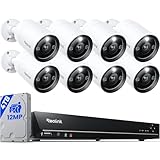
- INCREDIBLE 12MP UHD IMAGE -- Mind-blowing 12MP PoE home security camera system becomes affordable for your home and business security. Subtle details are recorded to ensure your peace of mind.
- FULL COLOR NIGHT VISION -- The Spotlight of the 12MP outdoor surveillance cameras enables a full color night vision. You can schedule it to work at a time period and switch to IR LED mode other time flexibly. The spotlight can also be Motion-activated to deter intruders working with the siren.
- SMART HUMAN/VEHICLE/PET DETECTION -- Reolink latest smart cameras can now identify people, vehicles, and pets according to their shapes and minimize unwanted alerts.
- TWO-WAY TALK -- The 12MP camera of this home security system has a speaker built-in for two-way communication with your family as well as threat deterrence. Simply press a button on Reolink App or Client to talk.
- 16 POE PORTS, EXPANDABLE to 24 CHANNELS -- The NVR with hardware version N6MB01 offers 24 channels for Reolink PoE, plug-in Wi-Fi cameras, and specific battery-powered Wi-Fi cameras (Argus PT Ultra, Argus Eco Ultra & Argus 3 Ultra only) with the latest firmware. Ensure battery cameras and Reolink App are updated. Supports max. 16 PoE/plug-in Wi-Fi cameras.
Before approving a design, write down the answers to these questions for an outage:
- Which detections still generate alarms locally, and where does an alarm go when no operator is reachable?
- Does each camera keep recording to local storage, and for how long?
- How is a device that drops off the network detected, and who is told?
- Can an operator take over a feed through a second path?
A sequence for placing workloads
- Start from the decision the alert must support. Write the response time the decision needs. If that response must happen within the length of a plausible backhaul outage, the analysis belongs at the device or aggregation edge.
- Classify each analytic by compute and network need. NIST describes device-edge lightweight analytics and aggregation-edge complex or deep analytics. Assign each workload by latency, compute, network, and operational need, not by which vendor supplies it.
- Decide what leaves the site. Where the use case allows, send metadata or selected clips rather than full streams. This reduces upstream load, but it also limits what central reviewers can see, so confirm that the reduced data still supports the evidence workflow.
- Define failure behavior for each layer. Write what a device does when it loses its aggregation point, what the aggregation point does when it loses upstream connectivity, and what the central operation does when it loses video.
- Set the identity model and the integration boundary. The next two sections cover these.
Identity: the campus network is not a trust boundary
NIST SP 800-207 states the principle directly: “Zero trust assumes there is no implicit trust granted to assets or user accounts based solely on their physical or network location (i.e., local area networks versus the internet) or based on asset ownership (enterprise or personally owned).” Published in August 2020, the document is the foundation for the zero-trust material in this article. For an edge design, that means a camera or gateway is not trusted merely because it sits on the campus LAN.
Rank #2

- 16 CHANNEL SECURITY CAMERA SYSTEM: This system has 16pcs 5MP 2.8mm fixed lens PoE IP cameras (Not PTZ) with built-in microphone, IP67-rated waterproof for indoor and outdoor use. The 4K 16CH NVR of this system comes with a 4TB hard drive. It has 2 SATA port to expand to total 16TB storage space.
- EASY POE SETUP - TRULY PLUG & PLAY: This NVR Security System utilizes PoE technology, allowing a single network cable to simultaneously handle power and video transmission between the NVR and IP cameras.
- SMART AI PERSON/VEHICLE DETECTION: This system features advanced AI technology that can distinguish between people and vehicles, ensuring you receive alarm notifications only for these specific events, while filtering out irrelevant alerts.
- IP67 WEATHERPROOF DESIGN: Build with durable metal housing, our security cameras withstand the harshest weather conditions like dust, rain, and extreme temperature ranging from -20°C to 50°C.
- REAL-TIME LIVE VIEWS & PLAYBACK: The system supports local playback and real-time live view, even without the Internet. If connected to the Internet, you can also use the GUARD VIEWER APP to view remotely and receive alarm pushes anytime, anywhere.
- Give each camera, gateway, and sensor its own identity and record the person or team that owns it.
- Authenticate and authorize devices and operators before they reach a resource, rather than granting access by network segment.
- Scope privileges narrowly. A camera service account should not be able to read an access-control database.
- Log administrative actions and every access to stored video, since evidence access is where disputes arise.
- Limit who sees video with policy, role, or attribute-based access. NIST’s public-safety video roadmap names these approaches as a way to restrict viewing. The roadmap also treats cybersecurity as spanning networks, hardware, software, and user access, so no single layer can carry the whole control.
The complete reference is NIST SP 800-207, Zero Trust Architecture.
Quick wins for a faster PC:
Scan for outdated or missing drivers - takes under a minuteDriver Scan →Clear out junk files and repair common Windows errorsFree Scan →Where enterprise zero-trust guidance stops
NIST SP 1800-35, published in 2025, reports 19 example zero-trust implementations developed by the NCCoE with 24 collaborators under cooperative research agreements. These are enterprise IT examples, not 19 building-security blueprints. The guide’s scope excludes operational technology (OT) and Internet of Things (IoT) devices, so building automation, access-control panels, cameras, and safety systems need their own domain-specific design and validation. The NCCoE introduction to the guide sets out that scope and its assumptions.
Rank #3

- Stunning True 4K Ultra HD Clarity - Capture every detail with 8MP (3840×2160) resolution—four times the clarity of 1080p. Ensure smooth, vivid footage with adjustable high bitrate and Clear Stream mode. Even when zooming in, you’ll enjoy crisp, distortion-free images.(Tip: For best results, use a 4K display and enable "Clear" stream in settings.)
- Person/Vehicle Detection – Smart PoE IP cameras can identify people and vehicles in terms of their shapes, minimizing unwanted alerts such as animals or shadows. Cameras can also be configured to specify the type of detection when sending alerts to you. Know what happened simply by glancing at the lock screen.
- Plug and Play PoE System – A simple PoE connection makes it easier to set-up and install your home security camera system. With one single network cable, users can enjoy smooth security coverage of their entire house. This is perfect for both beginner camera users and DIY enthusiasts.
- Reliable 24/7 Recording & Massive Storage - Comes with a pre-installed 4TB HDD for nonstop 24/7 or motion-triggered recording. Easily expand storage with an additional HDD (up to 8TB), supporting a total capacity of up to 16TB.
- Remote Access and Playback – The free Reolink app allows you to access all your cameras remotely, no matter how many you have. Check in on your home or business whenever, wherever. Perform live views and playbacks on your smart devices (iOS, Android) via WiFi or 3G/4G connection.
In practice, use the enterprise patterns for the IT side of the design, such as identity and access to the central video management system. Do not treat them as evidence that a door controller or a building management gateway is secured. Segment the enterprise network, the physical-security systems, and building OT and IoT, and govern each connection between them explicitly.
What the performance figure does and does not show
The NIST edge video presentation reports “High inference accuracies (>90%) on the available tagged video datasets” for its project. That is a result for that project and those datasets. It is not a general accuracy figure for campus surveillance or threat detection, and it says nothing about other sites, other models, or safety outcomes. The same use case states its goal as “Reduce cognitive overload on first responders via video analytics on the (device or network) edge.” That is a stated design goal, not a verified outcome.
Rank #4

- AI Motion Detection 2.0 – Driving AI to the next level, human&vehicle detection and flexible detection area are more accurate than before. For quicker locating in crucial moments, human&vehicle smart searching in recordings offers you great help.
- Tried-and-True Safe Guard – This one-stop security solution can work with TVI, AHD, CVI, CVBS & IP cameras, the kit includes 1080P cams. The 8CH 3K lite DVR can hook up with 1080P@30fps or 3K/5MP@20fps cams. Therefore, you can also DIY it with other cameras in your home.
- Reliable 24/7 Continuous Recording – With a pre-installed 1TB HDD(Support up to 10TB HDD), providing 24/7 surveillance recording for you. Upgraded H.265+ saves more storage space and uses less bandwidth, recording videos longer and smoother viewing.
- Smart Dual-Light Effectively Guard Your Home – This newly upgraded security system offers you a crisp full color night vision, IR mode and color night vision switch flexibly. Once detect intruders, immediate pushes pop up on your phone, securing your peace of mind day&night.
- Color Night Vision & IP67 Weatherproof – Built-in IR lights and white lights, these cameras can see up to 100ft in B&W night vision, full-color night vision up to 66ft. Rated IP67, these wired cameras can brave all weather, and stand from cold to hot.
A pilot in the intended environment should measure the things a headline accuracy number hides:
Do these 3 things before closing this tab:
1Scan for outdated or missing drivers - takes under a minute2Repair Windows errors before they cause bigger problems3Fix the driver behind crashes, sound loss and screen glitches| Measure | How to record it | Why it matters |
|---|---|---|
| False positives | Count alerts that operators judge to be non-events, per camera per period, under real lighting and traffic | Alert fatigue reduces the value of every correct alert |
| Misses | Compare detections against a labeled log of real events at the site | A high average accuracy can coexist with missed events that matter |
| End-to-end alert latency | Time from event to operator notification, measured on both normal and degraded backhaul | Shows whether the edge placement actually delivers the response window |
| Outage behavior | Disconnect each layer in turn and record what alarms, what is stored, and what is lost | Confirms the failure behavior written down during design |
Comparing options: the questions that matter
The NIST material identifies the decision axes for edge video systems, but it does not rank vendors or products. Use the following questions as a procurement file, and require each option to answer them in writing.
Best Value

- Facial Recognition-- Recognizes people to reduce false alarms and save storage space. (Updated on 10/30/2025)
- AcuSearch Technology- Precise suspect location. Instant video search. Rapid criminal tracking. (Updated on 10/30/2025)
- 2 Way Talk-- Hear and speak to anyone through the camera. (Updated on 10/30/2025)
- Smart Color Night Vision-- AI human vehicle detection activate warm lights, deliver color night vision.
- Structural Innovation effectively solves the issue of lights reflections-- Unlike traditional vandal-proof dome camera, the infrared lights are embedded in the body rather than within the dome cover.
| Axis | Question to put to each option |
|---|---|
| Where analytics run | Does analysis run on the camera, on a local server, or in the cloud, and can that be changed later? |
| Behavior during backhaul failure | What still alerts, what is buffered, and what is discarded? |
| Interoperability and metadata portability | Which video protocols and metadata formats are supported, and can metadata be exported without the vendor’s software? |
| Authentication and role-based access | How are devices and operators authenticated, and how are roles scoped? |
| Lifecycle support and patchability | How long will the device receive security updates, and how are they delivered? |
| Power, physical security, compute headroom, and environment | What compute margin remains at peak load, and what thermal and physical protection does the enclosure provide? |
| Retention and evidence workflows | Where is footage stored, how long is it kept, and how is an export logged? |
| Total operational complexity | How many systems, credentials, and update channels must one site maintain? |
Prototyping hardware
NIST’s 2023 security-in-depth diagram, Security-in-Depth From Edge to Cloud, labels Raspberry Pi 4 devices in a smart-building application. A Raspberry Pi 4 Model B is a reasonable low-cost platform for a classroom gateway or a test bench. It is not a hardened camera or access-control appliance, and it should not be specified as one.
Dates, geography, and what remains open
The sources span 2019 to 2025: the public-safety video roadmap (NIST IR 8299) is from 2020, the edge video presentation is marked #PSCR2019, the security-in-depth diagram is from 2023, and the zero-trust implementation guide is from 2025. Each is useful for principles and bounded examples. None establishes current product selection or comparative performance, so check for later revisions before procurement.
The intended deployment geography and institution type are not specified in these sources. Privacy, surveillance, retention, disclosure, and campus safety obligations therefore have to be determined locally. Those obligations shape where footage is stored and who can view it, so settle them before choosing which layer holds the video.
Free tools Windows power users keep installed
One-click scans. No signup required.
Quick Recap
Product prices and availability are accurate as of the date/time indicated and are subject to change. Any price and availability information displayed on Amazon at the time of purchase will apply.




