Windows Errors? Fix Them Before They Spread
Repair common Windows errors and clear accumulated junk for a smoother, more stable PC - no reinstall needed.Free scan · no reinstallCrashes, No Sound, or Screen Glitches?
Random freezes, missing sound and display glitches usually trace back to one bad driver. Find and replace yours safely.Free scan · under a minuteTo turn DeyeCloud solar data into a daily report with Amazon Bedrock, fetch the previous day’s historical figures once, validate them, calculate the report numbers in ordinary code, and then send only those checked figures to Bedrock to draft the summary. Bedrock writes the prose. It does not retrieve, correct, or total your energy data.
This guide assumes you already have an eligible DeyeCloud plant and account, plus AWS access with Amazon Bedrock enabled for a model you choose. DeyeCloud’s developer materials cover registration, credentials, and fetch guidance. They do not publish a canonical endpoint sequence, report schema, prompt, or deployment design. Those parts below are implementation choices of the kind you would make yourself, not official Deye instructions.
As an Amazon Associate I earn from qualifying purchases.
Prerequisites
- A DeyeCloud account and a developer application with its credentials. The official sample repository, DeyeCloudDevelopers API v1 sample code, uses Python examples and points to the QuickStart material and access-token acquisition. Its setup assumes a working account, so confirm your own plant is visible in the portal before writing code.
- An AWS account with permission to call Bedrock, and a foundation model enabled for your account in the region you use. Confirm model access in the Bedrock console first. Model availability varies by region and changes over time.
- A place to store credentials that is not source code, such as environment variables or a secrets manager.
The pipeline in order
- Register the application. Start at the DeyeCloud Developer Portal, create the developer application, and record the credentials it issues.
- Obtain an access token. Follow the token step in the sample repository. Refresh or re-request the token when it expires rather than assuming it lasts indefinitely.
- Fetch one closed day. Request historical data for a single, explicit date range in the plant’s local time zone. Use one request per report.
- Normalize. Convert timestamps to plant local time, express energy in one unit (kWh is the usual choice), and record missing intervals as missing rather than zero.
- Validate. Confirm pagination returned every page, remove duplicate intervals, and flag negative or implausible values for review rather than silently correcting them.
- Calculate in code. Compute the daily total, peak value and its time, the comparison with the previous day, and any other figures your report needs. Use only fields the API actually returned for that plant.
- Build a structured payload and call Bedrock. Send the computed figures, the date, the units, and a bounded instruction to summarize them. Do not include data you have not validated.
- Check the prose against the payload. Every number in the generated summary should match a value in the payload. If it does not, discard the output and fall back to a plain-text template built from the same figures.
- Store and deliver. Save the facts and the generated text together so a later reader can see which numbers the prose was based on.
How often to fetch
DeyeCloud’s API Usage Best Practices page, updated September 20, 2026, separates two use cases:
Free tools Windows power users keep installed
One-click scans. No signup required.
| Use case | Recommended interval (DeyeCloud, September 20, 2026) |
|---|---|
| Real-time monitoring dashboards | 1–2 minutes |
| Historical daily or weekly reports | Once per day |
The page gives the reason for the historical cadence in its own words: “Historical data doesn’t change retroactively.” For a daily report, that means one fetch after the day has closed is sufficient, and polling more often adds calls without adding information. The same guidance suggests backoff when you hit rate limits or server errors, so build retries with increasing delays and cache the result so a failed Bedrock step does not force a new API call.
#1 Best Overall

- SAFETY YOU CAN TRUST WITH UL CERTIFICATION: With Emporia Energy, your home energy monitoring is safe, reliable, and certified. The Emporia Vue is UL Listed, meaning it has met rigorous safety standards for electrical products in the U.S. and Canada. This certification ensures that every component has been thoroughly tested to prevent hazards, such as overheating, short-circuiting, or fire, offering you peace of mind as you manage your home’s energy consumption.
- INSTALLS IN CIRCUIT PANEL of most homes with clamp-on sensors. Supports Single phase, Single-split phase, and 2-wire systems. 3-wire systems; 3-phase, 4-wire Wye systems with earthed (TN or TT) neutral (no-Delta) are supported with an additional 200A sensor (sold separately).
- 24/7 ENERGY MANAGEMENT AND MONITORING: Automate, manage and control your home's real power anywhere, anytime to prevent costly repairs, conserve energy, and save costs. Monitor solar / net metering. PROTECTED BY A 1-YEAR WARRANTY.
- LOWER YOUR ELECTRIC BILL: Configure settings in the Emporia Energy App to automate energy management for time of use, peak demand, excess solar, and rewards programs. You can even see live reporting and invaluable savings opportunities instantly. Gauge real-time spending and get actionable notifications and automated energy management to help you reduce costs.
- REAL-TIME ENERGY DATA: REQUIRES 2.4 GHz WIFI WITH AN INTERNET CONNECTION to monitor energy use with iPhone / Android / Web app. Vue sensors collect energy data and are accurate from ±2%. The Vue is UL and CE Listed for your safety. 1 second data is only available in the app (when actively open) and retained 3 hours. Minute and hour data are retained in the cloud. 1 minute data is retained 7 days, 1 hour data is retained indefinitely. Export cloud data whenever you want in the app.
Quotas: treat them as preliminary
The same best-practices page lists two figures that are explicitly preliminary. The page states that final rules will be announced separately, and that final rules will take precedence.
| Figure | Value | Source and date | Status |
|---|---|---|---|
| Base API quota | 100,000 calls per month | DeyeCloud API Usage Best Practices, September 20, 2026 | Preliminary; final rules to be announced separately |
| Request rate | 60 requests per minute | DeyeCloud API Usage Best Practices, September 20, 2026 | Preliminary; final rules to be announced separately |
A single daily request uses roughly 30 calls a month, far below the preliminary base quota, but that calculation only holds if your integration makes one request per day. Check the portal again before you deploy, because these figures may change.
Rank #2

- SAFETY YOU CAN TRUST WITH UL CERTIFICATION: With Emporia Energy, your home energy monitoring is safe, reliable, and certified. The Emporia Vue is UL Listed, meaning it has met rigorous safety standards for electrical products in the U.S. and Canada. This certification ensures that every component has been thoroughly tested to prevent hazards, such as overheating, short-circuiting, or fire, offering you peace of mind as you manage your home’s energy consumption.
- INSTALLS IN CIRCUIT PANEL of most homes with clamp-on sensors. Supports Single phase, Single-split phase, and 2-wire systems. 3-wire systems; 3-phase, 4-wire Wye systems with earthed (TN or TT) neutral (no-Delta) are supported with an additional 200A sensor (sold separately).
- 24/7 ENERGY MANAGEMENT AND MONITORING: Automate, manage and control your home's real power anywhere, anytime to prevent costly repairs, conserve energy, and save costs. Monitor solar / net metering. PROTECTED BY A 1-YEAR WARRANTY.
- LOWER YOUR ELECTRIC BILL: Configure settings in the Emporia Energy App to automate energy management for time of use, peak demand, excess solar, and rewards programs. You can even see live reporting and invaluable savings opportunities instantly. Gauge real-time spending and get actionable notifications and automated energy management to help you reduce costs.
- REAL-TIME ENERGY DATA: REQUIRES 2.4 GHz WIFI WITH AN INTERNET CONNECTION to monitor energy use with iPhone / Android / Web app. Vue sensors collect energy data and are accurate from ±2%. The Vue is UL and CE Listed for your safety. 1 second data is only available in the app (when actively open) and retained 3 hours. Minute and hour data are retained in the cloud. 1 minute data is retained 7 days, 1 hour data is retained indefinitely. Export cloud data whenever you want in the app.
Keep the arithmetic out of the model
A language model should describe numbers you have already computed. It should not infer missing intervals, reconcile totals, or calculate the authoritative daily figure. Keep these responsibilities in code:
Quick wins for a faster PC:
Clear out junk files and repair common Windows errorsFree Scan →Scan for outdated or missing drivers - takes under a minuteDriver Scan →- Daily totals, peaks, and day-over-day comparisons.
- Labels for each value as measured, estimated, or absent. The official materials do not prescribe these labels, so define them in your own schema and apply them consistently.
- The date interval, plant time zone, and units, which should appear in the report header.
In the prompt, instruct the model to use only the supplied values, to say when a value is missing, and to keep the summary to a fixed length. Treat its output as text to be checked, not as data to be stored as fact.
Rank #3
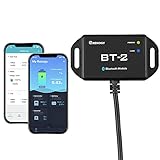
- 【Precise Control Over Your Devices】 Compatible with all Renogy RS485 communication port products includes the Rover Elite MPPT Solar Charge Controller, Smart Lithium Batteries, Pure Sine Wave Inverter with Power Saving Mode, and Dual DC-DC MPPT Battery Charger.
- 【Real-time Insight】 Get real-time and historical data via Bluetooth Module and Renogy DC Home App. Bluetooth 4.2 and BLE technology provides fast and uninterrupted communication.
- 【User-friendly】 Easily connect the Bluetooth Module to the RS485 communication port, and follow the App instructions. The Bluetooth Module is powered by solar energy, and the ultra-low-power dedicated chip will allow signal range up to 82ft.
- Connect the BT-2 to the component's RJ45 communication port to wirelessly check and adjust your system's parameters through the DC Home App (available in both the App Store and Google Play).
- Fully control the solar power generation, energy storage, and inverters' real-time operation data by monitoring from the DC Home App.
Logging and what enters the prompt
Bedrock invocation logging is off by default. AWS’s model invocation logging guide states: “Model invocation logging is disabled by default.” When you enable it for supported bedrock-runtime operations, request and response data can be captured in Amazon S3, in CloudWatch Logs, or in both.
| Destination | What it holds when enabled | Decision to make |
|---|---|---|
| Amazon S3 | Captured request and response data as stored objects | Bucket access policy, encryption, and retention period |
| CloudWatch Logs | Captured request and response data in a log group | Log group access, retention setting, and who can query it |
Either destination may contain whatever you sent. Keep the prompt limited to energy figures and the report date. Leave out device serial numbers, the street address of the plant, account identifiers, and any credential or token. If you do not need invocation logs, leave them disabled.
Rank #4

- ⚡ Professional-Grade PV Testing Measures maximum power (Pmax) up to 1000W, open-circuit voltage (Voc: 12-80V), and short-circuit current (Isc: 35A) with ±0.8% accuracy, ideal for validating solar panel performance in R&D, manufacturing, and field maintenance.
- ⚡ MPPT Efficiency Optimization Tracks Vmp (80V) & Amp (35A) in real-time to identify panel degradation or shading issues, helping installers maximize energy harvest and ROI for residential/commercial systems.
- ⚡ Industrial Safety & Durability Rated CAT III 1000V/CAT IV 600V with double-insulated probes, meeting IEC/EN 61010 standards for safe use on high-voltage PV arrays and combiner boxes.
- ⚡ Smart Data Management Features data hold + backlit LCD for reading values in dark environments (e.g., rooftops)
- ✅ Engineered for Solar Professionals Auto-ranging simplifies operation for technicians, while IP54 dust/water resistance and low-power auto-off ensure reliability in outdoor installations.
Testing before you rely on the report
The official materials do not publish report-generation benchmarks, so validate the pipeline against your own plant:
- Authentication: an expired token is refreshed or re-requested without losing the day’s job.
- Pagination: a day with more records than one page returns the full total.
- Empty and partial days: a day with no data, or a day that ended early because the plant was offline, is reported as missing rather than zero.
- Units and time zones: conversions are correct and the day boundary matches the plant’s local time, including the change to and from daylight saving time.
- Rate limits and server errors: retries back off and the job stops after a fixed number of attempts.
- Model failure: if Bedrock is unavailable or its output fails the number check, the facts still produce a plain report.
What the official sources do not settle
The DeyeCloud pages establish the developer prerequisite, the fetch cadence, and the preliminary quotas. They do not publish the endpoint names, response fields, or unit conventions you need to write the fetch code, so read the current reference in the DeyeCloud Developer Portal before you begin. The AWS documentation at Amazon Bedrock Documentation describes the service and its options; it does not describe a DeyeCloud integration. Which model you choose, and where you deliver the report, remain decisions for your own requirements.
Quick Recap
Best Value

- 1% Accuracy Measurement: Shunt-type battery monitor design provides much more accurate real-time voltage and current draw measurement.
- Protect the batteries: With High and low capacity alarm functions, our battery tester with shunt will alarm, and backlight and voltage value will flash simultaneously to protect the batteries from getting over-discharged.
- Fit for all battery: The energy monitor is compatible with various battery types, including Lead Acid (AGM, GEL), Lithium Iron Phosphate, Lithium-ion, Nickel-metal hybrid. 12V battery monitor compatible with batteries operating at 12 volts, 24 volts, and 48 volts.
- Easy To read: Renogy battery monitor displays multiple electronic parameters, including Voltage, Current, Consumed Power, Battery Capacity, and battery degradation rate with a customized brightness high-definition Backlight Display.
- Easy to Install: Transparent shunt holder makes the renogy lithium battery monitor easier to mount the shunt. And the 20ft Shielded cable allows you to monitor the battery status from a distance.
Product prices and availability are accurate as of the date/time indicated and are subject to change. Any price and availability information displayed on Amazon at the time of purchase will apply.




