Build a custom chatbot only when a clearly defined user need cannot be met well by better content, search, or an existing product—and your team can securely operate and maintain the result. A custom chatbot might be an application built around a model API, a heavily integrated service, or a privately hosted model; it does not automatically mean training a model from scratch. Buying, adapting, combining, or choosing no chatbot are all legitimate outcomes.
First decide whether a chatbot is the right change
Start with the task people are trying to complete, not with a model or vendor. For a customer-service team, that could mean finding an accurate answer, completing a routine request, or reaching the right person. Then compare a chatbot with simpler changes to the help content, navigation, search, or existing contact channels.


As an Amazon Associate I earn from qualifying purchases.
GOV.UK’s guidance on chatbots and webchat tools makes this trade-off explicit: “In some cases, you might find it more time and cost-effective to improve existing content, navigation and the search functionality on your website.” That guidance comes from the UK public sector, not US law, but the service-design question applies broadly: will a bot make the task easier and more reliable than the alternatives?
What’s actually slowing this PC down?
Pick the symptom - the matching free tool is one click away.
- Improve content or search if users mainly need to find information that already exists but is difficult to locate or understand.
- Use a chatbot if conversation is a practical way to clarify a request, guide someone through a task, or route them to help.
- Keep a human route for situations the bot cannot handle safely or accurately, and make that route clear to users.
- Choose no chatbot if the added interaction, data handling, and maintenance would create more complexity than value.
Before deciding, describe the intended task, its users, the information and systems it depends on, and what should happen when the bot cannot help. Make clear to users that they are interacting with an automated system and explain its limits.
#1 Best Overall
Compare the main build, buy, and reuse options
“Build or buy” is not a single technical choice. A managed chatbot product, a custom application that calls a third-party model, and a privately hosted model shift control and operating work in different ways. The table summarizes the options described in UK government and AWS guidance; it does not imply that every option is suitable for every support use case.
| Option | What the team controls | Main trade-off | Most plausible fit |
|---|---|---|---|
| Improve content, navigation, or search | The information and ways users find it; no chatbot is introduced. | Does not provide a conversational interface, but may solve the underlying discovery problem with less complexity. | Users need to locate or understand existing information. |
| Buy or adapt a managed chatbot/webchat product | Configuration and the service workflow available within the product. | Usually a simpler route when its capabilities fit, but the team must accept its limits, integrations, data handling, and maintenance terms. | The need is adequately served by a mature product and its supported integrations. |
| Build an application using a third-party model API | Your application logic, user experience, integrations, and the way requests and responses are handled. | Requests still go to the model provider, so provider terms, privacy, retention, and data sensitivity remain important; the team must operate the application. | The workflow or integrations are distinctive, while using an existing model is appropriate. |
| Fine-tune or train a model | More of the model adaptation process, depending on the approach. | Model work adds its own technical and data requirements; it is not automatically necessary to build a custom chatbot. | A team has established a need for model adaptation and the expertise to support it. |
| Host a model privately | More control over the hosting environment and, depending on the setup, where data is processed. | The organisation takes on infrastructure, security, model updates, and specialist machine-learning operations responsibilities. | Those control requirements justify the additional operational burden. |
| Combine or stage approaches | The team can reuse existing components while testing a specific uncertain part. | Still requires clear ownership of integration and ongoing service operations. | A proof of concept can test feasibility before a larger commitment. |
In UK government guidance, the criteria for build, buy, or reuse include how distinctive the need is, how mature available products are, how deeply the solution must integrate with existing systems, and whether the organisation has the required skills and maintenance capacity. These are decision criteria, not a promise that custom software will be cheaper, faster, or more accurate. No general cost, schedule, or performance advantage follows from the word “custom.”
When building your own chatbot makes sense
A custom application is worth considering when a real requirement is not met by available products, or when the integration and control needed for the service cannot be achieved acceptably through configuration. Examples of the underlying conditions—not a guarantee that a custom build is right—include:
Free tools Windows power users keep installed
One-click scans. No signup required.
- A distinctive task or workflow: the bot must follow domain-specific rules or fit a process that generic components do not support adequately.
- Deeper integration: it needs to work with existing systems in a way available products cannot provide at the required level.
- Control requirements: the organisation has specific data-handling, access-control, security, or resilience needs and can meet them in its chosen architecture.
- Team capacity: technical and domain experts can build, secure, test, update, and maintain the service, including its integrations and knowledge.
- A testable uncertainty: a small proof of concept can establish whether a critical assumption is feasible before wider deployment.
Custom does not necessarily mean creating a model from scratch. AWS distinguishes applications that use an existing third-party model through an API from approaches involving fine-tuning or self-training. A team can build its own application and workflow while relying on an existing model, but that choice still sends data to the provider and requires careful review of terms and data handling.
When to buy, adapt, combine, or skip the chatbot
Choose an existing product when it meets the actual need
A managed chatbot or webchat product is a reasonable choice when it can handle the intended tasks, required integrations, and expected answers, and its limits, data practices, and maintenance obligations are acceptable. Validate those points against the actual service rather than assuming that a product feature is suitable because it exists.
Use a staged or combined approach when one part is uncertain
If the uncertain question is whether a particular workflow or integration will work, use a scoped proof of concept to test that hypothesis while reusing components that already meet the need. UK government AI guidance recommends adequate discovery to establish feasibility and a small-scale proof of concept for testing a business hypothesis. Keep the test narrow enough to evaluate the unresolved question rather than treating a demo as proof that a production service is ready.
Skip the chatbot when a simpler change solves the problem
If improving information, navigation, or search addresses the user need, that may avoid the extra work of an automated conversation. A bot should be justified by the task it helps users complete, not by a desire to add AI to a service.
Plan the chatbot as an ongoing service
A chatbot is not finished when it answers a sample question. Its usefulness depends on the quality and currency of its information, the systems it connects to, the way it handles failure, and the team that maintains it. Use the following sequence to turn the decision into a workable service plan.
- Define the task and boundaries. Write down what users should be able to accomplish, what information they must provide, and what kind of response or decision is appropriate. Specify cases the bot must not handle and how it should route users to a human or another channel.
- Check the information. Confirm that the material needed for the task exists and is safe and ethical to use. Assess whether it is accurate, complete, timely, relevant, and consistent. For tasks that depend on changing information, plan how the bot will access current data.
- Map systems and data movement. Identify the information the user provides, the systems the application reads or updates, and whether requests or responses go to a model provider. For API-based designs, review provider terms, privacy, retention, and the sensitivity of the data before selecting an architecture.
- Set access and security controls. Assess identity and access, data protection, application security, threat scenarios, legal and privacy obligations, and service availability for the deployment you choose. AWS’s generative AI security guidance groups relevant disciplines around governance and compliance, legal and privacy, risk management, controls, and resilience.
- Design uncertainty and escalation behavior. Decide what the chatbot should do when a request is unclear, information is missing, or the system cannot give an appropriate answer. Provide a usable route to human support where the task calls for it; do not present automation as a guarantee that every request can be resolved.
- Test the service and its boundaries. Check representative tasks, missing or inconsistent information, integration behavior, and the handoff path. A proof of concept can test feasibility, but broader use also depends on discovery, security, data readiness, and operational planning.
- Assign ongoing ownership. Name the people responsible for maintaining information, integrations, access, security, and operational response. For a privately hosted model, include responsibility for infrastructure and model security and updates, which the UK Government AI Playbook identifies as organisational obligations requiring specialist machine-learning operations skills.
- Keep a route to adapt or stop. Plan how the service can change as user needs, integrations, and maintenance demands change. Treat the ability to alter the approach—not only the launch—as part of the decision.
Choose an architecture by weighing control against responsibility
Architecture changes what you can control, but it does not remove the need to manage data and risk. An application using an external model API can let a team shape its own workflow and inspect or process requests and responses in its application. The data still goes to the provider, so API use should not be described as keeping all data in-house.
Private hosting can keep data within infrastructure controlled by the organisation, but it transfers more work to that organisation: securing and updating the model, maintaining infrastructure, and supplying specialist machine-learning operations skills. The appropriate choice depends on the data, provider terms, access controls, resilience needs, integration requirements, and the team’s capacity—not on a general assumption that one architecture is inherently safer.
For generative AI systems, AWS’s security scoping guidance highlights governance and compliance, legal and privacy, risk management, controls, and resilience. Apply those areas to the actual deployment and threat context rather than treating “AI security” as one isolated feature.
Recommended Free Tools
Understand the difference between a ChatGPT GPT and an API-built assistant
OpenAI’s Help Center describes GPTs as configured assistants used inside ChatGPT, while API-built assistants are developer-built integrations for websites or other services. The Help Center says GPTs cannot be embedded directly in a website. Therefore, a configured GPT inside ChatGPT and a chatbot integrated into a company website are different product paths, even if both use AI.
Availability, workspace settings, eligibility, and privacy handling can affect whether a ChatGPT GPT is usable in a particular setting. Product lifecycle details can also change; do not assume a feature or plan will remain available indefinitely. If the requirement is a website integration, evaluate an API-built application or a suitable managed product rather than assuming that a ChatGPT GPT can simply be embedded.
Independent reader supportYour contribution helps us test, update, and keep practical guides available for everyone.Make the decision with a practical comparison
Score each viable option against the same service needs. A useful comparison records evidence and unresolved constraints rather than a single “AI” score.
| Decision area | Question to answer | Why it matters |
|---|---|---|
| User-task fit | Does this option help users complete the identified task better than content, navigation, search, or existing support? | A technically capable bot is not useful if conversation does not improve the service. |
| Answer limits and escalation | What can it answer or do, where are its boundaries, and how does a user reach a person? | Users need realistic expectations and a route when automation is not appropriate. |
| Integration | Which current systems must it read from or connect to, and can the option support the necessary workflow? | Integration depth is one reason an existing product may not fit. |
| Data and provider terms | What data moves where, how sensitive is it, and what do the relevant provider terms say about privacy and retention? | Using an API does not mean the provider never receives the data. |
| Access, security, and resilience | How are identity, permissions, application security, risk, and service availability handled? | Security obligations continue across the service lifecycle and vary by deployment. |
| Skills and maintenance | Who has the technical and domain expertise to build, maintain, secure, and update the service? | A custom build or private hosting brings responsibilities that a team must actually staff. |
| Adaptability | Can the service change as user needs, integrations, or operating requirements change? | The chatbot should remain a service the organisation can adjust, not a one-time launch. |
UK public-sector guidance is a useful framework for these questions, but it is not a substitute for US-specific legal, privacy, procurement, or compliance advice where those obligations apply. No broadly applicable cost, time, accuracy, or outcome figure is established here for build-versus-buy comparisons; those depend on the use case, architecture, provider terms, and operating plan.
Frequently Asked Questions
Do I have to train a model from scratch to build a custom chatbot?
No. A custom chatbot application can use an existing third-party model through an API. Fine-tuning or self-training are separate approaches, not prerequisites for custom application logic or integrations.
Best Value
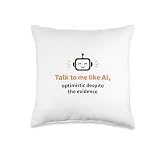
- Features a smiling, optimistic robot head graphic. This design includes the phrase 'Talk to me like AI, optimistic despite the evidence,' perfect for artificial intelligence enthusiasts and tech lovers.
- Ideal for programmers, developers, computer science students, or anyone who appreciates AI humor and a positive outlook on technology's future. Express your tech-savvy personality.
- 100% spun-polyester fabric
- Double-sided print
- Filled with 100% polyester and sewn closed
Can I put a configured GPT from ChatGPT directly on my website?
OpenAI’s Help Center says GPTs are used inside ChatGPT and cannot be embedded directly in a website. A website-integrated assistant requires a developer-built API integration or an appropriate managed service.
Does using a model API keep customer data private from the provider?
Not by itself. An API-based application sends requests to the provider. The data involved, applicable terms, privacy and retention practices, and the sensitivity of the information all need to be considered.
How can a team tell whether a chatbot is working well?
Define the user task and expected outcome before choosing an implementation, then test representative tasks, data gaps, integrations, and escalation behavior against those requirements. The guidance summarized here provides no universal benchmark or market-wide performance figure.
Quick wins for a faster PC:
Repair Windows errors before they cause bigger problemsFix Now →Fix the driver behind crashes, sound loss and screen glitchesFind Drivers →What skills are needed to run a privately hosted chatbot model?
The organisation needs capacity to maintain infrastructure and secure and update the model; the UK Government AI Playbook specifically notes the need for specialist machine-learning operations skills. Other needs depend on the application and its integrations.
Should a chatbot replace human customer support?
Not by default. Define which tasks automation is intended to handle and provide a clear route to human help for requests outside those boundaries or when the bot cannot appropriately assist.
Quick Recap
Product prices and availability are accurate as of the date/time indicated and are subject to change. Any price and availability information displayed on Amazon at the time of purchase will apply.




