Recommended Free Tools
A Class AB amplifier is a linear amplifier biased so its active output device conducts for more than half, but less than all, of a signal cycle. In the common push-pull design, a small bias keeps both output devices on briefly around the waveform’s zero crossing, reducing the crossover distortion associated with Class B.
What “Class AB” means
Amplifier classes are commonly described by a device’s conduction angle: the portion of an input cycle during which it conducts. The standard shorthand is 360° for Class A, 180° for Class B, and between 180° and 360° for Class AB, according to Analog Devices’ Class AB glossary. These angles describe operating categories, not measured efficiency or distortion; the actual conduction angle depends on the circuit, device, and bias point.
As an Amazon Associate I earn from qualifying purchases.
In a complementary push-pull stage, one output device principally handles the positive-going part of the waveform and the other handles the negative-going part. Class B devices hand off at the zero crossing. Class AB applies a small standing bias so both devices conduct for a short interval around that handoff. At small signal levels the overlap is more Class A-like; as the signal grows, each device chiefly handles its respective half-cycle.
What’s actually slowing this PC down?
Pick the symptom - the matching free tool is one click away.
Why use Class AB?
The overlap helps smooth the transition between output devices and reduces the crossover notch that can occur in Class B. Class AB therefore offers a practical balance: less crossover nonlinearity than Class B without keeping each output device conducting through the entire cycle as in Class A. It remains a linear, dissipative design—not a lossless or switching amplifier.
#1 Best Overall
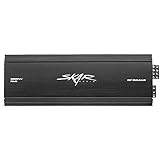
- 1,000-Watt MOSFET 4-Channel Class A/B Power Car Amplifier
- RMS Power at 2 Ohms: 250 Watts x 4 Channels
- RMS Power at 4 Ohms: 125 Watts x 4 Channels
- 4 Way Protection Circuitry | Frequency Response: 20 Hz - 20, 000 Hz
- Signal to Noise Ratio: 105 dB, 4 Gauge Power and Ground Input Terminals
The trade-off depends on the implementation and load. Class A is generally the least efficient of these conventional linear classes, while Class AB gives up some efficiency relative to Class B to improve behavior near crossover. Output devices dissipate heat, and the standing bias itself contributes to that dissipation. A reported efficiency figure for one speaker-amplifier application should not be treated as a universal Class AB specification.
Class A, AB, and B at a glance
| Class | Conduction angle | Typical crossover behavior | Design trade-off |
|---|---|---|---|
| Class A | 360° | Each device conducts throughout the cycle; generally the highest linearity of these three. | Continuous conduction makes it the least efficient of these conventional linear classes. |
| Class AB | More than 180° and less than 360° | Bias keeps both devices conducting briefly around the handoff, reducing crossover distortion. | Balances improved crossover behavior against bias-related and output-stage heat; actual efficiency varies. |
| Class B | 180° | Devices switch at the handoff, which can produce a crossover notch. | Less overlap than Class AB, with greater risk of crossover nonlinearity. |
The angle values are the conventional classifications published by Analog Devices, not performance measurements. The linearity and efficiency descriptions are qualitative; a circuit’s results depend on its topology, bias, devices, and load.
Rank #2

- COBALT SERIES: Introducing our Class A/B Amplifier CBA2000.4, boasting exceptional frequency response rates and a cutting-edge crossover, elevating its status among competitors. Its robust construction and unparalleled efficiency ensure a standout performance in the realm of 4-channel amplifiers.
- PERFORMANCE: Engineered to effortlessly power car speakers with a continuous 2/4 Ohm load, ensuring seamless performance devoid of overheating or extraneous noise. This amplifier is designed to power speakers that have a constant demand for high power in order to operate effectively.
- QUALITY: The CBA2000.4 amplifier for car stereo speakers with a MOSFET power supply comes with Low-level inputs. A low-level (RCA) input is measured in voltages. Essentially carry signals from your receiver to your amplifier to your speakers.
- FEATURES: The CBA2000.4 amplifier has features like - Frequency Response: 10~30kHz, Low Pass Filter, High Pass Filter, Bass Boost, and MOSFET Power Supply. The ultimate powerhouse for your audio needs.
- POWER: The Cobalt CBA2000.4 amplifier has a power rating of 75W RMS X 4 @ 2 OHMS, 40W RMS X 4 @ 4 OHMS. This amplifier for also provides a 2-way protection circuitry for you to unleash the full potential of your car audio system.
Where Class AB is used—and what bias design requires
Complementary push-pull Class AB stages are a familiar example in audio amplification, but Class AB biasing is also used in RF power amplifiers. In either application, the bias point must be controlled: too little bias can leave crossover distortion, while excessive bias raises idle current and heat. Temperature can shift device behavior and bias, so thermal stability matters, especially in higher-power stages. RF designs also need to account for temperature and supply variation.
For a practical circuit-level explanation of a push-pull stage, crossover distortion, bias components, and thermal stability, see Analog Devices’ Class B-to-Class AB teaching lab. Its discussion illustrates why “Class AB” names an operating approach rather than a promise of a particular efficiency or sound quality.
Quick Recap
Best Value
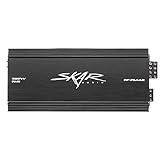
- 500-Watt MOSFET 4-Channel Class A/B Power Car Amplifier
- RMS Power at 2 Ohms: 125 Watts x 4 Channels
- RMS Power at 4 Ohms: 75 Watts x 4 Channel
- User Adjustable Controls: Gain, Variable LPF, HPF, Bass EQ Switch (0, +6, +12 dB)
- 4 Way Protection Circuitry | Frequency Response: 20 Hz - 20,000 Hz
Rank #4

- COBALT SERIES: Introducing our Class A/B Amplifier CBA2500.4, boasting exceptional frequency response rates and a cutting-edge crossover, elevating its status among competitors. Its robust construction and unparalleled efficiency ensure a standout performance in the realm of 4-channel amplifiers.
- PERFORMANCE: Engineered to effortlessly power car speakers with a continuous 2/4 Ohm load, ensuring seamless performance devoid of overheating or extraneous noise. This amplifier is designed to power speakers that have a constant demand for high power in order to operate effectively.
- QUALITY: The CBA2500.4 amplifier for car stereo speakers with a MOSFET power supply comes with a Low-level input. A low-level (RCA) input is measured in voltages. Essentially carry signals from your receiver to your amplifier to your speakers.
- FEATURES: The CBA2500.4 amplifier has features like - Frequency Response: 10~30kHz, Low Pass Filter, High Pass Filter, Bass Boost, and MOSFET Power Supply. The ultimate powerhouse for your audio needs.
- POWER: The Cobalt CBA2500.4 amplifier has a power rating of 100W RMS X 4 @ 2 OHMS, 60W RMS X 4 @ 4 OHMS. This amplifier also provides a 2-way protection circuitry for you to unleash the full potential of your car audio system.
Rank #3

- 4-Channel Class A/B Amp - Upgrade your car audio with a 4-channel amp for clearer sound. Customize your sound by connecting various speakers, balance audio between front and rear, and even add a subwoofer for extra bass.
- Maximum Power Output – Power up your music. The GM-A6704 cranks out an impressive 1,000 watts of max power output creating dynamic and impactful sound reproduction, with 60 watts RMS x 4 at 4 ohms (190 watts RMS x2 in bridged mode).
- Efficiency – The Pioneer GM-A6704 boasts a Class AB design, balancing efficiency and performance, ensuring optimal power usage for a reliable audio experience without excessive heat generation.
- Low Distortion – With minimized crossover distortion, this amplifier guarantees a clean and distortion-free audio output, preserving the integrity of the source signal for high-quality sound reproduction.
- Tone Control – Designed with variable high and low-pass filters, control the range of frequencies the amplifier sends to its speakers to enhance the sound based on music type and genre. Tailor your listening experience and enjoy your ride.
Product prices and availability are accurate as of the date/time indicated and are subject to change. Any price and availability information displayed on Amazon at the time of purchase will apply.




