Free tools Windows power users keep installed
One-click scans. No signup required.
Yes, UV can be involved in oxidation-related problems during protein analysis, but the risk depends on where and how the light is used. Irradiating a protein sample can alter it under some conditions; in HPLC–UV–MS, the UV detector can also generate oxidation artefacts that appear in downstream mass spectra. These are separate mechanisms, and neither means that every routine UV purity measurement damages its sample.
Why UV is used to assess proteins
Proteins absorb ultraviolet light partly because of their aromatic amino acids. Their UV spectra can therefore contribute to identity and purity assessments, and a diode-array detector can record spectra associated with chromatographic peaks. Mach, Middaugh and Denslow describe these approaches in “Determining the Identity and Purity of Recombinant Proteins by UV Absorption Spectroscopy” (Current Protocols in Protein Science; Wiley page first published in 1995).
As an Amazon Associate I earn from qualifying purchases.
UV absorbance can also be used to estimate protein concentration. NIST’s “NIST Spectroscopic Measurement Standards” (2018) discusses absorbance measurements and pathlength standards for microvolume spectrophotometers and short-pathlength cuvettes. A concentration reading, however, is not by itself proof that a sample is pure or chemically unchanged.
How UV can affect the sample or create a measurement artefact
| Where the light acts | What can happen | What the evidence establishes |
|---|---|---|
| On the protein sample before or during an assay | Under some irradiation conditions, UV can generate reactive species that contribute to protein oxidation or denaturation. | The 2021 study “Free Radicals and ROS Induce Protein Denaturation by UV Photostability Assay” reports denaturation mediated by reactive species under its tested vacuum-ultraviolet and far-UV conditions. It does not establish a universal threshold for other proteins or assays. |
| Inside an HPLC UV detector in an HPLC–UV–MS workflow | Detector-generated radicals can cause unwanted oxidation signals that appear in mass spectra, potentially making the analysed sample seem more oxidized than it was before measurement. | “HPLC–UV–MS Analysis: A Source for Severe Oxidation Artifacts,” published in Analytical Chemistry in 2019, reports misleading mass spectra in the pharmaceutical-development samples and workflows it studied. It does not show that every detector or sample has the same artefact magnitude. |
Direct photooxidation depends on conditions including wavelength, light dose and exposure time, formulation, photosensitizers, protein composition and oxygen exposure. A result from one protein or irradiation setup should not be assumed to predict what happens in another. The 2022 review “Photo-Oxidation of Therapeutic Protein Formulations: From Radical Formation to Analytical Techniques” describes the broader range of light-induced modifications and degradation reported for therapeutic proteins.
#1 Best Overall

- Measuring Range: 1 to 3999 uw/cm2 ; 0.01 to 39.99 mw/cm2 Automatic/manual selection of range Sensitivity Wavelength Region (nm): 260nm~395nm
- Wavelength for Calibration (nm): 365nm Accuracy: ±3%rdg, ±5dgts Response Time: 0.5 sec Temperature characteristics: ± 0.1% / °C (away from 25°C)
- Battery: Size AA battery x 2 Certificate of Traceable Calibration : Calibrated using Standards of NIST/USA or National Measurement Laboratory R.O.C (NML/ROC) Dimensions: 169x63x37 mm
- Weight: Approx.210g
- Meter Made in Taiwa
Does a routine UV purity measurement damage the protein?
Not necessarily. A UV absorbance measurement and deliberate UV irradiation are not automatically equivalent: the relevant exposure depends on the instrument, light delivered to the sample, measurement geometry and duration. The cited evidence does not establish that a routine absorbance reading, as a general category, oxidizes proteins. It does establish that UV can alter proteins under particular irradiation conditions and that an HPLC UV detector can cause artefacts in some HPLC–UV–MS workflows.
For an absorbance setup, confirm that the cuvette or microvolume instrument is suitable for the wavelength being measured and use the intended pathlength. NIST discusses pathlength measurement standards and short-pathlength equipment as measurement considerations; those standards are not evidence that a particular cuvette prevents oxidation.
Rank #2

- Test the UV index of UVB fluorescent Lamp and UVB LED lights, as well as sunlight.
- Test the UV index and irradiance intensity of UVC mercury Lamp and 255nm LED lights. Remark: The UVC irradiance testing function is not for sunlight.
- Test the irradiance intensity of UVA fluorescent Lamp and 365-380nm LED lights.
- Each sensor is rigorously calibrated under UVB fluorescent, UVC mercury and LED lights.
- Record the UVI-B, UVI-C, irradiance intensity of UVA and UVC distribution for different points.
Why a UV purity signal may not tell the whole story
A spectrum describes the absorbing material under the measurement and separation conditions. A contaminant that co-elutes with the target and has a similar spectrum can be difficult to distinguish by ordinary multiwavelength checks. In their 1987 study “Assessment of protein purity by chromatography and multiwavelength detection,” Frank, Braat and Duine reported detecting a closely resembling protein contaminant at 2% by weight using comparison of at least eight spectra, at a chromatographic resolution of 0.37 sigma. That is a result under the study’s conditions, not a general detection limit for protein purity methods.
Quick wins for a faster PC:
Fix the driver behind crashes, sound loss and screen glitchesFind Drivers →Clear out junk files and repair common Windows errorsFree Scan →Scan for outdated or missing drivers - takes under a minuteDriver Scan →Oxidation assays also need careful interpretation. In the 2015 multicentre study “Validation of protein carbonyl measurement: A multi-centre study,” ELISA and Western blotting detected increased carbonyl formation from 0 to 5 minutes of UV irradiation across participating laboratories. At 15 minutes, half the laboratories detected less oxidation than at 5 minutes. This finding illustrates how assay readouts and experimental conditions can complicate exposure-time trends; it does not show that oxidation universally reverses with longer exposure.
Rank #3

- Compact & Portable Design for On-the-Go Monitoring - This pocket-sized meter easily fits in your hand or lab coat pocket, making it perfect for fieldwork, outdoor UV exposure checks, and laboratory measurements. Ideal for environmental scientists, hobbyists, and safety professionals.
- Measures Both UVA & UVB Light - Dual-sensor technology allows you to accurately track UVA and UVB intensity simultaneously, providing complete data for sun safety, materials testing, or indoor lighting evaluations.
- Peak Hold, Min/Max, and Data Capture - Features peak hold, min/max, and real-time readings to capture fluctuations over time, enabling you to analyze trends, safety thresholds, and experimental data without missing critical UV peaks.
- Backlit Easy-to-Read LCD Display - The large, backlit screen provides crystal-clear readings even in bright sunlight or dimly lit environments, ensuring your data is always visible wherever you work.
- Durable & Reliable for Field and Lab Use - Rugged construction with battery-powered operation ensures reliable performance in labs, classrooms, outdoor monitoring, or on-site inspections. Includes auto shut-off to preserve battery life during extended use.
How to investigate unexpected oxidation in HPLC–UV–MS
- Map where the sample encounters UV. Record whether it is irradiated before injection, exposed during another assay, or passes through a UV detector before entering the mass spectrometer. Direct sample exposure and detector-generated oxidation require different investigations.
- Record the relevant conditions. Document wavelength range, detector configuration and light exposure history, along with sample concentration, volume or pathlength, formulation and oxygen exposure where known. These details help distinguish a sample-treatment effect from an instrument-workflow effect.
- Check the chromatographic evidence. Review whether peaks are resolved and whether a co-eluting impurity could share a spectrum similar to the target. A UV spectrum alone cannot rule out those possibilities.
- Use a complementary check when the result matters. Verify identity, purity or oxidation with an appropriate orthogonal method rather than treating a concentration estimate or spectral comparison as conclusive. The cited studies support the need to consider complementary evidence, but do not prescribe one universally valid follow-up method.
The 2019 Analytical Chemistry study is particularly relevant when oxidation appears unexpectedly in mass spectra from an HPLC–UV–MS workflow: it identifies the detector as a possible source of the signal, rather than proof that oxidation was already present in the original sample. The available studies establish these mechanisms in distinct experimental contexts; they do not quantify how often artefacts occur across all laboratories or instruments.
Quick Recap
Best Value
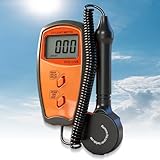
- 𝐏𝐫𝐨𝐟𝐞𝐬𝐬𝐢𝐨𝐧𝐚𝐥-𝐆𝐫𝐚𝐝𝐞 𝐔𝐕 𝐌𝐞𝐚𝐬𝐮𝐫𝐞𝐦𝐞𝐧𝐭 - This UV meter delivers professional-grade accuracy across 280-380nm spectrum. It ensures reliable ultraviolet irradiation measurements for various applications with consistent high-quality performance.
- 𝐂𝐥𝐞𝐚𝐫 & 𝐔𝐬𝐞𝐫-𝐅𝐫𝐢𝐞𝐧𝐝𝐥𝐲 𝐎𝐩𝐞𝐫𝐚𝐭𝐢𝐨𝐧 - Featuring an intuitive LCD display, this UV light meter provides effortless readouts of UVA data. Its straightforward interface allows quick interpretation of measurements in different lighting conditions.
- 𝐏𝐞𝐚𝐤 𝐕𝐚𝐥𝐮𝐞 𝐂𝐚𝐩𝐭𝐮𝐫𝐞 𝐓𝐞𝐜𝐡𝐧𝐨𝐥𝐨𝐠𝐲 - Equipped with Data-Peak function, this UVA UVB light tester automatically records maximum intensity readings. This sophisticated feature guarantees accurate tracking of peak values during extended monitoring sessions.
- 𝐀𝐝𝐯𝐚𝐧𝐜𝐞𝐝 𝐂𝐢𝐫𝐜𝐮𝐢𝐭 𝐑𝐞𝐥𝐢𝐚𝐛𝐢𝐥𝐢𝐭𝐲 - Built with precision LSI-circuit technology, this UV radiometer maintains exceptional durability and consistent performance. Its robust construction ensures long-term stability across diverse environmental conditions.
- 𝐅𝐥𝐞𝐱𝐢𝐛𝐥𝐞 𝐃𝐞𝐭𝐞𝐜𝐭𝐢𝐨𝐧 𝐏𝐨𝐬𝐢𝐭𝐢𝐨𝐧𝐢𝐧𝐠 - The separate UV sensor on this lightning detector enables optimal measurement placement. This innovative design permits precise readings from ideal angles and hard-to-reach locations.
Rank #4

- 3-in-1 REUSABLE CARD - The EIDEAL UV & UVC Test Card is double-sided. On the one side, you have two tests: UV light and UVC light, which indicate whether a bulb or light is indeed irradiating the type of UV light that it claims. On the other side, you can test any UV or UVC bulb's remaining intensity. Remember UV lights have a life span of about 9000 hours. We recommend storing the card in the packaging sleeve to protect the sensitive test area.
- SIMPLE TO USE - These cards have been designed to be simple to use and easy to understand. No confusing instructions and the card gives a clear indication of the test results. Please note that the intensity scale gives an approximate indication of the intensity remaining in a bulb. Should you require a more accurate reading, please use a Radiometer/ Optometer.
- HOW TO READ RESULTS: The UV & UVC test has to be observed directly under the light that you are testing. The letters will disappear immediately when not irradiated by the light. The UV Intensity test side can be used in a closed box or directly under the light. This test gives an indication of the UV or UVC remaining in the bulb depending on the time you leave the card exposed to the light. To calculate UV Dose: UV Intensity (μW/cm² - the reading which the card gives you) x Exposure Time (seconds).
- DIFFERENT USES/ TESTS - So you have bought this UVC sanitizing wand, but is it emitting the correct wavelength to kill all harmful bacteria as promised? The UV protection film that is installed on your car windows, does it block all UV as claimed? And those UV blocking glasses, are they protecting your eyes? Find out!
- DEVELOPED WITH THE CUSTOMER IN MIND - We wanted to create a simple to use card with added value. A lot of thought and investigation went into the planning of this card so that it would be easy to understand and simple to use.
Product prices and availability are accurate as of the date/time indicated and are subject to change. Any price and availability information displayed on Amazon at the time of purchase will apply.




