What’s actually slowing this PC down?
Pick the symptom - the matching free tool is one click away.
No—not across the board. In electrochemical carbon dioxide reduction, copper can help make products with carbon–carbon bonds, including ethylene and alcohols. Gold is useful in the cited studies for producing carbon monoxide. In some designs, the two metals work together: gold makes CO, which nearby copper sites can convert further. The better catalyst depends on the product and operating conditions.
What does “copper versus gold” mean here?
A catalyst helps a reaction proceed without being consumed as the overall product. In the studies discussed here, electricity drives the conversion of carbon dioxide (CO₂) at an electrode. The useful comparison is not which metal is universally superior, but what each catalyst makes under specified conditions.
As an Amazon Associate I earn from qualifying purchases.
That distinction matters because producing carbon monoxide (CO) and producing compounds with two or more carbon atoms are different targets. A study that favors CO cannot be ranked against one that targets multicarbon products without accounting for the intended product, applied potential or current, electrolyte, and stability.
Free tools Windows power users keep installed
One-click scans. No signup required.
What can copper and gold make from CO₂?
| Catalyst approach | Reported role in the cited work | What the result does—and does not—show |
|---|---|---|
| Copper-based catalysts | Can produce a range of products, including multicarbon products such as ethylene and alcohols. Work by Lum and Ager identified copper catalyst active-site types associated with ethanol/acetate, ethylene, and 1-propanol. | Product distribution varies with catalyst structure and reaction conditions; “copper catalyst” does not imply one fixed product or active surface. |
| Gold | In the cited examples, can selectively produce CO. | This describes a useful CO-producing role, not a universal ranking against copper for products gold was not being used to target in those experiments. |
| Gold on copper (Au/Cu) | Combines CO production on gold with further conversion at nearby copper sites. Morales-Guio and colleagues reported improved selectivity toward C–C-bonded products under their low-overpotential conditions. | The paper reported the tandem catalyst was “over 100 times more selective for the formation of products containing C–C bonds versus methane or methanol” under its experimental conditions. That is not a general performance ratio for all gold and copper catalysts. |
| Designed copper-based alloy | A 2024 study by Xue and colleagues incorporated isolated antimony and palladium atoms into a copper-based catalyst and reported it as a CO-evolution catalyst. | This is evidence for a deliberately designed copper-based material, not proof that elemental copper alone always replaces noble metals. |
Why copper is notable for multicarbon products
Making a product with two or more carbon atoms requires forming a carbon–carbon bond. Copper surfaces can support reaction routes that produce such products, which is why copper is prominent in electrochemical CO₂ reduction research. The outcome depends on the particular catalyst and reaction settings; a copper surface is not a single, unchanging recipe.
#1 Best Overall
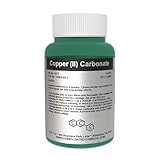
- CAS Number: 12069-69-1
- Chemical Formula: CuCO₃
- High Purity: 99% minimum purity ensures maximum effectiveness and consistency.
- Versatile Uses: Suitable for use in pigments, chemical reactions, and research experiments.
- Industrial Grade: Ideal for industrial processes, including catalysis, ceramics, and pigment formulation.
Lum and Ager’s 2019 study provides a more specific example: isotope experiments associated different active-site types on oxide-derived copper catalysts with ethanol/acetate, ethylene, and 1-propanol production. This supports the idea that different sites can favor different products, rather than every copper site performing the same job.
Why combine gold and copper?
A tandem catalyst assigns different steps to different sites. In the gold-on-copper design studied by Morales-Guio and colleagues, gold produces CO, and nearby copper sites can use that intermediate in further reactions. The point is not to crown one metal as the winner; it is to arrange the materials so that an intermediate made at one site can reach another site that converts it toward the desired product.
Rank #2

- Still Spirits Copper Saddles
- 100g of Copper Saddles
- Copper is required as a catalyst to remove sulphur odours during distillation
- Does not contain alcohol
The reported selectivity advantage belongs to that study’s catalyst and low-overpotential experimental conditions. It should not be read as a universal guarantee for other electrode structures, electrolytes, or operating regimes.
What changes a copper catalyst’s products?
Applied potential and current
The potential and current influence which reaction pathways are favored. Ren, Fong, and Yeo’s study specifically examined how currents and potentials affect copper’s selectivity in CO₂ electroreduction. Results obtained at one operating point do not establish the product distribution at another.
Rank #3

- 500mL bottle of copper (II) chloride
- Chemical for general purpose lab and educational use
- Used as a catalyst
- Perfect for use in any chemistry lab or classroom
- Includes directions for safe storage and SDS is available on product page and by request
Electrolyte composition
The solution around the electrode can matter as well as the metal. Monteiro and colleagues reported no CO₂ reduction on copper, gold, or silver electrodes without added metal cations under the particular conditions they tested, attributing the effect to cation stabilization of a reaction intermediate. That finding is specific to their setup; it does not establish that CO₂ reduction on these metals is impossible in every cation-free system.
Surface structure and active sites
The working surface can differ from the material initially placed in the cell. A 2022 commentary by Creissen and Fontecave cautioned that transient copper clusters could account for C₂+ products in some systems described as single-atom catalysts, and emphasized the need for operando characterization—studying the catalyst while it is operating. Claims about a particular active site therefore need to be considered in light of how and when that surface was observed.
Rank #4

- Chemical Formula: CuCl₂·2H₂O
- CAS Number: 10125-13-0
- Weight: 170.48 g/mol
- High Purity: Our Copper (II) Chloride Dihydrate is ≥99% pure, making it suitable for critical laboratory and industrial applications.
- Versatile Applications: Perfect for use in chemical synthesis, electroplating, etching, and as a catalyst in various chemical reactions.
Is copper ready to replace gold at industrial scale?
Laboratory results do not by themselves establish industrial readiness. A 2025 review by Kok and colleagues identifies copper reconstruction and loss of C₂ activity as stability challenges in CO₂ electrolysis. A catalyst that initially makes a desired product must also maintain useful activity and selectivity over time.
Scale adds another hurdle. Moon and colleagues’ 2026 review describes industrial implementation of CO₂ or CO reduction to multicarbon products as requiring square-metre-scale electrodes and more than 10 grams of catalyst per electrolyser. Those figures describe requirements discussed for industrial implementation, not a performance result or a universal specification for every electrolyser design. They underline why a small-area demonstration is not equivalent to a commercially proven process.
Best Value

- High Purity Porous Copper Foam Material – Premium copper foam sheet made from high purity copper, ideal as copper foam electrode, copper foam catalyst support, conductive porous copper material for battery research, electrolysis and electrochemical testing.
- 3D Open-Cell Structure & Large Surface Area – Uniform 3D porous copper structure with very high specific surface area, perfect for battery electrode material, supercapacitor electrode, hydrogen evolution electrode, fuel cell components, catalyst carrier and advanced filtration projects.
- Excellent Thermal & Electrical Conductivity – This copper foam combines high electrical conductivity with excellent heat dissipation, suitable for EMI shielding, heat sink and cooling applications, power electronics, LED cooling, and other thermal management projects requiring copper foam material.
- Easy to Cut, Shape and Process – Flexible, machinable copper foam sheet that can be easily cut, trimmed, bent and shaped with simple tools, convenient for custom copper foam electrodes, filter pads, heat dissipation blocks, EMI shielding gaskets and DIY copper foam parts.
- Wide Application in Lab, Industry & DIY – Versatile copper foam filter and electrode material widely used in electrolysis, electroplating, hydrogen production, fuel cells, catalyst support, gas and liquid filtration, materials science research, school experiments and hobby electronics projects.
How to judge a copper-versus-gold claim
For a meaningful comparison, check whether the studies target the same product and report results under comparable conditions. A useful assessment includes:
- Product: Is the goal CO, ethylene, an alcohol, or another compound?
- Selectivity and activity: What product distribution and activity were reported at the stated potential or current?
- Operating conditions: What electrolyte and other reaction conditions were used?
- Stability: Did activity and selectivity persist, or did the copper surface reconstruct or lose performance?
- Scale: Was the result demonstrated on a small laboratory electrode, or at a scale relevant to practical implementation?
On that basis, copper is important not because it simply takes gold’s place, but because copper-based catalysts can enable product pathways that make it valuable in a different part of CO₂ electrochemistry. Gold can remain useful for CO production, and a tandem arrangement can use both metals for successive steps.
Quick Recap
Product prices and availability are accurate as of the date/time indicated and are subject to change. Any price and availability information displayed on Amazon at the time of purchase will apply.
Quick wins for a faster PC:
Fix the driver behind crashes, sound loss and screen glitchesFind Drivers →Repair Windows errors before they cause bigger problemsFix Now →Scan for outdated or missing drivers - takes under a minuteDriver Scan →



