Outdated Drivers Are Slowing You Down
One free scan finds every outdated or missing driver and matches the right update for your exact hardware.Free scan · exact hardware matchPC Slower Than It Used to Be?
A free scan shows the junk files, broken settings and background clutter dragging Windows down - then fixes them in one click.Free scan · Windows 10 & 11For adults aged 65 and older, the clearest public-health target is muscle-strengthening activity at least two days a week, done alongside aerobic and balance activity. The U.S. Centers for Disease Control and Prevention (CDC) and the World Health Organization (WHO) both recommend this pattern. Strength training has solid support for keeping muscle strength, muscle-related function, and mobility, which are the things that make everyday independence possible. It does not, on current evidence, come with a measured number of extra years of life. Treat it as a core part of healthy aging, not a guaranteed lifespan extender.
What the main guidelines recommend
Two major guidance documents set the baseline. They agree on the core structure and differ mainly in wording and in how they describe the balance component.


As an Amazon Associate I earn from qualifying purchases.
| Guidance | Strength component | Other components | Notes on scope |
|---|---|---|---|
| CDC, Older Adult Activity: An Overview (updated December 4, 2025), for adults 65 and older | At least 2 days per week of muscle-strengthening activity | Aerobic and balance activity recommended; weekly amounts not stated in the cited overview | If a person cannot meet the targets, they should be as physically active as their abilities and conditions allow |
| WHO, Guidelines on Physical Activity and Sedentary Behaviour, Executive Summary (2020), for older adults | Moderate-or-greater intensity muscle-strengthening involving all major muscle groups, on at least 2 days per week | Varied multicomponent activity emphasizing functional balance and strength, on at least 3 days per week, to support functional capacity and help prevent falls | These are activity recommendations, not individualized training plans |
In practice, the strength portion is a minimum weekly frequency, not a prescription for specific loads or repetitions. The guidance does not tell you which exercises to pick or how hard to work. It sets the floor that makes strength work count as part of a broader week.
What’s actually slowing this PC down?
Pick the symptom - the matching free tool is one click away.
What the 2025 dose review found
Dose is the question most readers ask next: how much strength work is enough? A 2025 network meta-analysis by Régis Radaelli and colleagues, published in Sports Medicine (online October 15, 2024; print January 2025), pooled 151 randomized trials and 6,306 participants. Its title is Effects of Resistance Training Volume on Physical Function, Lean Body Mass and Lower-Body Muscle Hypertrophy and Strength in Older Adults. It compared training volume categories rather than a single ideal program.
#1 Best Overall
| Training volume category | Outcomes where it was ranked most effective |
|---|---|
| Low volume | Timed up-and-go performance, six-minute walk performance, lean body mass, and muscle hypertrophy |
| Moderate and high volume | Lower-limb strength |
What the dose result means
The practical reading is that more work does not automatically produce a better result on every measure. Low-volume training did well on several function and body-composition outcomes, while larger volumes were more effective for leg strength. If your main goal is strength in the legs, the review points toward a higher volume than if your goal is walking speed or general function. The review does not establish one optimal volume for everyone.
Who the evidence covers
The authors report that the results were observed mainly in healthy older adults. Evidence for people with physical impairments was limited, so the dose findings should not be applied to that group without professional input.
Rank #2
What strength training can and cannot promise about lifespan
The headline promise of longevity needs careful wording. The sources support several outcomes, but they do not translate those outcomes into a defined number of extra years.
- Muscle and strength: The U.S. Physical Activity Guidelines for Americans, 2nd edition (HHS, 2018), state that progressive muscle-strengthening activities preserve or increase muscle mass, strength, and power, and that greater amounts can improve muscle function to a greater degree.
- Mobility and healthy aging: The National Institute on Aging, in a June 30, 2022 article titled How can strength training build healthier bodies as we age?, describes research into maintaining muscle mass, improving mobility, and increasing healthy years of life. That is a healthy-aging rationale, not a measured lifespan effect of strength training alone.
Two claims are not supported by these sources. First, strength training does not prevent every age-related disease. Second, it does not make every older adult independent. Describe the benefit in specific terms, such as stronger legs for rising from a chair or better walking performance, rather than as a guaranteed extension of life.
Equipment is optional: home and gym options
Readers often assume they need a gym. The CDC guidance is explicit that equipment is not required. It lists resistance bands and bodyweight exercises as examples of muscle-strengthening activity. The choice of setting should match your ability, space, and routine.
Bodyweight movements
Bodyweight work uses your own body as resistance. Examples include sitting down and standing up from a sturdy chair and pressing against a wall. These can be scaled by changing the surface height or the range of motion, which makes them a common starting point for people who are new to strength work.
Rank #4
- Description|Table of Contents|Author|Excerpts|Sample Content
Resistance bands
The CDC lists resistance bands as a way to do muscle-strengthening activity, and the NIH also describes bands as a strength-training option. Bands are portable and can be used for pulling, pressing, and leg movements. The sources do not identify one band type or resistance level as best, so choose one that lets you complete the movement with control.
Free weights, machines, and supervised settings
Free weights, machines, and supervised or community exercise classes also count as muscle-strengthening options. The sources do not establish that one of these settings is superior. A supervised setting can be useful if you want technique feedback or have a condition that calls for monitoring.
Best Value

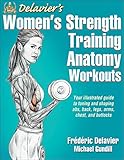
- This 214-page guide gives you a detailed 12-week dumbbell strength-training plan—designed specifically for women!
- Effective 30-minute workouts you can do at home or at the gym with a workout log to track your progress daily
- Get step-by-step instructions with photos illustrating every exercise to get fit, sculpt your body, and feel amazing
- Personalized tips to select the right dumbbell weights, recover faster, increase energy, enhance results, and more!
- Recommended equipment: 3 sets of dumbbells—light, medium, heavy—plus a yoga mat *Equipment not included
Building a plan that fits you
Use these five checks to turn the guidelines into a weekly routine:
- Goal: Decide whether you want general strength, muscle function for daily tasks, or a combination that also includes balance.
- Setting: Choose bodyweight, bands, free weights, machines, or a supervised class based on what you can access consistently.
- Dose: Start with at least two strength sessions a week to meet the guideline floor. Adjust frequency, number of exercises, and sets based on your goal and how you recover. The volume findings above can guide this choice.
- Balance: Include balance and functional movements, since WHO recommends multicomponent work with functional balance and strength on at least three days a week.
- Consistency: Pick a routine you can repeat in your available space. A modest plan you keep is more useful than an ambitious plan you abandon.
When health conditions change the starting point
The NIH advises people with a chronic health condition, or those recovering from illness or injury, to check with a doctor before starting a new routine. The CDC adds that older adults who struggle to meet activity targets should be as active as their abilities and conditions allow. Those two points together mean that the standard targets are a goal, not a requirement that overrides your situation. If you have a condition that limits movement, ask a clinician or a qualified exercise professional to help you choose the starting point, the exercises, and the progression.
Some general warning signs should prompt a call to your doctor before you continue: chest pain, unusual shortness of breath, dizziness, or pain that lingers after a session. These are not diagnostic criteria, but they are reasons to stop and seek advice.
Recommended Free Tools
Quick Recap
Product prices and availability are accurate as of the date/time indicated and are subject to change. Any price and availability information displayed on Amazon at the time of purchase will apply.




