You can build a browser-based prototype that classifies audio as snoring-like sound, speech, ambient noise, or silence. TensorFlow.js’s audio-recognizer tutorial is a closer fit for that task than Whisper: Whisper transcribes speech, not sleep-related breathing, and neither tool turns a recording into an apnea diagnosis.
What each model can—and cannot—do
The key design choice is to separate speech recognition from sound-event classification. They process audio for different purposes, so combining them does not automatically produce a sleep-health detector.
As an Amazon Associate I earn from qualifying purchases.
| Approach | What it does | Fit for this project | Important boundary |
|---|---|---|---|
| Whisper | General-purpose speech recognition, speech translation, language identification, and voice activity detection. | Optional: transcribe spoken notes or context associated with a recording. | The OpenAI Whisper repository documents a Python/PyTorch transcription workflow using sliding 30-second windows. It does not establish snoring classification or apnea detection. |
| TensorFlow.js custom audio classifier | Uses transfer learning to classify audio into custom sound classes in the browser. | A more direct starting point for labels such as snoring-like sound, speech, ambient noise, or silence. | TensorFlow’s tutorial demonstrates a custom-classifier approach, not a validated sleep-health model. |
| Clinical sleep testing | Evaluates sleep-related breathing using a medically appropriate test selected for the patient. | Relevant when symptoms or risk warrant clinical assessment. | A DIY audio classifier is not clinical testing. AASM guidance describes provider-led assessment and interpretation. |
Plan the prototype before collecting audio
Define labels as audible events
Start with labels the model can plausibly learn from sound alone: “snoring-like sound,” “speech,” “ambient noise,” and “silence.” Define what counts as each label and how ambiguous windows will be handled. “Possible snoring-like event” is a more defensible output than a statement about a person’s breathing condition.
Free tools Windows power users keep installed
One-click scans. No signup required.
Choose representative examples
A classifier learns the patterns present in its labeled examples. Recordings should reflect the variation the prototype is expected to encounter, including different rooms, microphones, background sounds, and examples that are not snoring. Keep labels tied to the audible window, rather than assuming that an entire recording has one class. The available TensorFlow tutorial supports the transfer-learning concept; it does not supply a sleep dataset, a clinically appropriate labeling protocol, or performance results for this particular project.
#1 Best Overall

- 2.25-inch LCD Screen with Backlight: This TS-501B sound level meter is measured noise levels are expressed in decibels and displayed on the 2.25-inch LCD screen, it easy to read on a big display design. Long press the backlight button to turn on a backlight, making it easy to view even in dim light
- Decibel Meter with A/C Weighting: TopTes TS-501B decibel meter uses a precise condenser microphone to capture sound. It’s equipped with A-weighting and C-weighting facilities that measure noise levels from 30 to 130 dB with an accuracy of 1.5 dB, Frequency from 30 to 8000Hz. Perfect for monitoring noise levels in communities, home theaters, audio systems, automobiles, workshops, schools, offices, factories
- MAX/MIN Measurement: The sound pressure level (SPL) meter has Max or Min measurement values to represent the maximum/minimum (high/low peak) value of the sound produced within a certain time, and the data hold function can freeze the current reading based on the sound measurement according to individual needs
- Easy Use and Feature Packed: The non-slip side design ensures that the portable noise meter fits easily in the hand. TS-501B SPL meter is a battery-operated noise meter that comes with three durable batteries and has an automatic power off function to extend battery life. A low battery indicator will appear on the screen when the battery is low to remind the user to replace the battery in time
- What’s in the Box: One TS-501B Decibel Meter, Three AAA Batteries, One User Manual, One Carry Case. The device has been factory calibrated to ensure high measurement accuracy and compliance with quality standards.
Set a privacy policy
Decide whether audio is retained, where model files are loaded from, and whether any feature or prediction data leaves the device. “Runs in the browser” does not by itself prove that the entire data path is local: remote model downloads, storage, analytics, or fallback services may still involve network traffic.
Build the audio-classification path
- Request microphone access. Explain why audio is needed and obtain the browser’s permission before capture. Provide a clear stop control and do not record in the background without the user’s informed choice.
- Capture short audio windows. Use a consistent windowing approach for training and prediction. The window should be long enough to preserve the sound pattern you intend to classify, while keeping processing and display responsive. The appropriate duration for this specific detector has not been established.
- Prepare audio consistently. Apply the same preprocessing used for the classifier’s training examples. Keep capture, normalization or feature preparation, and inference aligned; differences between training audio and microphone input can undermine the usefulness of the labels.
- Train or adapt a custom classifier. Follow TensorFlow’s transfer-learning audio-recognizer tutorial as an educational starting point, then adapt the labels and examples to the sound classes in this prototype. The tutorial is not evidence that the resulting model can recognize sleep apnea.
- Present classifications as uncertain observations. Show the label and time window, and make it easy to review or dismiss a possible event. Do not convert a series of audio labels into a disease score or a measure of apnea severity.
- Check the data flow. Verify whether microphone audio, model requests, logs, and saved results are transmitted or stored. Describe the implementation as local only if its actual behavior—including model loading and any fallback path—supports that description.
Where Whisper fits in a local design
Whisper is optional and should be treated as a separate speech feature, not as the snoring detector. For example, it could transcribe a spoken note a user chooses to add. It does not make a sound-event classifier more medically capable, and an absence of transcribed speech says nothing reliable about whether apnea occurred.
Rank #2

- Accurate 30-130dB Noise Measurement: The Goldeep SL750A decibel meter measures sound levels from 30 to 130dB with ±1.5dB accuracy and a 31.5Hz-8KHz frequency response. This sound decibel meter is ideal for checking home noise, neighbor noise, traffic sound, office noise, construction sites, factories, classrooms, baby rooms and musical instruments.
- A/C Weighting for Different Sound Environments: This digital sound level meter supports A/C weighting modes for more flexible noise testing. A-weighting is suitable for environmental noise such as urban traffic, schools, offices, business areas and construction sites. C-weighting is designed for industrial noise from machinery, equipment, aerospace, high-speed rail and other high-intensity sound sources.
- dB/SONE Units for Sound & Loudness Testing: Use the dB unit to measure sound intensity for environmental noise, machine noise, traffic noise and workplace noise. Switch to SONE to better understand perceived loudness, making this db meter useful for music, audio systems, acoustic checks and instrument noise control..
- FAST/SLOW Response with MAX/MIN Tracking: The spl meter includes FAST and SLOW response settings. FAST response, 0.125s per reading, is useful for changing noise levels, while SLOW response, 1s per reading, is suitable for steady-state noise. MAX/MIN value tracking helps record peak and minimum noise levels over a period of time.
- Easy-to-Use Sound Meter for Daily & Professional Needs: Designed with data hold, clear LCD display, anti-slip grip and a windbreak ball, this sound meter is practical for indoor and outdoor use. Package includes 1 sound level meter, 2 AAA 1.5V batteries and 1 user manual, so you can start measuring noise right away.
There is also a practical architecture distinction: the official Whisper project documents a Python/PyTorch implementation, while TensorFlow.js is designed to run machine-learning models in JavaScript environments such as a browser. A project that uses both therefore has to account for how those components run and exchange data. Do not describe the whole system as an all-browser or all-local application unless that is true of the implementation being shipped.
What “local” means in a browser
Microphone capture, model inference, and speech recognition are separate parts of the data path. Each can have different execution and network behavior. MDN’s Web Speech API documentation notes that speech recognition commonly uses a server-based service by default, which can send audio to a remote service.
Rank #3

- 【Widely Used】The noise meter is the use of environmental sound level instrument, can be widely used in such as factories, workshops, schools, residential, office areas, traffic roads, audio and other occasions of sound level measurement. Also suitable for noise engineering, product quality control, health,prevention and control.
- 【Accurate Measurement】Measuring Range:30~130dB ;Accuracy:±1.5dB(94dB@1KHz);Display Resolution:0.1dB
- 【A Weighted Measurement】 A Weighted network (automatic switching range display)
- 【Fast/Slow mode selection】Press the MODE key, you can convert the response speed of the noise meter, FAST fast, SLOW slow
- 【MAX/MIN Measurement】Press RANGE key to measure the maximum value of MAX and minimum value of MIN.A maximum duration of more than 3 seconds is recorded, with a normal test sampling rate of 0.5 seconds. The maximum error is ± 5%.
MDN also documents local speech recognition through the processLocally option and language-pack availability checks. That route depends on browser/API support and installed language packs; MDN marks the relevant features experimental or of limited availability. Consequently, a browser app should not promise private, offline speech recognition merely because it uses Web Speech APIs. Check support, confirm the required language resources are available, and explain what happens when local recognition cannot be used.
- Local inference: the model processes audio on the user’s device.
- Local model availability: the required model is already available or is downloaded; a download is still a network transfer.
- Local storage: recordings, predictions, and logs remain on-device rather than being uploaded.
- Local speech recognition: the browser supports local processing and has the necessary language resources; default server-based recognition is not equivalent.
How to describe the result responsibly
Call an output a detected snoring-like sound or a possible audio event. A sound recording captures acoustics, not the full clinical picture. This prototype has no established clinical dataset, validation protocol, or performance estimate for apnea detection; reporting a guessed accuracy, sensitivity, or specificity would be misleading.
Rank #4

- 【Accurate Measurement】 The measuring range of the sound level meter is 30dB to 130dB . Highly accurate with ± 2.0 dB. Real-time monitoring can give you accurate data on the sound level in the area.
- 【A/C Weighted Measurement】 The A weighted simulates the frequency characteristics of low-intensity human ear noise, which is suitable for the detection of ambient noise. The C weighted simulates the frequency properties of high-intensity noises of the human ear, which are suitable for the sound pressure analysis of machine motors and machines. More professional measurement methods provide users with a more perfect user experience.
- 【Fast and Slow Measurement】 The sound level meter has the function of converting the fast and slow response rate. The fast response rate uses a time constant of 0.125s/time for general environmental measurement. The slow response rate uses a 1s/time constant, which is used for environmental measurements with relatively large changes in noise levels.
- 【Digital LCD Display 】 The digital display is a 4-digit LCD display with a resolution of 0.1 dB. Backlit LCD digital display, the reading effect is clearer in dark places. When the battery is low, the LCD display will display a low voltage icon, indicating that the power is low at this point and the battery needs to be replaced.
- 【Convenient and Lightweight 】Tadeto sound level meter is lightweight and easy to carry. It's widely used in factories, transportation, car, baby room and audio system offices, sound quality control in homes, schools, and construction sites.
The American Academy of Sleep Medicine’s May 1, 2025 position statement says only a medical provider can diagnose conditions such as obstructive sleep apnea (OSA) and primary snoring. Its guidance on home sleep apnea testing describes HSAT as an alternative to polysomnography for selected uncomplicated adults with signs and symptoms indicating increased risk of moderate-to-severe OSA. A provider assesses whether testing is appropriate and orders it for diagnosis or efficacy evaluation; raw data must be reviewed and interpreted by a qualified physician.
Recommended Free Tools
The FDA’s September 28, 2026 product-classification page defines an over-the-counter device category for assessing OSA risk. That category provides risk notification for users not previously diagnosed; it is not intended to provide a standalone diagnosis, replace traditional diagnostic methods such as polysomnography, assist clinicians in diagnosing sleep disorders, or act as an apnea monitor. A DIY sound classifier should not imply that it has the role or evidence of even such a regulated risk-assessment product. If you are concerned about apnea, discuss symptoms with a medical provider.
Best Value
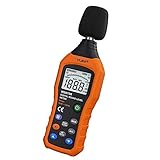
- The sound level meter is an instrument used to real-time measure the sound level,such as sound level around factories,workshops,schools,residential,offices,road,audio etc (Battery not include), Can not keep and generate a report directly from the device
- It also can be appropriate for noise engineering,product quality control,health prevention and treatment,etc.This audio noise measure device is a great tool for checking, monitoring or controlling and test the sound level of any environments. It is widely applicable for personal, families, business, studies, industrial and etc
- With the measuring scope from 30 to 130dB and shifting function. Digital display,good anti-interference performance,power saving
- With the backlight feature,it is appropriate for gathering the sound data at night.Backlight auto power off function is provided.With power saving and high-reliability circuit design,well-design high-efficiency power supply circuit makes the batteries more durable
- Composite material injection molding process is adopted for casing with anti-drop structure design.It is not only extremely wear-resisting,but also elegant,It’s a mini handheld portable sound level reader
What a credible next validation step would require
Before making health claims, a project would need more than a model that appears to identify snoring in a few recordings. It would need appropriate reference labels, a defined target population, and professional validation against a relevant clinical standard. None of those elements—or a validated dataset and performance estimate for this Whisper-plus-TensorFlow.js idea—is established here. Keep the prototype educational and its outputs descriptive until such evidence exists.
Quick Recap
Product prices and availability are accurate as of the date/time indicated and are subject to change. Any price and availability information displayed on Amazon at the time of purchase will apply.




