For an all-around travel photography pick, RTINGS ranks the Fujifilm X-T5 first in its mirrorless travel guide, updated September 8, 2026. That is RTINGS’ recommendation, not a universal winner: the best choice depends on the lenses you’ll carry, whether you want a viewfinder, and how much you prioritize stills, video, or low-light shooting.
How the six cameras compare
| Camera | Best fit | What stands out | Key tradeoff |
|---|---|---|---|
| Fujifilm X-T5 | Travel photography and hands-on controls | 40.2-megapixel APS-C sensor, exposure dials, weather-sealed build, battery life, autofocus tracking, and compact X-mount lens options (RTINGS) | Prioritizes a higher-resolution stills experience; the complete kit still depends on lens choice. |
| Sony α7C II | Compact full-frame setup | 33-megapixel full-frame sensor, weather-sealed body, battery life, autofocus, and broad native and third-party lens selection (RTINGS) | Small viewfinder and fewer custom buttons than the larger α7 IV. |
| Sony α6700 | Mid-range stills and video | Compact APS-C body, in-body stabilization, subject tracking, broad E-mount lens selection, and video up to 4K/120p (RTINGS) | The 4K/120p mode has a 1.58× crop; DPReview describes detailed 4K/60p video with 10-bit color. |
| Fujifilm X-M5 | Compact, screen-first entry-level use | 26-megapixel sensor, newer processing, internal 10-bit video, and 6.2K open-gate video (RTINGS) | No viewfinder or sensor stabilization; lower resolution than the X-T50 (DPReview). |
| Olympus OM-D E-M10 Mark IV | Portable Micro Four Thirds kit | Affordable lens options, compact overall kit, and in-body stabilization (RTINGS) | Less reliable autofocus and weaker low-light noise handling than larger-sensor models (RTINGS). |
| Sony ZV-E10 | Vlogging and screen-based shooting | Light body, fully articulated screen, vlogging features, and battery life (RTINGS) | No viewfinder or built-in stabilization; an optically stabilized lens can help reduce shake. |
Which travel camera fits your priorities?
For still photos and direct controls: Fujifilm X-T5
RTINGS’ top-ranked option combines a 40.2-megapixel APS-C sensor with exposure dials, weather sealing, battery life, and autofocus tracking. It makes sense if you want detailed still images and prefer changing exposure with physical controls. RTINGS identifies the smaller, less weather-sealed X-T50 as a lower-cost alternative, but it is not one of the six models in that guide’s ranking. Fujifilm’s X-T5 product page provides manufacturer model information.
As an Amazon Associate I earn from qualifying purchases.
For a compact full-frame body: Sony α7C II
The α7C II offers a 33-megapixel full-frame sensor in a compact, weather-sealed body, with battery life and autofocus that RTINGS highlights for travel. Its native and third-party lens options give travelers a broad selection. Account for the small viewfinder and fewer custom buttons than the α7 IV when deciding whether the compact body’s controls suit you. A compact full-frame lens can help keep the whole kit manageable.
The Tool Desk
Outbyte PC Repair FREEClear out junk files and repair common Windows errorsFree Scan →Outbyte Driver Updater FREEScan for outdated or missing drivers - takes under a minuteDriver Scan →For a hybrid stills-and-video camera: Sony α6700
The α6700 pairs a compact APS-C body with in-body stabilization, subject tracking, and a wide choice of E-mount lenses. RTINGS notes recording up to 4K/120p; DPReview adds that this high-frame-rate mode uses a 1.58× crop, while describing 4K/60p 10-bit video as detailed. If you expect to shoot at 120p, consider how the crop affects your framing and lens choice.
#1 Best Overall

- 20.1MP stacked back illuminated 1" Exmor RS CMOS sensor w/ DRAM, large aperture 24-70mm1 F1.8-2.8 ZEISS Vario-Sonnar T lens
- Enhanced subject capture: wide 425 Phase/ 425 contrast detection points over 84 percent of the sensor
- Fast and accurate: Up to 11Fps continuous shooting at 24.2 MP raw with crisp, clear natural colors
- Multiple movie functions: Make time lapse movies or slow/quick motion videos without post processing
- Tiltable LCD screen: customizable for vlogging, still photography or recording a professional film
For a small screen-first camera: Fujifilm X-M5
RTINGS describes the X-M5 as the most compact body in Fujifilm’s current mirrorless lineup, with a 26-megapixel sensor, newer processing, internal 10-bit video, and 6.2K open-gate recording. Its defining compromise is the absence of an electronic viewfinder: you compose on the screen. DPReview also notes that it lacks sensor stabilization and has lower resolution than the X-T50. That mix suits travelers who value a small body and video features more than an EVF or in-body stabilization.
For a portable Micro Four Thirds system: Olympus OM-D E-M10 Mark IV
RTINGS points to the E-M10 Mark IV’s stabilized body and affordable lens choices as strengths for building a portable kit. Its smaller sensor format is associated with weaker low-light noise handling than the larger-sensor cameras in this group, and RTINGS finds its autofocus less reliable. Consider it if the overall system’s portability and lens costs matter more than low-light performance or the most dependable tracking.
Rank #2

- 24.2MP APS-C Exmor CMOS Sensor and fast BIONZ X processor
- 4K Movie oversampled from 6k w/ full pixel readout, no pixel binning
- Product Showcase Setting transitions focus from face to object
- Background Defocus button instantly toggles between defocus effect on/off
- Easy live streaming w/ single USB cable and no extra hardware/software
For travel vlogging: Sony ZV-E10
The ZV-E10 is built around a light body, a fully articulated screen, and vlogging features, with battery life also noted by RTINGS. It is screen-first and lacks both a viewfinder and built-in stabilization. If reducing shake is important, RTINGS advises pairing it with an optically stabilized lens.
Choose the kit, not just the camera body
A travel camera’s practical size and capability come from the body and lens together. A larger sensor does not automatically make a camera the better travel choice: RTINGS notes that full-frame lenses are often larger than APS-C or Micro Four Thirds alternatives, though compact primes can make a full-frame setup easier to carry.
Rank #3
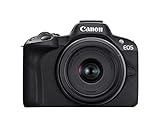
- High Image Quality: Canon EOS R50 4K digital camera features a 24.2 Megapixel CMOS (APS-C) sensor and DIGIC X processor for stunning image clarity and level of detail
- High-Speed Continuous Shooting: Capture fast action with up to 12 fps with Electronic First Curtain shutter and up tp 15 fps with Electronic Shutter for a superior vlogging camera
- Advanced Auto Focus: Dual Pixel CMOS AF II covers up to 100% x 100% area with 651 AF zones; features auto subject detection and tracking of people, animals, and vehicles using deep learning technology — perfect 4K camera for video recording
- Exceptional Low-Light Performance: Advanced A+ Assist offers an expanded array of auto-compatible scenes for greater expressive capability in auto mode and enables great imagery even in difficult settings such as night and backlit scenarios.
- Fluid Video Capture: Video recording features such as 6K oversampled uncropped 4K movie at up to 30 fps, Full-HD High-frame rate movie recording at up to 120 fps: Movie for Close-up Demo Mode quickly and automatically switches focus to the subject closest to the camera
- Think about your usual scenes. Landscapes, city details, portraits, and distant subjects can call for different focal lengths. Choose a lens range that suits the pictures you actually want rather than judging the body alone.
- Check stabilization needs. The α6700 and E-M10 Mark IV have in-body stabilization; the X-M5 and ZV-E10 do not. With the ZV-E10, an optically stabilized lens is one option for reducing shake.
- Decide how you prefer to compose. The X-M5 and ZV-E10 have no viewfinder. If you regularly frame through an EVF, that omission is a practical constraint, not a minor specification.
- Balance resolution and conditions. More megapixels can support detailed images, but sensor size, lens, light, and your shooting habits also affect results. The largest sensor or highest resolution is not automatically the best travel fit.
- Confirm the exact package before buying. Body-only and bundled-lens offers differ, as can local model naming, stock, warranty coverage, and regional availability. Check the current listing and included lens where you plan to buy.
Other cameras worth understanding as context
These alternatives are useful reference points, but they are not additional entries in RTINGS’ six-camera ranking.
- Fujifilm X-T50: DPReview describes a versatile travel setup with the 16–50mm F2.8–4.8 lens, a 40-megapixel APS-C sensor, in-body stabilization rated to 7EV, and 6.2K 10-bit video. It also notes a small viewfinder, small battery, and less reliable general autofocus tracking.
- Nikon Z50II: DPReview characterizes it as a capable all-around option with a viewfinder and solid autofocus, but without sensor stabilization and with a more limited lens selection than Sony or Fujifilm.
- OM System OM-3: DPReview describes a compact Micro Four Thirds option with IP53-rated dust and water resistance and a compact-lens system.
How to make the final choice
- Set your carry limit. Think in terms of a camera plus the lens or lenses you will bring. If a kit is burdensome, it is less likely to come along on a long day of travel.
- Pick your must-have way of shooting. Choose an EVF if you rely on a viewfinder; choose a screen-first body only if composing on its display works for you.
- Prioritize your main use. The X-T5 is RTINGS’ overall travel photography pick; the α7C II is its full-frame choice; the α6700 is the mid-range hybrid; the X-M5 is the compact entry-level option; the E-M10 Mark IV is the budget Micro Four Thirds pick; and the ZV-E10 is the vlogging-focused choice.
- Check the lens system and local offer. Compare suitable travel focal ranges, total kit size, included lenses, current local stock, and warranty terms before settling on a body.
RTINGS’ ranking reflects that publication’s standardized camera-testing approach and its own priorities. It says it has bought and tested more than 125 cameras in its lab; that is RTINGS’ testing history, not testing conducted for this article. Its guide can change, and prices, stock, and kit configurations vary by region and over time.
Quick Recap
Rank #4

- Designed for creators, vloggers and streamers: Nikon's easy to use Z 30 mirrorless 4K camera with a versatile 16-50mm wide-angle zoom lens
- Pro-grade video quality: Crisp 4K resolution, autofocus with eye tracking for people and pets, beautifully blurred backgrounds, outstanding low-light performance and rock-steady image stabilization
- Vlogger essentials: Flip out touchscreen selfie monitor, built-in stereo microphone with adjustable sensitivity, red REC light and smartphone app for controlling the camera with a compatible phone
- Easy live streaming: Plug and play webcam operation, smooth Full HD 60p streaming over USB-C, 4K 30p streaming over HDMI and constant power over USB-C
- A kit that grows with you: Compatible with Nikon's entire line of exceptional NIKKOR Z lenses, from fast primes to macro lenses, so you can expand your capabilities over time
Product prices and availability are accurate as of the date/time indicated and are subject to change. Any price and availability information displayed on Amazon at the time of purchase will apply.




