A small red star is gradually pulling material off a brown dwarf companion, and astronomers say they have watched it happen. The system, ZTF J0440+2325, sits roughly 300 light-years from Earth. A study in Nature Astronomy, published October 5, 2026, reports it as direct observation of stable mass transfer from a substellar object onto a main-sequence star. “Snacking” is a metaphor: the star is not swallowing its companion whole. It is taking a thin stream of gas over a very long time.
What is the star eating?
The star is an M dwarf, a small, dim red star. Its meal is a brown dwarf, which MIT describes as a planet-like object that is more massive than a planet but not quite large enough to count as a star. The two orbit each other every 87 minutes. The study did not find a planet being consumed.

As an Amazon Associate I earn from qualifying purchases.
MIT News, which covered the work on October 5, 2026, reports estimated masses of about 85 Jupiter masses for the M dwarf and about 25 Jupiter masses for the brown dwarf. Their orbit is tight enough to fit within the diameter of the Sun.
Recommended Free Tools
How can a star eat a brown dwarf slowly?
When a star and a close companion interact, the usual expectation is engulfment and destruction. This system shows a different outcome. Material flows from the lighter brown dwarf onto the M dwarf in a steady, stable way rather than in a runaway collapse. The paper’s abstract says that long-lived stable transfer of this kind was theoretically allowed but had not been observed before.
#1 Best Overall

- 【Pocket-Sized & Ultra-Lightweight】 Weighing just 1.85 lbs (840g), the DWARF mini easily fits into a backpack or large pocket. Its all-in-one, compact design makes it the ultimate grab-and-go digital telescope for hiking, camping, or traveling to dark-sky locations.
- 【Intuitive App Control & Built-in Sky Atlas】 Go from unboxing to your first shot in just 3 minutes! The DWARFLAB App provides a seamless experience with an interactive star map. Simply select your target and start exploring without the steep learning curve of traditional setups.
- 【Auto GOTO & 360° Pivot Freedom】 Enjoy pinpoint automated tracking with full 360° rotation. Powered by a high-sensitivity Sony IMX662 sensor (1/2.8-inch, 2.9μm pixels), it captures amazing, low-noise astro details, bringing faint nebulas and star clusters to life with stunning clarity.
- 【Pro-Level EQ Mode & Long Exposure】 Unlock advanced deep-space imaging with Equatorial (EQ) Mode. Supporting impressive single-frame exposures up to 90 seconds and featuring built-in light pollution filters, it easily cuts through city glow to reveal intricate celestial structures.
- 【Smart Cloud Processing & All-Ages Fun】 Effortlessly enhance your raw data with integrated cloud processing for professional-grade results. Perfect for beginners, kids, and adults, this telescope makes exploring and sharing the wonders of the universe an exciting, family-friendly adventure.
MIT’s Kevin Burdge put it this way: “When we think of stars interacting with planets or brown dwarfs, the picture is always that the star eventually swallows the other thing. This is what will happen to the Earth when the sun becomes a red giant. But here, we’ve found an alternative: Instead of swallowing the thing up, the star can gradually eat it, for billions of years.”
How the system was found and checked
- A distinctive light curve. The Zwicky Transient Facility flagged ZTF J0440+2325 because its brightness repeats in a triangular pattern.
- Follow-up measurements. Several telescopes measured the system’s properties, including a small but detectable orbital motion.
- Trajectory modeling. The team modeled the paths of test particles in the system. In the model, they fall onto the M dwarf’s surface. Graduate student Aaron Householder said: “When we track those test particles, we see they indeed fall right onto the surface of the star. This is the first time we’ve caught a low-mass star actively accreting from another low-mass object.”
The paper calls the result a direct observation of stable mass transfer. The trajectory work is a model that supports the physical interpretation. It is not a separate observation.
Rank #2

- 【Ultra-Light Design for All Adventures】Only 3lb/1.35kg - World's Most Portable Smart Telescope! Fits perfectly in standard backpack for travel. Ideal for spontaneous stargazing trips and outdoor adventures. Take it anywhere, anytime!
- 【Dual Imaging System for Day & Night】Advanced Dual Lens Design: Telephoto lens masters wildlife & landscape & deep space objects, while wide-angle lens captures Milky Way & star trails. In daytime, telephoto for subjects, wide-angle for target location. Perfect dual-camera imaging solution!
- 【Smart Auto-Tracking & 4K Clarity】Professional 4K Auto-Tracking ensures crystal-clear shots of stars, planets, and wildlife. Advanced system automatically follows celestial objects and moving subjects for stunning results every time.
- 【Cloud-Powered Image Processing】One-touch processing through dedicated DWARFLAB App with cloud computing power. Instantly enhance your photos - no PC or complex software needed. From capture to stunning final image in minutes!
- 【Easy-to-Master for All Ages】Perfect for beginners to experts (6-98 years)! Start amazing astrophotography in just 2 minutes. Intuitive app interface and automatic features make professional imaging accessible to everyone.
Why the brightness looks triangular
The researchers interpret the pattern as a hot spot where the transferred stream strikes the M dwarf. As the binary orbits, the spot rotates into and out of view, which produces the repeating triangular rise and fall. This explanation is the team’s reading of the light curve.
Free tools Windows power users keep installed
One-click scans. No signup required.
Will the brown dwarf be swallowed?
Not in the dramatic sense. MIT reports a calculated transfer rate of about one hundred-thousandth of an Earth mass per year. At that pace, the paper and MIT’s coverage say the gradual consumption could potentially continue for billions of years. That duration is a projection from the estimated rate, not something anyone has observed over time.
Rank #3

- Incredible Collection : We have the World's Largest Collection of Brass Nautical and a vast range of Nautical Telescopes. Our Telescopes are made with high quality Brass, Glass Lens, and some are sheathed with leather, some are of wooden. Most of the telescopes are packed in Wooden & Leather cases as described and also come in different finishes antique, bronze, dark, nickel & polished. All our telescopes are inspired
- Ease of Mind for Carrying: The pocket telescope has a mini size, telescopic design. It’s lightweight and easy to carry, allowing you to take the pirate brass telescope with you anywhere you go. It is a great imitation of vintage spyglass. It focuses and magnifies due to the excellent optics for real viewing.
- Ultimate Purpose : This pirate spyglass is fully functional and can be utilized for years as a decorative item at your home and workspace. It enhances your home décor by giving it an elegant and sophisticated touch. Ideal for using on boats, hiking trips, bird watching, sports events, outdoor travel, sightseeing, concert, ball game, role playing, traveling etc.
- Unique Gift : This handheld telescope is a unique gifting option for travelers, nautical collector’s, and educational present for occasions like birthday, promotion ceremony, Thanksgiving, Christmas, friendship’s day, Easter, engagements, weddings, anniversaries and more. This Incredible Telescope was also designed in the style of the Royal Navy.
- How to : This telescope uses a push-and-pull mechanism to focus distant objects. You need to Pull it out completely and slowly push the barrel inside, while looking through the telescope, till the desired object becomes clear. great piece of work, a very unique telescope. Wonderful usable nautical decor in any office, boat or home or gifting to your loved ones.
A second system: ZTF J1444+4820
The paper also names ZTF J1444+4820, which has a 67-minute period and sits in a hierarchical triple system. The authors present it as a strong candidate for low-mass mass transfer, not a confirmed case. The two systems differ in evidence status as well as configuration:
Quick Recap
Rank #4
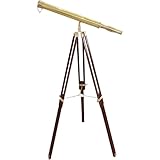
- Height: 55 inches, Tube length: 27 , weight: 4 kg , ground diameter : 25 inches # Nautical floor standing telescope
- Material used : Brass & Wood , Functional 35 X zoom telescope up to 1 km - you will have clear vision quality is very nice.
- Finish : Brass shiny finish - Polished to brass shiny finish, brass needs to be cleaned once in a month to keep it away from rust
- Usage: Home Decoration, Table décor etc. #These reproduce nautical new stylish telescope is very authentic floor decorative item.
- Their bigger lens collects more light to project larger, sharper and brighter image. Composed of high quality lens and mirror.
| System | Period | Configuration | Status in the paper |
|---|---|---|---|
| ZTF J0440+2325 | 87 minutes | Binary: M dwarf and brown dwarf | Reported direct observation of stable mass transfer |
| ZTF J1444+4820 | 67 minutes | Hierarchical triple | Strong candidate |
What the study does not say
- It does not show that this kind of transfer is common. The work reports one observed system and one candidate, not a population rate.
- The image circulated with MIT’s story is an artist’s impression credited to Aaron Householder, not a telescope photograph.
- The paper is “Stable mass transfer from a substellar object onto an M dwarf” in Nature Astronomy. MIT says the research was supported in part by the National Science Foundation.
Product prices and availability are accurate as of the date/time indicated and are subject to change. Any price and availability information displayed on Amazon at the time of purchase will apply.




