Freedom251 › Game Map Generators
WorldEngine
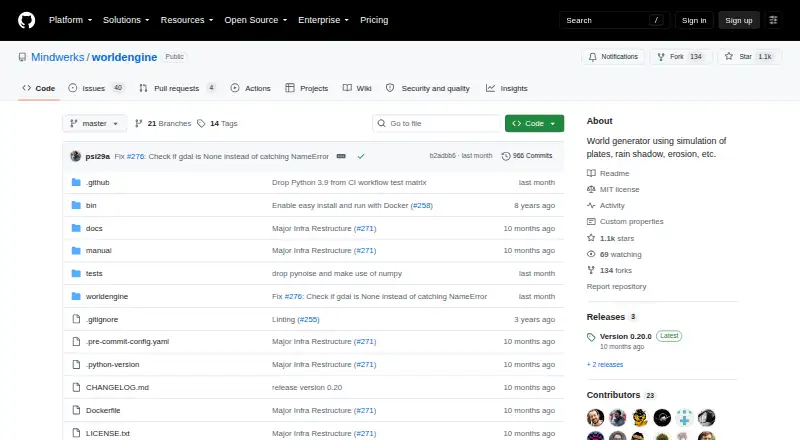
What WorldEngine is
WorldEngine is free, MIT-licensed software for procedural world generation. It models processes such as plate simulation, rain shadows, erosion, humidity, and terrain permeability to create world data and images. Outputs include heightmaps, biome maps, and maps of elevation, precipitation, temperature, biomes, and oceans. Its command line can also create an ancient-looking map from a world file. Users can control the seed and save worlds in protobuf or HDF5 formats; HDF5 support requires the optional h5py dependency. Python applications can load world files using WorldEngine as a library, while Java applications can use WorldEngine-Java. Installation instructions cover Docker, source, and uv, but the package is not currently released on PyPI. WorldEngine requires Python 3.9 or later and supports versions through 3.14. A separate graphical interface is available as an experimental, limited project. The README invites questions, suggestions, and contributions through its Google group or by opening an issue. The project has no SECURITY.md policy and no published security advisories.
Who it suits
WorldEngine suits people seeking procedural world data and map outputs, particularly those able to use its documented installation routes or Python and Java library options. Its separate GUI is experimental and limited.
What it does well
- Generates elevation, precipitation, temperature, biome, and ocean maps
- Seed control is available
- Worlds can be saved as protobuf or HDF5
- MIT licensed and free
What to know first
- Not currently released on PyPI
- HDF5 requires optional h5py
- Graphical interface is experimental and limited
- No SECURITY.md policy or published advisories
Limits
The graphical interface is experimental and limited. HDF5 export requires the optional h5py dependency.
Plans
| Plan | Billed and limits | Price |
|---|---|---|
| WorldEngine | MIT-licensed world-generation software | Free |
As github.com lists them, read 9 Oct 2026. The maker's own page has the final word.
Getting started
- Choose Docker, source or uv installation from the README.
- Use Python 3.9 or later, through version 3.14.
- Install the optional h5py dependency if you need HDF5 support.
- Generate a world and save it in protobuf or HDF5 format.
- Use the command line to create an ancient-looking map from a world file, if desired.
Overview
WorldEngine is a free, open-source procedural generator for 2D worlds. It is best suited to developers who want climate and biome data they can load into Python or Java applications. Its main trade-off is a command-line-oriented workflow with only a limited experimental GUI.
Key features
Generation accounts for plate simulation, latitude, rain shadows, erosion, humidity and terrain permeability, then models biomes with the Holdridge life-zones system. Seed control supports repeatable generation, useful when a project needs to regenerate a chosen world rather than start from scratch each time.
Outputs include elevation, precipitation, temperature, biome and ocean maps, along with heightmaps and biome maps as images. The command line can also produce an ancient-looking map from a world file. That range suits projects needing environmental layers as well as terrain; it is less suited to artists who want to build or refine maps in a mature visual editor.
Worlds can be saved as protobuf or HDF5 files. HDF5 requires the optional h5py dependency, so it adds a setup step for projects that need that format. Python applications can load world files using WorldEngine as a library, while Java applications can use WorldEngine-Java.
Pricing
WorldEngine is free: its plan costs nothing and the software is MIT-licensed. There is no free trial because the software is already free. The project is not currently released on PyPI, so installation requires another documented route: Docker, source, or uv.
Platforms
WorldEngine supports Linux, macOS and Windows, and can be self-hosted. It requires Python 3.9 or later and supports versions through 3.14. The separate graphical interface is experimental and limited, making the documented command-line and library routes more practical for developers than for GUI-first users.
Who it's for
Choose WorldEngine if you need seeded 2D world generation, multiple climate and terrain maps, or world files to use in Python or Java applications. It is a particularly practical fit for developers comfortable installing software outside PyPI. Look elsewhere if a polished graphical workflow is central to your work.
Pros and cons
- Pros: Free under the MIT License, with no paid tier to unlock the listed generation and export capabilities.
- Pros: Produces several environmental map types and supports repeatable generation through seed control.
- Pros: Protobuf and HDF5 exports, plus Python and Java library options, give developers more than one way to use generated worlds.
- Cons: PyPI installation is not available; users must choose Docker, source, or uv.
- Cons: The separate GUI is experimental and limited, so it is not a strong choice for a visual-editor-led workflow.
- Cons: HDF5 export depends on the optional h5py package.
Alternatives
For other options in the category, browse Game Map Generators.
World Machine is worth considering if you want a freemium alternative with a Basic plan capped at 1025x1025 pixels; its Indie plan costs $119 a month and includes one year of updates.
SimpleXTerrain is another free, MIT-licensed option, specifically a Godot 4 .NET terrain-generation addon, rather than a Python- or Java-loadable world generator.
Voxel Plugin may suit projects centered on voxel workflows: its free tier allows commercial use and full source access, but excludes Voxel Graphs and Voxel Plugin 2 previews.
Gaea offers a Windows-only Community Edition with non-commercial use and single-build resolution up to 1,024 × 1,024; consider it if those limits fit your project.
Heightmap Level Generator is a free alternative for people who prefer a web-based option with no installation or account.
L3DT has a free Standard Edition for heightfield and texture maps up to 2049 × 2049 pixels, making it a possible fit when those outputs and its Linux or Windows support are priorities.
MapMagic 2 has a free core asset and map generators; its Biomes and Functions add-on costs $45, paid once for one seat and requires an existing MapMagic 2 installation.
Ymir is a free GPL-3.0 alternative for Linux and Windows.
Verdict
WorldEngine is a strong fit for developers who want free, seeded 2D world data with climate-aware maps and Python or Java interoperability. Its broad outputs and MIT license are compelling; the main reasons to choose another tool are the unreleased PyPI package and the limited experimental GUI.
Verdict
WorldEngine provides several procedural map outputs and formats, with library options for Python and Java applications. The unreleased PyPI package and limited experimental GUI are relevant constraints when choosing how to use it.
Questions
How much does WorldEngine cost?
The listed WorldEngine plan is free. It is open source under the MIT License.
Which platforms does it support?
The listed platforms are Linux, macOS, self-hosted and Windows.
What does WorldEngine generate?
It generates world data and images, including heightmaps and biome maps. Its map outputs include elevation, precipitation, temperature, biome and ocean maps.
Can I use WorldEngine world files in applications?
Yes. Python applications can load them using WorldEngine as a library, and Java applications can use WorldEngine-Java.
What file formats can it export?
Worlds can be saved in protobuf or HDF5 formats. HDF5 support requires the optional h5py dependency.
Who maintains WorldEngine?
The README says it is maintained by Bret Curtis and Federico Tomassetti.
Facts from WorldEngine's own pages
- Algorithm
- The generation algorithm calculates precipitation with latitude and rain-shadow effects, erosion, humidity, terrain permeability, and biomes using the Holdridge life-zones model. · github.com, 9 Oct 2026
- Ancient maps
- The command line can generate an ancient-looking map from a world file. · github.com, 9 Oct 2026
- File formats
- Worlds can be saved in protobuf or HDF5 formats, with HDF5 support requiring the optional h5py dependency. · github.com, 9 Oct 2026
- Generated data
- It generates world data and images including heightmaps and biome maps. · github.com, 9 Oct 2026
- GUI limitation
- An experimental and limited graphical interface is available as a separate project. · github.com, 9 Oct 2026
- Installation
- The README documents Docker, source, and uv installation, and states that the package is not currently released on PyPI. · github.com, 9 Oct 2026
- Interoperability
- World files can be loaded in Python applications using WorldEngine as a library, or in Java applications using WorldEngine-Java. · github.com, 9 Oct 2026
- License
- WorldEngine is available under the MIT License. · github.com, 9 Oct 2026
- Maintainers
- The README says the project is maintained by Bret Curtis and Federico Tomassetti. · github.com, 9 Oct 2026
- Map outputs
- Its outputs include elevation, precipitation, temperature, biome, and ocean maps. · github.com, 9 Oct 2026
- Platforms
- The README says binary packages are available for Windows, Linux, and Mac. · github.com, 9 Oct 2026
- Purpose
- WorldEngine generates worlds using plate simulation, rain shadows, erosion, and other processes. · github.com, 9 Oct 2026
- Python support
- WorldEngine requires Python 3.9 or later and supports Python versions through 3.14. · github.com, 9 Oct 2026
- Security
- GitHub reports that the project has no SECURITY.md policy and no published security advisories. · github.com, 9 Oct 2026
- Support
- The README invites questions, suggestions, and contributions through its Google group or by opening an issue. · github.com, 9 Oct 2026
Where WorldEngine stands on Freedom251
- Game Map Generators#9 of 27