Freedom251 › AI Video Caption Generators
Whisply
What Whisply is
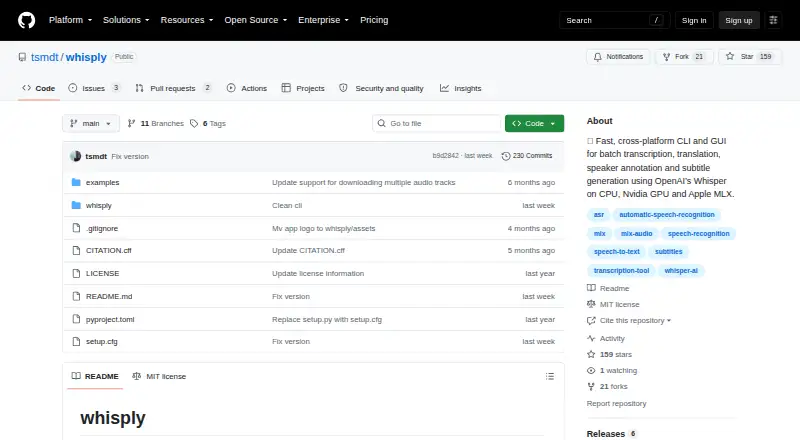
Whisply is free software for transcribing, translating, annotating, and creating subtitles from audio and video with Whisper models. It provides both a command-line interface and a browser app that runs locally, and it can process individual files, folders, URLs, or lists in batches. Processing stays on your own hardware, with implementations selected for CPU, Nvidia GPU, or Apple Silicon devices. Exports include JSON, RTTM, TXT, HTML, SRT, VTT, and WebVTT. Word-level speaker annotation uses whisperX and pyannote, requiring a Hugging Face access token and acceptance of the pyannote model conditions. The project is presented as a research tool for work such as qualitative interviews and group discussions. Installation requires FFmpeg and Python 3.10 through a version below 3.14. Whisply is MIT licensed, permitting use, copying, modification, publication, and distribution under its stated conditions. The README notes that overlapping speakers can make diarization inaccurate and that built-in word alignment supports ten languages.
Who it suits
Whisply suits researchers and other users processing audio or video locally, including qualitative interviews and group discussions. It fits people who need command-line or browser access, batch inputs, and subtitle or annotation exports.
What it does well
- Runs processing on the user's own hardware
- Supports files, folders, URLs, and input lists
- Offers CPU, Nvidia GPU, and Apple Silicon processing
- Exports subtitles and structured transcript formats
- Provides command-line and local browser interfaces
What to know first
- Speaker diarization may be inaccurate with overlapping speech
- Speaker annotation requires a Hugging Face access token
- Requires FFmpeg and a specific Python range
- Word alignment supports ten languages
Verdict
Whisply combines local Whisper-based transcription with translation, annotation, and subtitle creation. Its broad export options and batch workflows suit research processing, while speaker labeling adds setup requirements and an accuracy limitation for overlapping speech.
Facts from Whisply's own pages
- Annotation limitation
- The README notes diarization may be inaccurate when speakers talk at the same time and lists built-in word-alignment support for ten languages. · github.com, 12 Oct 2026
- Batch input
- It can process individual files, folders, URLs, and lists of files. · github.com, 12 Oct 2026
- Exports
- Export formats include JSON, RTTM, TXT, HTML, SRT, VTT, and WebVTT. · github.com, 12 Oct 2026
- Free plan
- Yes · github.com, 22 Sept 2026
- Hardware
- It selects implementations for CPU, Nvidia GPU, or Apple Silicon MLX processing. · github.com, 12 Oct 2026
- Hardware support
- It selects faster-whisper for CPU or Nvidia GPU processing and mlx-whisper for Apple M1–M5 devices. · github.com, 12 Oct 2026
- Intended use
- The project metadata describes Whisply as a research tool, including for transcribing qualitative interviews and group discussions. · github.com, 12 Oct 2026
- Interfaces
- Whisply offers a command-line interface and an optional browser app that runs at a local URL. · github.com, 12 Oct 2026
- Known limitation
- The README notes that speaker diarization can be inaccurate when multiple speakers talk at the same time. · github.com, 12 Oct 2026
- License
- The package metadata identifies the software as MIT licensed. · github.com, 12 Oct 2026
- Makers
- The package metadata names Thomas Schmidt and Renat Shigapov as authors. · github.com, 12 Oct 2026
- Privacy
- The project metadata says processing runs entirely on the user's own hardware to protect sensitive research data. · github.com, 12 Oct 2026
- Processing
- It supports batch processing of files, folders, URLs, and lists of inputs. · github.com, 12 Oct 2026
- Purpose
- Whisply transcribes, translates, annotates, and creates subtitles for audio and video files using Whisper models. · github.com, 12 Oct 2026
- Requirements
- The README lists FFmpeg and Python 3.10 through below 3.14 as requirements. · github.com, 12 Oct 2026
- Speaker annotation
- Word-level speaker annotation uses whisperX and pyannote and requires a Hugging Face access token and acceptance of the pyannote model terms. · github.com, 12 Oct 2026
- Speaker annotations
- Word-level speaker annotation uses whisperX and pyannote and requires a Hugging Face access token and acceptance of the model conditions. · github.com, 12 Oct 2026
- Speaker identification
- Yes · github.com, 22 Sept 2026
- Subtitle export
- other formats · github.com, 22 Sept 2026
- Subtitles and exports
- It can create SRT, VTT, and WebVTT subtitles and export JSON, RTTM, text, annotated text, and HTML. · github.com, 12 Oct 2026
Where Whisply stands on Freedom251
- AI Video Caption Generators#14 of 99