Freedom251 › Emulator Software
Unicorn Engine
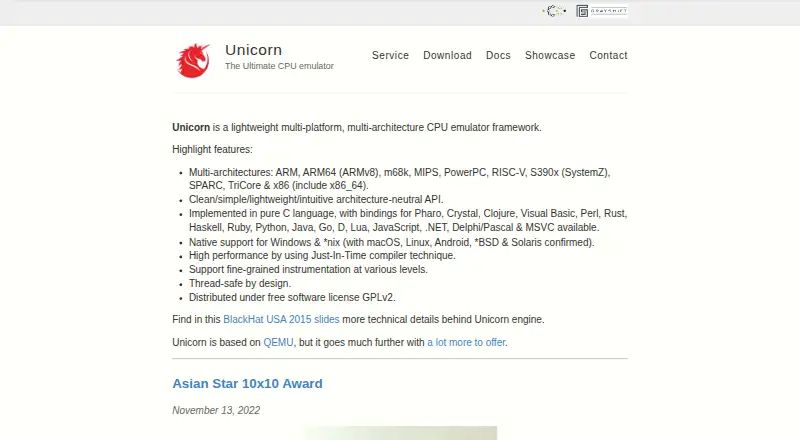
What Unicorn Engine is
Unicorn Engine is a free, open-source framework for emulating CPU operations across multiple architectures and host systems. It supports ARM, ARM64, m68k, MIPS, PowerPC, RISC-V, S390x, SPARC, TriCore, and x86, including x86_64. Implemented in C, it provides an architecture-neutral API and can work with raw binary code without requiring an executable or full system image. The framework offers fine-grained instrumentation and is described by its project as thread-safe by design; it also uses a just-in-time compiler technique. Native host support includes Windows, macOS, Linux, Android, BSD, and Solaris. The main code supports bindings for languages including Haskell, Ruby, Python, Java, Go, Rust, Visual Basic, Pascal, .NET, and MSVC, with additional community bindings. Installation options include source builds, software repositories, Python packages, and precompiled binaries. The download page lists version 2.0.1, released November 1, 2022. Unicorn is distributed under GPLv2. Listed capabilities also include snapshots and restore, debugging tools, and automation access.
Who it suits
It suits developers working with supported CPU architectures who need CPU emulation, instrumentation, or language bindings. The project showcase lists uses including reverse engineering, debugging, shellcode analysis, fuzzing, and emulation.
What it does well
- Supports a broad set of CPU architectures
- Can emulate raw binary code
- Provides an architecture-neutral C API
- Offers bindings for multiple languages
What to know first
- Download page lists version 2.0.1 from November 1, 2022
- Distributed under the GPLv2 license
Limits
Unicorn Engine focuses on CPU operations and raw binary code; it does not require or provide a full system image as part of that stated focus. It is distributed under the GPLv2 free software license.
Plans
| Plan | Billed and limits | Price |
|---|---|---|
| Unicorn Engine | GPLv2 free software license · source code, bindings, sample programs and binaries available | Free |
As unicorn-engine.org lists them, read 8 Oct 2026. The maker's own page has the final word.
Getting started
- Visit the Unicorn Engine website.
- Choose source code, a binary, or a Python package from the download options.
- Install from source, a software repository, pip, or a precompiled binary.
- Select a supported host system and use the available language binding for your workflow.
Overview
Unicorn Engine is a C framework for emulating CPU instructions across many architectures. It suits developers building tools for analysis, debugging, fuzzing, or emulation who need to work with raw code across different host systems. Its broad target support and instrumentation make it adaptable, though its CPU-level focus is a poor fit when you need a complete system emulator.
Key features
Unicorn supports ARM, ARM64, m68k, MIPS, PowerPC, RISC-V, S390x, SPARC, TriCore, and x86, including x86_64. That range is useful for software work spanning different processor families; the architecture-neutral C API gives developers a common interface across them. The framework can run raw binary code without an executable or full system image, which makes it practical for focused CPU-level tasks, but it does not provide full-system emulation.
The project describes Unicorn as thread-safe by design and says it uses just-in-time compilation for performance. Fine-grained instrumentation, snapshots and restore, and debugging tools support workflows that need to inspect or control execution. These capabilities are relevant to analysis and debugging, though they still center on CPU operations rather than simulating an entire device or operating system.
Bindings are supported for Haskell, Ruby, Python, Java, Go, Rust, Visual Basic, Pascal, .NET, and MSVC, with community bindings for Perl, Clojure, Crystal, D, Lua, Pharo, and JavaScript. This gives teams options beyond calling the C API directly, though support varies between the main code and community projects.
Pricing
Unicorn Engine costs nothing under the GPLv2 free software license. The plan includes source code, bindings, sample programs, and binaries, with no paid tier or trial to weigh against it. Its open-source terms suit users who can work within GPLv2; projects with different licensing requirements should review the license before adopting it.
Installation options include source builds, software repositories, Python pip packages, and precompiled binaries. The download page identifies version 2.0.1, released November 1, 2022. Python installation instructions cover Windows, macOS, and Linux, and macOS users also have Homebrew instructions.
Platforms
Unicorn supports Windows, macOS, Linux, Android, BSD, and Solaris as host operating systems. That breadth helps teams use the framework across desktop and mobile development environments. The site also lists native support for Unix-like systems, while platform-specific installation instructions cover Python packages on Windows, macOS, and Linux.
Who it's for
Unicorn is a strong fit for developers building reverse-engineering, debugging, shellcode-analysis, fuzzing, or emulation tools who need CPU execution across multiple architectures. Its raw-code support and instrumentation are especially useful when a complete executable or system image would add unnecessary scope. Choose a different kind of emulator when the task depends on reproducing a whole operating system or consumer device.
Pros and cons
Pros
- Broad architecture coverage lets one framework handle targets from ARM and RISC-V to x86_64.
- Raw binary execution supports focused analysis without requiring a full system image.
- Instrumentation, debugging tools, and snapshots with restore help users inspect and manage execution.
- Free GPLv2 licensing and language bindings make it accessible to a wide range of development workflows.
Cons
- Its CPU-only scope does not replace a full-system emulator.
- GPLv2 licensing may not suit every project's distribution requirements.
- The download page identifies version 2.0.1 from November 1, 2022, so users should check compatibility with their needs before adopting it.
Alternatives
Android Emulator is a better fit for Android-focused work: it is free with Android Studio and lists 16 GB RAM and 16 GB disk space.
Azahar is a free, open-source 3DS emulator for readers specifically seeking 3DS emulation.
Genymotion Desktop offers a free limited edition for personal use and an Educational plan at $49 a year, making it an option for readers comparing a freemium desktop product.
MAME is free under GPL-2.0 or later; it may suit readers seeking an emulator where ROMs and copyrighted software are generally not included.
PPSSPP is a free PSP emulator across Android, iOS, Linux, macOS, and Windows, so choose it for PSP emulation.
VICE is free software under GNU GPL v2 or later and may suit readers looking for that emulator.
86Box is a no-charge emulator for Linux, macOS, and Windows, with donations welcome.
BlueStacks App Player offers a free core experience on macOS and Windows, with BlueStacks Prime at $7.99 a month.
Browse more options in Emulator Software.
Verdict
Choose Unicorn Engine if you are developing CPU-level analysis or emulation tools and need one free framework spanning many processor architectures and host systems. Its C API, bindings, instrumentation, and debugging support give it range for development workflows. Look elsewhere when you need full-system emulation or a license other than GPLv2.
Verdict
Unicorn Engine provides CPU-focused emulation across a wide range of targets and host systems. Its C API, bindings, instrumentation, and debugging capabilities may suit varied development workflows.
Questions
How much does Unicorn Engine cost?
The listed plan is free. It is open source under GPLv2.
Which processor architectures does it support?
Targets include ARM, ARM64, m68k, MIPS, PowerPC, RISC-V, S390x, SPARC, TriCore, and x86, including x86_64.
Which operating systems can host it?
Native support includes Windows, macOS, Linux, Android, BSD, and Solaris.
What programming languages have bindings?
Main-code bindings include Haskell, Ruby, Python, Java, Go, Rust, Visual Basic, Pascal, .NET, and MSVC. Community bindings include Perl, Clojure, Crystal, D, Lua, Pharo, and JavaScript.
How can I install Unicorn Engine?
The site documents installation from source, software repositories, Python pip packages, and precompiled binaries. It also provides Homebrew instructions for macOS.
Who makes Unicorn Engine?
The project website is unicorn-engine.org.
Facts from Unicorn Engine's own pages
- API
- The framework provides a clean, architecture-neutral API implemented in C. · unicorn-engine.org, 8 Oct 2026
- API and implementation
- The framework is implemented in C and provides an architecture-neutral API. · unicorn-engine.org, 8 Oct 2026
- Architectures
- It supports ARM, ARM64, m68k, MIPS, PowerPC, RISC-V, S390x, SPARC, TriCore, and x86 including x86_64. · unicorn-engine.org, 8 Oct 2026
- CPU architectures
- It supports ARM, ARM64, m68k, MIPS, PowerPC, RISC-V, S390x, SPARC, TriCore and x86, including x86_64. · unicorn-engine.org, 8 Oct 2026
- Download
- The download page lists version 2.0.1, released November 1, 2022, and links to source code and binaries. · unicorn-engine.org, 8 Oct 2026
- Downloads
- The download page identifies version 2.0.1, released November 1, 2022, and offers source code, binaries and a Python package. · unicorn-engine.org, 8 Oct 2026
- Example uses
- The showcase lists products using Unicorn for reverse engineering, debugging, shellcode analysis, fuzzing and emulation. · unicorn-engine.org, 8 Oct 2026
- Installation
- The site documents installation from source, software repositories, Python pip packages, and precompiled binaries. · unicorn-engine.org, 8 Oct 2026
- Instrumentation
- It supports fine-grained instrumentation at various levels. · unicorn-engine.org, 8 Oct 2026
- Language bindings
- The main code supports bindings for Haskell, Ruby, Python, Java, Go, Rust, Visual Basic, Pascal, .NET, and MSVC; community bindings include Perl, Clojure, Crystal, D, Lua, Pharo, and JavaScript. · unicorn-engine.org, 8 Oct 2026
- License
- Unicorn is distributed under the GPLv2 free software license. · unicorn-engine.org, 8 Oct 2026
- Operating systems
- The site confirms native support for Windows, macOS, Linux, Android, *BSD, and Solaris. · unicorn-engine.org, 8 Oct 2026
- Performance
- The site says Unicorn uses a just-in-time compiler technique for high performance. · unicorn-engine.org, 8 Oct 2026
- Platform installation
- The site provides Python package installation instructions for Windows, macOS and Linux, and Homebrew instructions for macOS. · unicorn-engine.org, 8 Oct 2026
- Product
- Unicorn is a lightweight, multi-platform, multi-architecture CPU emulator framework. · unicorn-engine.org, 8 Oct 2026
- Purpose
- Unicorn is a lightweight, multi-platform, multi-architecture CPU emulator framework. · unicorn-engine.org, 8 Oct 2026
- Scope
- Unicorn focuses on CPU operations and can emulate raw binary code without requiring an executable or full system image. · unicorn-engine.org, 8 Oct 2026
- Support
- The project recommends its mailing list for long conversations, Twitter for quick questions, and email for private contact. · unicorn-engine.org, 8 Oct 2026
- Supported systems
- The site states native support for Windows and Unix-like systems, with macOS, Linux, Android, *BSD and Solaris confirmed. · unicorn-engine.org, 8 Oct 2026
- Thread safety
- The project describes Unicorn as thread-safe by design. · unicorn-engine.org, 8 Oct 2026
Where Unicorn Engine stands on Freedom251
- Emulator Software#27 of 39