Freedom251 › Site Search Software

Typesense
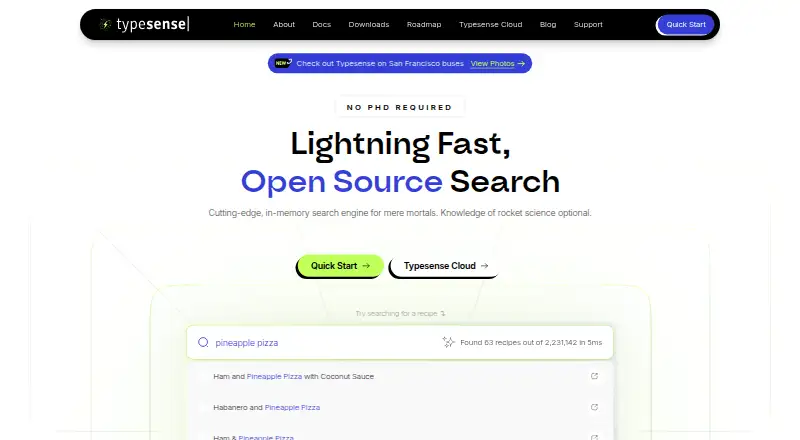
What Typesense is
Typesense is an open-source search engine for adding search to a website or app. It does not crawl the web; users supply the data they want to make searchable. The engine supports typo-tolerant, search-as-you-type queries designed to respond in typically under 50 milliseconds. Search features include adjustable ranking, sorting, faceting, filtering, grouping, federated search and geo search. Listed AI capabilities include vector and hybrid search, built-in RAG, natural-language, image and voice search. Typesense can run locally or on a server, or through hosted Typesense Cloud. Its REST API has integrations including Firebase, AWS Amplify, Laravel Scout, LangChain, LlamaIndex, InstantSearch, OpenAI and Google ML platforms. Cloud billing includes cluster runtime and bandwidth, and the hourly cluster charge continues while a cluster runs even without traffic. Paid Cloud clusters start at $22 a month. The free Cloud allowance is one-time only: selected configurations receive 720 hours and 10GB bandwidth, not a monthly renewal.
Who it suits
Typesense suits developers who want to add search to their own site or app and are prepared to supply the searchable data. It offers local, server-based and hosted deployment options.
What it does well
- Open-source engine supports typo-tolerant search.
- Includes faceting, filtering, grouping and geo search.
- Offers vector and hybrid search capabilities.
- Can run locally, on a server or in the cloud.
- Integrates with Firebase, LangChain and OpenAI.
What to know first
- Users must supply data; it does not crawl the web.
- Free Cloud allowance does not renew monthly.
- Cluster fees continue while a cluster runs without traffic.
- Paid Cloud clusters start at $22 a month.
Limits
The Cloud free tier is a one-time allowance of 720 hours plus 10GB bandwidth for select configurations; it does not renew monthly. Paid Cloud clusters start at $22 a month, with hourly cluster fees and per-GB bandwidth charges; the hourly fee continues while the cluster runs without traffic.
Plans
| Plan | Billed and limits | Price |
|---|---|---|
| Self-hosted | Open-source server · Run locally or on your own infrastructure | Free |
| Typesense Cloud | Cluster costs starting $22/month; cloud usage is billed hourly · Managed cloud clusters · Hourly usage billing · No per-search or per-record charges | $22 a month |
| Free support | Free · GitHub Issues · Public Slack Community · Best-effort support ticket response | Free |
| Developer support | $160.00 every 28 days · 72-hour support ticket response SLA · Consultative support · Email, GitHub Issues, Public Slack Community | $160 a month |
| Enterprise Signature support | $1,900.00 every 28 days · 24-hour support ticket response SLA · Private Slack Connect · Custom contracts · SOC 2 report and HIPAA BAA available | $1,900 a month |
| Typesense Cloud cluster | Starting $22/month; pay-as-you-go, billed for cluster runtime and bandwidth · Dedicated cluster · No limits on records or operations · One-time free tier for select configurations: first 720 hours and 10GB bandwidth | $22 a month |
| Business support | $400.00 every 28 days · 48-hour support ticket response SLA · Phone/video meetings · SOC 2 report and HIPAA BAA available | $400 a month |
| Enterprise support | $700.00 every 28 days · 24-hour support ticket response SLA · Private Slack Connect · Custom security questionnaires · Prioritized feature requests | $700 a month |
As typesense.org lists them, read 19 Sept 2026. The maker's own page has the final word.
Getting started
- Open the Typesense website and choose local, server, or Typesense Cloud deployment
- Load the data you want users to search
- Connect through the REST API
- Select a free plan or a Cloud cluster; paid Cloud clusters start at $22 a month
- For selected Cloud configurations, use the one-time allowance of 720 hours and 10GB bandwidth
Typesense is an open-source search engine for developers building search into sites and apps. It suits teams that need control over search behavior and deployment, with a hosted option for those who prefer not to manage a server. Its range of conventional and AI search capabilities is a strong draw; Cloud’s runtime charges and the need to provide your own searchable data call for planning.
Overview
Designed for search-as-you-type, Typesense typically returns results in under 50 milliseconds and tolerates typos. It searches data your team pushes into it rather than crawling the web, so it fits an application’s catalog or content—not a turnkey web-search service. Its REST query interface makes it a developer-oriented component rather than a standalone search app.
The open-source engine can run locally or on a server, while Typesense Cloud offers hosted clusters. Self-management gives teams deployment control; Cloud reduces that operational burden but adds ongoing usage charges.
Key features
Alongside typo tolerance, teams can tune ranking, sorting, faceting, filtering, grouping, federated search, and geo search. That breadth can support more tailored discovery than a basic text box, especially for structured collections, but it depends on supplying and organizing the underlying data.
Typesense also supports vector and hybrid search, built-in RAG, natural-language search, image search, and voice search. These capabilities give developers several ways to build beyond keyword queries. Integrations include Firebase, AWS Amplify, Laravel Scout, LangChain, LlamaIndex, InstantSearch, OpenAI, and Google ML platforms.
For Typesense Cloud, the maker says clusters are isolated and dedicated, API traffic is encrypted over HTTPS, and stored data receives full-disk encryption. Typesense Cloud states it is SOC 2 Type 2 certified and HIPAA compliant. Eligible customers on a Business Support plan or above can obtain a BAA, subject to a minimum one-year term.
Pricing
Typesense uses a freemium model. Free support costs nothing and provides GitHub Issues, the public Slack community, and best-effort ticket responses. This is a no-cost support route, not a hosted cluster plan.
The Typesense Cloud cluster starts at $22 a month, billed pay-as-you-go for runtime and bandwidth. It includes a dedicated cluster with no limits on records or operations, but the starting price is not a flat allowance: an hourly cluster fee continues while the cluster runs, even without traffic, and bandwidth is charged per GB. Its one-time free tier gives select configurations 720 hours and 10GB bandwidth; it does not renew monthly.
Paid support plans suit teams that need firmer response commitments. Developer support costs $160 a month, billed every 28 days, with a 72-hour ticket-response SLA, consultative support, email, GitHub Issues, and public Slack. Business support costs $400 a month, billed every 28 days, and adds a 48-hour SLA plus phone or video meetings; the SOC 2 report and HIPAA BAA are available. Enterprise support is $700 a month, billed every 28 days, with a 24-hour SLA, private Slack Connect, custom security questionnaires, and prioritized feature requests. Enterprise Signature costs $1,900 a month, billed every 28 days; it includes a 24-hour SLA, private Slack Connect, custom contracts, and access to the SOC 2 report and HIPAA BAA.
The cheaper support tiers offer less urgency and fewer direct-contact or compliance options, while the free tier relies on community and best-effort replies. Support fees are distinct from Cloud cluster runtime and bandwidth costs, so hosted-service budgeting should account for both.
Platforms
Typesense is available through an API and supports Linux, macOS, Windows, web, and self-hosted deployment. That range suits teams choosing between local or server operation and a hosted cluster.
Who it's for
Typesense is a good fit for developers who want fast, typo-tolerant search over data they control, with detailed controls for ranking and filtering and options for vector or hybrid retrieval. It is less suitable for anyone who needs a service to discover and index the open web, or for teams seeking predictable Cloud costs without monitoring cluster runtime and bandwidth.
Pros and cons
- Pros: Broad search controls, from faceting and geo search to vector search and built-in RAG, let teams tailor discovery to their application.
- Pros: Local, server, and hosted deployment choices give teams flexibility over operations.
- Pros: Dedicated Cloud clusters, encrypted API traffic, and stated at-rest encryption provide a clear security posture for hosted use.
- Cons: Teams must push in their own data; Typesense does not crawl the web.
- Cons: Cloud charges continue for a running cluster without traffic, and bandwidth adds a separate variable cost.
- Cons: The free Cloud allowance is one-time, not a recurring monthly quota.
Alternatives
For a wider comparison, browse Search Databases. Consider Chroma as another freemium, open-source database option with a Cloud offering. Qdrant has a free tier and may suit teams comparing hosted vector-search options. Vespa is a paid alternative with a free trial. Algolia offers a free plan with monthly request, record, recommendation, and crawl quotas, making it a candidate when those allowances suit the workload. Manticore Search is a free alternative with a community plan. Meilisearch offers free self-hosting with infrastructure costs and no usage limits, for teams prepared to manage their own deployment. Apache Solr is a free, open-source search platform. Datafari offers a free Community plan.
Verdict
Choose Typesense if you are building search into your own product and want substantial control over search behavior plus a choice of self-hosting or Cloud. Its standout advantage is the combination of conventional search controls and newer AI search capabilities. Look elsewhere if you need web crawling, or if Cloud’s runtime and bandwidth billing does not fit your budget or operating model.
Verdict
Typesense combines conventional search controls with a range of AI search capabilities and lets teams choose local, server or hosted deployment. Review Cloud runtime billing and its non-renewing free allowance if you plan to use the hosted service.
Questions
How much does Typesense Cloud cost?
Paid Cloud clusters start at $22 a month. Cloud also charges for cluster runtime and bandwidth.
Does Typesense have a free plan?
Yes. The free Cloud tier is a one-time offer for select configurations, providing 720 hours and 10GB bandwidth; it does not renew monthly.
What platforms does Typesense support?
Listed platforms are API, Linux, macOS, self-hosted, web, and Windows.
Does Typesense crawl the web?
No. Users push their own data into Typesense for searching in a site or app.
Which integrations are listed?
Integrations include Firebase, AWS Amplify, Laravel Scout, LangChain, LlamaIndex, InstantSearch, OpenAI, and Google ML platforms.
What support plans are available?
Community support is available through GitHub Issues and public Slack. Paid support plans range from $160 a month for Developer support to $1,900 a month for Enterprise Signature support; the listed billing terms for those plans are every 28 days.
Facts from Typesense's own pages
- AI search
- Its listed AI capabilities include vector and hybrid search, built-in RAG, natural-language search, image search, and voice search. · typesense.org, 30 Sept 2026
- Cloud billing
- Cloud billing has an hourly cluster fee and per-GB bandwidth costs, and the hourly fee continues while a cluster is running even when it receives no traffic. · cloud-help.typesense.org, 30 Sept 2026
- Compliance
- Typesense Cloud states it is SOC 2 Type 2 certified and HIPAA compliant, with a BAA available to eligible customers on a Business Support plan or above for at least a year. · cloud.typesense.org, 30 Sept 2026
- Data source
- Typesense does not crawl the web; users push their own data into it for searching in their site or app. · typesense.org, 30 Sept 2026
- Deployment
- Typesense can be run locally or on a server, and Typesense Cloud provides a hosted version. · typesense.org, 30 Sept 2026
- Founded
- 2015 · typesense.org, 28 Sept 2026
- Headquarters
- Houston, TX · typesense.org, 28 Sept 2026
- Integrations
- Listed integrations include Firebase, AWS Amplify, Laravel Scout, LangChain, LlamaIndex, InstantSearch, OpenAI, and Google ML platforms. · typesense.org, 30 Sept 2026
- Maker
- Typesense, Inc. describes itself as a lean, customer-funded team of engineers focused on making search technology accessible. · typesense.org, 30 Sept 2026
- Pricing limits
- The free Cloud tier is one-time only and provides 720 hours plus 10GB bandwidth for select configurations; it does not renew monthly. · cloud-help.typesense.org, 30 Sept 2026
- Product
- Typesense is an open-source, typo-tolerant search engine for instant, typically sub-50ms, search-as-you-type experiences. · typesense.org, 30 Sept 2026
- Search features
- It supports typo tolerance, tunable ranking, sorting, faceting, filtering, grouping, federated search, and geo search. · typesense.org, 30 Sept 2026
- Security
- Typesense Cloud says clusters are isolated and dedicated, API traffic is encrypted over HTTPS, and data is protected with full-disk encryption at rest. · cloud.typesense.org, 30 Sept 2026
- Support
- Typesense offers community support through GitHub Issues and public Slack, plus paid prioritized support with SLAs, consulting, and training for Cloud. · typesense.org, 30 Sept 2026
Where Typesense stands on Freedom251
- Site Search Software#11 of 25
- Search Databases#17 of 30