Freedom251 › Log Management Software

Quickwit
What Quickwit is
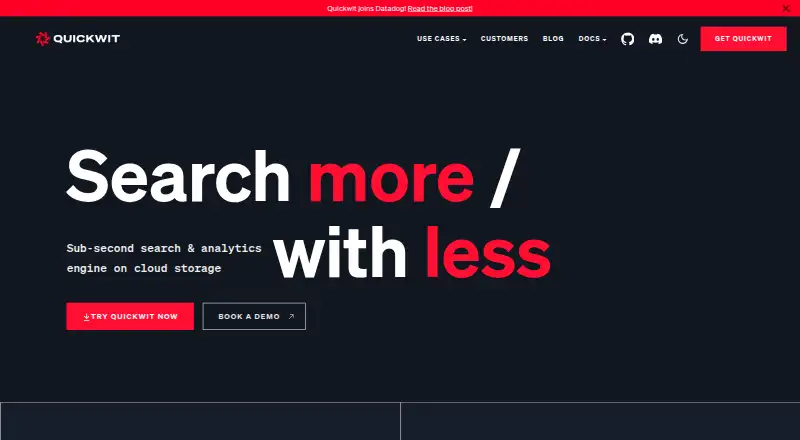
Quickwit is an open-source search and analytics engine that queries data directly in cloud storage, with sub-second search. It supports full-text and aggregation queries as well as the Elasticsearch query language. Documented uses include log management, distributed tracing, conversational data, and event-based analytics. Quickwit separates compute from storage and uses stateless indexers and searchers; it can run as a single node or a multi-node cluster. Storage options include Amazon S3 and compatible services, Azure Blob Storage, Google Cloud Storage, local files, and shared storage such as MinIO. Ingestion sources and tools include Kafka, Pulsar, Kinesis, S3 with SQS notifications, OpenTelemetry, Fluent Bit, and Vector. Quickwit accepts JSON logs through a REST API and supports OpenTelemetry protocols and Jaeger’s gRPC SpanReader API. It is free under the Apache 2.0 license, with Linux and macOS binaries, Docker, Helm for Kubernetes, and Glasskube among the installation options. Linux is the only officially supported operating system. The file-backed metastore cannot support multiple instances at once; the documentation recommends PostgreSQL for heavy workloads. The documentation also identifies low-latency e-commerce search and mutable data as poor fits.
Who it suits
Quickwit may suit teams searching and analyzing logs, traces, or event data held in cloud or shared storage. It is less suited to low-latency e-commerce search or mutable data, and Linux is the only officially supported operating system.
What it does well
- Free and open source under Apache 2.0
- Searches data directly in cloud storage
- Supports full-text and aggregation queries
- Offers multiple ingestion integrations
What to know first
- Linux is the only officially supported operating system
- File-backed metastore cannot run multiple instances simultaneously
- Documentation identifies mutable data as a poor fit
Limits
The file-backed metastore does not support multiple instances running at the same time; PostgreSQL is recommended for heavy workloads. Quickwit is described as a poor fit for mutable data and low-latency e-commerce search.
Plans
| Plan | Billed and limits | Price |
|---|---|---|
| Quickwit Enterprise License | Contact sales for an accurate quote. · Enterprise license; page’s example includes estimated infrastructure and license costs for 1 TB/day ingestion and 30-day retention | On request |
As quickwit.io lists them, read 9 Oct 2026. The maker's own page has the final word.
Getting started
- Choose a deployment route: Linux or macOS binary, Docker image, Kubernetes Helm chart or Glasskube.
- Select single-node or multi-node deployment and configure supported storage.
- Connect an ingestion source such as Kafka, Pulsar, Kinesis, S3 notifications, OpenTelemetry, Fluent Bit or Vector.
- Send JSON-formatted logs through the REST API or use supported OpenTelemetry protocols.
- Use the search and analytics capabilities through supported query options.
Verdict
Quickwit offers an open-source way to search and analyze data in cloud storage, with multiple deployment and ingestion options. Check its operating-system support and metastore limits against your workload.
Questions
Is Quickwit free?
Yes. Quickwit describes its software as free and open source under the Apache 2.0 license.
What platforms does Quickwit support?
It provides Linux and macOS binaries, Docker, Helm for Kubernetes and Glasskube installation. Linux is the only officially supported operating system.
What data can Quickwit search?
Its documented use cases include logs, distributed traces, conversational data and event-based analytics. It supports full-text and aggregation queries, along with Elasticsearch query language.
Which storage providers can it use?
Supported storage includes Amazon S3 and S3-compatible services, Azure Blob Storage, Google Cloud Storage and local files.
What integrations are available for ingestion and tracing?
Documented ingestion options include Kafka, Pulsar, Kinesis, S3 with SQS notifications, OpenTelemetry, Fluent Bit and Vector. Tracing support includes OpenTelemetry gRPC and HTTP protobuf and Jaeger’s gRPC SpanReader API.
Can Quickwit run as a cluster?
Yes. It can run as a single node or multi-node cluster, using shared storage such as Amazon S3 or MinIO.
Facts from Quickwit's own pages
- Architecture
- Quickwit decouples compute and storage and uses stateless indexers and searchers. · quickwit.io, 9 Oct 2026
- Company update
- Quickwit announced in January 2025 that it was joining Datadog while planning an Apache 2.0 release for the open-source community. · quickwit.io, 9 Oct 2026
- Deployment
- Quickwit can run as a single node or as a multi-node cluster, and is distributed as a binary or Docker image with a Helm chart for Kubernetes. · quickwit.io, 9 Oct 2026
- Deployment limit
- The file-backed metastore does not support multiple instances running at the same time; the documentation recommends PostgreSQL for heavy workloads. · quickwit.io, 9 Oct 2026
- Deployment limitation
- A file-backed metastore does not support multiple instances running at the same time; the documentation recommends PostgreSQL for heavy workloads. · quickwit.io, 9 Oct 2026
- Founded
- 2021 · quickwit.io, 28 Sept 2026
- Free plan
- No · quickwit.io, 24 Sept 2026
- Ingestion integrations
- Documented ingestion sources include its Ingest API, local files, Kafka, Pulsar, Kinesis, and S3 files using SQS notifications; log shippers such as OpenTelemetry, Fluent Bit, and Vector can also send data. · quickwit.io, 9 Oct 2026
- Installation platforms
- Quickwit provides Linux and macOS binaries, a Docker image, a Helm chart, and Glasskube installation; Linux is its only officially supported operating system. · quickwit.io, 9 Oct 2026
- Log ingestion
- Quickwit provides a REST API for JSON-formatted logs and supports OpenTelemetry gRPC and HTTP protobuf protocols. · quickwit.io, 9 Oct 2026
- Notable limitation
- The introduction says Quickwit is a poor fit for low-latency e-commerce search and mutable data. · quickwit.io, 9 Oct 2026
- Open source
- Quickwit describes its software as open and free, and its installation page lists the Apache 2.0 license. · quickwit.io, 9 Oct 2026
- Platform support
- Quickwit is officially supported only on Linux; macOS and FreeBSD are not officially supported but should work, and binaries are provided for Linux and macOS. · quickwit.io, 9 Oct 2026
- Product
- Quickwit is an open-source distributed search engine designed for search and analytics on large datasets stored on cloud storage. · quickwit.io, 9 Oct 2026
- Scalability
- The documentation says Quickwit is designed as a horizontally scalable distributed system with indexer, searcher, metastore, control plane, and janitor services. · quickwit.io, 9 Oct 2026
- Search
- Quickwit supports full-text search and aggregation queries, Elasticsearch query language support, and sub-second search on cloud storage. · quickwit.io, 9 Oct 2026
- Security and compliance
- The product overview lists support for infrequent targeted deletions for GDPR use cases. · quickwit.io, 9 Oct 2026
- Security and privacy
- The homepage lists support for infrequent, targeted deletions for GDPR use cases. · quickwit.io, 9 Oct 2026
- Storage and compute
- Quickwit separates compute from storage and supports shared storage such as Amazon S3 or MinIO for cluster deployments. · quickwit.io, 9 Oct 2026
- Storage integrations
- Supported storage providers include Amazon S3 and S3-compatible services, Azure Blob Storage, local files, and Google Cloud Storage. · quickwit.io, 9 Oct 2026
- Structured log parsing
- Yes · quickwit.io, 24 Sept 2026
- Support
- The official site links to community support through GitHub and Discord. · quickwit.io, 9 Oct 2026
- Support and community
- The site links to a Discord community and offers a book-a-demo link from its homepage. · quickwit.io, 9 Oct 2026
- Tracing integrations
- Quickwit natively supports the OpenTelemetry gRPC and HTTP protobuf protocols and the Jaeger gRPC SpanReader API. · quickwit.io, 9 Oct 2026
Where Quickwit stands on Freedom251
- Log Management Software#29 of 111
- Site Search Software#9 of 25
- Search Databases#16 of 30
- Search Engine Software#9 of 11