Freedom251 › Card Issuing Platforms
Thredd
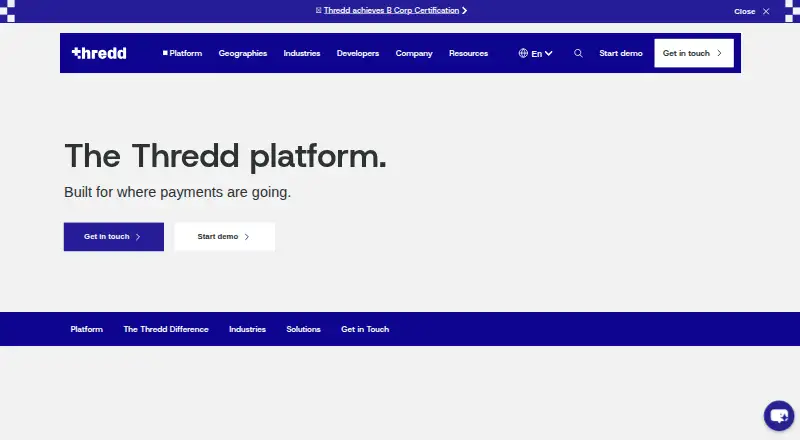
What Thredd is
Thredd is an issuer processing platform for fintechs, banks, and embedded finance businesses launching and scaling card programmes. Its API and web platform supports debit, credit, prepaid, and virtual cards, with gateway, cooperative, and full-service processing models. A shared API and cloud infrastructure underpin the platform, which includes multi-region resilience. Its real-time ledger provides a traceable and auditable view across accounts, wallets, and transactions. Thredd lists connections to Visa, Mastercard, and Discover, as well as US PIN networks STAR, NYCE, and Pulse. It supports Apple Pay, Google Pay, and Samsung Pay, with direct connections to MDES and Visa Token Service. The web-based Thredd Portal offers transaction tracking, card controls, cardholder analytics, and role-based access. Risk Management includes 3D Secure, fraud and scam monitoring, and dispute and chargeback tools. Thredd says AI-driven models support fraud monitoring, credit decisioning, and onboarding. Engineering and operations teams can use its Card Transaction Simulator to exercise transaction flows, edge cases, and programme configurations before launch. Pricing is on request. Full PAN retrieval is limited to PCI DSS Level 1-compliant organizations.
Who it suits
Thredd is intended for fintechs, banks, and embedded finance businesses building card programmes. It reports serving clients across multiple countries and offers local teams and specialist support from implementation through scale.
What it does well
- Supports debit, credit, prepaid, and virtual cards.
- Offers gateway, cooperative, and full-service processing.
- Ledger tracks accounts, wallets, and transactions.
- Portal includes card controls and transaction tracking.
- Supports major digital wallets and card networks.
What to know first
- Pricing is available only on request.
- Full PAN retrieval requires PCI DSS Level 1 compliance.
- Clients are responsible for applicable security and regulatory requirements.
Getting started
- Visit the Thredd platform website.
- Contact Thredd for pricing and details on its processing models.
- Choose a gateway, cooperative or full-service processing model.
- Plan your card programme around the supported card types and network connections.
- Use the Card Transaction Simulator to exercise flows and configurations before launch.
Thredd is an issuer-processing platform for fintechs, banks and embedded-finance businesses that need to launch and operate card programmes across markets. It is best suited to organisations wanting issuing, ledgering, network connectivity and operational controls behind one API. The main caveat is that full card-number retrieval is restricted to PCI DSS Level 1-compliant organisations.
Overview
Founded in 2007 and headquartered in London, Thredd combines debit, credit, prepaid and virtual-card programmes on shared cloud infrastructure. Its single API and multi-region resilience are a sensible foundation for businesses running several products or expanding internationally, while the unified architecture can reduce the need to stitch together separate issuing and processing systems.
A real-time ledger records accounts, wallets and transactions as a traceable, auditable source of truth. That is valuable for reconciliation, balance visibility and operational control. Thredd reports more than 130 clients in over 50 countries, with local teams and specialists supporting customers from implementation through scale. Clients remain responsible for meeting the security and regulatory obligations that apply to their own implementations.
Key features
Issuing, networks and wallets
The platform supports physical and virtual debit, credit and prepaid cards, with issuing APIs, funding and balances, and spend controls. Visa, Mastercard and Discover connections cover major card-network requirements, while STAR, NYCE and Pulse support US PIN transactions. Apple Pay, Google Pay and Samsung Pay are supported through direct connections to MDES and Visa Token Service, helping programmes offer mobile-wallet provisioning without abandoning the core platform.
Processing and ledger
Gateway, cooperative and full-service processing models let a programme choose how much processing responsibility it retains or delegates. The ledger's account-, wallet- and transaction-level traceability is a strong fit for finance and operations teams that need audit trails rather than a simple card feed.
Risk, compliance and decisioning
Risk Management includes 3D Secure, fraud and scam monitoring, disputes and chargebacks tools, and payment-network support. Thredd also says AI-driven models assist fraud monitoring, credit decisioning and onboarding. These capabilities can centralise controls, but they do not transfer compliance accountability: clients must satisfy applicable security and regulatory requirements. Full PAN retrieval is available only to organisations that are PCI DSS Level 1 compliant, a significant constraint for teams whose workflows require unrestricted card-number access.
Operations and delivery
Card Transaction Simulator allows engineering and operations teams to exercise transaction flows, edge cases and programme configurations before launch, which can reduce surprises during rollout. Thredd Portal is a web dashboard for real-time transaction tracking, card controls, cardholder analytics and role-based access. Named ecosystem partners include Saascada, Conferma Pay and GFT, with Featurespace, Apata and Cardinal among risk and compliance partners. Thredd says it holds PCI DSS certification, ISO accreditations, and completed SOC 1 and SOC 2 Type II audits; its partnerships materials also cite 24/7 client support.
Pricing
Thredd uses paid, quote-based pricing: pricing is available on request. That approach fits banks and established fintechs planning a tailored programme, but it gives smaller teams no published entry point for budgeting. There are no stated free or trial plans, seat allowances, usage quotas, renewal terms or standard implementation fees to compare, so prospective customers should request a complete programme-specific commercial proposal.
Platforms
Thredd provides an API and a web interface. The API is the route for building issuing and processing into an application, while Thredd Portal gives operations and support staff browser-based controls and analytics.
Who it's for
Thredd is aimed at fintechs, banks and embedded-finance businesses launching or scaling multi-card programmes across countries. It makes the strongest case for organisations that need debit, credit, prepaid and virtual issuing, network and wallet connections, a real-time ledger, configurable processing models and operational tooling in one environment. It is less suitable for teams seeking transparent self-serve pricing, KYC/KYB tools (which Thredd does not provide), or full PAN access without PCI DSS Level 1 status.
Pros and cons
Pros
- Unified multi-card issuing: Physical and virtual debit, credit and prepaid products share one platform and API.
- Broad connectivity: Visa, Mastercard, Discover, US PIN networks and the three major mobile wallets cover important launch requirements.
- Operational depth: A real-time ledger, simulator and portal support auditability, pre-launch validation and day-to-day controls.
- Flexible processing: Gateway, cooperative and full-service models accommodate different operating arrangements.
- Enterprise security posture: PCI DSS certification, ISO accreditations and SOC 1 and SOC 2 Type II audits support regulated programmes.
Cons
- Custom pricing only: Buyers cannot assess cost from a published rate card or free tier.
- Strict PAN condition: Full card-number retrieval requires PCI DSS Level 1 compliance.
- No KYC/KYB tooling: Organisations must provide those capabilities elsewhere.
- Client compliance burden: Customers remain accountable for applicable security and regulatory requirements.
Alternatives
Compare card issuing platforms if you want a wider shortlist. Choose Extend instead when a freemium product with a free Starter plan, mobile apps and limits of five users, ten guests and 100 virtual cards per month is a better fit. Visa DPS Forward suits teams wanting a free sandbox and production pricing handled through contact. Pick Conferma Pay when its Android, iOS, API and web footprint and demo-led buying process match your needs. Paynetics Card Issuing is an option for customisable Visa or Mastercard programmes with physical and virtual cards. Wallester White Label is more transparent for buyers who can budget €2,495 per month for non-financial institutions or €3,995 per month for financial institutions. Marqeta, Enfuce Cards and HPS PowerCARD are alternatives with their own programme and deployment approaches; compare their commercial terms directly.
Verdict
Choose Thredd if you are a bank, fintech or embedded-finance provider building a substantial, multi-market card programme and want issuing, processing, ledger, risk controls and operations in one API-led platform. Its network and wallet coverage, processing choices and operational tooling are the core reasons to shortlist it. Look elsewhere if you need published pricing, built-in KYC/KYB, or full PAN retrieval without PCI DSS Level 1 compliance.
Verdict
Thredd brings card processing, ledger functions, risk tools, and an operations portal together for card-programme providers. Organizations should account for their own compliance responsibilities and the PCI DSS Level 1 condition on full PAN retrieval.
Questions
How much does Thredd cost?
Thredd is paid, with pricing available on request.
Which platforms does Thredd support?
Thredd lists API and web platforms.
Which card programmes can it support?
It supports debit, credit, prepaid and virtual card programmes.
Which card networks and digital wallets does it connect to?
It lists Visa, Mastercard, Discover, and US PIN networks STAR, NYCE and Pulse. It supports Apple Pay, Google Pay and Samsung Pay, with direct connections to MDES and Visa Token Service.
Can every client retrieve full PAN data?
No. Full PAN retrieval is available only to organisations that are PCI DSS Level 1 compliant.
Does Thredd provide KYC/KYB tools?
No. KYC/KYB tools are listed as not available.
Facts from Thredd's own pages
- AI decisioning
- Thredd says AI-driven models support fraud monitoring, credit decisioning and onboarding. · thredd.ai, 5 Oct 2026
- AI features
- Thredd says AI-driven models are used for fraud monitoring, credit decisioning, and onboarding. · thredd.ai, 4 Oct 2026
- Architecture
- Thredd describes its platform as using a single API and cloud infrastructure, with multi-region resilience built in. · thredd.ai, 5 Oct 2026
- Card networks
- Thredd lists connections to Visa, Mastercard, and Discover, plus US PIN network support for STAR, NYCE, and Pulse. · thredd.ai, 4 Oct 2026
- Card types
- Its unified platform supports debit, credit, prepaid, and virtual card programmes. · thredd.ai, 4 Oct 2026
- Client tools
- Its Card Transaction Simulator lets engineering and operations teams test transaction flows, edge cases, and programme configurations before launch. · thredd.ai, 4 Oct 2026
- Company certification
- Thredd says it is a Certified B Corporation. · thredd.ai, 4 Oct 2026
- Customer responsibility
- Thredd's technical documentation says clients are responsible for ensuring their implementations meet applicable security and regulatory requirements, including PCI DSS where applicable. · docs.thredd.ai, 5 Oct 2026
- Digital wallets
- Thredd says it integrates with Apple Pay, Google Pay and Samsung Pay. · thredd.ai, 5 Oct 2026
- Founded
- 2007 · thredd.ai, 28 Sept 2026
- Headquarters
- London, United Kingdom · thredd.ai, 28 Sept 2026
- Integrations
- Thredd lists connections to Visa, Mastercard and Discover, as well as US PIN networks STAR, NYCE and Pulse. · thredd.ai, 5 Oct 2026
- Ledger
- It provides a real-time source of truth across accounts, wallets, and transactions, with traceability and auditability. · thredd.ai, 4 Oct 2026
- Ledger and controls
- Its real-time ledger provides a source of truth across accounts, wallets and transactions with traceability, auditability and control. · thredd.ai, 5 Oct 2026
- Notable limits
- Retrieval of a full card PAN from the Thredd platform is available only to organisations that are PCI DSS Level 1 compliant. · docs.thredd.ai, 5 Oct 2026
- Operations portal
- Thredd Portal is a web-based dashboard for real-time transaction tracking, card controls, cardholder analytics, and role-based access. · thredd.ai, 4 Oct 2026
- Partner ecosystem
- Named ecosystem partners include Saascada, Conferma Pay and GFT, while its risk and compliance services include partners Featurespace, Apata and Cardinal. · thredd.ai, 5 Oct 2026
- PCI limit
- Retrieval of full PAN from the platform is available only to organisations that are PCI DSS Level 1 compliant. · docs.thredd.ai, 4 Oct 2026
- Processing models
- Thredd offers gateway, cooperative and full-service processing models with different allocations of balance management and authorisation responsibilities. · thredd.ai, 5 Oct 2026
- Risk and compliance features
- Risk Management includes 3D Secure, fraud and scam monitoring, disputes and chargebacks tools, and payment network support. · thredd.ai, 4 Oct 2026
- Security
- Thredd's 2026 company announcement says it holds PCI DSS certification, a suite of ISO accreditations, and has completed SOC 1 and SOC 2 Type II audits. · thredd.ai, 5 Oct 2026
- Support
- Thredd's partnerships page lists 24/7 support among the resources available to clients. · thredd.ai, 5 Oct 2026
- Support approach
- Thredd says local teams operate in its markets and specialists support clients from implementation through scale. · thredd.ai, 4 Oct 2026
- Unified issuing
- The platform supports debit, credit, prepaid and virtual cards in one platform. · thredd.ai, 5 Oct 2026
Where Thredd stands on Freedom251
- Card Issuing Platforms#20 of 22