Freedom251 › Card Issuing Platforms
Marqeta
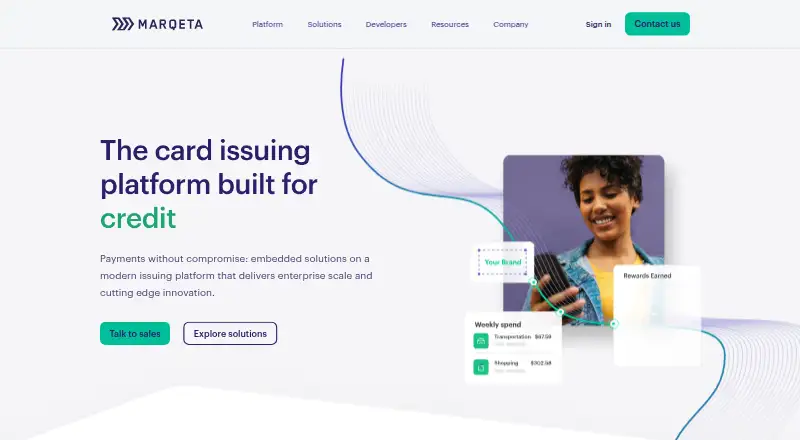
What Marqeta is
Marqeta provides a configurable card issuing and payment processing platform for businesses building payment programs. It supports debit, prepaid, credit, and flexible credentials in physical, virtual, and tokenized card forms. Programs can apply transaction-level rules and change spend controls in real time, alongside capabilities for accounts, payments, transfers, and cash access. Risk features include KYC, real-time decisioning, 3D Secure, and disputes. Developers can use APIs, SDK tools, documentation, and a sandbox to build and test programs. Cards can be provisioned to Apple Pay, Google Pay, and Samsung Pay. Marqeta describes partnerships across banks, networks, fintech and banking providers, and consulting and integration firms. Its Trust Center lists PCI DSS, SOC 1, and SOC 2 certifications, with controls tested by independent auditors. Customers may retain PCI compliance responsibilities. Program services include 24/7 cardholder support, card fulfillment, and compliance management. Availability varies by jurisdiction, and pricing is on request. The company is headquartered in Oakland, California.
Who it suits
Marqeta is aimed at fintechs, financial institutions, and technology companies building card or payment programs. Prospective customers should check availability in their jurisdiction and clarify their PCI compliance responsibilities.
What it does well
- Supports physical, virtual, and tokenized cards
- Changes spend controls in real time
- Includes APIs, SDK tools, and a sandbox
- Supports Apple Pay, Google Pay, and Samsung Pay
- Offers 24/7 cardholder support
What to know first
- Pricing is on request
- Availability varies by jurisdiction
- Customers may retain PCI compliance responsibilities
Plans
| Plan | Billed and limits | Price |
|---|---|---|
| Enterprise platform | Contact sales; pricing not stated on the pages reviewed | On request |
As marqeta.com lists them, read 3 Oct 2026. The maker's own page has the final word.
Getting started
- Visit the Marqeta website.
- Contact Marqeta to ask about pricing and availability in your jurisdiction.
- Use the APIs, SDK tools, documentation, and sandbox to build and test a card program.
- Review the available card types, transaction controls, and program services for your needs.
Marqeta is a configurable platform for companies that need to create and operate card-based payment programs. It is best suited to fintechs, financial institutions, and technology companies with engineering and compliance resources. The platform’s breadth and real-time controls are strong advantages, while enterprise positioning and custom pricing make it unsuitable for buyers seeking a simple packaged card service.
Overview
Marqeta combines card issuing and payment processing with accounts, payments, transfers, and cash access. A program can use debit, prepaid, credit, or flexible credentials and issue them as physical, virtual, or tokenized cards. That combination supports different products on a common platform, but it assumes the customer is designing and running a program rather than selecting a finished consumer card.
Founded in 2010 and headquartered in Oakland, California, Marqeta says its open APIs serve fintechs, financial institutions, and technology companies. The company says it launched those open APIs in 2014. Access is provided through API and web interfaces, with local service support varying by jurisdiction.
Key features
Issuing and transaction controls
Teams can issue physical and virtual cards, use tokenized credentials, and set rules at transaction level. Spend controls can be changed in real time, which suits programs that need permissions to react to account conditions, internal policy, or changing risk. The flexibility is valuable for sophisticated products; organizations wanting a fixed card-and-expense workflow may not need this breadth.
Accounts, funding, and money movement
Marqeta covers accounts and balances alongside payments, transfers, and cash access. Funding and balance capabilities help a program connect issuance with the movement of money, rather than treating the card as an isolated component. The platform supports card-program work at enterprise scale, so implementation and operational ownership remain significant considerations.
Risk and compliance tooling
KYC and KYB tools, real-time decisioning, 3D Secure, and dispute capabilities address identity, authorization, and post-transaction risk. These controls can reduce the need to assemble every risk function separately, but customers may still retain PCI compliance responsibilities. Marqeta’s widgets can reduce some of that burden rather than removing it.
Developer and wallet integrations
APIs, SDK tools, documentation, and a sandbox support building and testing card programs before production work. Cards can be provisioned to Apple Pay, Google Pay, and Samsung Pay. Marqeta also describes partner coverage across banks and networks, fintech and banking providers, spend management, core banking, consulting, and integration services, giving larger programs options for surrounding capabilities.
Security and program services
Its Trust Center cites PCI DSS, SOC 1, and SOC 2 certifications, with controls tested by independent third-party auditors. Program services include 24/7 cardholder support, card fulfillment, compliance management, and help with bank relationships, network approvals, compliance, and operations. Those services can fill operational gaps, although the customer still needs clear ownership of its own compliance duties.
Pricing
Enterprise platform
Marqeta uses paid, custom pricing. The Enterprise platform has no published price; prospective customers are directed to contact sales. That approach fits organizations whose volumes, countries, card products, and service requirements need individual scoping, but it prevents small teams from comparing a predictable entry cost or starting from a self-serve tier. No free plan, free trial, seat allowance, quota, or renewal term is published.
In practice, budget approval will depend on a programme-specific commercial discussion rather than a public monthly schedule. Buyers should also account for operational and compliance responsibilities that remain with the customer, including any PCI obligations that Marqeta’s widgets do not cover.
Platforms
Marqeta is available through API and web access. Its developer stack includes SDK tools, documentation, and a sandbox, making it more appropriate for a product team integrating issuance and payments than for a user who expects a standalone mobile application.
Who it's for
Marqeta is a strong fit for fintechs, financial institutions, and technology companies building branded or embedded payment programs. It suits teams that need multiple card types, physical and virtual delivery, real-time controls, wallet provisioning, and configurable risk flows. It is a weaker fit for a small business seeking a ready-made card product, transparent public pricing, or minimal compliance and operational involvement. Jurisdiction matters: supported services vary by location, so a programme must confirm local availability before committing.
Pros and cons
- Pros: Debit, prepaid, credit, and flexible credentials can be issued as physical, virtual, or tokenized cards.
- Pros: Real-time transaction rules and spend controls support responsive programme policies.
- Pros: APIs, SDKs, documentation, and a sandbox give engineering teams a path from development to testing.
- Pros: KYC/KYB, decisioning, 3D Secure, disputes, and digital-wallet provisioning cover important programme functions.
- Cons: Custom pricing and an enterprise-only programme model make cost and fit harder to assess for smaller buyers.
- Cons: Customers may retain PCI compliance responsibilities even when Marqeta’s widgets reduce part of the workload.
- Cons: Service availability differs by jurisdiction, which can limit where a programme can launch.
Alternatives
For a broader comparison, see Card Issuing Platforms. Choose Extend instead if you need a freemium product with Android, iOS, API, and web access, including a free tier capped at five users, ten guests, and 100 virtual cards per month. Visa DPS Forward is a better match when an API-first route with a free sandbox and separately scoped production fees is preferable.
Conferma Pay suits buyers seeking a cross-platform product discussed through a demo. Consider Paynetics Card Issuing for customizable Visa or Mastercard programmes with physical and virtual cards. Wallester White Label is the clearer choice when published white-label pricing is important, with plans at €2,495 or €3,995 per month depending on institution type. Thredd is another paid API-and-web option. Enfuce Cards fits programmes priced by implementation, monthly service, volume, and add-ons. HPS PowerCARD is worth considering when self-hosted deployment is required.
Verdict
Choose Marqeta if your organization is building an enterprise card programme and needs broad issuing options, real-time controls, developer tooling, risk capabilities, and wallet support in one platform. Its main reason to look elsewhere is the combination of custom pricing, jurisdiction-dependent availability, and continuing customer compliance responsibilities. For teams with the scale and expertise to manage those demands, Marqeta is a capable foundation; for everyone else, a more packaged or transparently priced alternative will be easier to adopt.
Verdict
Marqeta combines card issuing, payment processing, transaction controls, and developer tools for payment programs. Confirm local availability and compliance responsibilities before proceeding.
Questions
What does Marqeta cost?
Pricing is on request; no plan price is listed.
Which platforms are supported?
Marqeta lists API and web platforms.
What types of cards can it issue?
It supports debit, prepaid, and credit cards, plus flexible credentials. Cards can be physical, virtual, or tokenized.
Is Marqeta available everywhere?
No universal availability is stated. Product support varies by jurisdiction, and prospective customers are directed to contact Marqeta about local availability.
What developer resources are available?
Marqeta provides APIs, SDK tools, documentation, and a sandbox for building and testing card programs.
What security certifications are listed?
Marqeta's Trust Center lists PCI DSS, SOC 1, and SOC 2 certifications. Marqeta says customers may retain PCI compliance responsibilities, although its widgets can reduce some of them.
Facts from Marqeta's own pages
- Accounts and transfers
- The platform offers accounts, payments and transfers, and cash access alongside card products. · marqeta.com, 3 Oct 2026
- Availability
- Marqeta says its supported services vary by jurisdiction and directs prospective customers to contact it for availability details. · marqeta.com, 3 Oct 2026
- Availability limit
- Product support varies by jurisdiction, and Marqeta directs prospective customers to contact it about local availability. · marqeta.com, 2 Oct 2026
- Card types
- The platform supports debit, prepaid, credit, and flexible credentials, including physical, virtual, and tokenized cards. · marqeta.com, 3 Oct 2026
- Company history
- Marqeta's about page says it was founded in 2009 by Jason Gardner and launched open APIs in 2014. · marqeta.com, 3 Oct 2026
- Customer support
- Marqeta says its program services include 24/7 cardholder support, card fulfillment, and compliance management. · marqeta.com, 2 Oct 2026
- Developer access
- Marqeta provides APIs, a developer sandbox, API credentials, transaction simulation, and webhook setup instructions. · marqeta.com, 3 Oct 2026
- Digital wallet integrations
- Marqeta supports provisioning cards to Apple Pay, Google Pay, and Samsung Pay. · marqeta.com, 2 Oct 2026
- Founded
- 2010 · marqeta.com, 28 Sept 2026
- Headquarters
- Marqeta lists its corporate headquarters at 180 Grand Ave, Oakland, California. · investors.marqeta.com, 2 Oct 2026
- Integrations
- Marqeta describes an ecosystem of fintech and banking, spend management, core banking, consulting, and integration partners. · marqeta.com, 3 Oct 2026
- Intended customers
- Marqeta describes its open APIs as serving fintechs, financial institutions, and technology companies. · marqeta.com, 3 Oct 2026
- Partner integrations
- Marqeta describes an ecosystem that includes bank and network partners, fintech and banking partners, and consulting and integration partners. · marqeta.com, 2 Oct 2026
- PCI responsibility
- Marqeta states that its customers may retain PCI compliance responsibilities, although its widgets can reduce some of them. · marqeta.com, 3 Oct 2026
- Real-time controls
- Programs can set transaction-level card rules and change those rules in real time. · marqeta.com, 3 Oct 2026
- Risk tools
- Its risk and fraud offering includes KYC, Real-Time Decisioning, 3D Secure, and disputes. · marqeta.com, 3 Oct 2026
- Security and compliance
- Marqeta's Trust Center lists PCI DSS, SOC 1, and SOC 2 certifications, with controls tested by independent third-party auditors. · trust.marqeta.com, 2 Oct 2026
- Security certifications
- Marqeta's Trust Center says its certifications include PCI DSS and SOC 1 and SOC 2, with controls tested by independent auditors. · trust.marqeta.com, 3 Oct 2026
- Support
- Marqeta says its program services include 24/7 cardholder support and help with bank relationships, network approvals, compliance, and operations. · marqeta.com, 3 Oct 2026
- Transaction controls
- Customers can set transaction-level rules and change spend controls in real time. · marqeta.com, 2 Oct 2026
- What it does
- Marqeta provides a configurable card issuing and processing platform for payment programs. · marqeta.com, 3 Oct 2026
Where Marqeta stands on Freedom251
- Card Issuing Platforms#7 of 22