Freedom251 › Threat Modeling Software

ThreatModeler Nexus
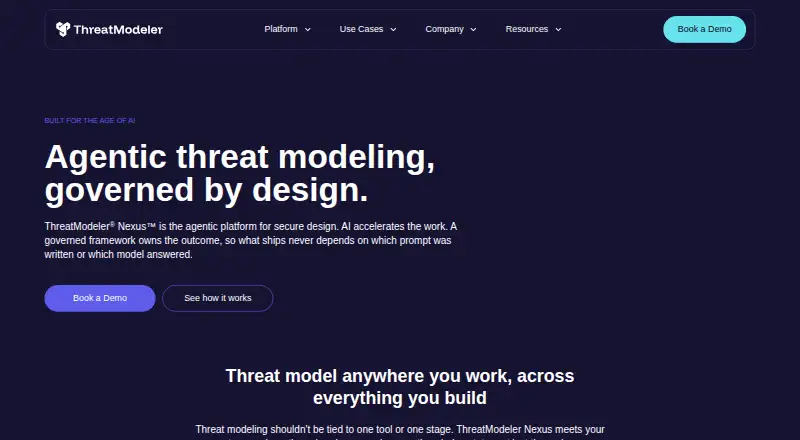
What ThreatModeler Nexus is
ThreatModeler Nexus is a platform for secure design and governed threat modeling across applications, cloud and hybrid architectures, devices, and operational technology. Its Secure Design Graph links architecture, threats, controls, compliance requirements, and security decisions in a connected system of record. System Mapping, Graph, and Reporting agents operate on that graph. The platform supports STRIDE, PASTA, and CSA MAESTRO for agentic systems, and maps findings to more than 180 security and regulatory frameworks, including NIST, ISO 27001, PCI DSS, HIPAA, DORA, and the EU AI Act. A built-in MCP Server checks pull requests and commits against a current threat model and returns threats, requirements, and mitigations in developer workflows. Integrations include infrastructure tools, cloud providers, development platforms, ServiceNow, and ArmorCode. Customers can connect their own AI model, with a deterministic framework governing output. The Secure Design Graph contains more than 1,500 catalogued threats and 3,500 security requirements. A free Community Edition is listed; the ThreatModeler license costs $4,000 a year on a 12-month contract, and additional AWS infrastructure costs may apply. Pricing is also available on request.
Who it suits
ThreatModeler Nexus is aimed at enterprise security, architecture, development, compliance, and risk teams managing large portfolios. It may suit teams that need threat modeling connected to developer workflows and compliance frameworks.
What it does well
- Maps findings to more than 180 frameworks
- Supports STRIDE, PASTA, and CSA MAESTRO
- MCP Server checks pull requests and commits against threat models
- Customers can connect their own AI model
- Lists ISO 27001:2022 and SOC 2 Type II certifications
What to know first
- ThreatModeler license costs $4,000 a year
- Additional AWS infrastructure costs may apply
- Support applies only to the current and preceding major versions
Limits
The free Community Edition is for practitioners, students, developers, architects, and security teams to experience threat modeling before scaling. The paid ThreatModeler license costs $4,000 a year on a 12-month contract, and additional AWS infrastructure costs may apply.
Plans
| Plan | Billed and limits | Price |
|---|---|---|
| Community Edition | for practitioners, students, developers, architects, and security teams · experience threat modeling before scaling | Free |
| ThreatModeler license | 12-month contract · single LICENSE dimension · additional AWS infrastructure costs may apply | $4,000 a year |
As threatmodeler.ai lists them, read 30 Sept 2026. The maker's own page has the final word.
Getting started
- Visit the ThreatModeler Nexus website.
- Choose the free Community Edition or the ThreatModeler license.
- Select web, API, or self-hosted deployment.
- Connect your architecture and security workflows using the listed integrations.
- Use the Secure Design Graph and supported methodologies to model threats.
ThreatModeler Nexus is a threat-modeling platform for organizations managing security across applications, cloud and hybrid environments, devices, and operational technology. It suits enterprise security, architecture, development, compliance, and risk teams that need one governed view of many systems. Its breadth is valuable for portfolio oversight, but the paid license requires a 12-month contract and AWS infrastructure may add cost.
Overview
Nexus uses the Secure Design Graph as a shared record for architectures, threats, controls, compliance requirements, and security decisions. That makes it possible to connect work across a large application and infrastructure portfolio instead of keeping isolated diagrams. The approach is more appropriate for organizations building a repeatable governance program than for a small team wanting a single lightweight model.
ThreatModeler was founded in 2010 and is headquartered in Jersey City, New Jersey. The product supports web and API access and can be deployed self-hosted. ThreatModeler lists ISO 27001:2022 and SOC 2 Type II certifications, and announced FedRAMP Moderate authorization for Nexus in September 2026.
Key features
Modeling and risk analysis
Nexus supports STRIDE, PASTA, and CSA MAESTRO for agentic systems, plus multiple modeling methods, templates, and frameworks. Attack-path analysis helps trace how weaknesses can combine, while risk prioritization focuses attention on the issues most consequential to the organization. The Secure Design Graph includes more than 1,500 catalogued threats and over 3,500 security requirements, giving teams a substantial starting library rather than requiring every control to be authored from scratch.
Agents and developer workflow
System Mapping, Graph, and Reporting agents operate on the shared graph. The built-in MCP Server checks pull requests and commits against the current threat model, then returns threats, requirements, and mitigations inside the development workflow. That is a strong fit for teams that want design decisions to remain relevant as code changes. Customers can connect their own AI model, while Nexus's deterministic framework governs the resulting output.
Integrations and compliance
Integrations cover Terraform, AWS CloudFormation, Azure ARM Templates, GitHub Actions, Azure DevOps, Jenkins, AWS, Google Cloud, Microsoft Azure, Bitbucket, ServiceNow, and ArmorCode. Findings map to more than 180 regulatory and security frameworks, including NIST, ISO 27001, PCI DSS, HIPAA, DORA, and the EU AI Act. That breadth is useful where one portfolio must satisfy several regimes, though teams with only one narrow compliance target may not need the full scope.
Pricing
Community Edition
The Community Edition costs nothing and is aimed at practitioners, students, developers, architects, and security teams wanting to experience threat modeling before scaling. It is the sensible entry point for evaluation or learning, but it does not provide the commercial licensing described for larger deployments.
ThreatModeler license
The ThreatModeler license costs $4,000 a year, billed on a 12-month contract, with a single LICENSE dimension. Additional AWS infrastructure costs may apply. This is aimed at organizations prepared to budget for governed, portfolio-level use; the annual commitment is a significant drawback for teams with uncertain adoption or short projects. Pricing is custom for plans without a published amount.
Platforms
Nexus is offered through web and API interfaces, with self-hosted deployment also supported. That combination gives platform teams a choice between managed access and greater control over where the system runs. AWS infrastructure charges should be included in any self-hosted or deployment-cost assessment where they apply.
Who it's for
Nexus is built for enterprise security, architecture, development, compliance, and risk teams operating across large portfolios. It is particularly well matched to organizations that need threat models tied to infrastructure-as-code, CI workflows, regulatory mappings, and centrally governed AI-assisted analysis. A small project team, or a user seeking only a free open-source diagramming utility, is likely to find the platform's governance emphasis and annual commercial term excessive.
Pros and cons
- Pros: A single Secure Design Graph connects architecture, threats, controls, compliance, and decisions across portfolios.
- Pros: MCP pull-request and commit checks bring threat-model guidance into developer workflows.
- Pros: STRIDE, PASTA, and CSA MAESTRO support, extensive libraries, attack-path analysis, and risk prioritization cover both established and agentic-system programs.
- Pros: More than 180 compliance mappings and FedRAMP Moderate authorization serve regulated environments.
- Cons: The commercial license is $4,000 a year on a 12-month contract, limiting flexibility.
- Cons: AWS infrastructure costs may be additional, complicating the total deployment budget.
- Cons: Support commitments differ: 99.5% monthly uptime for Standard Support versus 99.9% for Enterprise, and support covers only the current and immediately preceding major versions.
Alternatives
Choose CAIRIS when a free Apache-licensed tool with web, API, desktop, and self-hosted options is more important than Nexus's enterprise governance scope.
OWASP Threat Dragon is a free, open-source choice with no paid plans or stated usage limits.
pytm is a free option for teams wanting an OWASP-backed open-source approach.
ThreatForge offers a free Apache 2.0 application with no account required.
IriusRisk suits users wanting a freemium service whose Community Edition allows three active threat models and one user with limited collaboration.
Threagile is a free MIT-licensed open-source toolkit.
ThreatOpus fits teams seeking a paid monthly option with 15 users, ten workspaces, and 50 threat-model generations per month in its Starter plan.
ThreatTree is better for users who need a smaller freemium service, with a free tier capped at three forests, three DFDs per forest, and five attack trees per DFD.
See the broader Threat Modeling Software list for more options.
Verdict
Choose ThreatModeler Nexus if your organization needs threat modeling connected to architecture, compliance evidence, infrastructure changes, and developer workflows across a large portfolio. Its graph-based governance, broad methodology and compliance coverage, and regulated-environment credentials are the main reasons to choose it. Look elsewhere if you need a low-cost, short-term, or purely open-source tool, because the 4000.00 USD annual license, 12-month commitment, and possible AWS costs raise the entry bar.
Verdict
ThreatModeler Nexus connects threat modeling with architecture, compliance, and development workflows, with options for web, API, and self-hosted environments. The listed license has an annual contract, and deployment may also involve AWS infrastructure costs.
Questions
Is there a free plan?
Yes. The Community Edition is listed as free.
How much does the paid license cost?
The ThreatModeler license costs $4,000 a year on a 12-month contract. Additional AWS infrastructure costs may apply.
Which deployment options are available?
ThreatModeler Nexus is available through web, API, and self-hosted environments.
Which threat modeling methods does it support?
It supports STRIDE, PASTA, and CSA MAESTRO for agentic systems.
Which frameworks can findings map to?
Findings map to more than 180 regulatory and security frameworks, including NIST, ISO 27001, PCI DSS, HIPAA, DORA, and the EU AI Act.
What security certifications and federal authorization are listed?
ThreatModeler lists ISO 27001:2022 and SOC 2 Type II. It announced FedRAMP Moderate authorization for ThreatModeler Nexus in September 2026.
Facts from ThreatModeler Nexus's own pages
- AI agents
- ThreatModeler Nexus includes System Mapping, Graph, and Reporting agents that operate on the Secure Design Graph. · threatmodeler.ai, 30 Sept 2026
- Bring your own AI
- Customers can connect their own AI model, while the deterministic framework governs the output. · threatmodeler.ai, 30 Sept 2026
- Compliance mappings
- ThreatModeler Nexus maps findings to more than 180 regulatory and security frameworks, including NIST, ISO 27001, PCI DSS, HIPAA, DORA, and the EU AI Act. · threatmodeler.ai, 30 Sept 2026
- Federal authorization
- ThreatModeler announced that ThreatModeler Nexus achieved FedRAMP Moderate authorization in September 2026. · threatmodeler.ai, 30 Sept 2026
- Founded
- 2010 · threatmodeler.ai, 28 Sept 2026
- Headquarters
- Jersey City, New Jersey, USA · threatmodeler.ai, 28 Sept 2026
- Integrations
- Listed integrations include HashiCorp Terraform, AWS CloudFormation, Azure ARM Templates, GitHub Actions, Azure DevOps, Jenkins, AWS, Google Cloud, Microsoft Azure, Bitbucket, ServiceNow, and ArmorCode. · threatmodeler.ai, 30 Sept 2026
- MCP Server
- The built-in MCP Server checks pull requests and commits against the current threat model and returns threats, requirements, and mitigations in the developer workflow. · threatmodeler.ai, 30 Sept 2026
- Methodologies
- The platform supports STRIDE, PASTA, and the CSA MAESTRO methodology for agentic systems. · threatmodeler.ai, 30 Sept 2026
- Purpose
- ThreatModeler Nexus is an agentic platform for secure design and governed threat modeling across applications, cloud, hybrid architectures, devices, and operational technology. · threatmodeler.ai, 30 Sept 2026
- Secure Design Graph
- The platform uses the Secure Design Graph as a connected system of record for architectures, threats, controls, compliance requirements, and security decisions. · threatmodeler.ai, 30 Sept 2026
- Security certifications
- ThreatModeler lists ISO 27001:2022 and SOC 2 Type II. · threatmodeler.ai, 30 Sept 2026
- Security library
- The Secure Design Graph contains more than 1,500 catalogued threats and more than 3,500 security requirements. · threatmodeler.ai, 30 Sept 2026
- Support limits
- Support applies only to the current major product version and the immediately preceding major version. · threatmodeler.ai, 30 Sept 2026
- Support uptime
- The Standard Support policy states a 99.5% monthly uptime commitment, while Enterprise Support states 99.9%. · threatmodeler.ai, 30 Sept 2026
- Target customers
- The platform is built for enterprise security, architecture, development, compliance, and risk teams operating across large portfolios. · threatmodeler.ai, 30 Sept 2026
Where ThreatModeler Nexus stands on Freedom251
- Threat Modeling Software#9 of 23