Freedom251 › Distributed File System Software
Tahoe-LAFS
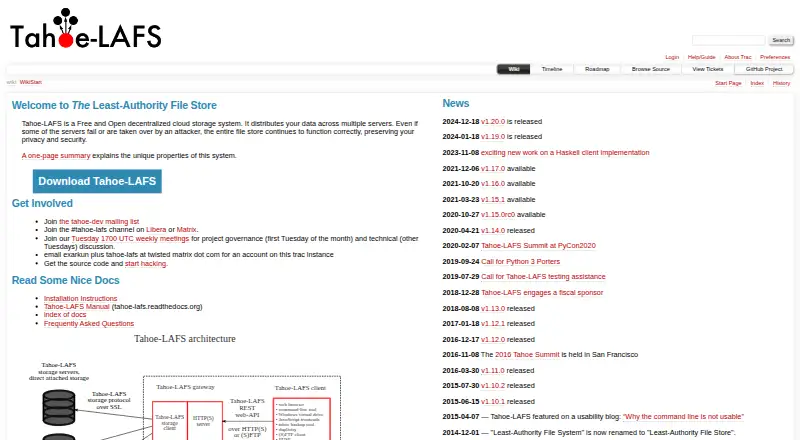
What Tahoe-LAFS is
Tahoe-LAFS is free, open-source software for storing files across multiple servers in a decentralized grid. The client encrypts each file with a unique key before sending it to storage, then erasure-codes it into shares so it can be recovered despite some server failures. The documented default spreads 10 shares across at least 7 servers and allows recovery from any 3. A gateway checks integrity and detects and ignores corrupted shares. Files can be immutable or mutable; mutable files and directories support read-write or read-only access. A gateway provides HTTP(S) and SFTP access, with a REST-style Web API for programmatic operations. Users can run a gateway or operate a complete grid of storage nodes and an introducer. Installation is documented for Windows, macOS, Linux, and BSD, and the project describes use with Tor and I2P. The public test grid is for experimentation, not reliable or large-scale storage. The default shares.happy setting is 7, so smaller grids need an adjustment for uploads to succeed. The project is offered under GNU GPL version 2 or later, or the Transitive Grace Period Public Licence version 1.0 or later.
Who it suits
Tahoe-LAFS suits people prepared to run a gateway or manage storage nodes across a grid. It may fit users who need encrypted, coded file storage and can account for the default server requirements.
What it does well
- Free and open source.
- Files are encrypted before reaching storage servers.
- Recovery is possible from any 3 of 10 shares.
- Gateway checks file integrity and ignores corrupted shares.
- HTTP(S), SFTP, and REST-style API access.
What to know first
- Default uploads require at least 7 storage nodes.
- Public test grid is not intended for reliable storage.
- File size is not protected.
- Expired leases may allow share deletion when garbage collection is enabled.
Limits
The software is free and self-hosted, with no hosted plan or paid tier stated. The documented default uses 10 shares across at least 7 servers and can recover from any 3; uploads will not succeed on grids with fewer than 7 storage nodes unless the shares.happy setting is adjusted.
Plans
| Plan | Billed and limits | Price |
|---|---|---|
| Free and open-source software | Self-hosted storage grid · no hosted plan or paid tier stated | Free |
As tahoe-lafs.org lists them, read 9 Oct 2026. The maker's own page has the final word.
Getting started
- Visit the Tahoe-LAFS website and choose an installation path for Windows, macOS, Linux, or BSD.
- Install Python 3.9 or later.
- Install and configure a client gateway, or set up storage nodes and an introducer for a complete grid.
- Connect the gateway to storage servers; account for the default requirement of at least 7 nodes for uploads.
- Use the gateway through HTTP(S) or SFTP, or use the REST-style Web API.
- Ask deployment questions on the tahoe-dev mailing list or Libera.chat.
Tahoe-LAFS is a free, open-source system for storing files across multiple servers. It suits people willing to run a gateway and arrange a storage grid. Its strongest appeal is protecting file contents from storage operators while retaining recovery options when servers fail; the trade-off is the work of building and maintaining a sufficiently large grid.
Overview
Tahoe-LAFS encrypts each file with a unique key at the client gateway, then divides it into erasure-coded shares for storage on multiple servers. The documented defaults create 10 shares across at least 7 storage nodes, with recovery possible from any 3. That design can tolerate server failures without requiring every node to remain available, but it is not plug-and-play: the default shares.happy value is 7, so uploads will not succeed on a grid with fewer than 7 storage nodes unless it is changed.
The gateway checks integrity and ignores corrupted shares. Storage servers cannot read or modify file contents under this architecture, but a remote gateway operator can view and change data. Users who need that trust boundary under their own control should run their own gateway. Tahoe-LAFS does not attempt to provide anonymity, and file size is not protected; documented Tor and I2P integrations do not remove those stated limits.
Key features
Recovery and access
Files and directories can be immutable or mutable, with read-write or read-only access for mutable data. The gateway exposes a storage grid over HTTP(S) and SFTP, while a REST-style Web API supports programmatic operations. This combination gives self-hosting users both interactive access and a route to build integrations, though it also puts gateway deployment and configuration in their hands.
Deployment choices
Users can run a client gateway or operate a complete grid of storage nodes and an introducer. The project documents installation on Windows, macOS, Linux, and BSD, and requires Python 3.9 or later; Python 2.7 users are directed to version 1.17.1. Storage servers communicate over HTTPS or Foolscap. Storage retention also depends on leases: servers may delete shares after leases expire if garbage collection is enabled, while garbage collection is disabled by default.
The public test grid is for experimentation, not reliable or large-scale storage. It is useful for learning the system, but should not be treated as a production storage destination. Deployment help is directed to the tahoe-dev mailing list and Libera.Chat. The software is offered under GNU GPL version 2 or later, or the Transitive Grace Period Public Licence version 1.0 or later.
Pricing
Tahoe-LAFS is free and open-source software. The Free and open-source software plan costs nothing and is a self-hosted storage grid; there is no hosted plan or paid tier stated. That makes it a fit for users prepared to supply and operate their own infrastructure, rather than buyers seeking managed capacity or a paid support package.
Platforms
Tahoe-LAFS supports API, Linux, macOS, self-hosted, web, and Windows. The project also documents installation on BSD systems. Its gateway provides HTTP(S) and SFTP access, and the client platform category is desktop.
Who it's for
Choose Tahoe-LAFS if you want decentralized storage with gateway-side encryption, integrity checks, and recovery from a subset of shares, and can coordinate enough storage nodes to meet your redundancy settings. It is especially suited to deployments where users run their own gateway and connect it to storage on other computers. It is a poor choice for someone who wants a managed service, expects the public test grid to hold dependable or large-scale data, or needs anonymity or file-size protection.
Pros and cons
Pros
- Storage-operator privacy: encryption and integrity checks at the gateway prevent storage servers from reading or modifying file contents.
- Failure recovery: the documented 10-share arrangement can recover from any 3 shares, so a file need not depend on every storage server remaining available.
- Flexible access: HTTP(S), SFTP, and a REST-style Web API cover both gateway access and programmatic use.
- No software charge: the self-hosted software is free and open source.
Cons
- Grid size matters: the default setting prevents uploads on grids with fewer than 7 storage nodes unless reconfigured.
- Gateway trust remains: a remote gateway operator can view and modify data, so users concerned about that exposure need to run their own.
- Security is not anonymity: the architecture does not conceal file size or provide anonymity.
- Retention needs attention: where garbage collection is enabled, expired leases can lead to shares being deleted.
Alternatives
MooseFS is worth considering if you want a freemium option with a free Community plan under GPLv2, while accepting its single active master and single-parity erasure coding.
SeaweedFS may fit better if community support is a priority: its free Community support plan covers any cluster size and offers GitHub issues, discussions, and public documentation, without a guaranteed response time.
Ceph is another free, open-source distributed storage option; its block storage requires a running Ceph cluster.
Hadoop Distributed File System is a free, self-hosted Apache-licensed cluster option for readers who prefer that distributed filesystem route.
JuiceFS offers a self-hosted Community Edition with community support through GitHub and Discord, and a separate Cloud Service option.
OpenAFS is a free, open-source distributed filesystem to consider as another self-hosted option.
OrangeFS is a free, downloadable open-source alternative, with support and services also offered.
Quobyte may suit users who want a free edition with a stated storage allowance of up to 150 TB.
Browse more options in Distributed File System Software or Secure Cloud Storage.
Verdict
Tahoe-LAFS is a strong choice for technically capable users who want client-side encryption, integrity checks, and recoverability across a grid they control. Its main reason to choose it is the combination of storage-operator privacy and share-based recovery; its main reason to look elsewhere is the operational burden, especially the default seven-node upload threshold and the need to manage gateway trust and retention.
Verdict
Tahoe-LAFS provides client-side encryption, integrity checks, and recovery across a multi-server grid. It requires deployment planning, especially around the default node count and the limits of the public test grid.
Questions
How much does Tahoe-LAFS cost?
The listed free and open-source software plan is free. No hosted plan or paid tier is stated.
How does Tahoe-LAFS protect files?
The client encrypts each file with a unique key before upload. A gateway checks integrity and ignores corrupted shares.
How many servers are needed?
The documented default is 10 shares across at least 7 storage servers, with recovery from any 3 shares. Uploads will not succeed on grids with fewer than 7 servers unless shares.happy is adjusted.
Which systems can run Tahoe-LAFS?
Installation is documented for Windows, macOS, Linux, and BSD. The listed platforms also include API, Linux, macOS, self-hosted, web, and Windows.
What access methods are available?
A gateway provides HTTP(S) and SFTP access, and a REST-style Web API supports programmatic operations.
What license does it use?
The project offers Tahoe-LAFS under GNU GPL version 2 or later, or the Transitive Grace Period Public Licence version 1.0 or later.
Facts from Tahoe-LAFS's own pages
- Access control
- Tahoe-LAFS supports immutable files and mutable files with separate read-only and read-write capabilities. · tahoe-lafs.readthedocs.io, 9 Oct 2026
- API
- Tahoe-LAFS documents a REST-style Web API for programmatic operations. · tahoe-lafs.readthedocs.io, 4 Oct 2026
- Community support
- The project points users to its tahoe-dev mailing list and Libera.chat for help with deployments. · tahoe-lafs.readthedocs.io, 4 Oct 2026
- Default redundancy
- The documentation gives defaults of 10 shares across at least 7 storage servers, with recovery from any 3 shares. · tahoe-lafs.readthedocs.io, 9 Oct 2026
- Encryption
- The client encrypts each file with a unique key before uploading it to storage servers. · tahoe-lafs.readthedocs.io, 4 Oct 2026
- Fault tolerance
- Its erasure coding lets a client recover files from a subset of shares even if some storage servers fail. · tahoe-lafs.readthedocs.io, 9 Oct 2026
- Founded
- 2007 · tahoe-lafs.org, 28 Sept 2026
- Gateway deployment
- Users typically run their own gateway, while a remote gateway can be accessed over HTTPS or SFTP and its operator can view and modify the data. · tahoe-lafs.readthedocs.io, 9 Oct 2026
- Installation
- The project documents installation on Windows, macOS, Linux, and BSD systems. · tahoe-lafs.readthedocs.io, 4 Oct 2026
- Integrations
- A Tahoe-LAFS client node can provide an SFTP server for use with regular SFTP clients. · github.com, 9 Oct 2026
- Integrity
- The gateway checks file integrity and detects and ignores corrupted shares. · tahoe-lafs.readthedocs.io, 4 Oct 2026
- Intended users
- The project describes a typical deployment where each user runs a gateway on their own machine and connects it to storage servers on other computers. · tahoe-lafs.readthedocs.io, 9 Oct 2026
- Interfaces
- A gateway provides access to a storage grid through HTTP(S) and SFTP. · tahoe-lafs.readthedocs.io, 4 Oct 2026
- License
- The project offers the software under GNU GPL version 2 or later, or the Transitive Grace Period Public Licence version 1.0 or later. · github.com, 4 Oct 2026
- Platforms
- The installation guide lists Windows, macOS, Linux, and BSD as supported operating systems. · github.com, 9 Oct 2026
- Protocols
- The documentation describes HTTP(S) and SFTP access through a gateway, and storage-server communication over HTTPS or Foolscap. · tahoe-lafs.readthedocs.io, 9 Oct 2026
- Provider-independent security
- The project says storage servers cannot read or modify file contents because encryption and integrity checks happen at the gateway. · tahoe-lafs.readthedocs.io, 9 Oct 2026
- Purpose
- Tahoe-LAFS is a decentralized file storage system that encrypts files, splits them into shares, and distributes those shares across storage servers. · tahoe-lafs.readthedocs.io, 9 Oct 2026
- Redundancy
- Files are erasure-coded into shares so the system can recover them even when some storage servers fail; the documented defaults are 10 shares across at least 7 servers, recoverable from any 3. · tahoe-lafs.readthedocs.io, 4 Oct 2026
- Requirements
- The project README says Python 3.9 or later is required and directs Python 2.7 users to version 1.17.1. · github.com, 9 Oct 2026
- Retention limits
- Storage servers may delete shares after leases expire if garbage collection is enabled; garbage collection is disabled by default. · github.com, 9 Oct 2026
- Security limits
- The architecture documentation says Tahoe-LAFS does not attempt to provide anonymity and that file size is not protected. · github.com, 9 Oct 2026
- Self-hosting
- Users can run a client gateway or operate a complete grid of storage nodes and an introducer. · tahoe-lafs.readthedocs.io, 4 Oct 2026
- Small-grid limitation
- The default shares.happy setting is 7, so uploads will not succeed on grids with fewer than 7 storage nodes unless it is adjusted. · tahoe-lafs.readthedocs.io, 4 Oct 2026
Where Tahoe-LAFS stands on Freedom251
- Distributed File System Software#12 of 32
- Secure Cloud Storage#21 of 30