Freedom251 › Distributed File System Software
OpenAFS
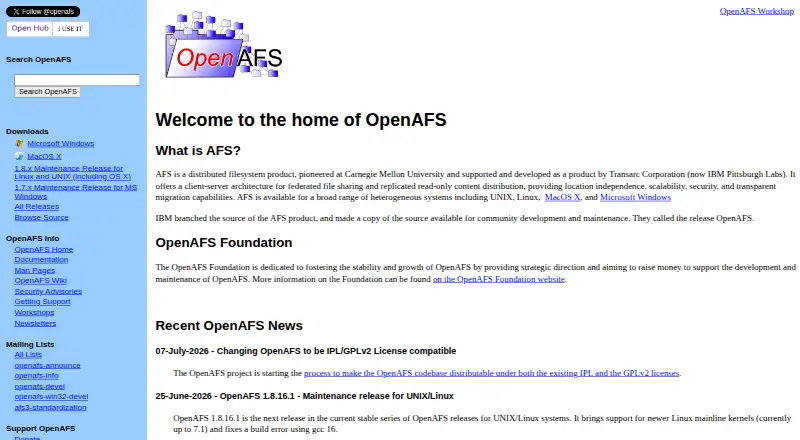
What OpenAFS is
OpenAFS is an open-source implementation of the AFS distributed filesystem, designed to let users access network files as if they were local. It supports federated file sharing and read-only replication across file servers. Location transparency means users can keep the same pathname when administrators move files between machines. The client Cache Manager keeps files in disk or memory cache to reduce repeated network requests. Kerberos-based authentication uses tokens to represent authenticated status, while directory access control lists define which users or groups can access files and their permissions. Clients and servers mutually authenticate, and server processes encrypt particularly sensitive information sent to clients. However, commands in the fs, pts and vos suites do not encrypt data before transmission. OpenAFS is free under the IBM Public License and supports Linux, macOS, Windows and self-hosted deployment. Each AFS volume has an administrator-assigned size limit or quota. The project lists release 1.8.16.1 as a June 2026 maintenance release for UNIX/Linux, supporting Linux mainline kernels up to 7.1.
Who it suits
OpenAFS may suit organizations such as companies or university departments that need shared network files across a defined group of users. It is intended for administrators who can manage AFS cells, access controls and volume quotas.
What it does well
- Free and open-source under the IBM Public License.
- Supports federated sharing and read-only replication.
- Pathnames remain usable after files move.
- Kerberos authentication and directory access controls.
- Available for Linux, macOS and Windows.
What to know first
- Commands in fs, pts and vos suites do not encrypt transmitted data.
- Administrators assign each volume a size limit or quota.
- Self-hosted deployment is listed.
Limits
Each AFS volume has a size limit or quota assigned by the system administrator.
Plans
| Plan | Billed and limits | Price |
|---|---|---|
| OpenAFS | Open-source distributed filesystem | Free |
As openafs.org lists them, read 29 Sept 2026. The maker's own page has the final word.
Getting started
- Visit the OpenAFS website.
- Choose a Linux, macOS, or Windows platform.
- Set up a self-hosted deployment.
- Use the project wiki's mailing lists, IRC channel, or support directory for guidance.
OpenAFS is an open-source distributed filesystem that makes network files behave like local files. It is best suited to companies, university departments, and other defined user groups operating their own infrastructure across sites. Its main appeal is transparent, replicated access under administrator control; organizations requiring encrypted administration commands or a hosted service should consider alternatives.
Overview
OpenAFS implements the AFS model on Linux, macOS, Windows, and self-hosted deployments. Federated cells allow file servers to participate in a shared namespace, while read-only replication can position content near different user populations. Location transparency is operationally valuable: administrators can move files between machines without making users change the pathname they use.
This is a managed storage system rather than an anonymous public-sharing product. Administrators assign every AFS volume a size limit or quota, giving each area an explicit capacity boundary. The project, founded in 2000, is distributed under the IBM Public License.
Key features
Replication and location transparency
AFS supports federated sharing and read-only copies across file servers. That suits organizations with multiple sites or heavily read data, because users can retain one namespace while administrators place replicated content where it is needed. Replication is specifically read-only, so workloads requiring independently writable replicas need a different design.
Caching
The client Cache Manager stores files in local disk or memory cache. Frequently reused files therefore generate fewer network requests and can feel more responsive, while the administrator must still size local cache space and manage each volume's quota.
Authentication and permissions
Kerberos-based authentication and tokens represent an authenticated session. Directory access-control lists then define which users or groups can access files and which permissions they receive. This combination fits centrally administered organizations that already operate identity and access policies.
Security boundary
Clients and servers mutually authenticate, and server processes encrypt particularly sensitive information sent to clients. There is an important exception: the administration guide states that the fs, pts, and vos command suites do not encrypt data before transmission. Those administrative operations require a network-security plan beyond OpenAFS's authentication model.
Protocols and current release
Native AFS access is supplemented by NFS through a translator and SMB/CIFS on Windows. The home page lists OpenAFS 1.8.16.1, a June 2026 maintenance release for UNIX/Linux with support for Linux mainline kernels up to 7.1. Support is community- and service-based: the project wiki points to mailing lists, an IRC channel, and individuals or companies offering support and consulting.
Pricing
| Plan | Price | What it includes |
|---|---|---|
| OpenAFS | free | Open-source distributed filesystem |
OpenAFS is free software with no paid tier or trial period. The zero-price plan removes licensing fees, but it does not provide hosted capacity: deployment is self-hosted, and administrators remain responsible for servers, volumes, quotas, authentication, and operational support. Storage is constrained by the quota assigned to each volume rather than by a vendor package. Organizations wanting commercial help can use the project's listed support and consulting providers, with pricing determined separately.
Platforms
OpenAFS supports Linux, macOS, and Windows, with self-hosted deployment. File access uses AFS natively, NFS through a translator, and SMB/CIFS on Windows. This mix is useful when an organization needs one distributed storage system across Unix-like and Windows clients, though protocol-specific access should be planned around the AFS model.
Who it's for
Choose OpenAFS for a company, university department, or similarly defined community that can run its own file servers and Kerberos environment. It is particularly appropriate when users need stable pathnames while data moves between machines, when read-only replicas can serve multiple sites, and when local caching can reduce repeated network traffic.
It is a poor fit for teams seeking a turnkey hosted drive, public anonymous sharing, or encrypted transmission for every administrative command. The quota-per-volume model also requires administrators to plan capacity rather than relying on an automatically expanding consumer-style plan.
Pros and cons
Pros
- Transparent namespace: Files can move between servers without forcing pathname changes for users.
- Federated, multi-site design: Cells and read-only replication support shared access across file servers and locations.
- Efficient repeat access: Disk or memory caching reduces recurring network requests.
- Structured identity controls: Kerberos tokens and directory ACLs provide central authentication and per-user or per-group permissions.
- No license charge: The OpenAFS plan costs nothing and is open source.
Cons
- Self-hosting burden: You supply and operate the infrastructure, identity system, quotas, and maintenance.
- Unencrypted administration suites: fs, pts, and vos commands transmit data without encryption.
- Read-only replication: Replicas are not a solution for independently writable copies.
- Quota management: Every volume has an administrator-assigned size limit, requiring active capacity planning.
Alternatives
Tahoe-LAFS is another free, open-source self-hosted option, with API, web, and desktop-platform coverage and no stated hosted or paid tier.
MooseFS offers a free Community plan and a paid Personal plan, so it is worth comparing when a freemium structure and single-active-master Community deployment fit your needs.
SeaweedFS provides free community support and a free trial, making it an alternative for teams evaluating a freemium distributed-storage project.
Ceph is free open-source distributed storage, intended for organizations prepared to run a Ceph cluster for block storage.
Hadoop Distributed File System is a no-charge Apache-licensed, self-hosted cluster option.
JuiceFS has a free self-hosted Community Edition plus a cloud-service tier with custom pricing, useful when you want a path from community deployment to managed service.
OrangeFS provides free open-source software alongside separately priced support and services.
Quobyte offers a free edition capped at 150 TB, an option for organizations whose capacity fits that limit.
See the broader Distributed File System Software category for more choices.
Verdict
OpenAFS is a strong choice for self-hosted organizations that need a stable shared namespace, Kerberos identity, caching, and read-only replication across sites without license fees. Look elsewhere if you need hosted storage, writable replication, or encrypted traffic for the fs, pts, and vos administration suites.
Verdict
OpenAFS offers distributed file access with replication, caching and Kerberos-based authentication. Its documented transmission-encryption limitation for fs, pts and vos commands is important to consider.
Questions
How much does OpenAFS cost?
OpenAFS is free. Its listed plan is free.
Is OpenAFS open source?
Yes. The project states that it is distributed under the IBM Public License.
Which platforms does it support?
The listed platforms are Linux, macOS, self-hosted, and Windows.
How does OpenAFS handle authentication and permissions?
It supports Kerberos-based authentication with tokens, and directory access control lists specify access for users or groups.
Does OpenAFS encrypt transmitted data?
Clients and servers mutually authenticate, and server processes encrypt particularly sensitive information sent to clients. Commands in the fs, pts, and vos suites do not encrypt data before transmitting it.
Where can users find support?
The project wiki points to mailing lists, an IRC channel, and a page listing individuals and companies offering support or consulting.
Facts from OpenAFS's own pages
- Access controls
- Directory access control lists specify which users or groups can access files and what permissions they have. · docs.openafs.org, 29 Sept 2026
- Authentication
- OpenAFS supports Kerberos-based authentication and uses tokens to represent authenticated status. · wiki.openafs.org, 29 Sept 2026
- Caching
- The client Cache Manager stores files in local disk or memory cache to reduce repeated network requests. · docs.openafs.org, 29 Sept 2026
- Current release
- The home page lists OpenAFS 1.8.16.1 as a June 2026 maintenance release for UNIX/Linux, with support for Linux mainline kernels up to 7.1. · openafs.org, 29 Sept 2026
- Federated sharing
- AFS supports federated file sharing and read-only content replication across file servers. · openafs.org, 29 Sept 2026
- Founded
- 2000 · openafs.org, 28 Sept 2026
- Intended users
- The documentation describes AFS cells as suitable for organizations such as companies, university departments, or other defined groups of users. · docs.openafs.org, 29 Sept 2026
- License
- The project states that OpenAFS is distributed under the IBM Public License. · wiki.openafs.org, 29 Sept 2026
- Location transparency
- Users can keep using the same pathname when administrators move files between machines. · docs.openafs.org, 29 Sept 2026
- Platforms
- The project home page lists UNIX, Linux, macOS, and Microsoft Windows among supported systems. · openafs.org, 29 Sept 2026
- Security
- AFS clients and servers mutually authenticate, and server processes encrypt particularly sensitive information sent to clients. · docs.openafs.org, 29 Sept 2026
- Security limitation
- The administration guide says commands in the fs, pts, and vos suites do not encrypt data before transmitting it. · docs.openafs.org, 29 Sept 2026
- Storage limits
- Each AFS volume has a size limit or quota assigned by the system administrator. · docs.openafs.org, 29 Sept 2026
- Support
- The project wiki points users to mailing lists, an IRC channel, and a page listing individuals and companies offering support or consulting. · wiki.openafs.org, 29 Sept 2026
- What it does
- OpenAFS is an open-source implementation of the AFS distributed filesystem for accessing network files as if they were local. · openafs.org, 29 Sept 2026
Where OpenAFS stands on Freedom251
- Distributed File System Software#8 of 32