Freedom251 › Storage Management Software

Quobyte
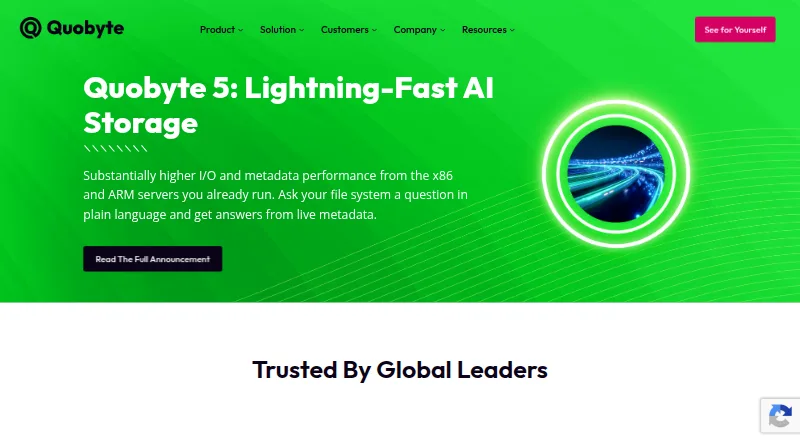
What Quobyte is
Quobyte is a distributed parallel file system and unified storage platform for enterprise workloads. The maker describes it for AI and machine learning, video rendering, MPI applications, databases, and home directories, serving enterprises and researchers running large-scale storage infrastructure. Storage access is available through Linux POSIX, Windows, macOS, NFS v3 and v4, S3, Hadoop/HDFS, and MPI-IO. For Kubernetes, Quobyte provides a CSI plugin for persistent volume provisioning and a Helm chart for cluster deployment. OpenStack drivers are available for Nova, Cinder, and Glance. Its policy engine can manage redundancy, media placement, tiering, encryption, caching, and quality of service. Security capabilities include end-to-end data encryption, TLS, X.509 certificates, and unified access controls across supported interfaces. High-security tenants can enforce TLS, require certificate-only access, manage encryption keys, and use hardware isolation. Quobyte exports metrics for Prometheus and provides a Grafana dashboard for I/O and metadata metrics and trends. The Free Edition costs nothing, lasts forever, and supports up to 150 TB of storage. A free Quobyte account provides access to packages, container images, the manual, an AI support bot, Quobyte Support, and license keys for Free and Enterprise Edition. For commercial pricing, the maker directs visitors to contact its storage experts for a live demo.
Who it suits
Quobyte suits enterprises and researchers operating large-scale storage infrastructure for workloads such as machine learning, video rendering, MPI applications, databases, or home directories. Its management and security controls may fit teams that need multiple storage interfaces, Kubernetes or OpenStack integration, and storage monitoring.
What it does well
- Free Edition supports up to 150 TB of storage forever.
- Supports POSIX, NFS, S3, HDFS, and MPI-IO access.
- Policy engine manages redundancy, tiering, encryption, caching, and quality of service.
- Provides Kubernetes CSI and Helm deployment options.
- Exports Prometheus metrics and includes a Grafana dashboard.
- High-security tenants can use certificate-only access and hardware isolation.
What to know first
- Free Edition is capped at 150 TB of storage.
- Enterprise Edition pricing is custom and requires contacting storage experts for a demo.
- The listed platform is designed for enterprise and research scale storage infrastructure.
Limits
The Free Edition supports up to 150 TB of storage. Enterprise Edition pricing is custom and available through contact with Quobyte's storage experts.
Plans
| Plan | Billed and limits | Price |
|---|---|---|
| Free Edition | Up to 150 TB of storage · free forever | Free |
As quobyte.com lists them, read 29 Sept 2026. The maker's own page has the final word.
Getting started
- Visit https://quobyte.com/.
- Create a free Quobyte account to access packages, container images, the manual, support, and license keys.
- Choose the Free Edition for up to 150 TB of storage, or contact storage experts about commercial pricing and a live demo.
- Deploy with the available Kubernetes CSI plugin and Helm chart if using Kubernetes.
- Use the available OpenStack drivers for Nova, Cinder, and Glance if using OpenStack.
Quobyte is a distributed parallel file system and unified storage platform for enterprise workloads. It best suits enterprises and researchers managing large-scale storage across varied workloads and access protocols. Its policy, security, and monitoring controls are broad, while the free edition’s 150 TB ceiling and custom-priced enterprise edition shape the buying decision.
Overview
Quobyte brings file, object, and workload-specific access into a single storage platform. The maker positions it for AI and machine learning, video rendering, MPI applications, databases, and home directories, so it can serve environments where several kinds of workloads share storage. That breadth is useful for consolidation, but organizations seeking only a basic file server may find its enterprise focus and policy controls more than they need.
Deployment is hybrid, with storage provisioning, capacity monitoring, performance optimization, and automated tiering. A free account provides downloads, documentation, an AI support bot, Quobyte Support, and license keys for both editions.
Key features
Quobyte supports Linux POSIX, Windows, macOS, NFS v3 and v4, S3, Hadoop/HDFS, and MPI-IO. That range lets teams connect conventional file clients, object workflows, Hadoop environments, and MPI applications to the same platform. Kubernetes users get a CSI plugin for persistent volume provisioning and a Helm chart for cluster deployment; OpenStack environments get Nova, Cinder, and Glance drivers.
The policy engine can manage redundancy, media placement, tiering, encryption, caching, and quality of service. These controls give storage teams room to align placement and performance with workload needs. Security features include end-to-end data encryption, TLS, X.509 certificates, and unified access controls across interfaces. High-security tenants can also use enforced TLS, certificate-only access, tenant-managed encryption keys, and hardware isolation.
For operations, Quobyte exports metrics to Prometheus and provides a Grafana dashboard covering I/O and metadata metrics and trends. This makes capacity and performance oversight part of the platform, though the value of those controls depends on teams having the operational capacity to use them.
Pricing
Free Edition: free, up to 150 TB of storage, free forever. It is a substantial option for organizations that can operate within the capacity cap and want to evaluate or run Quobyte without a license fee. The published limit is on storage capacity; no seat count or trial period applies to this free-forever plan.
Enterprise Edition: custom pricing. Organizations seeking the commercial edition must contact Quobyte’s storage experts for a live demo. With no published price, buyers will need a sales conversation to assess the commercial commitment.
Platforms
Quobyte lists API, Linux, macOS, self-hosted, web, and Windows support. Its multiple storage interfaces and Kubernetes and OpenStack integrations make it suited to mixed infrastructure, while the platform’s core focus remains enterprise storage rather than a standalone end-user app.
Who it's for
Quobyte is a strong fit for enterprises and researchers running large-scale infrastructure, especially where AI/ML, rendering, MPI, databases, or home directories need shared storage through different protocols. Its policy controls and security options also suit teams with differentiated placement, access, or tenant isolation requirements. Smaller teams with straightforward storage needs or no appetite for managing a distributed platform should consider a simpler alternative.
Pros and cons
- Pro: Broad file, object, Hadoop, and MPI access can serve diverse workloads through one platform.
- Pro: Policy controls cover redundancy, placement, tiering, encryption, caching, and quality of service.
- Pro: The free edition includes up to 150 TB forever, a meaningful capacity for a no-cost tier.
- Pro: Prometheus metrics, a Grafana dashboard, and Kubernetes and OpenStack integrations support infrastructure operations.
- Con: The Free Edition stops at 150 TB, which can constrain growing storage estates.
- Con: Enterprise Edition uses custom pricing, so buyers cannot compare its cost without contacting the maker.
Alternatives
Choose TrueNAS if you want a free software download for any x86 hardware with community support. Consider MinIO AIStor for its free single-node deployment with the full feature set, subject to a redistribution prohibition. StarWind Virtual SAN offers a free self-supported edition with functionality limits, though its Linux KVM version may have none. Ceph is a free open-source distributed storage option that requires a running Ceph cluster for block storage. BeeGFS is another distributed file system option. openmediavault is free software under GNU GPL v3. Hitachi Universal Volume Manager is a paid option requiring a license on the local storage system.
Browse more Storage Management Software or Distributed File System Software.
Verdict
Quobyte is a compelling choice for enterprises and researchers consolidating large-scale workloads that need varied storage interfaces, fine-grained policies, and operational visibility. The free edition makes a sizable starting point available, but its 150 TB cap and the custom pricing of Enterprise Edition are the key reasons to look elsewhere if capacity or predictable commercial costs matter most.
Verdict
Choose Quobyte if your organization needs a unified storage platform for large-scale workloads, with broad storage interfaces and controls for policy, security, and monitoring. The Free Edition has a 150 TB ceiling; organizations considering Enterprise Edition need to contact the maker for commercial pricing.
Questions
Is Quobyte free?
Yes. The Free Edition costs nothing, is free forever, and supports up to 150 TB of storage.
What workloads is Quobyte intended for?
The maker describes it for AI and machine learning, video rendering, MPI applications, databases, and home directories.
Which storage interfaces does Quobyte support?
It supports Linux POSIX, Windows, macOS, NFS v3 and v4, S3, Hadoop/HDFS, and MPI-IO.
Does Quobyte support Kubernetes and OpenStack?
For Kubernetes, it provides a CSI plugin and Helm chart. For OpenStack, it offers drivers for Nova, Cinder, and Glance.
How do I find Enterprise Edition pricing?
The maker directs visitors to contact its storage experts for a live demo. Enterprise Edition pricing is custom.
Facts from Quobyte's own pages
- Commercial pricing
- The maker directs visitors to contact its storage experts for a live demo; the pages reviewed did not state Enterprise Edition pricing. · quobyte.com, 29 Sept 2026
- High-security tenants
- Quobyte supports enforced TLS, certificate-only access, tenant-managed encryption keys, and hardware isolation for high-security tenants. · quobyte.com, 29 Sept 2026
- Intended users
- Quobyte describes its platform for enterprises and researchers running large-scale storage infrastructure. · quobyte.com, 29 Sept 2026
- Kubernetes
- Quobyte provides a CSI plugin for persistent volume provisioning and a Helm chart for deploying clusters. · quobyte.com, 29 Sept 2026
- Monitoring
- Quobyte exports metrics for Prometheus and provides a Grafana dashboard for I/O and metadata metrics and trends. · quobyte.com, 29 Sept 2026
- OpenStack
- Quobyte offers drivers for Nova, Cinder, and Glance. · quobyte.com, 29 Sept 2026
- Security
- The maker describes end-to-end data encryption, TLS, X.509 certificates, and unified access controls across supported interfaces. · quobyte.com, 29 Sept 2026
- Storage interfaces
- Quobyte supports access through Linux POSIX, Windows, macOS, NFS v3 and v4, S3, Hadoop/HDFS, and MPI-IO. · quobyte.com, 29 Sept 2026
- Storage management
- The policy engine can set redundancy, media placement, tiering, encryption, caching, and quality of service. · quobyte.com, 29 Sept 2026
- Support and downloads
- A free Quobyte account provides access to packages, container images, the manual, an AI support bot, Quobyte Support, and license keys for Free and Enterprise Edition. · quobyte.com, 29 Sept 2026
- What it does
- Quobyte is a distributed parallel file system and unified storage platform for enterprise workloads. · quobyte.com, 29 Sept 2026
- Workloads
- The maker describes Quobyte for AI and machine learning, video rendering, MPI applications, databases, and home directories. · quobyte.com, 29 Sept 2026
Where Quobyte stands on Freedom251
- Storage Management Software#5 of 28
- Distributed File System Software#10 of 32