Freedom251 › Storage Replication Software
XtreemFS
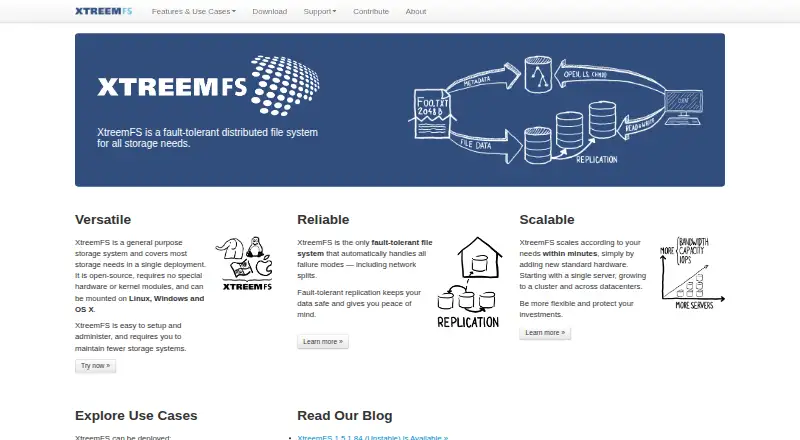
What XtreemFS is
XtreemFS is a free, fault-tolerant distributed file system for general-purpose storage. It keeps copies of files across storage servers and can switch to a backup replica if the primary server fails. Full or partial read-only replicas for immutable files can also support caches across datacenters. The project says installations can grow to thousands of storage and metadata servers by adding or removing storage servers. XtreemFS offers POSIX compatibility for use as an NFS replacement, along with SSL and X.509 certificate support; its site says it can run over the internet without a VPN. A Hadoop client is available for using it as an HDFS replacement. The project provides Linux distribution packages and precompiled Windows and Mac OS X clients, and lists uses such as filer replacement, HPC and Hadoop clusters, VM block storage and cross-branch data sharing. Its FAQ says a single volume may contain up to tens of millions of files, with no known limits reported for volumes or services. It is developed as an open-source project by Zuse Institute Berlin.
Who it suits
XtreemFS may suit organizations or technical teams seeking distributed storage across servers, datacenters or branches. Its POSIX compatibility, Hadoop client and listed HPC, VM and filer uses address several storage setups.
What it does well
- Files replicate across storage servers.
- Automatic failover can switch to a backup replica.
- Read-only replicas can cache across datacenters.
- POSIX compatibility supports NFS replacement.
- Free under an open-source BSD license.
What to know first
- A single volume holds up to tens of millions of files.
- User questions go to a public mailing list.
- Bug reports use the GitHub bug tracker.
Limits
A single volume may contain up to tens of millions of files. The FAQ reports no known limits for the number of volumes and services.
Plans
| Plan | Billed and limits | Price |
|---|---|---|
| XtreemFS | Open-source BSD license · free of charge | Free |
As xtreemfs.org lists them, read 30 Sept 2026. The maker's own page has the final word.
Getting started
- Visit the XtreemFS website.
- Choose a Linux distribution package or a precompiled Windows or Mac OS X client.
- Deploy XtreemFS in a self-hosted environment.
- Use the Hadoop client if configuring XtreemFS as an HDFS replacement.
XtreemFS is a self-hosted distributed file system for teams building shared storage across servers or sites. It is most compelling for infrastructure workloads that need file-level replication, failover or POSIX compatibility. Its open-source BSD license costs nothing; the trade-off is that you run the storage system yourself.
Overview
XtreemFS distributes files across storage servers and can automatically switch to a backup replica if the primary fails. That makes it a practical option when continuity matters, while its file-oriented design and POSIX compatibility suit applications built around conventional shared storage. The project is developed as open source by Zuse Institute Berlin.
Documented uses include replacing a filer, HPC and Hadoop clusters, VM block storage, and data sharing between branches. A Hadoop client supports using XtreemFS in place of HDFS, and POSIX compatibility makes it a potential NFS replacement. These capabilities cover varied infrastructure needs, but XtreemFS is not a managed service: deployment and operation remain with your organization.
Key features
- File replication and failover: Files are replicated across storage servers, with automatic failover to a backup replica after primary failure. Continuous replication and multi-site support help deployments span locations, though this remains file-level rather than a general-purpose block replication model.
- Read-only replicas: Full or partial replicas of immutable files can serve as caches across datacenters. This is useful for distributing stable data near readers, but the read-only condition makes it unsuitable for workloads that need those replicas to accept writes.
- Scale-out architecture: The project says an installation can grow to thousands of storage and metadata servers by adding or removing storage servers. That offers room to expand an existing deployment, while the FAQ sets a practical per-volume boundary at up to tens of millions of files. It reports no known limits on volume or service counts.
- Filesystem and Hadoop compatibility: POSIX support enables use as a drop-in NFS replacement, and a Hadoop client allows use as an HDFS replacement. These interfaces make it relevant to existing file-oriented and Hadoop environments without changing the system's self-hosted nature.
- Security and client packages: Built-in SSL and X.509 certificate support allow it to run over the internet without a VPN, according to the project. Linux distribution packages and precompiled Windows and Mac OS X clients reduce the need to build client software from source.
Pricing
XtreemFS — free. The plan is free of charge under an open-source BSD license. It is a strong fit for organizations able to deploy and maintain their own storage; there is no paid tier or subscription term to weigh, but support is community-based rather than a stated commercial service.
Users can ask questions on the public mailing list and report bugs through the GitHub bug tracker. That works for teams comfortable with community channels, but organizations requiring a guaranteed support response should factor that limitation into their decision.
Platforms
XtreemFS supports Linux, macOS and Windows, and is self-hosted. Linux distribution packages and precompiled clients for Windows and Mac OS X broaden access across mixed client environments; the deployment model still calls for managing the underlying infrastructure.
Who it's for
XtreemFS fits infrastructure teams that need distributed shared files, replication across servers or sites, or failover when a primary replica fails. Its POSIX and Hadoop compatibility make it particularly relevant to NFS replacement, HPC, Hadoop, VM block-storage and cross-branch use cases. It is a weaker fit for buyers seeking managed storage, or for a volume whose file count exceeds the stated tens-of-millions scale.
Pros and cons
- Pro: Automatic failover and continuous file replication address availability across storage servers, including multi-site deployments.
- Pro: POSIX support, NFS replacement use and a Hadoop client let teams consider it for established file and Hadoop workloads.
- Pro: The BSD-licensed software is free, with clients for Linux, macOS and Windows.
- Con: Self-hosting puts deployment and ongoing operation on the user rather than a managed provider.
- Con: A single volume is described as holding up to tens of millions of files, so very large per-volume collections need careful fit assessment.
- Con: Support runs through a public mailing list and GitHub bug tracker, which may not suit teams that need guaranteed assistance.
Alternatives
For other options, see Storage Replication Software and Distributed File System Software.
- Synology Photos is a free alternative for people who need photo software across mobile, desktop and web platforms and already have a Synology NAS; it requires that NAS.
- Obstor is another free, self-hosted open-source option, with Linux, macOS, Windows, web and API platforms.
- SeaweedFS is worth considering for users who want a free community-support plan for any cluster size, with GitHub issues and discussions and public documentation, but no guaranteed response time.
- LINBIT DRBD offers a free open-source community version for Linux, self-hosted and Windows environments; consider it when DRBD 9 source code, documentation and community support match the need.
- Longhorn is a free, open-source distributed block storage option for Kubernetes, making it the more direct fit for Kubernetes block-storage needs.
- OpenEBS is a free open-source Kubernetes storage option for teams choosing storage in that ecosystem.
- Amazon S3 uses usage-based billing with no minimum charge; choose it when that consumption-based pricing model is preferable to operating self-hosted storage.
- DAOS is another free option for Linux and self-hosted deployments.
Verdict
Choose XtreemFS if your team can operate self-hosted infrastructure and needs replicated, failover-capable file storage with POSIX or Hadoop compatibility. Its free BSD-licensed model and multi-site file replication are the clearest reasons to adopt it; look elsewhere if you need managed storage, guaranteed support or a volume beyond its stated file-count scale.
Verdict
XtreemFS offers replicated storage, failover and read-only replicas, with support for Linux, macOS, Windows and self-hosted deployment. Consider the per-volume file limit and the community-based support channels when assessing fit.
Questions
How much does XtreemFS cost?
The listed plan is free: free, under an open-source BSD license.
Which platforms are supported?
The listed platforms are Linux, macOS, Windows, and self-hosted deployments. The project provides Linux distribution packages and precompiled Windows and Mac OS X clients.
Can XtreemFS replace NFS or HDFS?
Its POSIX compatibility supports use as an NFS replacement. A Hadoop client is available for using it as an HDFS replacement.
Does XtreemFS replicate files and fail over?
Yes. It replicates files across storage servers and can automatically switch to a backup replica if the primary fails.
Who develops XtreemFS?
Zuse Institute Berlin develops it as an open-source project.
How can users get support or report bugs?
Users can ask questions on the public mailing list and report bugs through the GitHub bug tracker.
Facts from XtreemFS's own pages
- Compatibility
- XtreemFS offers POSIX compatibility and can be used as a drop-in replacement for NFS. · xtreemfs.org, 30 Sept 2026
- Deployment
- The project provides Linux distribution packages and precompiled client packages for Windows and Mac OS X. · xtreemfs.org, 30 Sept 2026
- Developer
- The site says XtreemFS is developed as an open-source project by Zuse Institute Berlin. · xtreemfs.org, 30 Sept 2026
- Hadoop
- A Hadoop client is available for using XtreemFS as an HDFS replacement. · xtreemfs.org, 30 Sept 2026
- Limit
- The FAQ says a single volume may contain up to tens of millions of files; it reports no known limits for the number of volumes and services. · xtreemfs.org, 30 Sept 2026
- Purpose
- XtreemFS is a fault-tolerant distributed file system for general-purpose storage. · xtreemfs.org, 30 Sept 2026
- Read-only replicas
- It supports full and partial read-only replicas for immutable files, which can be used to build a cache across datacenters. · xtreemfs.org, 30 Sept 2026
- Replication
- It replicates files across storage servers and can automatically fail over to a backup replica if the primary fails. · xtreemfs.org, 30 Sept 2026
- Scalability
- The site says an installation can scale to thousands of storage and metadata servers by adding or removing storage servers. · xtreemfs.org, 30 Sept 2026
- Security
- It has built-in SSL and X.509 certificate support, and the site says it can run over the internet without a VPN. · xtreemfs.org, 30 Sept 2026
- Support
- Users can ask questions on the public mailing list and report bugs through the GitHub bug tracker. · xtreemfs.org, 30 Sept 2026
- Use cases
- The site lists filer replacement, HPC and Hadoop clusters, VM block storage, and cross-branch data sharing as use cases. · xtreemfs.org, 30 Sept 2026
Where XtreemFS stands on Freedom251
- Storage Replication Software#9 of 24
- Distributed File System Software#13 of 32