Freedom251 › Storage Replication Software

OpenEBS
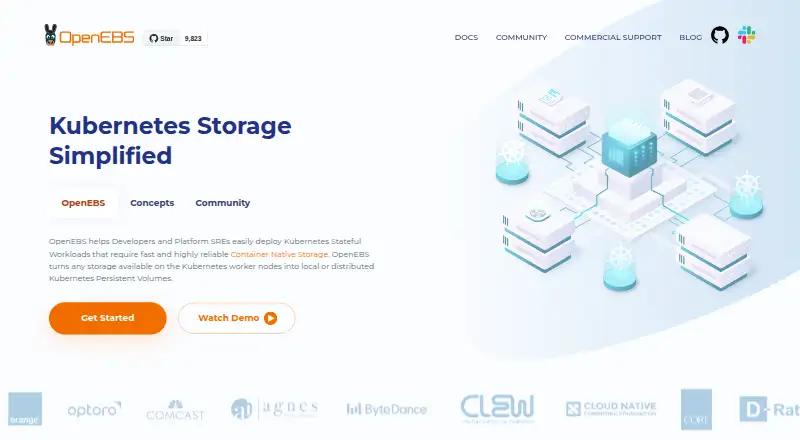
What OpenEBS is
OpenEBS is open-source Kubernetes storage software for developers and platform SREs deploying stateful workloads. It converts storage on Kubernetes worker nodes into local or distributed persistent volumes, using userspace software rather than Linux kernel-dependent components. Its engines include Replicated PV Mayastor, Local PV Hostpath, LVM and ZFS, plus experimental Rawfile. Mayastor can synchronously replicate volumes across Kubernetes zones; Kubernetes-native operations support copy-on-write snapshots and clones. For backup and restore, OpenEBS works with Velero and targets AWS S3, GCP Object Storage or MinIO. Volume metrics include IOPS, throughput, latency and traffic patterns for Prometheus and Grafana. The software exposes declarative Kubernetes custom-resource APIs and can be installed with Helm 3.2 or newer. Mayastor disk pools support data-at-rest encryption with user-defined AES-XTS keys. OpenEBS is free, and listed use cases include self-managed databases, observability stacks, CI/CD, object storage, websites and ML pipelines on Kubernetes.
Who it suits
It suits developers and platform SREs running stateful Kubernetes workloads, including databases, observability stacks, CI/CD, object storage, websites and ML pipelines. Teams looking for local or replicated persistent volumes, snapshots, backups or volume metrics may find its listed capabilities relevant.
What it does well
- Free and described as 100% open source.
- Offers local and replicated Kubernetes persistent volumes.
- Supports copy-on-write snapshots and clones.
- Velero backup targets include S3, GCP Object Storage and MinIO.
- Exposes volume metrics for Prometheus and Grafana.
What to know first
- Mayastor DiskPools support only one block device.
- Encryption keys cannot be rotated.
- Plaintext communication is the default.
- The kubectl plugin is available for Linux.
Limits
The listed plan is free. Mayastor DiskPools are limited to a single block device, and data-encryption keys cannot be rotated; plaintext communication is the default.
Plans
| Plan | Billed and limits | Price |
|---|---|---|
| OpenEBS open source | Open source · Kubernetes storage | Free |
As openebs.io lists them, read 2 Oct 2026. The maker's own page has the final word.
Getting started
- Visit the OpenEBS website.
- Install OpenEBS with Helm 3.2 or newer.
- Use the default chart to install Local PV Hostpath, Local PV LVM, Local PV ZFS, and Replicated Storage.
- Manage declarative storage APIs through Kubernetes custom resources.
OpenEBS is open-source, Kubernetes-native storage for developers and platform SREs running stateful workloads. It suits teams that need both node-local volumes and replicated persistent storage under declarative Kubernetes control. Its breadth and zero price are compelling, but Mayastor’s hardware and key-management constraints can rule it out for some high-availability designs.
Overview
OpenEBS implements the Container Native Storage pattern: Kubernetes orchestrates volume services, while OpenEBS runs entirely in userspace instead of depending on Linux kernel storage software. Its custom-resource APIs let platform teams manage storage through the same declarative model as other Kubernetes resources.
The project began at MayaData, was donated to the Cloud Native Computing Foundation and is a CNCF sandbox project. OpenEBS describes itself as 100% open source. Helm 3.2 or newer provides installation, and the default chart installs Hostpath, LVM, ZFS and Replicated Storage components.
Key features
Storage engines and replication
OpenEBS v4.6 includes Local PV Hostpath, Local PV LVM, Local PV ZFS, experimental Local PV Rawfile and Replicated PV Mayastor. Local engines use storage on Kubernetes worker nodes, which fits workloads that benefit from local access and a straightforward volume model. Mayastor synchronously replicates volumes across Kubernetes zones, adding a high-availability option for stateful services.
That choice is useful but not frictionless. Teams must select an engine appropriate to each workload, and Mayastor DiskPools are limited to a single block device. The single-device boundary matters when a design expects several devices in one pool. Mayastor also supports data-at-rest encryption with user-defined AES-XTS keys, but those keys cannot be rotated, an important drawback for organizations with regular key-lifecycle requirements.
Snapshots, clones and backup
Copy-on-write snapshots and clones use Kubernetes-native kubectl operations, so administrators can incorporate point-in-time volume work into familiar workflows. Velero plugins provide backup and restore, with AWS S3, GCP Object Storage and MinIO as object-storage targets. This combination suits teams that already standardize on Velero; it does not replace the need to operate Velero and an object-storage destination.
Monitoring and integrations
Volumes expose IOPS, throughput, latency and traffic-pattern metrics for Prometheus and Grafana. Documented integrations also include Alert Manager, ELK, Loki, Logstash, OpenShift, EKS, DigitalOcean, Rancher, MicroK8s and KubeSphere. These connections make OpenEBS practical for platform teams with an existing Kubernetes observability stack rather than a reason to adopt it on their own.
Security and support
Replicated PV Mayastor supports TLS for its public REST API. JWT authentication and internal TLS are planned, while plaintext communication is the default, so operators should treat secure configuration as a deployment requirement. DataCore offers support services led by program managers and engineers holding Certified Kubernetes Administrator and Developer qualifications, giving organizations a commercial support path around the open-source project.
Pricing
OpenEBS open source — free (Open source · Kubernetes storage). The plan includes Hostpath, LVM, ZFS, Rawfile and Replicated PV Mayastor volume types, snapshots and multi-attach. There are no paid tiers or seat and quota charges stated, making it suitable for self-managed Kubernetes teams that can provide their own infrastructure and operations. The trade-off is that DataCore support services are a separate option rather than a paid plan described here.
Platforms
OpenEBS is available through an API on Linux and is self-hosted. The OpenEBS kubectl plugin is available for Linux, so teams using another workstation platform may need a Linux administration environment for that workflow.
Who it's for
OpenEBS is aimed at developers and platform SREs operating Kubernetes stateful workloads, including self-managed databases, observability stacks, CI/CD systems, object storage, scalable websites and ML pipelines. It is a strong fit when storage must be managed as Kubernetes resources, when local and replicated volume choices are both useful, or when Velero-based backup is already part of the operating model.
Look elsewhere if replicated pools must combine multiple block devices, if encryption keys must rotate, or if secure communication must be the default rather than an operator-configured decision. Teams unwilling to run self-hosted storage and its supporting Kubernetes stack will also find the model demanding.
Pros and cons
Pros
- Broad engine selection: Hostpath, LVM, ZFS, Rawfile and Mayastor let teams match storage behavior to different workloads.
- Zone-level replication: Mayastor can synchronously replicate volumes across Kubernetes zones for high availability.
- Kubernetes-native data operations: Copy-on-write snapshots and clones use familiar kubectl workflows.
- Practical backup path: Velero plugins connect volume backup and restore to S3, GCP Object Storage and MinIO.
- Useful telemetry: Prometheus and Grafana can consume volume performance metrics.
Cons
- Single-device DiskPools: Mayastor cannot build a DiskPool from multiple block devices.
- Keys cannot rotate: Mayastor encryption keys are user-defined AES-XTS keys without rotation support.
- Plaintext by default: Internal communication is not secure by default; JWT and internal TLS remain planned.
- Linux plugin limit: The kubectl plugin is available only for Linux.
- Operational responsibility: The free, self-hosted model leaves infrastructure, Kubernetes operations and Velero running to the adopting team.
Alternatives
Choose Storage Replication Software when you want a broader directory of replication-focused products. Software-Defined Storage Software is the better starting point for comparing software-defined storage systems beyond Kubernetes-native volumes.
Obstor is another free, self-hosted open-source option with API, Linux, macOS and web platforms. SeaweedFS suits readers wanting a freemium system with any cluster size on its community plan and optional paid support. LINBIT DRBD is worth considering for Linux-focused replication, with a free community version and a LINBIT Starter plan at $1,000 a year. XtreemFS is a free BSD-licensed alternative for Linux, macOS and Windows. Longhorn offers free, open-source distributed block storage specifically for Kubernetes. Amazon S3 is preferable when you need managed object storage billed by usage rather than self-hosted persistent volumes. DAOS is another free option for API, Linux and self-hosted deployments. Synology Photos is a free Synology-NAS-dependent product for photo management, not a direct Kubernetes storage substitute.
Verdict
Choose OpenEBS if you run Kubernetes yourself and want free, open-source storage with local engines, optional synchronous replication, Kubernetes-native snapshots and Velero backup. Its main reason to look elsewhere is Mayastor’s single-device DiskPool limit and non-rotatable encryption keys, compounded by plaintext communication as the default.
Verdict
OpenEBS combines several local volume types with replicated storage, Kubernetes-native snapshots and Velero-based backup. Before choosing it, consider the single-device DiskPool limit, non-rotatable encryption keys and default plaintext communication.
Questions
Is OpenEBS free?
Yes. Its listed OpenEBS open source plan costs nothing.
Is OpenEBS open source?
Yes. The OpenEBS homepage describes the project as 100% open source.
Which platforms are listed?
The listed platforms are API, Linux, and self-hosted. The OpenEBS kubectl plugin is available for Linux.
Which storage types does OpenEBS provide?
Its listed volume types are Hostpath, LVM, ZFS, Rawfile, and Replicated PV Mayastor. Rawfile is experimental.
What backup integrations and targets are supported?
OpenEBS backup and restore works with Velero plugins and can target AWS S3, GCP Object Storage, or MinIO.
Who provides OpenEBS support services?
DataCore offers support services led by program managers and engineers with Certified Kubernetes Administrator and Developer qualifications.
Facts from OpenEBS's own pages
- API
- OpenEBS exposes declarative APIs through Kubernetes custom resources. · openebs.io, 1 Oct 2026
- Architecture
- OpenEBS operates exclusively in userspace, avoiding Linux kernel-dependent software. · openebs.io, 1 Oct 2026
- Audience and use cases
- OpenEBS is used for self-managed databases, observability stacks, CI/CD, object storage and scalable websites or ML pipelines on Kubernetes. · openebs.io, 2 Oct 2026
- Backup
- OpenEBS backup and restore works with Velero through OpenEBS Velero plugins and can target AWS S3, GCP Object Storage, or MinIO. · openebs.io, 1 Oct 2026
- Backup integrations
- OpenEBS volume backup and restore works with Velero and object-storage targets including AWS S3, GCP Object Storage and MinIO. · openebs.io, 2 Oct 2026
- Container-native storage
- OpenEBS is an open-source implementation of the Container Native Storage pattern and uses Kubernetes to orchestrate volume services. · openebs.io, 2 Oct 2026
- Current limitation
- Replicated PV Mayastor DiskPools are limited to a single block device and data-encryption keys cannot be rotated. · openebs.io, 2 Oct 2026
- Encryption
- OpenEBS supports data-at-rest encryption for Mayastor disk pools using user-defined AES-XTS keys. · openebs.io, 2 Oct 2026
- Governance
- OpenEBS was originally built by MayaData, donated to the Cloud Native Computing Foundation, and is a CNCF sandbox project. · openebs.io, 1 Oct 2026
- Installation
- OpenEBS can be installed with Helm, and the default chart installs Local PV Hostpath, Local PV LVM, Local PV ZFS and Replicated Storage. · openebs.io, 2 Oct 2026
- Integrations
- OpenEBS documents integrations with Prometheus, Grafana, Alert Manager, ELK, Loki, Logstash, Velero, OpenShift, EKS, DigitalOcean, Rancher, MicroK8s, and KubeSphere. · openebs.io, 1 Oct 2026
- Observability
- OpenEBS volumes expose IOPS, throughput, latency and data-pattern metrics for Prometheus and Grafana monitoring. · openebs.io, 2 Oct 2026
- Open source
- The OpenEBS homepage describes the project as 100% open source. · openebs.io, 1 Oct 2026
- Platform limitation
- The OpenEBS kubectl plugin is available for Linux. · openebs.io, 1 Oct 2026
- Purpose
- OpenEBS provides local or distributed persistent volumes for Kubernetes stateful workloads. · openebs.io, 2 Oct 2026
- Replication
- Replicated Storage can synchronously replicate volumes across Kubernetes zones for high availability. · openebs.io, 2 Oct 2026
- Security
- Replicated PV Mayastor REST API TLS is available but security features are opt-in and plaintext communication remains the default. · openebs.io, 2 Oct 2026
- Snapshots and clones
- Replicated Storage supports instantaneous copy-on-write snapshots and clones managed with standard kubectl commands. · openebs.io, 2 Oct 2026
- Storage engines
- OpenEBS v4.6 includes Replicated PV Mayastor, Local PV Hostpath, Local PV LVM, Local PV ZFS, and experimental Local PV Rawfile. · openebs.io, 1 Oct 2026
- Storage types
- OpenEBS turns storage on Kubernetes worker nodes into local or distributed Kubernetes persistent volumes. · openebs.io, 1 Oct 2026
- Support
- Users can file GitHub issues or ask questions in the Kubernetes Slack #openebs channel. · openebs.io, 2 Oct 2026
Where OpenEBS stands on Freedom251
- Storage Replication Software#6 of 24
- Software-Defined Storage Software#10 of 30