Freedom251 › Partition recovery software
SystemRescue
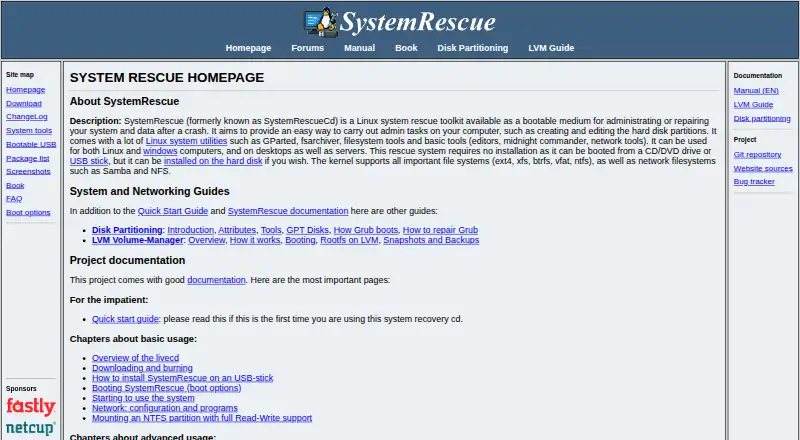
What SystemRescue is
SystemRescue is a free, bootable Linux toolkit for administering or repairing Linux and Windows computers after a system or data failure. It can start from CD/DVD or USB without installation, or be installed on a hard disk, and is intended for desktops and servers. Its kernel supports filesystems including ext4, xfs, btrfs, vfat, ntfs, Samba, and NFS. Included partition tools GParted and GNU Parted can create, resize, copy, move, format, and modify partitions. Testdisk can recover lost partitions and repair boot sectors; photorec focuses on recovering lost files. GNU ddrescue copies block devices and is optimized for disks with bad blocks. Networking tools include OpenVPN, WireGuard, OpenConnect, SSH, rsync, and rclone. Users can customize the ISO, add packages, configure YAML files, create modules, and run scripts at startup. Filesystems are not mounted automatically because mounting could interfere with block-level copying and risk corruption. The current download page offers version 13.02 for amd64; 32-bit releases appear among previous versions.
Who it suits
SystemRescue suits administrators and users repairing Linux or Windows systems, recovering files or partitions, and working with disks that may have bad blocks. It also supports custom rescue media and networking tools.
What it does well
- Boots from CD/DVD or USB without installation
- Includes partition, file, and disk recovery tools
- Supports Linux and Windows computers
- ISO can be customized with packages, modules, and scripts
- Free Linux rescue toolkit
What to know first
- Current download offers amd64; 32-bit releases are previous versions
- At least 2 GB memory is recommended for default boot options
- ZFS is not included, though a build script is provided
Plans
| Plan | Billed and limits | Price |
|---|---|---|
| SystemRescue | Free Linux rescue toolkit · download is an ISO image | Free |
As system-rescue.org lists them, read 8 Oct 2026. The maker's own page has the final word.
Getting started
- Visit system-rescue.org and download the ISO image.
- Verify the download with the provided SHA256 or SHA512 checksum or GnuPG signature.
- Boot the computer from CD/DVD or USB, or install SystemRescue on a hard disk.
- Use the included recovery, partition, disk-copying, or networking tools as needed.
- Customize the ISO, add packages, create modules, configure YAML files, or add startup scripts if needed.
Verdict
SystemRescue combines bootable recovery media with tools for partitions, files, disks, and networking. Check its memory recommendation and amd64 availability against the machine you need to rescue.
Questions
How much does SystemRescue cost?
SystemRescue is free. Its plan is priced at $0.
Which computers can it help rescue?
It can be used to rescue Linux and Windows desktops and servers.
Does SystemRescue need to be installed?
No. It can boot from CD/DVD or USB without installation, and it can optionally be installed on a hard disk.
Does it include ZFS?
ZFS is not included due to licensing concerns. The project provides a script to build a module containing ZFS tools and a kernel module.
What architecture is offered on the current download page?
The current download page offers version 13.02 for amd64. The 32-bit releases are among previous versions.
How much memory does it require?
The download page recommends at least 2 GB for default boot options, or 4 GB when caching the system into RAM.
Facts from SystemRescue's own pages
- Architecture limitation
- The current download page offers SystemRescue 13.02 for amd64; 32-bit releases are available only among previous versions. · system-rescue.org, 8 Oct 2026
- Automatic mounting
- SystemRescue does not automatically mount filesystems because that could interfere with block-level disk copying and risk corruption. · system-rescue.org, 8 Oct 2026
- Boot media
- It can boot from CD/DVD or USB without installation, and can optionally be installed on a hard disk. · system-rescue.org, 8 Oct 2026
- Customization
- Users can customize the ISO, add packages, configure YAML files, create modules, and run scripts at startup. · system-rescue.org, 8 Oct 2026
- Disk imaging
- GNU ddrescue is included to copy block devices and is optimized for disks with bad blocks. · system-rescue.org, 8 Oct 2026
- Filesystems
- Its kernel supports ext4, xfs, btrfs, vfat, ntfs, Samba, and NFS filesystems. · system-rescue.org, 8 Oct 2026
- License and support
- The project source code is licensed under GPLv3, and the site links to project documentation, forums, and a bug tracker. · system-rescue.org, 8 Oct 2026
- Memory requirement
- The download page recommends at least 2 GB of memory for default boot options or 4 GB when caching the system into RAM. · system-rescue.org, 8 Oct 2026
- Networking
- Included network capabilities include OpenVPN, WireGuard, OpenConnect, SSH, and file transfer tools such as rsync and rclone. · system-rescue.org, 8 Oct 2026
- Partition tools
- Included tools such as GParted and GNU Parted can create, resize, copy, move, format, and modify partitions. · system-rescue.org, 8 Oct 2026
- Purpose
- SystemRescue is a bootable Linux rescue toolkit for administering or repairing systems and data after a crash. · system-rescue.org, 8 Oct 2026
- Recovery tools
- The included testdisk can recover lost partitions and repair boot sectors, while photorec focuses on recovering lost files. · system-rescue.org, 8 Oct 2026
- Security
- The download page provides SHA256 and SHA512 checksums and a GnuPG signature that users can verify. · system-rescue.org, 8 Oct 2026
- Supported systems
- It can be used to rescue Linux and Windows computers, including desktops and servers. · system-rescue.org, 8 Oct 2026
- ZFS limitation
- ZFS is not included due to licensing concerns, but the project provides a script to build a module containing ZFS tools and a kernel module. · system-rescue.org, 8 Oct 2026
Where SystemRescue stands on Freedom251
- Partition recovery software#15 of 33
- Partition Recovery Software#18 of 34