Freedom251 › Decentralized Storage Services
Swarm
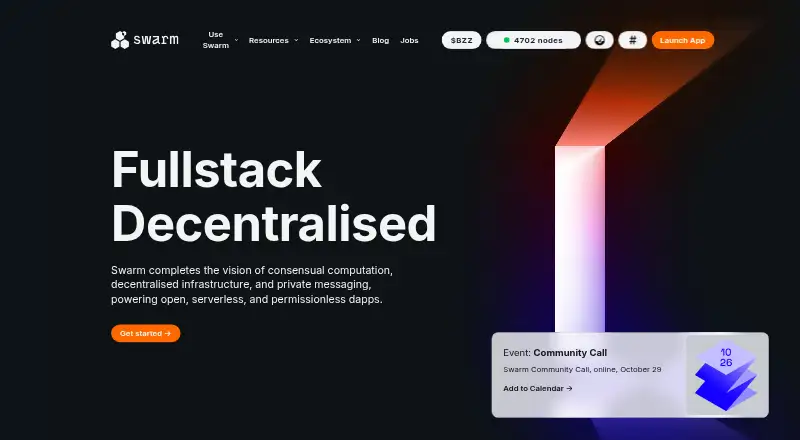
What Swarm is
Swarm is decentralized infrastructure for transferring, storing, and sharing data across a peer-to-peer network. Uploads are divided into 4 KB chunks and distributed and retrieved using Kademlia routing. Local replication is intended to help keep data available through node dropouts or data loss. Swarm describes the network as open, permissionless, censorship resistant, and private by design; its Postal Service over Swarm (PSS) protocol provides end-to-end encrypted messaging.
Developers building decentralized applications can use Bee, the peer-to-peer client, alongside Bee-js, Swarm-CLI, and a Bee HTTP API. Swarm Desktop is a beta app that provides network access through a lightweight node and supports browsing, uploading, downloading, and managing data. It can publish websites with preview URLs or link them to an ENS name. Publishers use BZZ postage stamp batches to write data and prepay storage rent; the displayed storage price is 0 BZZ per 1 GByte for 1 month. Full node operators contribute disk space and may receive BZZ through a blockchain-based incentive system. Swarm Desktop installers are available for Windows, Linux, and OSX. The beta includes Sentry monitoring that automatically collects data, and comes without guarantees of stability, efficiency, or security.
Who it suits
Swarm suits developers building and hosting decentralized applications, NFT metadata, and media files. Its tools also serve publishers who want to store or share data on a peer-to-peer network, and node operators who contribute disk space.
What it does well
- Open source code and an open, permissionless network.
- PSS messaging uses end-to-end encryption.
- Bee, Bee-js, Swarm-CLI, and an HTTP API support development.
- Desktop app can upload and share websites.
- Local replication is intended to support availability.
What to know first
- Swarm Desktop is in beta without stability, efficiency, or security guarantees.
- The beta automatically collects data through Sentry monitoring.
- The default ultra-light desktop node has a download threshold.
- Storage publishers prepay rent using BZZ postage stamps.
Limits
The default ultra-light Swarm Desktop node is limited to downloading data within the free threshold allowed by other nodes. Swarm Desktop is in beta, with no guarantees of stability, efficiency, or security; publishers prepay storage rent using BZZ postage stamps.
Plans
| Plan | Billed and limits | Price |
|---|---|---|
| Swarm network storage | Storage access and persistence use BZZ postage stamps; publishers prepay storage rent. | On request |
As ethswarm.org lists them, read 5 Oct 2026. The maker's own page has the final word.
Getting started
- Visit the Swarm website.
- Choose Bee, Bee-js, Swarm-CLI, or the Bee HTTP API for development.
- For desktop access, install Swarm Desktop for Windows, Linux, or OSX.
- Use the desktop app to browse, upload, download, or manage data.
- To publish data, use BZZ postage stamp batches to write it and prepay storage rent.
Verdict
Choose Swarm if you are building decentralized applications or want peer-to-peer infrastructure for storing, transferring, and sharing data. Swarm Desktop is in beta and its default lightweight node has a download threshold; publishing data also uses BZZ postage stamps to prepay storage rent.
Questions
Is Swarm open source?
Yes. Swarm describes its code as open source and its network as open and permissionless.
What does storage cost?
The displayed price is 0 BZZ per 1 GByte for 1 month. Publishers use BZZ postage stamp batches to write data and prepay storage rent.
Which desktop platforms are supported?
Swarm Desktop installers are available for Windows, Linux, and OSX.
Who makes Swarm?
The Swarm Foundation operates Swarm. It is a nonprofit established in 2021 and based in Switzerland.
Does Swarm include messaging?
Yes. Postal Service over Swarm (PSS) is an end-to-end encrypted messaging protocol on Swarm’s decentralized peer-to-peer network.
Does Swarm Desktop collect data?
The beta includes Sentry monitoring and bug reporting software that automatically collects data to help improve the software.
Facts from Swarm's own pages
- Data routing
- Swarm nodes use Kademlia routing to distribute and retrieve data in 4 KB chunks. · ethswarm.org, 5 Oct 2026
- Desktop app
- Swarm Desktop is in beta and provides access through a lightweight node, with features to browse, upload, download, and manage data. · ethswarm.org, 4 Oct 2026
- Desktop app data collection
- The Swarm Desktop beta page says it includes Sentry monitoring and bug reporting software that automatically collects data to help improve the software. · ethswarm.org, 4 Oct 2026
- Desktop beta and security
- Swarm Desktop is in beta, includes Sentry monitoring that automatically collects data, and comes with no guarantees of stability, efficiency, or security at this stage. · docs.ethswarm.org, 5 Oct 2026
- Desktop download limit
- The default ultra-light desktop node is limited to downloading data within the free threshold allowed by other nodes. · docs.ethswarm.org, 5 Oct 2026
- Desktop platforms
- Swarm Desktop installers are available for Windows, Linux, and OSX. · docs.ethswarm.org, 5 Oct 2026
- Developer stack
- Its developer stack includes Bee, the Bee-js JavaScript library, Swarm-CLI, and a Bee HTTP API. · ethswarm.org, 5 Oct 2026
- Developer tools
- Bee is the peer-to-peer client for joining the network, and Bee-js is its complementary JavaScript library for building decentralized apps. · ethswarm.org, 4 Oct 2026
- Integrations
- The maker lists fairOS, Fairdrive, and the Fair Data Protocol as ecosystem tooling for databases, personal data storage, and interoperability; it says these projects are under development and their performance is not guaranteed. · ethswarm.org, 5 Oct 2026
- Maker
- The Swarm Foundation is a nonprofit established in 2021 and based in Switzerland. · ethswarm.org, 5 Oct 2026
- Messaging
- Postal Service over Swarm (PSS) is described as an end-to-end encrypted messaging protocol running on Swarm’s decentralized P2P network. · ethswarm.org, 5 Oct 2026
- Node operators
- Full node operators share disk space and may receive BZZ through a blockchain-based incentive system. · ethswarm.org, 5 Oct 2026
- Open source
- Swarm describes its code as open source and its network as open and permissionless. · ethswarm.org, 4 Oct 2026
- Organization
- The Swarm Foundation is a nonprofit established in 2021 and based in Switzerland. · ethswarm.org, 4 Oct 2026
- Payments and storage
- Publishers use BZZ to buy postage stamp batches for writing data and paying for storage; the displayed current storage price is 0 BZZ per 1 GByte for 1 month. · ethswarm.org, 4 Oct 2026
- Privacy and messaging
- Swarm describes its network as private by design and says its PSS messaging protocol uses end-to-end encryption. · ethswarm.org, 4 Oct 2026
- Privacy and resilience
- The maker describes Swarm as censorship resistant and private by design, with local replication intended to preserve availability when nodes drop out or data is lost. · ethswarm.org, 5 Oct 2026
- Resilience
- The site says local replication helps keep data available despite node dropouts or data loss. · ethswarm.org, 4 Oct 2026
- Storage model
- Uploaded data is split into 4 KB chunks and distributed among nodes using Kademlia routing. · ethswarm.org, 4 Oct 2026
- Storage payments
- Publishers spend BZZ on postage stamps to write data and prepay rent for long-term storage. · ethswarm.org, 5 Oct 2026
- Support
- The maker directs users to its Discord community and lists [email protected] for questions or complaints. · ethswarm.org, 5 Oct 2026
- Website publishing
- Swarm Desktop can upload websites and share them through preview URLs or link them to an ENS name. · ethswarm.org, 5 Oct 2026
- What it does
- Swarm provides decentralized infrastructure for transferring and storing data across a peer-to-peer network. · ethswarm.org, 5 Oct 2026
- Who it serves
- Swarm presents its tools as infrastructure for developers building and hosting dApps, NFT metadata, and media files. · ethswarm.org, 4 Oct 2026
Where Swarm stands on Freedom251
- Decentralized Storage Services#20 of 25